MISSION: IMPOSSIBLE – Danny Elfman
 THROWBACK THIRTY
Original Review by Jonathan Broxton
When the big-screen reboot of Mission: Impossible was greenlit in 1992, almost thirty years had passed since the original TV series starring Peter Graves premiered on CBS. It was produced by Tom Cruise’s new production company to be a vehicle for the box-office star; he was a fan of the original show and wanted to showcase himself in the spy genre, as well as give himself the opportunity to engage in some extravagant stunt work. Development began with filmmaker Sydney Pollack, but Cruise eventually turned to Brian De Palma to direct it, with a screenplay by David Koepp, Robert Towne, and Steven Zaillian.
Cruise stars as special agent Ethan Hunt of the IMF (Impossible Missions Force), who is forced to go on the run when his team is massacred during an operation in Prague and he is falsely framed as a traitor. Determined to identify the real traitor and clear his name, Hunt recruits two other disavowed agents – computer expert Luther Stickell (Ving Rhames) and pilot Franz Krieger (Jean Reno) – while also forming an uneasy alliance with Claire Phelps (Emmanuelle Béart), another apparent survivor of the Prague disaster. Together, the unlikely group crisscrosses the world, from the CIA headquarters to Paris, before the whole thing culminates in a spectacular confrontation involving a TGV train and a helicopter inside the Channel Tunnel. Alongside Cruise, the cast includes Jon Voight as veteran IMF leader Jim Phelps, Henry Czerny as IMF director Eugene Kittridge, and Vanessa Redgrave as the mysterious arms dealer Max.
It’s incredible to think that the Mission: Impossible film series is thirty years old now, and that Tom Cruise was just 34 when the first one came out. Although it was a box-office success, few people could have expected the series to last this long, spawn so many sequels, or become so financially successful, and it is a testament to Cruise’s enduring popularity that the eight films have grossed over $4.74 billion worldwide. What’s also interesting is that, long before the series became synonymous with Cruise hurling himself out of airplanes and off mountains, this first film was actually a much more cerebral espionage movie. Yes, it has some iconic sequences, including the ‘exploding fish tank’ chase sequence, the nerve-shredding high-wire act inside CIA headquarters, and the entire finale, but for the most part the film is cool, deliberately labyrinthine, a bit paranoid, and filled with the director’s characteristic visual gamesmanship.
 The original Mission: Impossible TV show had, of course, an iconic main theme by the great Argentine jazz composer Lalo Schifrin. It is built around an unusual and relentlessly propulsive 5/4 meter that gives it its distinctive off-balance momentum. Rather than flowing in a conventional four-beat pattern, the music seems to lurch forward in an irregular sequence of accents, creating an immediate sense of urgency, danger, and controlled instability. Schifrin drives the piece with a tightly coiled bass ostinato, crisp percussion and bongos, over which he layers stabbing brass figures and a sharply etched, jazz-inflected melody. It is one of the most famous TV themes of all time. It’s not entirely clear why Schifrin was not asked to score the film – he was only 63 in 1996, and very much still working – but whatever the reason was, the producers went in a different direction.
Alan Silvestri was originally hired as composer, and he wrote and recorded a complete score, but it was rejected late in production, at which point Danny Elfman was brought in to replace him. Elfman and De Palma had never worked together before, and at the time there was very little in Elfman’s filmography to indicate that he would be a good musical match for this sort of film. However, in retrospect, Elfman was something of an inspired choice. By 1996 Elfman was trying to move away from the romantic Gothic melodies of his early career – Batman and Beetlejuice and Edward Scissorhands – and toward something leaner, more rhythmically complex, and more psychologically probing, and Mission: Impossible gave him the opportunity to explore some of those ideas, while still engaging in some large-scale action.
The unavoidable musical elephant in the room, however, was Lalo Schifrin’s legendary Mission: Impossible theme. Fans would likely have revolted if the famous theme were not incorporated into the score and, wisely, Elfman did not attempt to replace it – instead, he embraced it, fully incorporating it into the DNA of his score. His arrangement in “Mission: Impossible Theme” retains the famous asymmetric rhythmic pulse and brass swagger of Schifrin’s original, but dresses it in his own sharper orchestral colors, bringing it up to date for the 1990s. Elfman also goes further, making extensive use of Schifrin’s secondary “Plot” theme from the television series, weaving its brassy, militaristic vibe into the score with pleasing regularity.
The opening cue, “Sleeping Beauty,” establishes Elfman’s tone for the score immediately with furtive strings, rapid-fire dry percussion, unusual instrumental gestures, and a constant sense of uneasy movement that gives the impression that nobody and nothing can be trusted. “Red Handed” accompanies the disastrous Prague operation, and sees Elfman developing both the mystery and the nervous rhythmic side of the score, blending fragments of Schifrin’s theme with his own agitated orchestral writing. Elfman does some fascinating things with endless layers of metallic percussion and snare drums, offsetting them against fast brass clusters, skittery woodwinds, pizzicato strings, and even an occasional cimbalom to acknowledge the East European setting. There are subtle stylistic echoes of Darkman, Dick Tracy, the more aggressive parts of Batman, and even Dolores Claiborne, which means that the whole thing is clearly emanating from Elfman’s musical world, but it’s all a bit different. “Big Trouble” expands this palette further with longer-lined string writing that becomes increasingly aggressive and dissonant as Hunt’s world collapses around him, but then builds to an almost operatic conclusion.
The amusingly titled “Love Theme?” is an elegant and appealing idea connected to Ethan’s relationship with Claire Phelps, but even here nothing is straightforward, as the sinister phrasing and minor-key harmonies never allow the music to become conventionally romantic, reflecting the uncertainty surrounding Claire herself. “Mole Hunt” builds to a flamboyant, brassily extravagant ending, and then “The Disc” offers the first of the score’s many statements of Schifrin’s ‘plot’ motif as the conspiracy around the Prague job starts to reveal itself. The music here is twitchy, rhythmically complicated, never settling on one instrumental sound or percussive pattern, which gives it an overriding sense of panicky tension. “Max Found” and the excellent “Looking for ‘Job’” continue the conspiracy material, combining little repeating cells with dark woodwinds, restless strings, bass guitar rhythms, and percussion, alongside more allusions to Schifrin’s ‘plot’ motif. The subsequent “Betrayal” is one of the score’s absolute highlights, especially when a melancholy choir floats into play, giving the score a new sense of dark mystery that again recalls parts of the score for Batman.
“The Heist” accompanies the celebrated Langley ‘dropping-down-on-a-rope-and-avoiding-laser-beams’ sequence and is a masterclass in controlled tension. The sequence itself is stripped down to tiny sounds and microscopic movements, and Elfman responds with music that is equally restrained: little tinkling metallic percussion ideas, snare drum riffs, bongos and tom-toms, fluttering woodwinds, trilling string figures, low brass, odd breathy ‘chak-chak’ noises, and more allusions to Schifrin’s ‘plot’ motif. It’s all very tense and tightly clenched, matching the breathless anxiety of the scene perfectly. “Uh-Oh!” provides a short burst of panic, while “Biblical Revelation” and “Phone Home” return to the score’s more cerebral mystery writing as the identity and motivation of “Job” become increasingly clear.
The final sequence is superb, underscoring the now-iconic set piece aboard a high-speed train bound for the Channel Tunnel, where the various double-crosses are finally exposed and Ethan attempts to clear his name in a spectacular confrontation involving the train, Krieger’s helicopter, and the tunnel itself.
“Train Time” contains a fantastic rising brass idea embedded into the action that gives the cue much of its muscular identity, and Elfman cleverly offsets this against more allusions to Schifrin’s ‘plot’ motif. “Ménage à Trois” tightens the dramatic screws with a dark reprise of the love theme as the confrontation between Ethan, Claire, and Phelps reaches its climax, before “Zoom A” and especially “Zoom B” unleash Elfman’s action writing at full force. These three minutes find Elfman at his exciting best; strings race, brass snarls, percussion hammers away, and Schifrin’s material re-enters to excellent effect, as the score finally releases all the tension it has spent the previous hour accumulating. The huge, brassy fanfares are tremendous, and the massive thematic conclusion is thoroughly satisfying and steeped in nostalgia.
It’s interesting. It took me quite a long time to properly appreciate this score, and I spent much of that time convincing myself that I really didn’t like it. I became an Elfman fan via his great Gothic masterpieces – Batman and Edward Scissorhands and Sommersby and the like – and Mission: Impossible is very much not that kind of score, so I think that, as a young film music fan, hearing him do something so drastically different was jarring to the point that I couldn’t quite accept it.
 However, with the benefit of time and experience, I find myself appreciating it a lot more now than I did then. Elfman clearly understood that a modern spy score does not have to be continually bombastic to be exciting. Much of this film is about people watching one another, uncovering hidden motives, surveillance, deception, and waiting for something to go wrong, and Elfman embraces that aesthetic with music of a similarly shadowy nature. Knowing all that going in makes the whole thing a much more engaging experience.
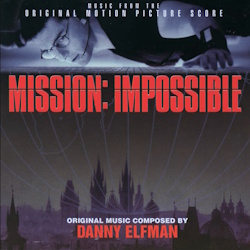
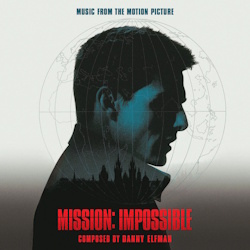
The original Point Music album runs a little over 52 minutes, and is a reasonable presentation of the score, but La-La Land’s 2019 2-CD expansion adds a great deal more. Disc One features a remastered version of the original 1996 album assembly, while Disc Two showcases the remastered film score, expanding the original album release by more than twenty minutes with additional film versions and previously unreleased material, including more prominent appearances of Schifrin’s themes. Personally, I find that the expanded version doesn’t really increase my enjoyment or appreciation of the score – the original album is fine – but die-hard fans of the film may want to indulge.
Mission: Impossible may initially seem less immediately lovable than Batman or Edward Scissorhands, but that is precisely what makes it so fascinating. This is Elfman writing with restraint, constructing a score from rhythm, texture, minimal motifs, and carefully controlled bursts of orchestral violence. It is intelligent, unconventional, occasionally abrasive, and enormously effective. This review will self-destruct in ten seconds.
Buy the Mission: Impossible soundtrack from the Movie Music UK Store
Track Listing:
- ORIGINAL 1996 RELEASE
- Sleeping Beauty (2:28)
- Mission: Impossible Theme (1:02)
- Red Handed (4:21)
- Big Trouble (5:33)
- Love Theme? (2:21)
- Mole Hunt (3:02)
- The Disc (1:54)
- Max Found (1:02)
- Looking for “Job” (4:38)
- Betrayal (2:56)
- The Heist (5:46)
- Uh-Oh! (1:28)
- Biblical Revelation (1:33)
- Phone Home (2:25)
- Train Time (4:11)
- Menage A Trois (2:55)
- Zoom A (1:53)
- Zoom B (2:54)
- EXPANDED 2019 LA-LA LAND RELEASE
- Sleeping Beauty (2:33)
- Theme from Mission: Impossible (1:07)
- Red Handed (4:23)
- Big Trouble (5:37)
- Love Theme? (2:24)
- Mole Hunt (3:05)
- The Disc (1:58)
- Max Found (1:05)
- Looking for “Job” (4:40)
- Betrayal (2:59)
- The Heist (5:49)
- Uh-Oh! (1:31)
- Biblical Revelation (1:37)
- Phone Home (2:28)
- Train Time (4:15)
- Ménage à Trois (2:57)
- Zoom A (1:54)
- Zoom B (2:58)
- Sleeping Beauty (Film Version) (3:03)
- Theme from Mission: Impossible (1:07)
- Red Handed (Film Version) (6:21)
- Big Trouble (Film Version) (7:01)
- Lonely March (0:54)
- Mole Hunt (Film Version)/Escape (3:35)
- Looking For “Job” (4:44)
- Max Returns/Max At Last (1:30)
- Max Found (1:05)
- The Disc (1:59)
- Disavowed/Worse Than You Think (2:48)
- Langley (1:01)
- The Heist (Film Version) (5:05)
- Uh-Oh! (1:31)
- Biblical Revelation (1:36)
- Phone Home (2:28)
- Betrayal (Film Version) (3:01)
- Love Theme? (2:24)
- Train Time (Film Version)/Is He? (5:33)
- Ménage à Trois (2:57)
- Zoom A (Film Version)/Zoom B (Film Version) (5:21)
- Red Handed (Alternate Ending) (1:46) BONUS
- Disavowed (Alternate)/Worse Than You Think (Alternate) (2:59) BONUS
- Zoom A (Alternate)/Zoom B (Alternate) (5:19) BONUS
Running Time: 52 minutes 22 seconds — Original
Running Time: 128 minutes 28 seconds — Expanded
Point Music 454 525-2 (1996) Original
La-La Land Records LLLCD 1411 (1996/2019) Expanded
Music composed by Danny Elfman. Conducted by Artie Kane. Orchestrations by Steve Bartek, Mark McKenzie, Edgardo Simone and Steven Scott Smalley. Original Mission: Impossible themes by Lalo Schifrin. Recorded and mixed by Shawn Murphy. Edited by Kenneth Karman and Ellen Segal. Album produced by Danny Elfman. La-La Land expanded album produced by Dan Goldwasser, Neil S. Bulk, MV Gerhard and Matt Verboys.

Shop at the Movie Music UK Store

Member of the


