THE END OF OAK STREET – Michael Giacchino
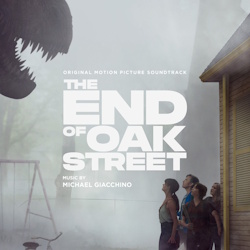 Original Review by Jonathan Broxton
The End of Oak Street is an action-adventure sci-fi/horror film written and directed by David Robert Mitchell, and produced by J. J. Abrams. Mitchell is best known for the outstanding 2014 horror film It Follows, and The End of Oak Street sees him returning to some of that film’s preoccupations with suburban unease and unseen threats, albeit on a vastly larger scale. Set in Michigan in 1982, the film stars Anne Hathaway and Ewan McGregor as Denise and Greg Platt, a married couple whose relationship is beginning to fracture, while Maisy Stella and Christian Convery play their children Audrey and Brian. Their mundane domestic problems are abruptly rendered insignificant when a bizarre cosmic event somehow transports their entire suburban neighborhood millions of years into the past, leaving the residents of Oak Street stranded in a prehistoric wilderness populated by dinosaurs. Mayhem ensues.
Mitchell has explained that the idea for the film came to him while he was walking through his neighborhood in Michigan. He passed an ordinary suburban garage, chain-link fence, and some garbage cans and suddenly imagined a dinosaur standing there; that simple juxtaposition between something impossibly ancient and something aggressively mundane became the germ of the entire movie. Mitchell has also spoken about his childhood love of dinosaurs, something he shared with his late father, as well as the influence of films and television shows including Poltergeist, The Twilight Zone, and Signs. Despite the inevitable comparisons with Jurassic Park, Mitchell’s primary interest was less in straightforward dinosaur spectacle than in placing a recognizable family with familiar emotional problems into a completely impossible situation. I actually think the film is very good – some minor logical lapses aside, it’s a fun, old-fashioned adventure movie that doesn’t try to be anything more than an entertaining dinosaur romp. Its 1980s setting, nostalgic tone, and youthful protagonists give it the feeling of a classic Steven Spielberg film, an aspect that appeals to me greatly.
That classic 1980s throwback approach is also important when it comes to the music, which was written by Michael Giacchino. Giacchino is, of course, no stranger to dinosaurs. One of his earliest major professional assignments was writing music for the 1997 video game adaptation of Steven Spielberg’s The Lost World: Jurassic Park, and he subsequently inherited John Williams’s dinosaur legacy directly when he scored Jurassic World in 2015, Jurassic World: Fallen Kingdom in 2018, and Jurassic World: Dominion in 2022. His involvement here is also significant because of producer J. J. Abrams, who is one of Giacchino’s longest-standing collaborators. Abrams first discovered Giacchino through his Medal of Honor video game scores and hired him to score Alias in 2001, beginning a creative partnership that subsequently encompassed Lost, Mission: Impossible III, Super 8, and a handful of Star Trek films.
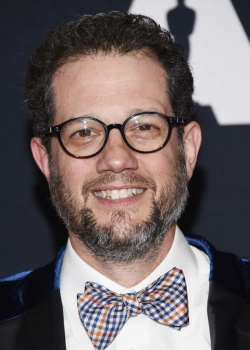 There is an especially obvious precedent for The End of Oak Street in Super 8. Both films use a late-1970s/early-1980s suburban setting, both revolve around fractured families caught up in extraordinary creature-driven science-fiction events, and both deliberately engage with the emotional language of Steven Spielberg and the Amblin films of the period. It was Abrams who ultimately connected Mitchell with Giacchino; Mitchell has said that he specifically wanted Giacchino for the project and asked Abrams to approach him, believing he was the ideal composer to balance the film’s combination of family drama, horror, humor, and spectacle.
The resulting score is a fascinating combination of approaches. On the one hand there is an unmistakable throwback quality to the music, with Giacchino embracing the broad symphonic approach associated with the type of science-fiction and adventure films Mitchell is paying homage to. Some people have understandably mentioned John Williams as a clear inspiration, and there are moments when the sense of orchestral excitement and wonder deliberately recalls the Spielberg/Amblin sound that Williams helped define. However, reducing the score to a simple Williams pastiche does Giacchino a disservice, because there is plenty of classic Giacchino here too – the music draws upon the emotional warmth of Super 8, the monster-movie instincts of his Jurassic World scores, and the more unsettling side of his suspense writing, while constantly keeping the fractured Platt family at the center of everything. Some of the action and horror music here is especially bold and aggressive as well, resulting in a score that is satisfying on numerous levels.
There are several themes running through the score: an adventurous overarching main theme, a pleasant theme which speaks to the initial all-American suburban setting, a related theme specifically for the Platt family and their relationship, a sinister variation on the main theme for darker moments that asserts itself once the strange occurrences begin, and a spooky electronic-metallic sound that represents the space-time anomaly at the center of the story. As I said, there are also some unexpectedly dynamic and tonally vicious action and suspense cues for the various dinosaur encounters, and there are some recurring rhythmic ideas and small motifs within that action music that suggest Giacchino may have written specific motifs for certain dinosaurs – there appears to be one for the deadly Allosaurus, one for the snakelike Titanoboa, and several others besides.
The adventurous main theme is introduced in the opening cue “A Thin Flowervale Between Life and Death,” which is awash in dancing strings, soaring brass melodies, and swooping woodwind flourishes, but then after a moment of good-natured carnage it switches to the aggressively wholesome suburban theme, a perfect encapsulation of warmly nostalgic Americana carried by strings: a world full of backyard cookouts, perfectly manicured lawns, and games of catch with dad. “Horticulture Club” is a softer, more intimate, and poignant version of the Americana theme initially arranged for piano and harp, before switching to a mysterious version of the main theme for spooky low woodwinds as Denise finds the first evidence that something is not right in her neighborhood. The bittersweet Platt family theme runs through much of “Father and Father Away,” illustrating the marital tensions between Denise and Greg and their shared regrets – but these are all soon swept away as the mystery of the cosmic space-time anomaly begins to intrude.
The main adventure theme combines with shrill, unsettling textures of metallic percussion, electronics, and creepy orchestral dissonances in “The Light in the Static,” which represent the bizarre ‘lights in the sky’ that herald the dramatic change in the Platt family’s circumstances. These textures continue through “Let Sleeping Dogs Library,” “Something Weird This Way Comes,” and “No More Mr. Nice Geyser,” as it becomes increasingly impossible to ignore the fact that something is dreadfully wrong; I especially like the varied instrumental colors Giacchino gives to the main theme across these cues. Everything kicks off in the ten-minute “A Den of Coelophysis or The Swamp Drains You,” as the Platts endure the first of numerous dinosaur attacks, and are forced to sprint for their lives through their formerly quiet streets while being pursued by these ‘terrible lizards’.
Giacchino scores the sequence with some truly massive, orchestrally complex, sometimes viciously dissonant action music, aggressively snapping and snarling at the heels of Denise and Greg with a ferocity that I haven’t heard from him in quite some time. Some brief textures and instrumental combinations recall classic late-1970s/early-1980s John Williams, combined with a little flavor of Twilight Zone-era Jerry Goldsmith and Bernard Herrmann, especially in the way he uses chaotic layers of strings to drive the action and horror forward, and I love many of these little homages. The pounding rhythms for low-end pianos and blatting horns that build from the 2:30 mark onward are great. The frantic explosion of brassy chaos after 4:30 is fantastic – listen to those frenzied whooping notes at 5:18! – as are the shrill, spiky rhythms that jump back and forth between strings and woodwinds after 7:20, as hordes of coelophysis rampage through the neighborhood, indiscriminately eating the neighbors.
The reprises of the main theme and the Platt family theme in “Strung Out Theory” give a moment of respite, but then “A Few Fries Short of a Happy Mel” and the two-part “Spoiled Platts” return to the action-horror thrills and spills; the former uses banks of skittering strings, blaring horns, and off-kilter pianos to ratchet up the tension, while the latter pair move from despondent tragedy to energetic chase music, and eventually full-on rampaging orchestral havoc by the end. There is a fantastic, almost Indian-inspired little theme in “Part 1” that seems to represent the creepy snakelike Titanoboa and that I particularly like, and a cool electronic pulse at the beginning of “Part 2” that reinforces the 80s vibe.
The giant booming rhythms of “Lurch and Rescue” capture the size and power of the immense allosaurus, the mysterious reprise of the main theme in “Sphere Street Blues” reintroduces the concept of the space-time anomaly, and there is a rare moment of romantic warmth in the lovely “Reunion Station,” which carries on into the unexpectedly sweet “One Good Mate Deserves Another” that underscores the hilarious scene where Denise and Greg stumble upon a sauropod love scene. However, things go terribly wrong in “Once and for Allosaurus,” which takes the dinosaur mayhem to its pinnacle with some of the score’s most thrillingly anarchic orchestral writing, and some of its most unexpectedly heroic and triumphant adventure music, only for everything to collapse in utter horror during its devastating final moments. The subsequent “Don’t Be Sorrow with Me” makes the emotional consequences of that event explicit with a heartbreaking statement of the Platt family theme.
“Mi Casa Boo Casa” underscores the finale of the score, as the Platt family tries to return to their own time via the space-time anomaly, but has to fight its way through a house full of deadly ankylosaurs in order to do so. Giacchino’s music offers several off-kilter performances of the main theme, long sequences of eerie ambiance prominently featuring the space-time anomaly motif, and a climax full of violent orchestral passages as the ankylosaurs attack – the brass clusters here are notably brilliant. “The Starbuck Stops Here” underscores a moment of heroism for the family dog with a rumbling, pounding, frenetic piano motif that tracks his galloping footsteps; his subsequent aerial fight with a hungry pterosaur features yet more of that howling, shrieking brass writing that I just love.
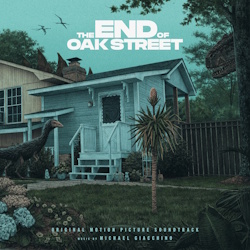 There is relief, warmth, and tenderness, mixed with more than a bit of trepidation and regret, in the statements of the main theme in “Old Pool Politics,” but then Giacchino allows the score to reach its big-hearted conclusion in “I Need a Little Space-Time” and “The Swap of the Ages” with an especially stirring reprise of the Platt family theme, and a wholesome guitar-inflected final statement of the Americana theme. “Main on End of Days” plays over the first part of the end credits and is a fantastic version of the main theme arranged in the vein of John Williams at his most wholesome, full of terrific little textures and instrumental flourishes. The five-minute “The End of Oak Suite” then closes the score with an outstanding run through all of its thematic ideas.
One of the things I especially appreciate about the score is that Giacchino never appears embarrassed by the film’s emotional sincerity. There has been a tendency in some modern blockbuster scoring to underplay emotion or hide behind texture and sound design, but The End of Oak Street is proudly musical. When Mitchell wants excitement, Giacchino provides it. When he wants genuine fear, the score becomes considerably darker and more aggressive. And when the Platts’ emotional relationships become the focus, Giacchino allows the orchestra to embrace them without irony.
This is one reason why the obvious John Williams comparisons are wholly appropriate. The entire film intentionally engages with the language of late-1970s and 1980s American genre cinema, and asking Giacchino to avoid that musical heritage would have been wrong. What matters is whether he is able to take that heritage and make it function specifically for this story, and I think he does. There are certainly moments of Jurassic Park-style orchestral grandeur and E.T.-esque suburban wonder, but there are also clear echoes of Giacchino’s own history – especially Super 8 – and his characteristic ability to write emotionally direct melodic music within large-scale action set pieces.
The result is a very entertaining and impressively accomplished score that understands that the dinosaurs are only half the point. For all the orchestral spectacle, action, horror, and knowingly terrible Giacchino cue-title puns, the thing holding The End of Oak Street together is the Platt family, and the score’s ability to retain that emotional core amid all the prehistoric carnage is ultimately its greatest strength. Giacchino has spent most of his career demonstrating that huge genre concepts work best when the music finds the human story underneath them; The End of Oak Street is another excellent example of precisely that philosophy.
Buy the End of Oak Street soundtrack from the Movie Music UK Store
Track Listing:
- A Thin Flowervale Between Life and Death (1:18)
- Horticulture Club (2:06)
- A Good Fence Is the Best Defense (0:37)
- Father and Father Away (1:24)
- The Family Loners (0:56)
- The Light in the Static (1:11)
- Let Sleeping Dogs Library (0:55)
- Something Weird This Way Comes (1:19)
- No More Mr. Nice Geyser (2:33)
- A Den of Coelophysis or The Swamp Drains You (10:12)
- Strung Out Theory (2:48)
- A Few Fries Short of a Happy Mel (1:51)
- Spoiled Platts, Pt. 1 (3:12)
- Spoiled Platts, Pt. 2 (3:13)
- Lurch and Rescue (2:09)
- Sphere Street Blues (1:36)
- Reunion Station (1:43)
- One Good Mate Deserves Another (1:04)
- Once and for Allosaurus (4:49)
- Don’t Be Sorrow with Me (1:27)
- Mi Casa Boo Casa (6:06)
- The Starbuck Stops Here (2:39)
- Old Pool Politics (3:15)
- I Need a Little Space-Time (2:28)
- The Swap of the Ages (1:12)
- Main on End of Days (1:44)
- The End of Oak Suite (4:45)
Mutant MBM-118 (2006) — CD
Watertower Music (2026) — Digital
Running Time: 68 minutes 19 seconds
Music composed by Michael Giacchino. Conducted by Jennifer Hammond. Orchestrations by Jeff Kryka, Paul Apelgren, and Logyn Okuda. Recorded and mixed by Warren Brown. Edited by Paul Apelgren. Album produced by Michael Giacchino.
Leave a comment

Shop at the Movie Music UK Store

Member of the


Thank you Jonathan. Very inspiring review as Ciacchino never fails to capture the essence of the film. I’m now prompted to a theater to see this.