TWISTER – Mark Mancina
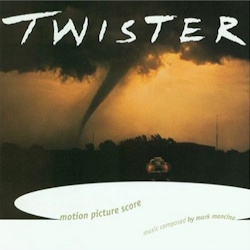 THROWBACK THIRTY
Original Review by Jonathan Broxton
The summer of 1996 contained some of the best and most crowd-pleasing blockbuster movies of the entire decade, and the one that kick-started the trend was Twister. Directed by Jan de Bont and written by Michael Crichton and Anne-Marie Martin, it stars Helen Hunt and Bill Paxton as Jo Harding and her estranged husband Bill, both meteorologists and tornado researchers, who reunite during a massive storm outbreak in Oklahoma. Along with a ragtag team of eccentric storm chasers – played by character actors such as Philip Seymour Hoffman, Alan Ruck, Jeremy Davies, and Oscar-nominated director Todd Field – and with Bill’s entirely unprepared new fiancée Melissa (Jami Gertz) along for the ride, they race to deploy “Dorothy,” an experimental device designed to collect data from inside a tornado, while facing competition from a rival group of storm chasers led by the smarmy Jonas (Cary Elwes). As increasingly powerful tornadoes form, Jo and Bill must confront both the dangers of the storms and the unresolved tensions in their relationship.
I love this film. It’s one of my all-time favorite action movies, and much of that has to do with its combination of heart, humor, spectacle, and scale. When it was released, Twister was considered groundbreaking for its visual effects and large-scale tornado sequences. The film combined practical effects, full-scale sets, and then-cutting-edge CGI, but one of the best things about Twister is how physical and immediate it still feels. Even decades later, the tornado scenes retain a visceral intensity because the filmmakers relied heavily on practical effects – giant wind machines, debris cannons, full-scale sets, and real stunt work – instead of rendering everything digitally.
All of this makes the storms feel dangerous in a way many modern CGI-heavy disaster movies do not. The tornado sequences are staged almost like monster encounters, with each storm possessing its own personality, and the movie successfully turns weather into a cinematic antagonist without making it feel supernatural. Hunt and Paxton are immensely likable in the leading roles and share believable chemistry, while the supporting storm-chaser team feels memorable and lived-in. The film also captures a very specific Midwestern Great Plains atmosphere that feels authentic and distinctive.
Before I move on to the score, I also want to touch on something I don’t mention very often in reviews: the sound design and sound-effects editing, both of which are exceptional and resulted in Oscar nominations for lead engineers Steve Maslow, Gregg Landaker, Kevin O’Connell, and Geoffrey Patterson. The tornadoes in Twister roar like freight trains mixed with animal sounds and machinery, giving them a terrifying presence that further reinforces the idea of each tornado being its own unique entity.
 The score for Twister is by composer Mark Mancina, who here was reuniting with director Jan de Bont after their successful first collaboration on Speed in 1994. These two scores – along with his work on projects like Bad Boys and Money Train – cemented Mancina’s status as one of the key action composers of the decade and one of the most important voices in establishing what quickly became known as the Media Ventures sound.
The original soundtrack album was arranged as six long suites, with each suite then broken down into individual cues. Oddly, however, the cues bleed into one another without clear delineation, meaning that on some playback systems there may be brief pauses or skips between tracks that become annoying. It’s also worth noting that some of the cues are not presented in chronological order, instead being sequenced for a better listening experience, so if that sort of thing bothers you, it’s worth keeping in mind.
The first suite is subtitled “Oklahoma” and underscores the sequence in which Jo and Bill reconnect, the storm-chasing crew is introduced, and the first tornado encounter results in Jo and Bill crashing into a ditch and taking shelter beneath a bridge while their truck is sucked into the storm. The opening cue, “Wheatfield,” introduces the film’s outstanding main theme, a bold and adventurous orchestral romp full of energy, optimism, and warm Americana stylings that remain immensely appealing; even after 30 years, this is still my favorite Mark Mancina melody. A more somber and thoughtful secondary theme for Jo and Bill emerges around the 45-second mark, and after the suite segues into the second cue, “Where’s My Truck?”, Mancina introduces another of the score’s principal ideas: a blustery flurry of low strings backed by ominous orchestral textures that acts as a herald for approaching tornadoes, sounding almost like an approximation of gusting wind. This motif recurs frequently, often embedded within the action writing, always signaling the lurking danger of these meteorological behemoths. There is also an interesting variation in several cues where Mancina substitutes the string flurry with a bassoon, giving the idea an unusual and distinctive color.
A homespun acoustic-guitar texture accompanies the intimate, downbeat string writing of “Futility,” building toward a superb sweeping statement of the Jo and Bill theme, before the suite concludes with the excellent “Downdraft,” which incorporates all the ideas introduced thus far into a thrilling action sequence full of prancing strings and strummed guitars. The cue also unveils the score’s fourth major recurring idea: a religioso choral sound that adds depth and gravitas to the tornadoes. The chorus often combines with the string-and-bassoon motif, unifying the score’s various tornado textures into a coherent musical identity.
The second suite is subtitled “It’s Coming” and underscores the sequence in which Jo, Bill, and the others are forced to take refuge in a garage pit near a drive-in theater as a tornado unexpectedly strikes in the middle of the night. Mancina scores “Drive In” like a Gothic horror film, a wash of darkly expressive orchestral writing held together by variations on the choral tornado motif and its associated string-and-bassoon figure. The subsequent “The Big Suck” features the Jo and Bill theme augmented by choir and ends on a brighter, more hopeful note.
The third suite, “The Hunt,” underscores several extended chase sequences across the Oklahoma countryside as Jo and Bill pursue specific tornadoes, trying to find opportunities to deploy Dorothy while simultaneously staying ahead of Jonas and his goons, who are attempting to do the same thing with intellectual-property technology stolen from Bill years earlier. “Going Green” is a fabulous statement of the main action theme, energized by roaring electric guitar writing, and is tremendous fun. The interplay between the main theme, the Jo and Bill theme, and the tornado material is superb, allowing the sequences to build a genuinely frantic momentum; this is 1990s Media Ventures scoring at its best. The twinkling metallic textures in “Sculptures” underscore the scientific epiphany Jo experiences after observing the behavior of Aunt Meg’s wind-vane sculptures, but the action soon intensifies again, combining the principal themes and tornado motifs with some fabulous throaty brass clusters. There is an increased choral presence in “Cow,” as Jo and Bill get perilously close to the tornado – and famously encounter a flying bovine caught in the updraft – as well as a prominent power anthem driven by aggressive string rhythms that greatly intensify the tension. The suite concludes with the thrilling “Ditch,” another explosion of pulsating action writing.
The fourth suite, “The Damage,” comprises just one cue: “Wakita,” which underscores the aftermath of the devastating tornado that destroys the town of the same name and the tragic realization that Aunt Meg’s home has been obliterated. The cue is suffused with tragedy and loss and features especially poignant writing for strings, woodwinds, and choir that occasionally recalls the more dramatic portions of The Lion King. The tornado motifs remain prominent throughout, and the piece ultimately resolves on a more hopeful note as Aunt Meg and her dog are pulled mostly unharmed from the wreckage.
The fifth suite, “Hailstorm Hill,” underscores an earlier scene in which Jo and Bill attempt to deploy Dorothy in front of a tornado but are repelled by a massive hailstorm. Both “Bob’s Road” and “We’re Almost There” lean heavily on the operatic, religioso tornado writing and make excellent use of both the main theme and the Jo and Bill theme, embedding them within stylish and chaotic action material. The sixth and final suite, “F5,” underscores the climax in which – after witnessing Jonas tragically killed by a tornado following his refusal to heed Jo and Bill’s warnings – the pair finally succeeds in deploying Dorothy into a massive mile-wide F5 tornado and achieves their long-sought scientific breakthrough.
The three concluding cues – “Dorothy IV,” “Mobile Home,” and “God’s Finger” – offer yet more immensely satisfying interplay between the score’s principal thematic ideas and action motifs, all of which are presented here at their most dramatic and intense. The staccato string writing in “Mobile Home,” combined with stark brass outbursts, choral textures, and eerie minor-key passages, is outstanding. The return of the power anthem from “Cow” in the cue’s second half is superb, while the massive celebratory statement of the main theme accompanying Dorothy’s successful launch is triumphant in all the best ways. The sequence concludes with a sweeping reprise of the Jo and Bill theme as the two reconcile and embrace.
After a brief – and admittedly odd – foray into source music with the “William Tell Overture” and a scene in which Todd Field and Wendle Josepher sing excerpts from the musical Oklahoma!, the “End Title” reprises both the main theme and the Jo and Bill theme before the orchestra gradually gives way to “Respect the Wind,” an original instrumental piece written and performed by Eddie Van Halen and Alex Van Halen, full of their signature screaming, reverb-heavy electric guitars.
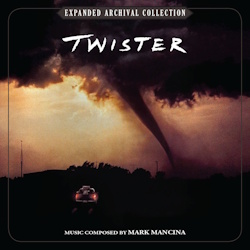 Although I have always personally liked the original album a great deal (despite its obvious sequencing/programming flaws), many people wanted a more appropriate presentation of the Twister score, and so in 2017 La-La Land Records and producers Mike Matessino and Dan Goldwasser obliged with a remastered and expanded re-issue of the score in chronological order, including previously unreleased music and alternate cues. The general consensus is that the 2017 release is superior in almost every way, as it offers a more logical dramatic progression, and includes several outstanding action cues that were not included on the original album, so fans of the score will likely want to invest in that.
It’s also worth mentioning the mega-successful Twister song album, which was released in conjunction with the score album, and features an array of country and rock songs by artists such as Tori Amos, Alison Krauss, K. D. Lang, the Red Hot Chili Peppers, the Goo Goo Dolls, Shania Twain, and Stevie Nicks, many of which were exclusive releases for the film. The lead single was “Humans Being” by Van Halen and is notable for being the last recording to feature vocalist Sammy Hagar before his departure from the band in June 1996; it was in contention for Best Song Academy Award nomination that year, but ultimately did not make the final shortlist.
Mark Mancina’s score for Twister remains one of the standout action soundtracks of the 1990s: thematically rich, relentlessly energetic, emotionally sincere, and packed with inventive orchestral textures that perfectly capture both the terror and exhilaration of storm chasing. From its soaring Americana main theme to its ominous tornado motifs and thunderous action writing, the score never loses momentum while still finding room for warmth and humanity. Whether experienced through the original album or the superb expanded edition, Twister is a masterclass in blockbuster scoring from a composer operating at the height of his powers. In the world of film music, this score lands with the force of an F5.
Buy the Twister soundtrack from the Movie Music UK Store
Track Listing:
- ORIGINAL 1996 RELEASE
- Wheatfield (1:19)
- Where’s My Truck? (0:19)
- Futility (2:14)
- Downdraft (1:46)
- Drive In (2:37)
- The Big Suck (1:09)
- Going Green (2:48)
- Sculptures (3:03)
- Cow (5:37)
- Ditch (1:27)
- Wakita (5:02)
- Bob’s Road (2:09)
- We’re Almost There (2:58)
- Dorothy IV (1:47)
- Mobile Home (4:38)
- God’s Finger (1:46)
- William Tell Overture/Oklahoma Medley (written by Gioachino Rossini/Richard Rodgers and Oscar Hammerstein II, vocals by Todd Field and Wendle Josepher) (1:05)
- End Title/Respect the Wind (written and performed by Eddie Van Halen and Alex Van Halen) (9:17)
- EXPANDED 2017 RELEASE
- Wheatfield (1:26)
- The Hunt Begins (3:51)
- The Sky (1:03)
- Dorothy IV (1:56)
- The First Twister (0:49)
- In The Ditch/Where’s My Truck? (2:00)
- Waterspouts (2:49)
- Cow (5:42)
- Walk In The Woods (2:05)
- Bob’s Road (2:13)
- Hail No! (2:43)
- Futility (2:17)
- Drive-In Twister (2:57)
- Wakita (5:19)
- Sculptures (3:06)
- House Visit (4:47)
- The Big Suck (1:47)
- End Title (2:20)
- Wheatfield (Alternate Version) (1:33) BONUS
- Waterspouts (Alternate Version) (2:50) BONUS
- The Big Suck (Alternate Version) (1:13) BONUS
- End Title/Respect the Wind (written and performed by Eddie Van Halen and Alex Van Halen) (9:21) BONUS
Running Time: 55 minutes 01 seconds — Original
Running Time: 64 minutes 07 seconds — Expanded
Atlantic Classics 82954-2 (1996) — Original
La-La Land Records LLLCD-1412 (1996/2017) — Expanded
Music composed by Mark Mancina. Conducted by Don Harper. Orchestrations by Bruce Fowler, Y. S. Moriarty, Ladd McIntosh, Don Harper, John Van Tongeren and Mark Mancina. Recorded and mixed by Shawn Murphy, Christopher Ward and Steve Kempster. Edited by Zigmund Gron. Album produced by Mark Mancina. Expanded album produced by Mike Matessino and Dan Goldwasser.
Leave a Reply

Shop at the Movie Music UK Store

Member of the


Wonderful review, Jon. I do admit I’m surprised you didn’t reviewed the La La Land Records release which it’s way better. The score was overdue for a re-release given that the original score album was out of stock years ago.
Something that wasn’t mentioned is that Mancina wrote a rising motif for the tornadoes for choir and orchestra which you can hear through the score, and Benjamin Wallfisch actually reused it for his score for Twisters.