THE SON OF KONG – Max Steiner
 GREATEST SCORES OF THE TWENTIETH CENTURY
Original Review by Craig Lysy
Given the tremendous commercial success of King Kong in 1933, RKO executives decided to milk the cash cow and make an immediate sequel. Merian C. Cooper and Ernest B. Schoedsack, the producers and directors of the first film were asked to again manage production, however Cooper’s enthusiasm was dampened when he was provided with a budget of only $269,000, which was half the budget of original, with the caveat that they had to have it in theaters within six months, for a Christmas 1933 release. Ruth Rose was tasked with writing the screenplay. She decided that the sequel could not duplicate the success of the first film, and so she made a creative decision; “If you can’t make it bigger, make it funnier”. The cast would include Robert Armstrong, who would reprise his role as Carl Denham. Joining him would be Helen Mack as Hilda Petersen, Frank Reicher as Captain Englehorn, John Marston as Nils Helstrom, Victor Wong as Charlie, and Ed Brady as Red.
The story reveals Denham and Engelhorn fleeing New York to the South Seas to escape multiple lawsuits. Along the way Denham reacquaints with Nils Helstrom who had sold him the map to Skull Island, and now offers a map to buried treasure on the island. Denham, who is facing bankruptcy rolls the dice and is joined by love interest Hilda. On the island they rescue a smaller ape believed to be Kong’s son from quicksand and they bond. They discover the treasure, but after numerous battles with denizens of the island they are face with a hurricane and earthquake, which sinks the island into the sea. Little Kong sacrifices himself to save their lives with a thankful Denham and Hilda departing with the treasure for a happy life together. The movie was again a commercial success making a profit of $133,000. Critical was mixed and the film received no Academy Award nominations.
Producer Merian C. Cooper again tapped Max Steiner to score the sequel as he was greatly impressed with his first score, which he believed greatly contributed to the film’s success. Steiner was delighted to take on the project given the lighter and comedic tone of the film, despite the fact that he was given only two weeks to write 45 minutes of music, and provided with a small orchestra of only twenty-eight players. In conceiving his soundscape I believe Steiner understood that he needed to speak to the five core elements of the film’s narrative; adventure, romance, Little Kong, comedy, and provide aggressive action writing for Little Kong’s numerous battles with the denizens of the island.
 To establish the lighter more comedic tone of the film, Steiner ingeniously composed the languorous “Runaway Blues” song. The song’s melody served as an idée fixe used to reel in the audience in with a classic Blues piece that offered all-American charm. It supports both principal actors in the sense that both Denham, and Hilda, are running away from broken lives in search of a new beginning. The melody is brilliantly conceived, as it was extremely malleable and effective as a driver of the film’s narrative, providing both heart, and the requisite forward momentum. The opening five-note phrase is employed as a recurring motif throughout the film. The Courage Theme offers a repeating four-note declaration, and is employed whenever our heroes are presented obstacles, and challenges, which require fortitude. He reprised his Native Theme form the first film, which serves as the identity of the island’s tribal natives. It offers kinetic rhythms born of nativist drums, chattering xylophone, woodwinds, and propelled by strings furioso, which fully capture their primitive aboriginal auras. For Little Kong he endeared him to the audience by creating a more playful, tender and comedic identity, masterfully integrating Papa Kong’s three-note theme into its fabric. In his notes to his orchestrators, Steiner used the description “screwy”, and indeed in many scenes we get musical buffoonery, which contributed to the film’s goal for adventure, with comedy. Charlie’s Theme offers the cliché Hollywood approach with a spritely pentatonic identity enrich with classic orientalism. For our villain, Helstrom, Steiner offers a dire, repeating three-note theme cloaked with menace. He adapts the instruments based on whether his actions are forceful, or lurking.
Following the morse code transmission that supports the RKO Studio logo, we flow into “Main Title”, a score highlight, where Steiner masterfully weaves the film’s dramatic and comedic elements into an inspired musical narrative. We open with grandiose melodrama atop horn bravura declarations, which support the flow of the opening credits. At 0:14 they usher in a stepped four-note ascent crescendo dramatico, which crests powerfully, transforming into a heroic musical narrative. At 0:57 the Runaway Blues Theme (Main Theme) enters and supports the photo roll of the principal actors. At 1:22 we segue darkly into the film proper as we behold a poster; “King Kong – The Eighth Wonder of the World”. Steiner empowers the poster with reprises of two of his themes from the first film; the primal power of the three-note Kong Theme, which is crowned with the four-note Courage Theme. The Courage Theme shifts to woodwinds comici as we see Carl Denham, a refugee in hiding, trying to evade credit warrants for the extensive damage he caused with the ill-fated King Kong premiere show. The music ends here as a sympathetic landlady, Mrs. Hudson helps him evade a process server. A knock on the door brings in a young female reporter, who is desperate to make her mark by securing an interview with Denham. He muses that he is sorry for the deaths, the damage, and for bringing Kong to New York. He decides to flee, and grants her a headline on the way out; “Carl Denham is Flat Broke”.
“Ship at Sea” reveals Charlie the cook delivering a note from Captain Englehorn, who offers him safe passage out of New York as he too is being sought by process servers. He secures the assistance of his friend Mickey, who agrees to transport him in his wagon to the docks. On board, he dines with Englehorn who relates that he has a plan for them to go into business shipping cargo in the East Indies. Mickey arrives and informs them that he has been indicted by a grand jury, which convinces him that it is time to go. Music enters with the uplifting of the ship’s anchor, offering a ratcheting ascent motif, which usher in a quote of “Columbia, the Gem of the Ocean” as the ship passes the Statue of Liberty and heads out to sea. A churning nautical travel motif unfolds as we see the ship’s wake, with ports of call script informing us of its journey; Colombo, Singapore, Semarang, Makasser, and Lombak, ending with trumpet calls as Dakang displays, and we fade on a diminuendo orientale. “In Dakang” reveals Denham and Englehorn on deck, docked in Dakang harbor and discussing the need for business so they can pay the crew. Denham asks for the distance to Skull Island, and Englehorn replies, 1,753 miles. They decide to explore the town, find a poster for a cabaret show, and decide to take in the show. Steiner keeps his music in the background and unobtrusive, supporting with a misterioso orientale empowered by a rhythmic three-note motif.
(*) “Petersen’s Famous International Show” reveals them taking in the show, which opens with “The Streets of Cairo”, a snake-charmer song performed with comic delight by La Belle Helene’s Monkey Band. Petersen, who is Hilda’s father, introduces her as La Belle Helene, lauding that she has performed before the crowned heads of Europe. She comes on stage, takes a seat, and proceeds to sing the song of a woman, aching for her man’s return, while strumming a guitar. Afterwards, as the crowd departs, Hilda strums the festive melody to the song “The Billboard”.
“Runaway Blues” offers a score highlight with a beautiful exposition of the Main Theme. Outside Denham and Englehorn debate whether they should have come, while inside Hilda asks her father about if that man is coming back again tonight? They quarrel as he values his company as he is a white man, with her saying it is just an excuse to drink. He sends her off to bed and we shift to Petersen and Norwegian captain Nils Helstrom who are drinking. The song’s melody opens on a yearning cello, then shifts to bass clarinet, and finally culminates with full the orchestra. Yet at 1:27 the music darkens as the men, now drunk, quarrel, with Helstrom ridiculing Petersen’s loser, two-bit show, and Petersen mocking him for having no ship due to a failed arson attempt to collect insurance money. We flow seamlessly into “Fire!” as the men’s quarrel escalates with the song’s melody shifted to a stepped, trumpet led crescendo dramatico. Petersen takes away his bottle of whiskey, and is punched by Helstrom, which causes him to fall unconscious. The fall knocks over a lantern and its crashes down to ignite straw, which erupts into a rapidly growing fire. At 0:34 Steiner creates orchestral fire with blaring trumpets of alarm, dire horns, and a shrill piccolo leading kindred woodwinds, which evoke a musical conflagration as Helstrom flees. Hilda wakes up, sees the fire, and at 1:10 manic high register clarinets support her releasing her monkeys and seals. Steiner unleashes a tempest as Hilda rescues her father, and retrieves her clothes trunk. We close with a molto tragico rendering of the Main Theme as Petersen dies in Hilda’s arms, and their circus tent is consumed in the conflagration.
“An Offer of Help” opens with weeping strings, which lead a musical narrative of loss as Hilda coaxes her monkeys to come down from the trees. At 0:34 the melody shifts to warm French horns as Denham arrives and offers his assistance. He relates that he liked her performance last night, but at 1:09 the music shifts to sadness and loss as she relates that the tent burned down, and that her father was killed. He offers his sympathy, asks about her past and at 1:17 strings tenero support her reminisces as a ballerina. She said they were cut loose from the show because of her dad’s drinking, and so started their own show with the monkey’s, adding that it was not very good. At 1:45 crescendo di speranza supports his belief that in show business, she needs to be more positive, and have more faith in herself and her act. She sees that he has show business experience and asks if she could be part of his show, but the music again offers disappointment when he declines, saying he is in the cargo shipping business. He advises her that he has an appointment, pats her on the back, and tells her to keep her chin up. At 2:57 a menacing Helstrom’s Theme supports him offering his sympathy to Hilda, and offering his assistance if needed. His theme darkens and entwines with an aggrieved Main Theme when she says that he has done enough, including killing her father. He denies it, but she says he died from a head wound, not the fire. At 3:17 a menacing crescendo commences when she makes a veiled threat of calling the magistrate, and then alludes that she was there. Dire trumpets sound the opening phrase of the Main Theme punctuating the threat by asking if he knew what her father’s last words were? We close with an agitato as he also makes a veiled threat, and we close on a diminuendo of uncertainty as she walks away into her hotel.
(*) “Helstrom’s Story” reveals Denham and Englehorn having a drink at a saloon. Steiner supports the saloon ambiance using a number of source piano tunes, including; the animated bar tune “Maple Leaf Rag”, “Dill Pickles” and “Fit As a Fiddle” played on a banjo. Helstrom walks in, recognizes Denham, and walks to his table. Denham is welcoming, and informs Englehorn that Helstrom was the man who gave him the map to Skull Island. He offers Helstrom a drink and he sits down to join them. Helstrom advises that he is down on his luck, and asks for passage to a port out of Dutch jurisdiction. They decline, and we see Helstrom’s mind working as the piano tune shifts to the carefree, playfulness of the song “The Glow-Worm”. He sets his hook by asking Denham if he got the treasure when he took Kong off the island? Well, Denham bites, taking the story hook, line and sinker as finding the treasure would solve his financial woes. “Memories” reveals Denham paying Hilda a visit at the hotel. A flute tenero with a retinue of kindred woodwinds offers the Main Theme, which warms on strings as he bids her farewell as he is departing on a voyage. The Main Theme assumes a pleading sensibility, within which is woven subtle romantic undercurrents, as she repeated asks to join him, declining the money he is gifting her, to depart to a port of her choice. At 1:20 a solo viola tristi voices unrequited love, which support him declining her offer, as he presses the money roll into her hand. We close on a diminuendo of yearning as he wishes her well and departs as she gazes with longing eyes.
“Chinese Chatter” reveals Helstrom sowing seeds of mutiny with the crew, relating how Denham lost a dozen men on the island. He adds that if he was captain, he would not put the crew in such danger. An energetic and playful Charlie’s Theme enters and offers a comedic interlude as Charlie arrives and informs Helstrom of a secret, which is passed along mouth to ear among the crew. At 0:38 we shift to a foreboding march as the twelve-man crew approach Denham and Englehorn. Charlie’s Theme reprises and usher in a crescendo dramatico as he announces that he found something in the forward hold. At 1:00 a lush string borne Main Theme with harp adornment supports the revelation of Hilda who emerges from their ranks. A celeste waterfall supports Denham’s descent to the deck. A romantic rendering of the Main Theme supports her saying that she had nowhere else to go. Yet the music darkens ominously on Helstrom’s Theme on strings at 2:02 as he is summoned, and locks eyes with Hilda. Later, the two are alone and he tells her to remain silent, offering veiled threats buttressed by his theme. Denham arrives, advises Helstrom that the captain wishes to see him, and he departs. A 3:02 yearning strings romantico offer an extended rendering the Main Theme as Denham expresses his frustration with her and advises that she needs to get along with everyone, including Helstrom. Yet, she moves in closer to him, asks if he is mad at her, and we see her worming her way into his heart. We close at 3:42 with an ominous statement of the Native Theme as we see two warriors observing the Venture anchored off the coast of Skull Island.
In an unscored scene, Denham is roused from his cabin with news of their arrival. He comes on deck, feels a gun barrel pressed against his back and sees below an armed crew holding Englehorn at gunpoint. Helstrom orders them into a lifeboat, and Hilda joins after she reveals to everyone that Helstrom murdered her father. They find Charlie waiting below with a rifle hidden from view. They row off and Helstrom tries to assume command, but the mutineers have had it with captains, and after a struggle, toss him overboard. “Forgotten Island” reveals a panorama of the island’s massive cliffs, that tower over a verdant jungle and pristine beach. Steiner offers a woodwind lead misterioso draped with harp as the boat arrives. A violent stinger at 0:33 supports the landing of a spear, which heralds the arrival of the chief and his warriors. An ominous musical narrative unfolds empowered by a war-like Native Theme as the Chief blames Denham for unleashing the great Kong, which lead to the destruction of their village and many deaths. He orders them to leave with spears poised. Denham wisely, agrees to depart and they set off to find a landing, which is safer. Grim horns empower a foreboding musical narrative as they enter a gorge and make landfall. As Denham and Hilda set off to explore at 1:06, a plodding four-note motif supports. At 1:20 horns solenne sound as he finds a cave entrance and enter. As Denham ascends step by step on a rock staircase, so too does the orchestra support with a stepped ascent. The music softens as Hilda joins Denham, and we conclude at 3:47 with a plodding travel motif as Englehorn, Helstrom and Charlie set-off to locate Denham and Hilda.
“Quicksand – Little Kong” reveals Denham and Hilda reaching the staircase summit and making a remarkable discovery; Kong’s son, Little Kong mired in quicksand. The initial musical narrative offers a warm and sympathetic rendering of the Main Theme, crowned with a harp glissando as they decide to help Little Kong escape. Denham topples a nearby tree across the pit, and then they run for safety atop an overlooking ledge. A crescendo dramatico unleashes a stepped ascent motif as Little Kong pulls himself up and escapes. Now free, Little Kong looks up at them, and at 1:09 a trumpet sciooca comically introduces Little Kong’s playful, and endearing theme. He departs, and at 1:24 the plodding trek motif brings Englehorn, Charlie and Helstrom to the edge of the quicksand. Portentous horns and a brief piccolo quote of Little Kong’s Theme supports Denham informing Englehorn of Little Kong. As they discuss King Kong, Steiner reprises his three-note theme as a lament, which usher in an impassioned string ascent as Denham says he helped the son to atone for what he did to his father. At 3:02 the four-note motif empowers a misterioso as they discover a carved relief in the rocks, which Denham suggests may mark a temple where the treasure is buried. Helstrom, Englehorn and Charlie set off in search of an entrance, and Denham backs up into Hilda, which is supported comically at 3:22. At 3:30 Denham and Hilda set off and begin searching for an entrance to the temple.
“The Styracosaur” (original cue title Stegasaurus). It offers Steiner’s original conception, which was replaced in the film and retitled by John Morgan after he determined during reconstruction that Max Steiner had gotten his dinosaurs mixed up.) Film Version: reveals Helstrom, Englehorn and Charlie trekking through the jungle supported by a plodding two-note travel motif buttressed by trumpets. They turn and see a Styracosaur with Englehorn firing his rifle with no effect. They flee into a small crevice in the cliff face as the beast repeated slams his armored head plate with its massive horn into the rock face. Steiner propels the scene with monstrous primal force. The beast eventually withdraws, but Englehorn’s rifle has been smashed, so they are now defenseless. Album Version: offers a monstrous tempest, joined by a charging motif as the men flee into the crevice, and a repeating crescendo violento as the beast repeatedly smashes into the cliff side. “The Black Bear reveals Denham and Hilda exploring when a massive bear attacks. Denham shoots it, causing it to stumble, and they run up the stairs to a ledge propelled by the Main Theme. A charging tempest supports the bear getting up and pursuing. Hilda scream catches Little Kong’s ear at 0:17 and his silly theme is voiced by two unison clarinets. Little Kong comes to the rescue, attacks the bear and Steiner supports with surging, primal ferocity. An interlude at 0:53 by a soprano saxophone sardonica emoting Little Kong’s Theme supports him being knocked senseless to the ground. He snaps out of it, and the titanic fight resumes with Wagnerian force. At 1:57 Little Kong knocks out the bear, turns to Denham and Hilda, and Steiner reprises his theme with soprano saxophone sardonica as Little Kong solicits recognition of his victory. Yet the bear wakes up at 2:05 and the maelstrom of violence resumes. Little Kong grabs a large tree branch and at 2:23 Steiner supports each strike of the bear with orchestral strikes. The bear flees and we close with violins, high register clarinets and a piccolo joining to voice the bear’s humiliating defeat.
“Finger Fixings” offers a score highlight with Little Kong’s silly theme beautifully transformed by a solo violin tenero. It reveals that a bear bite has injured Little Kong’s fingers. As he examines his wound, his theme is emoted by an aching violin. Steiner evokes tenderness and sympathy as Hilda convinces Denham to help her tend to Little Kong’s wounds. At 0:36 a descending violin flight motif carries their run downstairs to Little Kong. At 0:51 Steiner synchronizes the orchestra to their footfalls as the warily approach Little Kong from behind. At 0:56 woodwinds and horns softly howl as Hilda says wait, and tears off a portion of her under dress to use as a bandage. They walk to Little Kong supported by the footfall motif and an orchestral scream of pain at 1:29 supports Little Kong recoiling in pain when Denham tries to bandage his finger. A tender musical narrative, within which is woven Little Kong’s Theme on solo violin supports, joined by the Courage Theme on harp as Denham’s makes a second attempt. Having completed their mission, they walk away at 2:41 carried by a pleasant strolling variant of the Main Theme. Hilda spots a coconut and asks Denham to retrieve it. At 3:09 Steiner synchronizes the orchestra to support each of Denham’s push of the palm tree as he tries to shake off a coconut. At 3:19 Little Kong notices, walks up to the tree, and shakes it, with Steiner offering a rainstorm of coconuts as the tree sheds its wealth, pummeling Denham and Hilda.
We flow seamlessly into “Campfire at Night” atop a bassoon sardonica as Denham chastises Little Kong to be more careful. We shift to night time where Denham and Hilda sit together by a campfire. Steiner supports with a tapestry of tranquility, a beautiful nocturne in which is woven the Main Theme. At 1:48 a brief ‘oops’ quote of Little Kong’s Theme supports him peering around the corner, and then backing off. But he returns, and beds down as the three fall asleep. At 2:17 the musical narrative becomes foreboding as we shift to a panorama of the island. Echoes of the dark past manifest with King Kong’s Theme, which sounds over an eerie meandering line of woodwinds led by flute. At 2:36 Charlie’s spritely theme supports their wary emergence from the crevice as it appears the Styracosaur has left. Steiner sow tension as they find the broken rifle, and set off to find Denham and Hilda carried by the plodding trek motif. At 2:57 an idyllic flute evokes the Main Theme as Hilda and Denham wake to greet the new day. A strolling rendering of the Main Theme takes them to the ledge, where Denham fires his rifle to alert the others.
We flow seamlessly into “The Old Temple” atop a crescendo of alarm as Little Kong stands up frightened. They laugh to diffuse the tension and are thankful he stood guard. Little Kong’s playful theme supports as Denham states that he is going to try and enter the temple, if he doesn’t mind. Steiner offers a bassoon comici as Little Kong scratches his head in confusion. We shift to a determined Main Theme buttressed by the Courage Theme as Denham tries to determine how to open the temple. He tries to leverage the rocks with a large branch to no avail. At 0:47 a horn empowered crescendo dramatico erupts as Little Kong climbs up and pushes in the rocks, supported by an orchestral avalanche, which reveals a massive cave. At 1:06 Denham celebrates the discovery of the treasure and a Main Theme surging with determination supports as they view the altar. At 1:21 as he loads his gun Little Kong’s silly theme supports his joining them. They walk towards the altar carried by an ascending motif of anticipation crowned at 1:42 with a crescendo magnifico as they reach the altar. Denham cannot scale the altar stone and they ask Little Kong to retrieve the massive diamond pendant, which he does empowered by fanfare grandioso. As he boasts that they are now rich, a warm rendering of the Main Theme supports, but is dampened when Hilda reminds him that they have no way to get off the island. We close with the silliness of Little Kong’s Theme as he grabs Denham’s rifle. We flow into “Johnny Get Your Gun” where we see Little Kong playing with the rifle and endangering himself. Steiner supports both dramatically, and with buffoonery as he ends up snapping the rifle in two, leaving them with no weapon.
(*) “Battle With The Dragon” reveals a large dragon roaring as it enters the cave. It moves aggressively towards them, supported with menace by strings and dire abyssal woodwinds and horns. Steiner unleashed a maelstrom propelled by strings furioso, and buttressed by his father’s three-note theme as Little Kong becomes his embodiment during this life-or-death fight. Kong fists pummel the beast, killing it, and sliding strings support him playing with the carcass, crowned by a bassoon comici as he raises his fist in victory. Yet the beast bites his hip, and he responds with a crushing blow to its head. We end with urgency as Englehorn calls out to Denham and they run carried by a flight motif, leaving Kong alone scratching his head and supported by Steiner’s buffoonery. “Finale” offers a dramatic and sentimental score highlight. It reveals Denham going back to retrieve the rest of the treasure while the other four head for the row boat. Soon the onslaught of a catastrophic earthquake erupts and as the island collapses in on itself Steiner propels the island’s death with a dramatic maelstrom of destruction, within which is woven a powerful King Kong Theme, as Kong has now taken on the mantle of his dead father. A molto tragico rendering of the Main Theme supports as Kong and Denham climb to the island’s summit as it sinks, while the four struggle to survive violent waves in the boat. Kong’s leg becomes trapped in a crevice and he holds up Denham for the others to retrieve him. They watch with sadness as his bandaged hand slowly sinks below the waters. At 1:11 we flow into a lamentation as they five survivors contemplate what has happened. The next day a beleaguered Main Theme supports as they float aimlessly under the scorching tropical sun. At 2:08 the music brightens with hope, swelling on a crescendo felice as a steamer is seen in the distance and they are rescued. Later Hilda joins Denham on deck and we hear at 3:01 a final reprise of Little Kong’s Theme as a thankful Denham counts his blessings. As they muse about their good fortune, Denham says that he will split the diamond money four ways. At 3:18 the Main Theme shifts to a romantic variant as Hilda offers a counter proposal; split the money three ways – Charlie, Englehorn, and us. Denham smiles, takes her into his loving embrace, and we conclude the film atop a Main Theme, which concludes with a magnificent flourish.
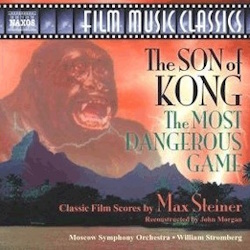
I would like to thank Naxos Records for this wonderful re-recording of Max Steiner’s sequel score Son of Kong. The score reconstruction by John Morgan is excellent, as is the audio quality, and performance of the Moscow Symphony Orchestra under the baton of William Stromberg. Steiner’s score for “King Kong” was a seminal event in Hollywood, which firmly established the utility and necessity of the musical score for films. This sequel, presented Steiner with different challenges as the film’s narrative shifted to a more comedic and playful Kong, which did not awe and frighten the audience as did his father, but instead endeared him to them. Indeed, Little Kong offered a playful, child-like and at times buffoonish persona, which Steiner perfectly captured musically. Also, the use of the Blue’s song melody “Runaway Blues” as a Main Theme offered a more inviting and sympathetic musical narrative for the film as Denham and Hilda sought to abandon their failed pasts in search of new beginnings. Three monster encounters, two of which involved a battle with Little Kong offer some exceptional action music, with Steiner dramatically channeling awesome Wagnerian power. Also notable is Steiner’s masterful writing for woodwinds as in the cue “Fire!” where he creates a conflagration musically. Folks, this early career score by Steiner will not be found on his greatest score lists, however, it offers a very entertaining forty-five minutes of well-conceived and executed music, which fits its film like a glove. I recommend that you purchase this compilation album, which also includes the score to “The Most Dangerous Game”, as well as taking in the film to experience the score in context.
For those of you unfamiliar with the score, I have embedded a YouTube link to the Main Title; https://www.youtube.com/watch?v=j50v2WwUS5o&list=PLkAUJkbhd-Riby8-jJoF5WoEdX1PjyIXY&index=1
Buy the Son of Kong soundtrack from the Movie Music UK Store
Track Listing:
- Main Title (1:50)
- Ship at Sea (0:57)
- In Dakang (1:25)
- Runaway Blues (1:29)
- Firel (2:34)
- An Offer of Help (4:16)
- Memories (2:11)
- Chinese Chatter (4:05)
- Forgotten Island (4:14)
- Quicksand – Little Kong (3:57)
- The Styracosaur (0:46)
- The Black Bear (2:41)
- Finger Fixings (3:31)
- Campfire at Night (3:24)
- The Old Temple (2:21)
- Johnny Get Your Gun (0:34)
- Finale (4:59)
Naxos Film Music Classics 8.570183 (1933/2006)
Running Time: 45 minutes 28 seconds
Music composed by Max Steiner. Conducted by William Stromberg. Performed by the Moscow Symphony Orchestra. Featured musical soloist Leonid Makarevich. Original orchestrations by Bernhard Kaun and Emil Gerstenberger. Recorded and mixed by Edvard Shakhnazarian and Vitaly Ivanov. Score produced by Max Steiner. Album produced by John Morgan, William Stromberg and Betta International.

Shop at the Movie Music UK Store

Member of the

 MOVIE MUSIC UK