Malcolm Arnold, 1921-2006
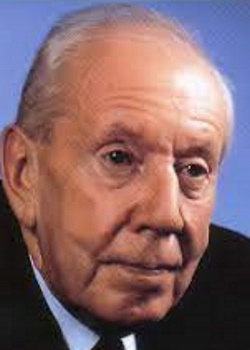 Composer and conductor Sir Malcolm Arnold died at his home in Norwich, England, on September 23, 2006, at the age of 84, following a short illness.
One of the most prolific and distinctive British composers of the twentieth century, Arnold wrote nine symphonies, numerous concertos and orchestral works, and more than 100 scores for films and documentaries. His music for David Lean’s The Bridge on the River Kwai won the Academy Award for Best Original Score in 1958.
Arnold was born in Northampton on October 21, 1921. Inspired by jazz and especially by hearing Louis Armstrong, he took up the trumpet and studied at the Royal College of Music with Ernest Hall while learning composition from Gordon Jacob. He joined the London Philharmonic Orchestra in 1940 and eventually became its principal trumpet before abandoning orchestral playing in 1948 to concentrate entirely on composition.
Film music quickly became an important part of Arnold’s career. His ability to write rapidly, his instinctive command of the orchestra and his gift for direct, memorable melody made him exceptionally well suited to the demands of British cinema. During the 1950s he scored such films as The Captain’s Paradise (1953), The Belles of St Trinian’s (1954), The Sea Shall Not Have Them (1954), The Night My Number Came Up (1955), 1984 (1956), Trapeze (1956) and A Hill in Korea (1956).
Arnold enjoyed an especially important relationship with David Lean, beginning with the aviation drama The Sound Barrier (1952) and continuing with Hobson’s Choice (1954). The latter demonstrated Arnold’s lighter touch, combining warmth, humor and characterful orchestral writing in support of Charles Laughton’s performance. Their third collaboration would become Arnold’s most famous contribution to cinema.
The Bridge on the River Kwai (1957) was composed under extraordinary pressure: Arnold was given only around ten days to complete the score. The film famously used Kenneth J. Alford’s pre-existing “Colonel Bogey March,” whistled by the British prisoners, while Arnold composed his own accompanying “River Kwai March” and the remainder of the dramatic score. His music moves between martial swagger, brutal action writing, tropical atmosphere and passages reflecting Colonel Nicholson’s increasingly obsessive state of mind. The film won seven Academy Awards, including Best Picture and Best Director, while Arnold received the Oscar for his score.
The following years were among his busiest. The Inn of the Sixth Happiness (1958), starring Ingrid Bergman, brought him an Ivor Novello Award, while Dunkirk (1958), The Key (1958) and The Roots of Heaven (1958) further demonstrated his command of large-scale dramatic scoring. Later films included Tunes of Glory (1960), The Angry Silence (1960), Whistle Down the Wind (1961), The Inspector (1962), Nine Hours to Rama (1963), The Chalk Garden (1964), The Thin Red Line (1964) and The Heroes of Telemark (1965). He also provided music for several entries in the enormously popular St Trinian’s series.
Away from cinema, Arnold was a major concert composer whose enormous output included nine symphonies, seven ballets, more than twenty concertos, chamber music and numerous works for brass and wind bands. His English Dances, Scottish Dances, Tam O’Shanter Overture and Peterloo Overture became especially popular, while he wrote concertos for performers including Benny Goodman, Julian Bream and Larry Adler. His music was generally tonal, brilliantly orchestrated and often exuberantly melodic, although his symphonies frequently revealed a much darker and more troubled emotional world. He was appointed CBE in 1970 and knighted for services to music in 1993.

Shop at the Movie Music UK Store

Member of the


