Archive
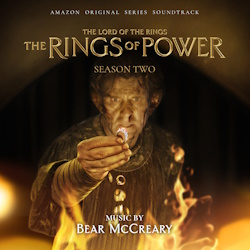
THE LORD OF THE RINGS: THE RINGS OF POWER, SEASON TWO – Bear McCreary
 Original Review by Jonathan Broxton
WARNING: THIS REVIEW CONTAINS PLOT SPOILERS. IF YOU HAVE NOT YET SEEN THE SHOW, YOU MIGHT WANT TO CONSIDER WAITING UNTIL AFTER YOU HAVE DONE SO TO READ IT.
Despite being one of the most lavish, ambitious, and expensive television shows in the history of the medium, the first season of The Lord of the Rings: The Rings of Power was not quite the overwhelming success that Amazon Prime Video hoped and expected it to be. Although it quickly became the most-watched Prime Video original series in history, and although it received generally positive reviews from critics – particularly for its visuals and designs – many Tolkien purists took great exception to the fact that showrunners J. D. Payne and Patrick McKay took some creative liberties with the source material. Not only that, the show was also the victim of racist online ‘review bombing’ stemming from complaints about the casting of non-white actors in key roles, as if that matters in a fantasy setting. Such is the way of toxic fandom today. Despite this, I thought it was absolutely outstanding, one of the most impressive television productions I have ever seen. Read more…
THE LORD OF THE RINGS: THE RINGS OF POWER – Bear McCreary
 Original Review by Jonathan Broxton
WARNING: THIS REVIEW CONTAINS PLOT SPOILERS. IF YOU HAVE NOT YET SEEN THE SHOW, YOU MIGHT WANT TO CONSIDER WAITING UNTIL AFTER YOU HAVE DONE SO TO READ IT.
The Lord of the Rings: The Rings of Power is one of the most lavish, ambitious, and expensive television shows in the history of the medium. It’s a prequel to Peter Jackson’s Lord of the Rings film series, based on J.R.R. Tolkien’s Lord of the Rings histories, The Silmarillion, and its various appendices, and is set in the Second Age of Middle-Earth, thousands of years before the events of The Hobbit and The Lord of the Rings took place. Essentially it tells the ‘origin story’ of several key events in LOTR lore: the fall of the Dark Lord Morgoth and subsequent rise of his chief servant Sauron, the creation of the land of Mordor, the fate of the island kingdom of Númenor, and the forging of the Rings of Power, as well as the relationships between various elves, dwarves, and men, who make and break alliances in an effort to combat the tide of evil. Numerous familiar characters from the film series appear, not least the elves Galadriel and Elrond, as well as a race of creatures known as ‘harfoots,’ the ancestors of the hobbits. Read more…
THE HOBBIT: THE BATTLE OF THE FIVE ARMIES – Howard Shore
 Original Review by Jonathan Broxton
And so, at last, after an astonishing 13-year trip across Middle Earth in the company of director Peter Jackson, through three Lord of the Rings films and two Hobbit films, we come to the conclusion of the saga with The Battle of the Five Armies, the third and final film based on J.R.R. Tolkien’s classic fantasy story The Hobbit. The film picks up immediately where the second film in the trilogy, The Desolation of Smaug, left off last year, with the hobbit Bilbo Baggins (Martin Freeman) and his dwarf cohorts looking on helplessly as the dragon Smaug (Benedict Cumberbatch), having emerged from under the mountain of Erebor, decimates the city of Laketown, before finally being brought down by the brave Bard (Luke Evans). In the aftermath of the devastation, the survivors of Laketown regroup in the ancient city of Dale, while the newly-crowned dwarfish king Thorin Oakenshield (Richard Armitage) jealously guards his new wealth from inside his impregnable stronghold. However, news of Smaug’s death quickly spreads across Middle Earth, and before long numerous different armies are massing outside Erebor’s gates, each claiming a valid right to the treasure inside, or having insidious ulterior motives of conquest and destruction. Read more…
THE HOBBIT: THE DESOLATION OF SMAUG – Howard Shore
 Original Review by Jonathan Broxton
The second film in Peter Jackson’s new Middle Earth trilogy based on J.R.R. Tolkien’s The Hobbit is The Desolation of Smaug; it picks up immediately where the first film in the trilogy, An Unexpected Journey, left off last year, with the hobbit Bilbo Baggins (Martin Freeman) journeying to the ancient dwarf stronghold of Erebor in the company of the wizard Gandalf (Ian McKellen), dwarfish king-in-waiting Thorin Oakenshield (Richard Armitage), and his band of adventurers, to take back their homeland from the dragon Smaug (Benedict Cumberbatch). Along way, however, the heroic company must traverse any number of dangers, including vicious orcs, unfriendly elves, a treacherous forest, and the inhabitants of an impoverished lake town in the shadow of the lonely mountain. Meanwhile, much to Gandalf’s consternation, the shadowy threat of a mysterious necromancer continues to grow, looming large over all of Middle Earth, and threatening its long-lasting peace. The film is a significant improvement over the first installment, eschewing some of its comic action material and embracing a more serious tone that befits a story that touches on much more adult themes involving obsession and corruption. It’s visually spectacular, of course (although the orc leader Azog still looks like a bad video game rendering), has a wonderful supporting cast that includes Stephen Fry, Evangeline Lilly, Luke Evans and a returning Orlando Bloom as Legolas, and – most importantly from this website’s point of view – sees Howard Shore returning to Middle Earth for the fifth time as composer. Read more…
THE HOBBIT: AN UNEXPECTED JOURNEY – Howard Shore
 Original Review by Jonathan Broxton
They say you can never go home again, but that’s not true for Howard Shore, the multi-award winning Canadian composer of the music for The Lord of the Rings. Prior to the release of the first LOTR film, The Fellowship of the Ring, in 2001, Shore was a respected but generally little-known composer, best known for writing a series of dark, brooding scores for director David Cronenberg, and thrillers like Seven and The Silence of the Lambs. Even when he was first announced as the composer for Fellowship, many commentators questioned whether Shore had the thematic strength to write the broad and expansive music the films required. Fast forward a decade, and Shore is a three-time Oscar winner and international film music superstar, with impressive album sales, sold-out concerts, and massive critical acclaim. When director Peter Jackson announced that he was making a new Middle Earth trilogy based on JRR Tolkien’s book The Hobbit, it was never a question of whether Howard Shore would return to score the films, but whether the music would stand up to the massive hype and sense of expectation that inevitably came with it’s release. For better or worse, the Lord of the Rings scores have become some of the best-loved of the new millennium, and for many fans whose first experience of film music came through those films and Shore’s now-iconic themes, there was bound to be an unimaginable sense of anticipation. So does The Hobbit continue the trend of excellent music in Middle Earth? The answer is yes and no, but not for reasons you might think. Read more…
Academy Award Winners 2003
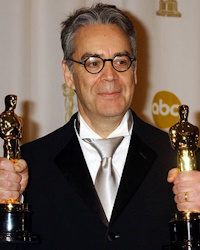 The Academy of Motion Picture Arts and Sciences (AMPAS) have announced the winners of the 76th Academy Awards, honoring the best in film in 2003.
In the Best Original Score category, Canadian composer Howard Shore won the Academy Award for his score for The Lord of the Rings: The Return of the King, the third film in Peter Jackson’s epic fantasy trilogy based on the novel by J. R. R. Tolkien. In his acceptance speech Shore said:
It’s incredible. Just breathe a bit. Many thanks to the Academy. I’d like to share this Oscar with all of the amazing musicians and great vocal artists who played on this piece. Special note to Annie Lennox, Renee Fleming, Sir James Galway, Ben del Maestro. I was incredibly inspired by Tolkien’s great work, Peter Jackson’s visionary filmmaking, the great writing of Fran Walsh, Philippa Boyens. Elizabeth, my darling, I love you. Thank you for your love and support. Mae, for your wonderful encouragement. All the people who have helped us through this making of these films: Bob and Michael, Paul and Lori, Barrie Osborne, Rick Porras, Sam and Mike, Ronald, Jean-Jacques, I thank you, Robby Kearns, Mark Willsher and, of course, Stephen Einhorn. Thanks so much. Thank you, Academy.
The other nominees for Best Original Score were Danny Elfman for Big Fish, Gabriel Yared for Cold Mountain, Thomas Newman for Finding Nemo, and James Horner for House of Sand and Fog.
In the Best Original Song category, Fran Walsh, Howard Shore and Annie Lennox won the Academy Award for “Into the West,” also from The Lord of the Rings: The Return of the King.
The other nominees for Best Original Song were Sylvain Chomet and Benoît Charest for “Belleville Rendez-vous” from The Triplets of Belleville; Michael McKean and Annette O’Toole for “A Kiss at the End of the Rainbow” from A Mighty Wind; T Bone Burnett and Elvis Costello for “The Scarlet Tide” from Cold Mountain; and Sting for “You Will Be My Ain True Love,” also from Cold Mountain.
THE LORD OF THE RINGS: THE RETURN OF THE KING – Howard Shore
 Original Review by Jonathan Broxton
And so, five years after his journey began, Howard Shore’s travels through the musical word of Middle Earth and the spectacular Lord of Rings trilogy comes to an end with The Return of the King, the final installment of Peter Jackson’s groundbreaking adaptation of the classic fantasy novel by J.R.R. Tolkein. To say that Shore has come a long way is understatement indeed. Before Lord of the Rings, Howard Shore was “the David Cronenberg guy” who specialized in dark, tortured scores for dark tortured movies. Now, he is the undisputed king of the epic adventure, with the potential to become the benchmark by which all future sword-and-sorcery scores are measured. Before Lord of the Rings, Howard Shore was a well-respected, but largely unheralded member of the film music world. Now, he is a household name, with an Oscar on his mantle, who sells out concert halls worldwide. It’s been one massive ride for the quiet, unassuming Canadian – and with the strength of this final score, his stock can only rise. Read more…
THE LORD OF THE RINGS: THE TWO TOWERS – Howard Shore
 Original Review by Jonathan Broxton
Howard Shore, welcome to the world of film music pressure. It’s a peculiar phenomenon, akin to the “second album” syndrome faced by rock and pop musicians whose debut works are hugely successful; John Williams faced it when embarking on the follow-up scores in the Star Wars saga. Jerry Goldsmith and James Horner, such is their popularity and fan base, face it each time they write a new score. Other composers face it when they write music for a beloved piece of fiction – especially in the fantasy or comic book genres – or have scored a major hit with their last effort in a series. With The Lord of the Rings, Howard Shore has joined this latter group. Read more…
Academy Award Winners 2001
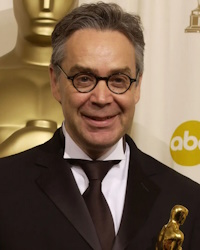 The Academy of Motion Picture Arts and Sciences (AMPAS) have announced the winners of the 74th Academy Awards, honoring the best in film in 2001.
In the Best Original Score category, Canadian composer Howard Shore won the Academy Award for his score for Peter Jackson’s epic fantasy film The Lord of the Rings: The Fellowship of the Ring, based on the novel by J. R. R. Tolkien. In his acceptance speech Shore said:
This is incredible. Thank you to the members of the Academy. I had the good fortune of having such fantastic collaborators on this project. Peter Jackson, Fran Walsh, Philippa Boyens who guided me on an amazing journey through Middle Earth. It was just a tremendously rewarding experience to translate the words of Tolkien into music and I just feel blessed to be a part of this production. I want to thank my wife Elizabeth and daughter Mae whose love and support are incredible to me and have just guided me on my journey. Thanks to Bob Shaye, Michael Lynne, Mark Ordesky, Paul Broucek, Barrie Osborne, everybody at, the crew in Tuxedo. I love you all. Thank you very much.
The other nominees for Best Original Score were John Williams for A.I. Artificial Intelligence, James Horner for A Beautiful Mind, John Williams for Harry Potter and the Sorcerer’s Stone, and Randy Newman for Monsters, Inc.
In the Best Original Song category, composer and songwriter Randy Newman won the Academy Award for “If I Didn’t Have You” from Pixar’s Monsters, Inc.
The other nominees for Best Original Song were Enya, Nicky Ryan and Roma Ryan for “May It Be” from The Lord of the Rings: The Fellowship of the Ring; Diane Warren for “There You’ll Be” from Pearl Harbor; Sting for “Until” from Kate & Leopold; and Paul McCartney for “Vanilla Sky” from Vanilla Sky.
THE LORD OF THE RINGS: THE FELLOWSHIP OF THE RING – Howard Shore
 Original Review by Jonathan Broxton
To say that Peter Jackson took on a mammoth task in undertaking a 9-hour, three-film cinematic version of The Lord of the Rings is an understatement indeed. Adapting J.R.R. Tolkien’s mammoth literary work for the screen took three years of the affable New Zealander’s life, and as the first part of the trilogy hits the world’s multiplexes, his vision and talent are for all to see. The Fellowship of the Ring is quite possibly the best fantasy film ever made, putting to shame Ralph Bakshi’s lamentable 1978 attempt to tell the same story through animation. Read more…

Shop at the Movie Music UK Store

Member of the


