THE GHOST AND THE DARKNESS – Jerry Goldsmith
 THROWBACK THIRTY
Original Review by Jonathan Broxton
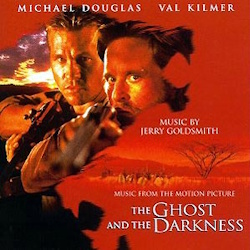
The Ghost and the Darkness is a historical adventure film directed by Stephen Hopkins and written by William Goldman. The film is set during the construction of a railway bridge in Tsavo, Kenya, in 1898, amid the Scramble for Africa, when a number of European powers colonized the continent. Val Kilmer stars as Irish engineer John Patterson, who arrives in Kenya determined to finish the job, only to find his workers terrorized by two man-eating lions. Michael Douglas plays Charles Remington, the experienced hunter brought in to help Patterson stop them. John Kani appears as Samuel, Patterson’s trusted colleague, while Tom Wilkinson plays the railway official Beaumont. Hopkins, whose earlier films included Predator 2 and Blown Away, turns the attacks into a mixture of old-fashioned adventure and creature-feature suspense.
Goldman drew the screenplay from the real Tsavo attacks and Patterson’s account of them, The Man-Eaters of Tsavo, but shaped the material into a more conventional partnership between engineer and hunter. Bringing that story to the screen meant constructing a period railway setting and staging encounters with trained lions on location in South Africa. Those production choices give the film its scale, even when its fictional embellishments are obvious. I liked the film enough when I saw it – it has a classic boys’ own adventure vibe that I appreciated – but it was only a middling success at the box office when it was first released. It won the Academy Award for Best Sound Editing, but director Hopkins has publicly disowned the film in the years since its release, saying that it “was a mess… I haven’t been able to watch it.”
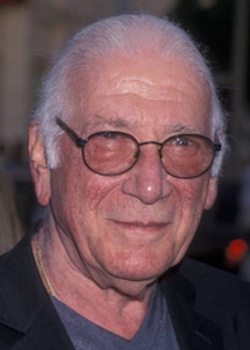 The score for The Ghost and the Darkness was written by Jerry Goldsmith, making this his only collaboration with Hopkins; most of Hopkins’s previous films were scored by Alan Silvestri. Previous films with African settings had already drawn strikingly colorful work from Goldsmith. King Solomon’s Mines from 1985 used forceful African-style percussion within a playful orchestral romp, while Congo from 1995 brought voices and pounding rhythms into a grander jungle adventure. The Ghost and the Darkness takes that interest somewhere darker: its brass can sound gloriously heroic one moment and alarmingly savage the next, while percussion and voices give the landscape a restless life of its own. The music treats the bridge at the center of the story as a feat of human determination while allowing the surrounding wilderness – and the two lions that stalk it – to remain mysterious and frightening.
The opening “Theme from The Ghost and the Darkness” lays out the score’s appeal immediately. A lilting, flute-colored rhythm backed by lightly tapped percussion suggests Patterson’s Irish identity before broad brass harmonies open up the vista around him. It’s a fascinating collision of cultures: the Irish character of the woodwinds blends with the British colonial regality of the horns, while the percussion textures and chanted vocals are distinctly African. “The Bridge” develops this music further, conveying the railway project with real conviction and a sense of nobility. The sturdy brass fanfare makes the building work feel purposeful, a warmer string melody gives the cue a welcome human dimension, and the continued use of African percussion and vocals reinforces the geographic setting. Light synthesizer work adds a little magic, perhaps even a touch of the supernatural, as the two lions who terrorize Tsavo are initially considered demons by the local tribespeople. It’s a strong opening, one of Goldsmith’s most distinctive efforts of the period.
In “Catch a Train,” Goldsmith finds room for tenderness, introducing a lovely variation on the main Irish theme as music associated with Patterson’s family. It becomes increasingly valuable as the danger closes in and is very much in the style of Goldsmith’s other romantic themes from the time; it especially foreshadows some of the music he would write for Star Trek: First Contact later in 1996. Then comes “Lions Attack,” and the score shows its teeth for the first time. Brass figures rise and snarl, the percussion turns ferocious, and the shouted African vocals make the assault feel overwhelming. Goldsmith made a habit of using low brass to accompany his villains, and anyone who appreciated the similar writing in The Shadow, Congo, and First Knight, as well as his later scores for The Mummy and The Thirteenth Warrior in 1999, will find his efforts here outstanding. Goldsmith was exceptionally good at controlling the distance between anticipation and impact in this kind of action cue: the quieter stretches keep you listening for movement in the grass, the swish of a tail, or the brief glimpse of a mane, making each orchestral eruption more startling.
“First Time” answers the violence with a stirring sense of collective resolve. Further statements of Patterson’s theme are joined by rhythmic energy and clapping that give the Tsavo railway workers a musical presence of their own. After an initially restrained opening, “Starling’s Death” develops into another superb action cue, its extended build and violent outbursts making the threat feel relentless. The clattering percussion, yelping vocals, and ragged brass clusters convey panic with remarkable force, before the finale gives way to tragedy and loss.
“Lions Reign” is a wonderfully evocative tribute to both the African landscape and the lions themselves, its wide-open brass writing and ululating African vocals imbuing the animals with a sense of awe and dread that captures their near-mythic hold over Tsavo. “Preparations” underscores the scenes in which Patterson and Remington plan to hunt the lions, and Goldsmith gives their efforts a muscular rhythmic drive. A new theme for Remington appears to emerge here, bold, heroic, and adventurous. The subsequent “Remington’s Death” turns that strength toward sorrow without sacrificing the score’s grandeur: a reprise of the massive lion motif from “Lions Reign” combines with a stately version of Remington’s theme to acknowledge the hunter’s demise.
In the climactic “Prepare for Battle” and “Final Attack,” Goldsmith builds pressure, bringing his aggressive brass, voices, and percussion together for a thrilling conclusion. The former is built around a stirring, heroic variation on Patterson’s theme blended with African vocals, while the latter is a savage explosion of orchestral power that brings back the low-brass writing to excellent effect. Finally, “Welcome to Tsavo” lets Patterson’s family theme emerge from the ordeal with genuine warmth as the bridge is completed and Patterson returns home, reunites with his wife Helena, and meets his newborn son for the first time.
The original soundtrack ends with five African chants and songs performed by the Worldbeaters and arranged by Franco-Senegalese composer and songwriter George Acogny. Some feature vocals by Pakistani qawwali singer Nusrat Fateh Ali Khan. They are all very good, authentic, and contribute to the sense of time place established by the film.
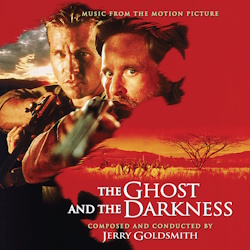 Although the original soundtrack album offered a decent representation of Goldsmith’s score, Intrada Records released an expanded two-CD set in 2015. According to the album’s press release, the expansion includes 70 minutes of score heard in the film, along with numerous alternates assembled by Goldsmith and engineer Bruce Botnick to accommodate changes during post-production. Some cues were recorded, re-recorded, and then reworked with complex layers of voices, electronics, and percussion over the orchestra. Several excellent cues make their album debut, including the action pieces “Over There,” “One Shot,” and “First Kill,” the outstanding “John’s Nightmare,” and the extended suspense and horror passages “The Trap” and “The Cave.” There is also a 10-minute alternate version of “Welcome to Tsavo” that climaxes with a resounding brass flourish not heard on the original album.
Stephen Hopkins apparently described The Ghost and the Darkness to Jerry Goldsmith as “Lawrence of Arabia meets Jaws,” and it’s easy to hear how Goldsmith responded to that idea. He anchors his melodies in the sweep of a classic David Lean epic, then sets them against some of his most ferocious low-brass action motifs. The result is a score that is both richly melodic and frighteningly aggressive. The Ghost and the Darkness may not rank among Goldsmith’s most celebrated films, but its score deserves a place among his finest adventure works of the 1990s. I love the way its generous melodies and heroic fanfares coexist with music that makes the lions feel genuinely terrifying, and the expanded album reveals just how much invention went into that balance. If you enjoy Goldsmith at his most colorful, forceful, and unapologetically cinematic, I strongly recommend spending some time in Tsavo.
Buy the Ghost and the Darkness soundtrack from the Movie Music UK Store
Track Listing:
- ORIGINAL 1996 ALBUM
- Theme from The Ghost and the Darkness (2:11)
- The Bridge (4:09)
- Catch a Train (2:02)
- Lions Attack (5:18)
- First Time (2:00)
- Starling’s Death (5:57)
- Lions Reign (2:40)
- Preparations (2:46)
- Remington’s Death (2:31)
- Prepare for Battle (2:00)
- Final Attack (2:53)
- Welcome to Tsavo (4:59)
- Hamara Haath (Our Hands Unite) (written by George Acogny, performed by The Worldbeaters feat. Nusrat Fateh Ali Khan) (3:05)
- Dueling Chants, Part 1 – Jungal Bahar (written by George Acogny, performed by The Worldbeaters feat. Nusrat Fateh Ali Khan) (3:20)
- Safari Ya Bamba (Journey to Bamba) (written and performed by The Worldbeaters) (2:32)
- Terere Obande (written by George Acogny performed by The Worldbeaters) (2:42)
- Iye Oyeha (written by George Acogny performed by The Worldbeaters) (2:13)
- EXPANDED 2015 INTRADA ALBUM
- Opening Title (Tall Grass) (1:03)
- Train To Catch (2:01)
- First Time (4:01)
- Over There (0:56)
- One Shot (1:34)
- The Claws – Revised [Alternate] (3:54)
- Mahina’s Death [Alternate] (0:48)
- The Funeral (0:45)
- The Wall (1:31)
- Starling’s Death [Alternate] (5:56)
- The Lions Reign (2:39)
- Near Miss (1:23)
- Prepare For Battle (4:33)
- You’ve Been Hit (3:23)
- Preparations – Revised [Alternate] (1:38)
- The Trap [Alternate] (2:00)
- Lions Attack (5:33)
- The Cave (4:14)
- After You (0:44)
- The Baboon [Alternate] (0:41)
- First Kill [Alternate] (2:44)
- John’s Nightmare (1:23)
- Remington’s Death (2:30)
- Final Attack – Revised (2:49)
- Welcome to Tsavo #2 – Revised (9:50)
- Tall Grass [Original] (1:03) BONUS
- The Claws – Revised (2:56) BONUS
- Mahina’s Death [Original] (0:48) BONUS
- The Box Car [Unused Insert] (0:29) BONUS
- The Box Car [Original] (0:57) BONUS
- Near Miss [Alternate] (0:27) BONUS
- Stand Off [Original] (2:12) BONUS
- Starling’s Death [Original] (5:57) BONUS
- The Thicket [Original] (3:29) BONUS
- Preparations [Original] (1:34) BONUS
- The Trap [Original] (2:00) BONUS
- The Baboon [Original] (0:41) BONUS
- First Kill [Original] (2:40) BONUS
- First Kill [With Extension] (2:38) BONUS
- Welcome To Tsavo #2 [Original] (2:53) BONUS
- Theme from The Ghost and the Darkness (2:11)
- The Bridge (4:09)
- Catch a Train (2:02)
- Lions Attack (5:18)
- First Time (2:00)
- Starling’s Death (5:57)
- Lions Reign (2:40)
- Preparations (2:46)
- Remington’s Death (2:31)
- Prepare for Battle (2:00)
- Final Attack (2:53)
- Welcome to Tsavo (4:59)
- Hamara Haath (Our Hands Unite) (written by George Acogny, performed by The Worldbeaters with The Johannesburg Choir feat. Nusrat Fateh Ali Khan) (3:05)
- Dueling Chants, Part 1 – Jungal Bahar (written by George Acogny, performed by The Worldbeaters with The Johannesburg Choir feat. Nusrat Fateh Ali Khan) (3:20)
- Safari Ya Bamba (Journey to Bamba) (written by George Acogny, performed by The Worldbeaters with The Johannesburg Choir) (2:32)
- Terere Obande (written by George Acogny, performed by The Worldbeaters with The Johannesburg Choir) (2:42)
- Iye Oyeha (written by George Acogny, performed by The Worldbeaters with The Johannesburg Choir) (2:13)
Running Time: 53 minutes 27 seconds — Original
Running Time: 152 minutes 35 seconds — Expanded
Hollywood Records HR-62089-2 (1996) — Original
Intrada Special Collection Volume ISC 312 (1996/2015) — Expanded
Music composed and conducted by Jerry Goldsmith. Performed by the National Philharmonic Orchestra. Orchestrations by Alexander Courage. Recorded and mixed by Bruce Botnick. Edited by Kenneth Hall. Original album produced by Jerry Goldsmith. Intrada expanded album produced by Douglass Fake and Roger Feigelson.

Shop at the Movie Music UK Store

Member of the


