FINAL DESTINATION: BLOODLINES – Tim Wynn
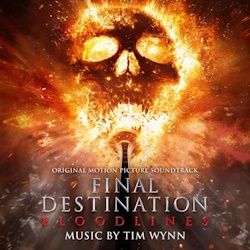 Original Review by Jonathan Broxton
The inexplicable longevity of the Final Destination horror movie franchise is such that the latest instalment, subtitled Bloodlines, is the sixth in the series that began some 25 years ago, in the year 2000. I remember seeing the first film in the theater, and my notes tell me that I saw at least some of the third film, Final Destination 3, from 2006, but beyond that my knowledge of them is limited to what I have read over years. Broadly, the core idea of the films is that you can’t cheat death. Each film follows a similar structure; someone has a vision of a deadly disaster – maybe a plane crash, or a highway pile – prevents it, and then the survivors start dying in the exact order they would have originally. The deaths are not caused by a villain per se, but by “death” itself as an unseen force, correcting the disruption to its plan.
In this latest film, college student Stefani Reyes (played by Kaitlyn Santa Juana) experiences recurring nightmares of the 1968 tower collapse that her grandmother, Iris, prevented through a premonition. Stefani discovers that ‘death’ is now targeting the descendants of those who escaped the original tragedy, and as her family members begin to die in gruesome accidents, Stefani seeks out her reclusive grandmother for answers. The film is directed by Zach Lipovsky and Adam Stein, and is the first Final Destination film since the fifth entry in 2011. The film is also notable for being the final film role of horror icon Tony Todd, who played creepy funeral home owner William Bludworth in four previous films, and who sadly died of stomach cancer shortly after filming his part.
The first three Final Destination films were all scored by the late, great Shirley Walker, with Final Destination 3 coming out just a few months before her death in 2006. Final Destination 4 and Final Destination 5 were both scored by Brian Tyler, but Bloodlines sees a new composer entering the franchise in the shape of Tim Wynn. I feel like Wynn has been around forever, writing great music for numerous film, TV, and video game projects, and often working with Chris Lennertz, without ever really having a breakout moment of his own. I said something similar after The Legend of La Llorona in 2022, but now it looks like Final Destination: Bloodlines could finally be that score. It’s a full blooded, bombastic, hugely entertaining action horror score in the grandest orchestral tradition, which eschews the current prevailing trend for low-key horror droning and instead embraces themes, melody, and good old-fashioned orchestral carnage to carry the weight of the film.
 What I really like about the score is how thematically dense it is. There was really no need for Wynn to write a score as complex and intricate as this, but I get the feeling that he wanted to showcase his writing talents as much as possible on a film with this type of commercial potential, and showcase them he did. Stylistically the score could be described as a sort of amalgam of Shirley Walker, 1980s Christopher Young, and Jerry Goldsmith in horror mode, with all the quality that implies. Wynn also enhances his orchestra with a little bit of Brian Tyler’s more contemporary sounding electronica from the fourth and fifth films, but on the whole this is a much more traditionally symphonic score than one would expect to hear in a mainstream horror film in 2025, and that’s one of the reasons I appreciate it so much.
There are at least four recurring themes in the score – a bold and bombastic main theme, a more lyrical and mysterious theme that represents Stefani’s familial ties to the ‘final destination’ curse, and two related but distinct themes for the ‘specter of death’ that constantly seeks to dispatch the characters in a series of increasingly creative and grisly ways. Wynn also intentionally quotes Shirley Walker’s original score in several key scenes involving the late Tony Todd’s Bludworth character, as a tribute to him and to link it to how his character appears in multiple movies in the franchise. Cleverly, Wynn regularly plays two or more of these themes consecutively and sometimes even contrapuntally within the same cue, musically illustrating conflicts and shifting narrative ideas. I love this type of approach to musical storytelling, and Wynn absolutely nails it in multiple instances.
Several cues stood out to me as being especially noteworthy. There’s a terrific statement of the main theme at the beginning of “Bloodlines (End Titles),” which reverberates with resounding brass majesty. The ‘specter of death theme’ emerges with eerie menace at the start of “Elevator Ride,” in an arrangement that made me think of Jerry Goldsmith and Hollow Man in the way that high strings and woodwinds rock back and forth, seesaw style. The main theme is underpinned with sampled sounds of medical machinery in the creative action cue “The MRI,” and is a much better use of this conceit than Steve Jablonsky’s Battleship.
There’s a lovely, emotional, bittersweet performance of Shirley Walker’s theme in “Bludworth’s Goodbye,” moving around between statements of the new main theme and the ‘specter of death’ theme carried by dark cellos. After a sequence of murky and rhythmic ‘sneaking around’ music that alludes to several themes the action music returns with a vengeance in exciting cues like “Waterworld,” “Lawnmower Man,” and the determined-sounding “Drive to Iris,” either side of the most prominent and most emotional statement of the family theme in “The Skyview,” where it is carried by poignant strings and tender pianos.
There’s another prominent statement Shirley Walker’s theme in “Meet Bludworth,” which blends perfectly with more allusions to the main theme and the family theme. There’s musical carnage in the brutal “I See You,” a sense of gradual realization and revelation in the moodily rhythmic “Connecting the Dots,” and then an apocalyptic crescendo at the end of the otherwise soft and gentle “Resurrection.” Throughout all these cues Wynn makes constant allusions to one or more of the different themes, playing the rhythms and chords of one against the melody of one or the others, so that everything comes together as a cohesive whole. It’s really very impressive.
There is a bank of massive Goldenthal-style screaming brass in the raucous action cue “Tower of Terror” that I adored. The use of glass bowls as part of the family theme in “Graveyard” gives it a vague religioso feel. The rampant energy of “Recycling” palpable, I like the electronic textures in “Your Plan is Nuts,” and the way Wynn brings together three different themes in less than a minute in “Premonition” is very impressive. There’s a menacing, growling darkness all the way through “Psycho Grandma,” which explodes into a huge, anarchic statement of the ‘specter of death’ theme in “The Collapse,” before ending with a moment of almost romantic reflection via the statement of the family theme in “Look After Paco.”
After one final burst of energy in “The Compound” the five-minute “End Credits Suite” brings together the main theme, the ‘specter of death’ theme, and Shirley Walker’s Bludworth theme for a final salvo, with several prominent thematic refrains shining through in a way that makes for a superbly satisfying conclusion, and which features even more of those magnificent throaty brasses. There’s a real energy and freshness to the music in Final Destination: Bloodlines that took me by surprise, considering that it’s the sixth instalment in a horror franchise that should have died out years ago. The album presentation itself is perhaps a little too much – a tighter edit and a trim of perhaps 15 minutes of filler might have resulted in a more compelling listen – but in terms of actual composition Tim Wynn’s music here is of a significantly superior quality. The action music is large and intense, the horror stingers are appropriately vivid, and there is an intellectual design to the whole work that vastly over-achieves in terms of the quality of the film it accompanies.
It’s also worth remembering that, as of the time of writing, none of Shirley Walker’s first three scores have been legitimately released as soundtracks beyond some rare (and dubiously-sourced) promos, and as such record labels should seeks to capitalize on the excellence of this work to rectify that oversight.
Buy the Final Destination: Bloodlines soundtrack from the Movie Music UK Store
Track Listing:
- Bloodlines (End Titles) (1:45)
- Elevator Ride (1:46)
- The MRI (2:25)
- We Can’t Give In (1:46)
- Bludworth’s Goodbye (2:45)
- Bludworth (2:43)
- Escape to the Compound (1:36)
- Two of Us (2:30)
- The Plan (1:45)
- Waterworld (2:44)
- Seeing is Believing (1:50)
- The Skyview (1:29)
- Lawnmower Man (2:00)
- Drive to Iris (1:34)
- Meet Bludworth (1:08)
- I See You (1:33)
- Decoding Iris’ Book (1:23)
- Connecting the Dots (4:13)
- Resurrection (3:19)
- I Screwed Up the Order (3:03)
- Tower of Terror (2:21)
- Tempting Death (1:43)
- Technically You Weren’t Dead (1:15)
- Graveyard (2:02)
- Recycling (1:11)
- Your Plan is Nuts (2:06)
- Premonition (1:01)
- The Book (1:42)
- Psycho Grandma (1:46)
- The Collapse (1:05)
- Look After Paco (1:38)
- The Compound (2:02)
- End Credits Suite (5:13)
Lakeshore Records (2025)
Running Time: 65 minutes 59 seconds
Music composed by Tim Wynn. Conducted by Tim Davies. Orchestrations by Andrew Kinney, Michael J. Lloyd, Tim Davies, Gernot Wolfgang and Philip Klein. Additional music by Lukas Geppert. Original Final Destination themes by Shirley Walker. Recorded and mixed by Damon Tedesco. Edited by Ronald J. Webb. Albums produced by Tim Wynn.
Leave a comment

Shop at the Movie Music UK Store

Member of the


“there is an intellectual design to the whole work that vastly over-achieves in terms of the quality of the film it accompanies”
This is an ignorant comment my man. You haven’t seen the film so don’t say that. It may be surprising to you but the movie has been very well received. It only takes a second to find that out. You shouldn’t just assume that it’s trash.