THE PAGEMASTER – James Horner
 THROWBACK THIRTY
Original Review by Jonathan Broxton
The Pagemaster is a family fantasy film directed by Joe Johnston and Maurice Hunt that combines live-action and animation to tell a whimsical coming-of-age story. The film stars Macaulay Culkin – who at the time was right in the middle of his post-Home Alone superstardom – as Richard, an overly cautious, fearful boy who avoids risks at all costs. During a storm, he takes shelter in a grand library where he meets the enigmatic librarian, Mr. Dewey (Christopher Lloyd). After slipping on the library floor, Richard finds himself transported into a magical, animated world of books. In this fantastical realm, Richard encounters three anthropomorphic books—Adventure (Patrick Stewart), Fantasy (Whoopi Goldberg), and Horror (Frank Welker)—who guide him on an epic journey through iconic literary worlds. Together, they face pirates, dragons, haunted castles, and other challenges drawn from classic tales such as Moby Dick, Treasure Island, and Dr. Jekyll and Mr. Hyde, all of which forces Richard to confront his fears and discover his inner bravery. The film has a noble and worthwhile sentiment that espouses the wonderful nature of classic literature, and is ambitious in its scope, but it was not a critical or commercial success, and the production was marred by in-fighting between director Johnston, the production company, and screenwriter David Kirschner.
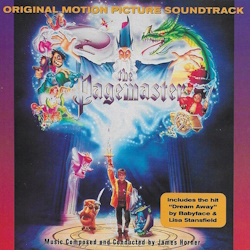
The score for The Pagemaster was by James Horner, who previously worked with Kirschner on An American Tail in 1986 and Once Upon a Forest in 1992, and with Johnston on Honey I Shrunk the Kids in 1989 and The Rocketeer in 1991. Taking inspiration from the rich narrative, Horner crafted a score awash in broad orchestral strokes that range in style – as one would expect – from classic adventure to sweeping fantasy, murky horror, and even some swashbuckling pirate music. It was written and recorded almost simultaneously with Legends of the Fall, but there is very little overlap between the two – instead, Horner’s back catalogue inspirations come from scores like Willow, The Land Before Time, and even Glory, as well as classical works like Tchaikovsky’s The Nutcracker, and Paul Dukas’s The Sorcerer’s Apprentice. As I have written before, these influences are completely clear and obvious, and in order to enjoy the score you simply have to acknowledge that this was something that Horner did, move past it, and enjoy the score for what it is.
 Unlike a lot of Horner’s scores from the period, which tended to be very expansive and wide-ranging, The Pagemaster is much more eclectic. Considering that the film itself jumps around from genre to genre willy-nilly, Horner’s music naturally follows suit, which results in a score which feels perhaps a little more unfocused than his other scores for animated films. This is not necessarily a criticism, because the music is still outstanding; it’s simply an acknowledgement that the score is structured that way.
The score is built around a series of recurring themes, the majority of which are introduced in the outstanding “Main Title”. After a few moments of gorgeous build-up featuring the heavenly choir from Willow the first part of the score’s main theme emerges, a swashbuckling fanfare, before it all explodes into life at the 0:35 mark with a gorgeous, sweeping rendition of the main theme’s second part for the full orchestra, lyrical and wholly beautiful. These massive themes were Horner’s bread-and-butter throughout his career, and although the theme from The Pagemaster has never entered public consciousness in the way that others have, I have always had a soft spot for it. The piece concludes with a light, prancing passage for sparkling, Tchaikovsky-like chimes and glockenspiels, and xylophones backed by hooting woodwinds, playful and child-like but with a lively sense of humor. This part of the cue, and the subsequent action piece “A Stormy Ride to the Library” have quite a lot in common, musically, with the score for We’re Back: A Dinosaur’s Tale from 1993, in that they blend whimsical mischief with something that is at times quite unexpectedly intense and brutal; the density of the orchestrations in parts of “A Stormy Ride to the Library” is seriously impressive.
These four main ideas – the two parts of the main theme, the choral motif, and the more lighthearted and playful theme – dominate the beginning and the end of the score. They feature prominently in the expressive “The Library… The Pagemaster…,” which sees Horner utilizing an array of magical textures and impressionistic passages, including a bombastic explosion of tremendous power around the 2:30 mark which, again, has quite a lot in common with the score for We’re Back: A Dinosaur’s Tale, especially the use of muted kazoos as part of the ensemble.
However, once Richard leaves the ‘real world’ and enters the animated literary world, Horner introduces a trio of new themes for the three anthropomorphic books who accompany him on his journey. “Meeting Adventure and Fantasy” begins with a new theme for Adventure, a vivacious and boisterous sea shanty-type theme that reaches back to the sound of classic Hollywood and the swashbuckling pirate scores composers like Erich Wolfgang Korngold wrote for the films of Errol Flynn. Meanwhile, the theme for Fantasy clearly has its roots in Paul Dukas’s The Sorcerer’s Apprentice, the famous 1897 tone poem which was famously used by Walt Disney in the classic 1940 animated film Fantasia, with Mickey Mouse as an accident-prone trainee wizard. Then in the subsequent “Horror” Horner captures the morose personality of the character with some darkly brooding arrangements of the main theme at the beginning and end of the piece, but the meat of the cue is actually unexpectedly pretty, almost timid and delicate, built around a wavering set of woodwind passages.
One thing that stands out in these cues – indeed, throughout the whole score – is the richness of the orchestrations that Horner and his orchestrators, Don Davis and Thomas Pasatieri, bring to the work. Horner was always tremendously accomplished at bringing out the best in his orchestra, but the detail and expressiveness of the arrangements in The Pagemaster is notably excellent, and sometimes very eclectic, with some having brief allusions to Gershwin jazz, while others have an almost ‘restoration French’ sound that is lovely but unexpected. Horner weaves statements of the main theme throughout all these cues too, bringing Richard into this new world and establishing his growing friendship with the tomes.
The motif for Horror is prevalent throughout the first part of “Dr. Jekyll and Mr. Hyde,” but as it develops the whole thing becomes darker and more sinister as the film’s primary antagonist – memorably voiced by Leonard Nimoy – attacks the intrepid adventurer. Bold string figures churn endlessly against an increasingly weighty bank of horns, which then emerges into a propulsive and turbulent passage for the full orchestra that foreshadows the “Samuel’s Death” sequence from Legends of the Fall. The subsequent “A Narrow Escape” continues in very much the same vein, containing some imposing and powerful passages, and a searching version of the main theme for anguished-sounding strings.
“Towards The Open Sea…” and “Pirates!” are spectacular settings of the Adventure theme, and see Horner fully embracing the Korngold swashbuckling pirate epic sound. Unlike John Debney and Cutthroat Island, Horner never scored a contemporary pirate movie, and so these cues are really the only indication of what that might have sounded like. On the evidence of the music here, it would have been a mouth-watering prospect. Horner offers a nautical variation on a theme he used in both The Journey of Natty Gann and The Land Before Time, here as a motif for the whole pirate concept, Moby Dick, Captain Ahab, and Long John Silver. His thinking seems to be inspired by the notion of the protagonist heading out on a long journey, as was the case with its previous iterations, and it works like a charm. There are several reprisals of the main theme, occasional hints of scores like Krull and Willow in the sensational action music, and creative and expressive orchestral passages that are endlessly delightful and charming – the energetic and exhilarating run that begins at 1:57 in “Pirates!” is one of the best and most underrated grand adventure cues of Horner’s entire career. Those brass triplets! Those sleigh bells!
After a brief respite for a soothingly emotional version of the main theme in “Loneliness” the Fantasy section kicks into high gear in “The Flying Dragon,” with which Richard must do battle in order to escape back to the real world. Throughout this cue and the subsequent “Swallowed Alive!/The Wonder In Books” Horner offers up several majestic variations on both parts of the main theme and the Fantasy theme, all deeply embedded into yet more tremendously energetic and expressive action music. The echoes of fantasy scores like Krull and Willow are again prevalent here, both in terms of the specific orchestral sound and in some of the chord progressions and rhythmic devices Horner uses, and it’s just tremendous. The bold and brassy version of the main theme at the beginning of “Swallowed Alive!” is especially noteworthy, as is the use of a light choir to accompany Richard’s eventual successful magical exit from the animated world.
The final cue, “New Courage/The Magic of Imagination,” sees Richard returning to the real world with a new sense of determination to overcome his fears, and with a new love of classic literature, all of which is accompanied by a series of outstanding reprises of the main theme, including the welcome return of the heavenly ‘Willow choir’ that had been absent for most of the score. Horner was never shy about providing the ultimate emotional catharsis in moments like this, and The Pagemaster reaches deep into that approach; although it was for a mostly silly children’s film, the emotional sincerity and musical authenticity that Horner always showed was one of the reasons I loved his work so much.
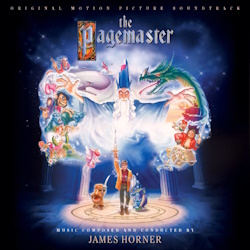 The original Fox/Arista Records album also includes two original songs. “Whatever You Imagine,” with music by Horner and lyrics by his An American Tail collaborators Barry Mann and Cynthia Weil, is based on the score’s main theme and is sung by Wendy Moten in a light pop/R&B style that is very enjoyable. The song was nominated for a Grammy Award for Best Song Written for Visual Media in 1996 – the Grammy’s eligibility years are weird – but it lost to “Colors of the Wind” from Pocahontas. The other song, “Dream Away,” was written by Diane Warren and is performed by Babyface and Lisa Stansfield, but has no relationship with the score whatsoever; I like it nonetheless, in an easy-listening undemanding pop way.
Considering that the Arista album had been out of print for many years, in 2015 La-La Land Records released an expanded special edition of the score with around seven minutes of additional music and alternate takes, and re-mastered and notably improved sound, all presented in a handsome package featuring liner notes by writer Jeff Bond. This is likely the only version that anyone will be able to find at decent prices any more, and as such it comes with a hearty recommendation.
In the years since its release The Pagemaster has become a somewhat overlooked entry in James Horner’s career, something exacerbated by the fact that it would be immediately overshadowed by the subsequent release in late 1994 and 1995 of three of the best scores that he or anyone else would write in the history of film music – Legends of the Fall, Braveheart, and Apollo 13. Despite this, The Pagemaster is well worth exploring for fans of Horner’s bold and appealing writing for children’s adventure films. The main theme is a knockout, the swashbuckling pirate music is especially sensational, and all the various little Hornerisms throughout the score make it a consistently familiar, appealing, and hugely entertaining listen.
Buy the Pagemaster soundtrack from the Movie Music UK Store
Track Listing:
- ORIGINAL 1994 ARISTA ALBUM
- Dream Away (written by Diane Warren, performed by Babyface and Lisa Stansfield) (4:38)
- Whatever You Imagine (written by James Horner, Barry Mann, and Cynthia Weil, performed by Wendy Moten) (3:27)
- Main Title (2:27)
- A Stormy Ride To The Library (2:52)
- The Library… The Pagemaster… (4:41)
- Meeting Adventure and Fantasy (5:12)
- Horror (3:20)
- Dr. Jekyll and Mr. Hyde (5:05)
- A Narrow Escape (2:04)
- Towards The Open Sea… (7:01)
- Pirates! (4:07)
- Loneliness (3:11)
- The Flying Dragon (3:10)
- Swallowed Alive!/The Wonder in Books (7:56)
- New Courage/The Magic of Imagination (4:03)
- EXPANDED 2015 LA-LA LAND ALBUM
- Main Title (2:30)
- Dad Builds Treehouse (0:23)
- A Stormy Ride To The Library (2:51)
- Library Card (1:17)
- The Library… The Pagemaster… (4:42)
- Meeting Adventure and Fantasy (5:11)
- Baskerville Hound (0:21)
- Horror (3:20)
- Dr. Jekyll and Mr. Hyde (5:07)
- A Narrow Escape (2:05)
- Towards The Open Sea… (7:03)
- Pirates! (4:06)
- Loneliness (3:11)
- Fire Breathing Dragon (3:10)
- Swallowed Alive!/The Wonder in Books (7:55)
- New Courage/The Magic of Imagination (4:11)
- Whatever You Imagine (written by James Horner, Barry Mann, and Cynthia Weil, performed by by Wendy Moten) (3:29)
- Dream Away (written by Diane Warren, performed by Babyface and Lisa Stansfield) (4:42)
- Main Title (Alternate Ending) (2:18) BONUS
- Loneliness (Alternate) (2:20) BONUS
Fox/Arista Records 07822-11019-2 (1994) – Original
La-La Land Records LLLCD 1378 (1994/2015) – Expanded
Running Time: 63 minutes 14 seconds – Original
Running Time: 70 minutes 12 seconds – Expanded
Music composed and conducted by James Horner. Performed by the London Symphony Orchestra. Orchestrations by Don Davis and Thomas Pasatieri. Recorded and mixed by Shawn Murphy. Edited by Jim Henrikson. Original album produced by James Horner. Expanded album produced by Nick Redman and Mike Matessino.

Shop at the Movie Music UK Store

Member of the


