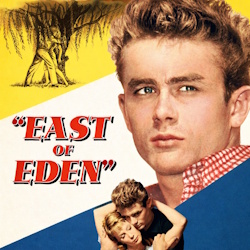
EAST OF EDEN – Leonard Rosenman
 GREATEST SCORES OF THE TWENTIETH CENTURY
Original Review by Craig Lysy
Warner Brothers Studios was approached by director Elia Kazan with a proposition to base a film on the fourth, and final part of John Steinbeck’s 1952 novel East of Eden. Given his reliable track record of success, the studio gave him the green light to proceed with the project. Kazan purchased the film rights from Steinbeck, and would manage production as well as direct. Paul Osborn was hired to write the screenplay. Casting was a struggle; Kazan rejected Marlon Brando and Montgomery Cliff as too old to play the teenage brothers and instead selected new talent 24-year-old James Dean to play Cal Trask. Joining him would be Julie Harris as Abra Bacon, Raymond Massey as Adam Trask, Richard Davalos as Aron Trask, Jo Van Fleet as Cathy Trask, and Burl Ives as Sam the sheriff.
The story is set in the central California towns of Monterey and Salinas in 1917 as America has joined the fight in World War I. It offers a modern retelling of the biblical tale of Cain and Abel as we see Cal (Cain) desperate to gain his father Adam’s love, only to time and time again be denied his affection. Adam is a devout religious man who clearly favors his more pious and dutiful first born son Aron over the rebellious and moody second born. The more Cal tries, the more he suffers rejection. The fact that Aron’s girlfriend develops feeling for Cal exacerbates the tension between the brothers. Jealous of his brother Cal takes him one day to see their mother, who runs a brothel in Monterey. The revelation destroys Aron’s mind, and he signs up to join the army, smashing his head through the window of the departing train as Adam watches in horror and suffers a stroke. As the father lays dying, he refuses reconciliation with Cal until Abra intercedes. Adam relents, Abra takes Cal to him and the father at last gives Cal the affection he longed for his whole life. The film was a commercial success, earning the studio a significant profit. Critics offered mixed assessments all directed at Dean’s performance, which they either loved or hated. Nevertheless the film earned four Academy Award nominations for Best Supporting Actress, Best Actor and Best Director and winning one for Best Screenplay.
 Composer Leonard Rosenman had graduated from the University of California in 1952 and secured a fellowship to study under Italian composer Luigi Dallapiccola. By chance he was introduced to actor James Dean in New York, and a friendship developed when Dean asked him to mentor him on the piano. Rosenman had never scored a film before, but was offered the assignment by director Elia Kazan based on the recommendation of James Dean, who was making his film debut. Rosenman was very exciting and motivated by his first film assignment and made an audacious proposal to director Kazan, which was granted, that he be part of the project from day one. He related; “I insisted on working the way Russian composers had worked. This involves being constantly on location, so that when the film is rough cut, then the music will be rough cut”.
Additionally, he did something never done before – he played on piano for the actors the music he had composed for the scene, which was received well and appreciated as it helped inform their acting. I believe Rosenman understood that the film was a story of unrequited love, of a son desperate to gain his father’s love. Yet the film is much more than this, and so he composed an idyllic, Americana Main Theme, which speaks to the aspirational desire of each of the characters to achieve love, and fulfillment. It emotes in ¾ time using an ABA construct with the sensibility of a graceful danza gentile. The string borne A Phrase offers warm and tender tones, while the woodwind B Phrase speaks of yearning. It offers classic Americana and speaks of innocence, with a sense of longing, which inform us that what we desire if often, illusive and difficult to realize. Musical support for Cal often embraces the aspirational Main Theme, but also at times, dissonance, anger, and vengeance as his efforts to win his father’s love repeatedly fail to bear fruit. Adam’s Theme speaks to his wounded psyche, caused by his wife who abandoned of him and two sons. He hides his pain and shame with a strict, taciturn and impassive demeanor, a wall that prevents him from loving, but also prevents reception of love by Cal. It emotes with dissonant phrasing and a descending contour beset by grief and shame.
Lastly, to provide a contemporaneous cultural sensibility, a number of folk songs and marches were incorporated into the fabric of the score, including; “Oh, You Beautiful Doll” by Nat Ayer, “Avalon” by Vincent Rose, “Pack Up Your Troubles in Your Old Kit Bag and Smile, Smile, Smile!” by Felix Powell, “Smiles” by Lee S. Roberts, “It’s a Long, Long Way to Tipperary” by Jack Judge, “Ain’t She Sweet” by Milton Ager, “I’m Forever Blowing Bubbles” by James Kendis, James Brockman and Nat Vincent, “Ain’t We Got Fun” by Richard A. Whiting, and “Cuddle Up a Little Closer, Lovey Mine” by Karl Hoschna and Otto A. Harbach.
(*) “Overture” offers stunning score highlight, a three-minute overture, which often preceded a Golden Age films. It unfolds with “Overture” displayed on the screen against vistas of the rocky California coastline. The piece opens grandly with a sweeping introduction, and then unfolds with an impressionist sensibility. It is non-melodic and textural, offering subtle, and almost intangible references to Adam’s theme, which are woven into the musical narrative. The emotions evoked speak of Cal’s torment, anger, and alienation, raging like the restless waves on the screen. Having watched the film, I believe that Rosenman sought with this very unsettling and discomforting piece, to speak to the long simmering emotional drivers, which led Cal to destroy both his brother, and father. For me, this is a masterful composition. “Main Title” offers a score highlight, where Rosenman introduces his two primary Themes, which perfectly establish the tone of the film. It opens with a dramatic prelude, which supports the display of the Warner Brothers Pictures logo. At 0:13 trumpets resound as “John Steinbeck’s East of Eden” displays, which launches the roll of the opening credits. At 0:44 we are graced by Cal’s Theme, which is presented in its complete ABA form. At 1:28 a woodwind bridge introduces Adam’s Theme, which emotes with a dissonant and foreboding exposition. The music supports script that speaks of the film’s 1917 setting in the small northern California farming town of Salinas, fifteen miles inland from the seaport of Monterey.
(*) “Cal And Mother” reveals Cal sitting on the main street of Monterrey as Kate Ames (his mother’s assumed name) passes by. A dramatic woodwind stepped ascent ushers in a misterioso as she walks past Cal. She walks with a proud albeit defiant affect into the bank where she makes an imperious demand to deposit funds. She departs and Cal trails her, propelled by an agitato. She notices him, and once home, she sends her handyman Joe out to confront him. Cal admits that he would like to speak to Kate, but Joe says no. He then tells him to give her a message, that he hates her, and then departs. He then train-hops to get back to Salinas. As he arrives back in Salinas a pastorale supports his walk past verdant farmland fields. A grim, and foreboding Adam’s Theme permeates the fabric of the musical narrative, reflecting not only Kate’s disaffection towards him, but also Cal’s. (*) “Cal Rejected” reveals Cal finding Aron and Abra who are walking home together. Aron warns him that father knows that he did not come home last night. He joins them as they go to meet their father who is purchasing an ice house so as to grow his business. Cal’s reception is not well-received when he offers no apology. When Cal finally speaks, he posits that with war imminent, profit can be made planting corn and beans. Will Hamilton agrees, saying beans are up in price. Yet Adam, supported by his grim theme, coldly tells Cal that he is not interested in profit, and then turns away.
(*) “Let’s Get Married” reveals Cal hiding in the ice house and listening in on a intimate conversation between Aron and Abra. She says Cal scares her, but Aron reassures her and says he loves Cal. She then asks if they can marry, and Aron says yes, after his schooling is completed. He adds that their life together will be perfect. Abra and Aron then begin to hum Cal’s Theme as he grabs an ice pick and makes his presence known. Abra is frightened and runs to a refuge in the corner joined by a reassuring Aron who reaffirms his love. We flow into (*) “Ice Shoot”, which erupts with fury on a crescendo irato borne by repeating phrases of Adam’s Theme as Cal maliciously uses the ice pick to thrust ice blocks down the chute, to the outcries of Adam below. That night in a pivotal scene, Rosenman made the decision to let the poignant dialogue carry the scene. Adam holds a family meeting where he reads biblical passage from Psalm 32.2, which speaks of forgiveness. When Cal refuses to explain his action, Adam orders him to read verses 5-8, which he does without any contrition. Adam tells him to stop reading the verse numbers, but Cal continues to do so as a defiant provocation. Adam explodes with anger, declaring that Cal is bad, through and through. Cal then exploits Adam’s disappointment by declaring that he is indeed bad, and that Aron is the good son. Cal then doubles down, by saying that his mother is not dead and in heaven, is she? Adam, relents and says he lied to spare them pain. He tells Cal that she lacked kindness, conscience, was full of hate, and that he does not know why she left him. Cal begs Adam to talk to him and explain to him who she was and why he is this way. He says she had beautiful ivory hands, but was terrified that she would develop arthritis like her mother. When Adam says he cannot tell him anything more, Cal storms out, passes by Aron and Abra, and declares he is going out as you are the only son he wants.
(*) Cal Visits His Mother” offers a riveting score highlight. It reveals Cal returning to Monterrey by train-hopping, and sneaking into the brothel while Joe is distracted throwing a patron out. The folk song “Oh, You Beautiful Doll” supports the bar’s and gambling table’s ambiance as he takes a seat at the bar and orders a beer. He meets barmaid Anne and asks questions about Kate. He uses his charm to elicit her to show him to her office. As he approaches Rosenman sow an eerie and foreboding misterioso. He enters and finds her sleeping, the camera revealing swollen, arthritic hand joints. He kneels in supplication and when she wakes, he begs her to please talk to her. The music erupts with fury as she screams for Joe to come and to call the sheriff as she hides her face from Cal. A tormenting musical narrative of pain unfolds as he repeatedly yells, please, I want to talk to you! Adding Mother to his last cry as she opens the door and watches him dragged away.
“Cal & Sam” offers a poignant score highlight, with one of the score’s finest compositions. Cal asks Sam, the sheriff, if there is a law against a son trying to see his mother. Sam says, I guess not and offers Cal a compress for his black eye and some coffee. He then shows Cal a photo of his father and mother on their wedding day, acknowledging that Kate lives in town and that Adam is unaware. He asks Cal how did he know that Kate is his mother, and he answers because she ain’t no good, and neither am I. He then voices hatred for both his parents. We see Sam is sympathetic and declares that he is driving Cal home. Music enters on an abyssal bassoon, which ascends in register, joined by strings tristi. He asks why his father married her, and Sam says she was a beautiful woman. He then asks if she shot his father, and Sam says yes. He adds that after she left, your father died in spirit and never recovered from the loss. Cal asks if he hurt his mother, and Sam says no, that your father gave her everything a woman could want, and that he was the kindest man he ever met. With that, Cal walks away to his house. This scene was supported by shifting forlorn clarinet solos, weeping strings and aching kindred woodwind solos for a truly bleak musical narrative, where Cal’s emotional estrangement is laid bare.
“Cal Helps Father”, offers a beautiful score highlight where Adam’s Theme sheds is grim austerity and blossoms with hope. Cal stops on the porch and peers through the window. We hear Adam humming with sadness, his theme as he reviews his home experiment assessing the efficacy of keeping the lettuce fresh for market with ice as they are transported east by train. The cue music commences with a warm, and hopeful rendering of Adam’s Theme as Cal looks in. The next day, a confident rendering of the theme empowers Cal, who works with filial devotion to make his father’s dream come to fruition, employing a chute to better off-load the lettuce. At 0:56 Adam’s Theme blossoms with hope as the train departs the farm for Salinas with lettuce housed in ice cooled cars. At 1:22 the music becomes foreboding as a coal cart team arrives an complains to Adam that someone stole their coal chute. Adam blames it on these lawless times as Cal looks on warily as the men depart. The beautiful musical narrative continues with woodwinds felice, which support Cal’s happiness as his father compliments him on his ingenuity of off-loading the lettuce. At last Cal obtains what he has desperately desires his father’s recognition and compliment. The melodic shift to solo violin at 3:11 is exquisite. “Fog Scene” seems to be attached to a scene edited out of the film, as there are no scenes where fog is present. It offers an excellent composition, unfolding as a misterioso with an eerie extended exposition of Adam’s Theme
(*) “Cal And Abra” reveals the two sharing a tender moment where she overcomes her fear of Cal, and reveals intimate moments of her life; the loss of her mother, how she hated the world after she died, her father’s remarriage, and how she threw the diamond wedding ring he intended to give his new wife into the river. Music enters when she says that she forgave her father for remarrying, and now they get along fine. Woodwinds tenero offer a gentle musical narrative as Cal seems intrigued by her. Yet when she says I still don’t like her much, because she is a woman, the moment is lost as Adam’s grim theme enters as a misterioso as Cal’s thoughts again turn to his mother. He begins to sulk and Aron arrives, yet when he asks dad about where they got a coal chute, Adam becomes angry. He reprimands Cal, orders him to take it back, yet realizes its utility, and so orders Aron to build a wooden version.
(*) “The Train Departs” reveals an off-key street band playing a send-off source tune “Avalon” as Adam watches the “Salinas Lettuce” train depart. Later, Adam is coaxed to buy a new car by Will Hamilton. Adam believes he should wait until he is paid for the successful delivery of the lettuce, but succumbs to Hamilton’s flattery and coaxing. Sam arrives and relates devastating news; that a snow slide closed the mountain pass, which halted the train. They all journey to the train, whose freight cars are hemorrhaging water. Dissonant horns blare disaster and express a horrific musical narrative as Adam opens a crate and pulls out a spoiled lettuce head. Adam is surprisingly accepting, saying that the idea of refrigeration is sound, and some day someone will prove it. (*) “Cal Seeks Out Hamilton” reveals Cal trying to speak to Will, but is held back as he is leading a calisthenics class to get men in shape for the war. A man on stage plays a rhythmic piano piece to propel the workout. Cal pulls the fire alarm to halt the workout and empty the auditorium. He then pitches his idea of making money to help his father by planting beans, which are up to 3.5 cents/basket. Will admires Cal’s filial devotion, but stuns him when he said he would need $5,000 to obtain and plant the beans. Cal says he will borrow the money. Will says if you can get the money, he knows a farmer with 800 unplanted acres that they can use. He adds that if we guarantee him 5 cents a pound, and obtain a seed loan, he will partner with us – so will other farmers.
(*) “Cal Goes To Kate” reveals him lying in wait for Kate as she walks home. She sees him, is receptive, and motions him to join her. Rosenman sow a misterioso of unease to support the encounter. She asks what Cal stands for, and he says Caleb, and that his brother is Aron. She asks if he is like her, and Cal says no – he’s good, which makes Kate laugh. He then says that he is more like her. When she asks about Adam, he says that he does not want to talk about it, and she senses shared feelings. When she asks why he has come, he hesitates and says that he came to borrow $5000. She pauses, but does not reject it out of hand and they go to her office. They acquaint themselves and bond when they share a contempt for living on a ranch. He makes his sale pitch and promises her repayment with interest. yet tension surges when he asks why she left, and why she shot Adam. She becomes emotional and says, because he would not let her go, saying she was suffocating on his stinking little ranch. When she rages against his holier than thou bible thumping, he smiles, and she realizes that she sees herself in Cal. She boasts about her business acumen and success, and then voices the irony of her bailing out his father. She writes out the check and places it in an envelope. She says Will is a good businessman and Cal is to give it to him, and tell him and come see her. As he departs she tells him that he is a good kid. Cal hesitates, and leans forward to hold her hand, but she pulls away and tells him to go. He departs, but we sense his hurt, as like his father, so too does his mother deny him love and affection.
(*) “War!” opens on a dire chord as a newspaper declares “War With Germany”. A marching band plays several festive folk songs, as they parade with patriotic pride down Main Street to cheering crowds. We open with “Pack Up Your Troubles in Your Old Kit Bag. Smile, Smile, Smile!”, we the segue into “Smiles” as the WCTU car rolls by, and conclude with “It’s a Long, “It’s Long Way to Tipperary” when little kids release their balloons. Cal is very happy that war has come as it means profits, while Aron detests it, telling Abra that it is wrong, and that he will never go. Later a dire chord of alarm resounds as a newspaper declares “German take 120,00 prisoners in Fall Drive”. Townsfolk vent their anger by throwing a rock, which shatters the store window of German shoemaker Gustav Albrecht. “Cal’s Dance in the Fields” reveals Cal lying in his field of beans, which have burst into the light in a field of green rows. We open with a pastorale of Adam’s Theme, which springs into a danza felice as Cal dances with joy, marveling at his accomplishment.
(*) “Carnival” reveals that later that night Cal goes to a carnival with a girl, whom he impresses with his marksmanship at a shooting gallery supported by the folk song “Ain’t She Sweet”. He dumps her when he sees Abra who is waiting for Aron. They have time to kill waiting for Aron and he takes her to the bottle throwing stall. The folk song “I’m Forever Blowing Bubbles” supports as he fails, but she wins! Abra then coaxes him to ride the Ferris Wheel with her. In “Ferris Wheel”, as they wait, the folk song “Ain’t We Got Fun” plays under the dialogue (not on the album). She is unsure of Aron’s love as he has become angry and remote of late. She opens up about her confusion about love and then asks Cal about all the girls that flock to him, asking if he really loves them. She turns to him thanks him for being very kind to her while they wait. Music enters with an extraordinarily beautiful woodwind prelude full of yearning, joined by warm French horns. He turns towards her with her with a clear invitation, which she accepts at 0:29, and as they kiss Cal’s Theme blossoms. Yet it is fleeting, dissipating into sadness as she turns away, cries, and says unconvincingly, that she does love Aron.
Aron arrives and as they look below, some men begin pushing Mr. Albrecht around and we flow into (*) “The Riot” atop a scampering motif as Cal leaves the cart and scampers down. The musical narrative slowing becomes ominous as Albrecht flees to his house as a mob assembles outside his gate. A woman demands Albrecht read a letter aloud, which turns out to be a death notice for her son. He apologizes, but they do not believe him. Aron’s attempts to calm everyone leads to charges of him being a ‘German Lover’ and a coward for not enlisting. All Hell breaks loose and a riot erupts propelled by a torrent of orchestral violence. When Sam arrives, everyone stops, and follows his order to disperse. Sam assures the Albrecht’s that he will ensure the damage is fixed. Aron’s face is bruised from several punches, and when he turns and sees Abra holding Cals coat, we see jealousy surge. Cal comes over to comfort his brother, but he pushes him away rebuking him for starting a fist fight. Cal says he was trying to defend him, and Aron angrily rebukes him again. Cal then pummels Aron to the ground and runs off. Abra starts to follow Cal, but Aron forbids her, and then runs into the Albrecht house.
(*) “It Didn’t Mean Anything” reveals Cal downing a shot of liquor in the saloon supported by a dispirited quote of his theme and grim echoes of Adam’s Theme. Abra enters and he says I was trying to help him, then recants, saying he was really trying to kill him. She tells him not to get drunk, and then pleads with him, saying that what happened on the Ferris wheel did not mean anything. She then asks him to say it, but Cal replies that someday father is going o know who his real son is. An ominous, pulsing motif of anger draped in dissonance supports the arrival of Aron, who orders Abra to leave. He then also leaves as Cal orders a third shot. Later Cal goes over to Will’s house and demands his money. Will agrees to buy him out in the morning and Cal departs. “Bedroom Window” reveals Cal climbing up the trellis to reach the Abra’s second floor bedroom window. There are undercurrents of unease borne by plaintive quotes of his theme as he wakes her up. Fragments of Adam’s Theme are woven into a dissonant and unsettling musical narrative as he advises Abra that he has obtained the money father lost. She congratulates him, and then he asks her to join him Thursday to celebrate his father’s birthday. She agrees and his distressed theme joins as he voices regret for hitting Aron so hard. She agrees to assist him, and a foreboding Adam’s Theme carries his departure. Masterful is how Rosenman never allows Cal’s Theme to resolve, thus informing us that his efforts to gain his father’s love will come to naught.
In an unscored scene Cal and Abra have decorated the house and cooked a turkey anxiously waiting for his father to arrive. He arrives with Aron and is happy with the decorations. Cal presents him with his gift, only to have Aron interrupt and advise of his gift; that he and Abra are engaged. Adam is very happy, and Abra, surprised and conflicted as she looks at Cal. Adam is surprised at Cal’s gift of $5,000 to pay for his loses with the lettuce and asks how he made it. When he said he bought bean futures and when war broke out, the price soared. He father refuses, saying he cannot profit from war. Cal pleads to no avail and breaks down. He sobs and hugs Adam, who remains stiff, remote, and unreceptive. Unable to bear the pain, Cal staggers out saying he hates him. Abra runs to him over Aron’s objections and comforts him. Aron demands Abra stop, which she does, and then he tells Cal with disdain to never touch her again as he does not trust him. He eith contempt tells Cal that he is not good, vicious, mean and wild.
In “Cal & Aron Visit Mother” music enters ominously and Rosenman sow a diabolical musical narrative as Cal makes a fateful decision to destroy his sanctimonious brother. He comes out from behind the weeping willow tree branches and entices Aron with an offer to see their mother, who he says never died. Aron reluctantly agrees and we shift to the brothel corridor leading to her office. At 2:33 a crescendo orribile, within which are woven dissonant phrases of Adam’s Theme surges as Cal opens the door. She is happy to see Cal, but when he pulls Aron into the room and introduces him, an eerie, and dissonant diminuendo of disbelief, and revulsion follows. We close horrifically as Cal shouts Aron, meet your mother, and then shoves him atop Kate. He then slams the door and departs with grim satisfaction, and as he walks down the corridor, the source song “Smiles” reprises (not on the album).
(*) “Destruction of Aron And Father” offers a devastating score highlight of revenge, torment and pain. Cal returns home and Adam demands to know where Aron is. Cal then offers a devastating rebuke, saying he knows where mother is, what she is, and why she left, driven out by your goodness and righteousness. Adding that just as he did not love her, you do not love me. Adam is overcome, and Cal piles on, saying that Aron is with mother at one of those houses. He adds he did it for revenge as he was jealous, jealous his whole life. The final blow comes when Cal declares that tonight he tried to buy your love, but now, I no longer want it. Adam tells Abra to let him go, but she refuses and joins him in his bedroom. Sam arrives, advises that Aron is drunk, and has gone crazy, getting into some fights in town. A tense musical narrative joins when Sam exhorts Cal to come with him as Aron has decided to leave town by train and enlist in King’s City. The music writhes with pain, joined by the source song “Cuddle Up a Little Closer, Lovely Mine” (not on the album) as Adam runs along the train cars desperately calling out for Aron. He finds Aron, who looks at him through the window, starts laughing, and then with a crescendo orribile smashes his face through the window. As the train departs, Aron laughs with madness, and Adam collapses into Cal’s arms as a tormented Adam’s Theme writhes in pain. Back home we shift to a grim musical narrative as Dr. Edwards comes out of Adam’s bedroom and advises Cal, Abra and Sam that his father has had a massive stroke and suffers left sided paralysis and partial right sided paralysis from which he will not recover. After the doctor departs, Sam, with disdain, paraphrases Genesis 4:8-16: “Cain rose up against his brother Abel and slew him. And Cain went away to dwell in the land of Nod on the East of Eden.” He then with contempt asks Cal to go away.
“Finale” offers a poignant score highlight, where the score becomes transcendent. Cal and Abra enters the bedroom supported by a grave Adam’s Theme. As Cal apologizes, the music softens, yet still bears sadness and regret as Adam stares with a vacant expression. Cal departs, and Abra sits on the bed and intercedes for Cal, saying he is a wounded soul as he has never felt loved. She exits the room and outside pleads with Cal to go back in and speak to him before it is too late. He does so, offers contrition, and Adam speaks, asking him to get rid of the nurse as he cannot stand her. At 1:02 the music brightens with hope as Adam calls Cal to come closer and whispers into his ear. He goes to Abra and informs her that he wants him to stay, and for her to take care of him. The scene seems to be edited as music from 1:26 – 3:47 is not found in the film. After 3:47, we resume album-film synchrony with a beautiful, life-affirming exposition of Cal’s Theme, which expresses familial love and the thankfulness of forgiveness. At 4:37 we conclude with a grand flourish to bring the film to an end.
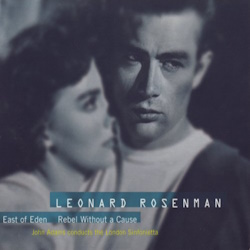 I would like to thank Tommy Krasker, Nonesuch Records and Warner Music for re-recording Rosenman’s long-sought score to East of Eden. The audio quality is good, and I commend the performance of the London Sinfonia Orchestra under the baton of John Adams. Regretfully, financing limited the scope of this compilation album, which includes the score to “Rebel Without a Cause”. Only nine tracks totaling 29 minutes of the score to “East of Eden” are offered, with fourteen compositions, including the Overture not included. Perhaps one day we will be blessed with a recording of the full score.
Although Rosenman is generally viewed as a modernist, avant-garde composer, this score also reveals his capacity for classic harmonies and melodic diatonic writing. The Main Theme, the heart of his score, emotes with the sensibilities of Aaron Copland, while maintaining Rosenman’s singular voice. Adam’s Theme speaks to Cal’s taciturn father, who has in grief walled off his heart, creating an impenetrable barrier that traps him, and to which Cal cannot breech. The construct of this theme is masterful in that it never achieves resolution, as Adam cannot come to terms with Kate’s abandonment of him and their sons. There is much discord, dissonance and anger, both overt, and festering in Rosenman’s soundscape, which speak to the pain found in each of the four family members; Adam, Kate, Aron and Cal. Also masterful is how the music descends diabolically into angry, and vengeful malevolence as Cal uses the rage born of his father’s rejection to fuel his purposeful destruction of both his brother and father. Yet from out this psychic carnage arises the transcendent finale when father and son are at last reconciled by the power of love. Folks, this was Rosenman’s inaugural score, which was widely praised and launched his career. His music is woven into the very sinews of this film’s narrative, fleshing out with drama, anger, and pathos the powerful emotions expressed in this compelling retelling of the biblical tale of Cain and Abel. I recommend this compilation album, however counsel that you take in the film to experience the fourteen tracks not included, and to behold the cinematic confluence of great music, storytelling, and acting performances.
For those of you unfamiliar with the score, I have embedded a YouTube link to the timeless Main Theme; https://www.youtube.com/watch?v=Bh7iF0BxuNo
Buy the East of Eden soundtrack from the Movie Music UK Store
Track Listing:
- Main Title (1:59)
- Cal & Sam (2:45)
- Cal Helps Father (3:54)
- Fog Scene (2:50)
- Cal’s Dance in the Fields (0:55)
- Ferris Wheel (1:21)
- Bedroom Window (3:51)
- Cal & Aron Visit Mother (3:33)
- Finale (5:06)
Nonesuch Records/Warner Music 79402-2 (1955/1997)
Running Time: 29 minutes 14 seconds
Music composed by Leonard Rosenman. Conducted by John Adams. Performed by The London Sinfonietta. Orchestrations by Leonard Rosenman. Recorded and mixed by John McClure. Score produced by Leonard Rosenman. Album produced by Tommy Krasker.
Leave a Reply

Shop at the Movie Music UK Store

Member of the


There is an early 90’s rerecording of the whole score on a two cd set combined with Rebel Without a Cause, conducted by William Motznig with the Czech Symphony Orchestra. Rosenman wrote the liner notes.