MAVERICK – Randy Newman
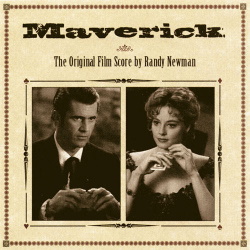 THROWBACK THIRTY
Original Review by Jonathan Broxton
1994’s Maverick was director Richard Donner’s attempt to bring the popular 1957 ABC TV show of the same name to the silver screen. That show starred James Garner as the eponymous Brett Maverick, a wise-cracking and charismatic poker player plying his trade on riverboats and in saloons across the American Wild West. The big-screen version of the story sees Maverick being played by Mel Gibson, who here is re-teaming with director Donner for the first time since Lethal Weapon 3 in 1992. In this story, Maverick finds himself needing to raise $25,000 to enter a high-stakes poker tournament on a riverboat; as he does so he repeatedly encounters the resourceful and sly con-artist Annabelle Bransford (Jodie Foster), while falling afoul of the stern lawman Marshal Zane Cooper (Garner). The film’s supporting cast features Graham Greene, James Coburn, and Alfred Molina, and has many cameo appearances by classic Western film actors and country music stars.
The film was a resounding success at the box office – it grossed more than $101 million at the domestic box office, and is among the top ten highest grossing Western films of all time – and was mostly liked by critics, who praised the witty comedy of William Goldman’s screenplay and the chemistry between Gibson and Foster, likening both to two of Goldman’s other classic buddy-comedy screenplays, Butch Cassidy and the Sundance Kid, and The Sting. It also went on to receive an Oscar nomination for Best Costume Design.
For the music, Donner turned to composer Randy Newman, who in the summer of 1994 was in the middle of a run of reasonably successful drama scores comprising titles like Avalon, Awakenings, and The Paper. Maverick was the last score Newman would write before becoming a Disney legend with his score for the first Toy Story movie in 1995, and in many ways it could be that it was the score which convinced Toy Story director John Lasseter to hire him for that film, as there a is great deal of crossover between the lively, knockabout, good-natured comedy western music Newman wrote for this film, and the music he eventually wrote for Woody.
 Ironically, Donner and Newman didn’t have an especially great working relationship on Maverick, and they often clashed about how ‘funny’ to make the music. Newman recalls that Donner asked him “what funny instruments there are” and that he kept wanting him to add more banjos. Newman says “I said some vulgarisms. A tuba isn’t that funny. You could stick a trumpet up your ass, which is what we ended up doing. No, I ended up on the stand in front of 100 people with three of the best trumpeters in the world – two anyway – having them go ‘nwak, nwak, nwak’ with a trombone going like that too because he wanted what he wanted. He might have been right because the movie was successful, and he’s been successful. He just wanted to make sure that the audience got the joke.”
To address the commercial song soundtrack first; it features several original songs written specially for the film, including “Renegades, Rebels and Rogues” written by Larry Boone, Earl Clark, and Paul Nelson for Tracy Lawrence, “A Good Run of Bad Luck” written by Clint Black and Hayden Nicholas and performed by Black, and “Something Already Gone” written by Al Anderson and Carlene Carter and performed by Carter, as well as a cover of composer David Buttolph’s theme for the original TV show performed by country music band Restless Heart. Most interesting for film music fans will be Newman’s own original song, “Ride Gambler Ride,” which was produced by none other than James Newton Howard. The song is performed with Newman’s usual character-led storytelling style, and it is awash in traditional country music arrangements ranging from fiddles to slide guitars and more; it you don’t break out into a grin when Newman exclaims “riiiyeeed!” then this is clearly not the song for you.
In terms of the score, what Newman ultimately wrote is a piece which combines the easy-going charm of Buttolph’s theme for the original TV series with an expansion on the classic cowboy music Newman wrote for Steve Martin’s cowboy routine in Parenthood in 1989, period honky-tonk Americana, and some unexpectedly impressive action music that sometimes sounds like a combination of Elmer Bernstein and Ennio Morricone.
The first half of the ”Opening” is actually a quite serious piece of dark drama, anchored by a tremendous lonely-sounding trumpet solo, off-kilter strings that recall the phrasing of Newman’s classic song “’Davy the Fat Boy,” and some imposing orchestral suspense music that encroaches into light horror territory, all of which subtly references the core elements of what will eventually become the film’s main theme. However, this is swiftly replaced by the first of several performances of the main Maverick theme, a light, jaunty Western caper melody which takes the tonal building blocks from Aaron Copland’s Rodeo, and filters them through Newman’s wry comedic sensibility to create a perfect musical representation of Gibson’s character.
The theme for Jodie Foster’s character “Annabelle” is awash in swooning strings, and is a loving homage to the romantic music that accompanied many ‘damsels in distress’ from classic Hollywood westerns – although, in this case, the distress is all an act, and Annabelle is just as cunning and conniving as Maverick is. Finally, the theme for James Garner’s character “Coop” has a sense of taciturn nobility, forthright strings and honorable brass, perfect for the depiction of a righteous lawman trying to keep the peace on the western frontier.
Interestingly, the score also regularly references one of the melodic flourishes from the “Ride Gambler Ride” song, in what appears to be a minor motif acknowledging Maverick’s love of gambling and pursuit of money. You first hear it as a little three-note motif underpinned by clip-clop strings at around 0:53 in “Money in the Bank,” and it also appears later in “In & Out of Trouble,” with an ethereal tone at the beginning of “Magic Cards, Maybe/Lucky Shirt,” and in “Coop Sails Away,” among many others.
However, despite all this unexpected thematic depth, it is still Maverick’s theme that dominates the score – there are prominent performances in the aforementioned “Money in the Bank,” throughout “In & Out of Trouble,” in the title cue “Maverick,” with cheerful panache in both “Trap” and “The Hanging,” and more. Thankfully, Newman varies its tone constantly – sometimes it is light and whimsical, a musical reflection of Mel Gibson’s laconic grin and easy charm, and sometimes it is bold and heroic, a true western anthem.
“Fight” is the first of the score’s primary action cues, and initially sees Newman arranging Maverick’s theme for guitars, but then sending it off running through a series of homages to classic western scores – a flash of The Magnificent Seven here, a snip of High Noon there, a quick burst of The Big Country over there. The orchestrations are rich and complicated – compliments to Don Davis and Jack Hayes – but some of the stylistic changes do come at you thick and fast, resulting in a sound which occasionally approaches mickey-mousey. Later action and suspense cues include “Sneakin’ Around,” the second half of “Trap,” the deadly serious “The Hanging,” and “Bret Escapes,” but the showstopper is clearly “Runaway Stage,” which takes both Maverick’s theme and the Gambler motif, wraps them around a whole host of classic Western orchestrations including guitars, honkytonk pianos, xylophones, and of course banjos, and sends them off on a raucous gallop across the prairie. Newman would revisit this style in the superb ‘Cowboy’ sequence on Toy Story 3 in 2010, and if you enjoyed that piece then know that this is in a similar vein.
Interesting one offs include the jaunty and jazzy “Headed for the Game” which has its roots in Newman’s score for Ragtime, the mock Russian music in “Joseph and the Russian,” the lovely romantic reprises of Annabelle’s theme in “Oh Bret” and “Annabelle Toodleoo,” and the stirring reprise of Coop’s theme in “Coop Sails Away,” which also at times threatens to break out into a sailor’s hornpipe. The whole thing ends with a second original Newman song, “Tartine de Merde,” a piano-driven Western parody with a title that translates to “Shit Pie,” and I’ll leave you to make of that what you will.
If you don’t buy in to Randy Newman’s idiosyncratic and wholly personal musical style, then Maverick is likely to be more of an annoyance than anything else, but as I have always found plenty to appreciate in Newman’s music – both songs and scores – I enjoy Maverick a lot. The main theme is an ear worm which gets a lot of mileage through different arrangements. The sub-themes are all good, especially the one which links the score with the original song “Ride Gambler Ride,” and the action music is at times seriously impressive, paying excellent homage to some of the classic Western scores of all time.
Buy the Maverick soundtrack from the Movie Music UK Store
Track Listing:
- Opening (5:37)
- Annabelle (2:28)
- Fight (2:06)
- Coop (0:41)
- Money in the Bank (1:06)
- In & Out of Trouble (1:26)
- Magic Cards, Maybe/Lucky Shirt (1:32)
- Headed for the Game (1:31)
- Runaway Stage (4:49)
- Sneakin’ Around (0:46)
- Maverick (0:55)
- Joseph and the Russian (1:08)
- Oh Bret (2:05)
- A Noble Aims (0:49)
- Trap (1:50)
- The Hanging (2:01)
- Bret Escapes (1:26)
- Bret’s Card/Sore Loser (1:27)
- Coop Sails Away (1:33)
- Annabelle Toodleoo (1:55)
- The Commodore (1:23)
- Pappy Shuffle (1:11)
- Bath House (0:40)
- Tartine de Merde (written and performed by Randy Newman) (1:33)
Reprise Records 9362-45816-2 (1994)
Running Time: 41 minutes 58 seconds
Music composed and conducted by Randy Newman. Orchestrations by Jack Hayes and Don Davis. Recorded and mixed by Frank Wolf. Edited by Christopher Brooks. Album produced by Randy Newman and Frank Wolf.
Leave a comment

Shop at the Movie Music UK Store

Member of the


One of my favorite Newman scores- the theme is catchy! I just wish the album didn’t sort of peter out at the end…if only there was an end title suite!