AN AMERICAN TAIL – James Horner, Barry Mann, Cynthia Weil
 THROWBACK THIRTY
Original Review by Jonathan Broxton
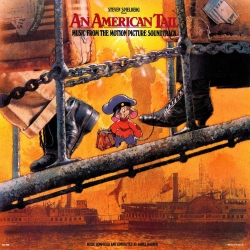
In the wake of the success of The Secret of NIMH in 1982, master animator Don Bluth began a collaboration with Steven Spielberg and Universal Pictures, who wanted to capitalize on NIMH’s popularity and produce their own animated film, the studio’s first since 1965. The result was An American Tail, the story of a family of Russian-Jewish mice who emigrate to the United States in the late 1800s, having been lured there on the promise of there being ‘no cats in America’. During their ocean crossing the family’s youngest son, Fievel Mousekewitz, is swept overboard and feared drowned; upon their arrival in New York, the remaining Mousekewitzes resign themselves to having lost their son, and sadly begin their new lives. However, Fievel has miraculously survived and makes his way to New York on his own, and the plucky young rodent embarks on a quest to reunite with his family, engaging in numerous adventures on the way. The film features the voices of Nehemiah Persoff, Erica Yohn, Dom DeLuise, Christopher Plummer, and the then-8-year-old Phillip Glasser as Fievel; it was a huge success at the box office, especially with children, who loved the film despite its dark tone.
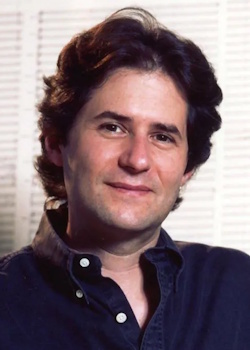
The score for An American Tail was by James Horner, and was the last of the five theatrical scores he wrote in 1986, after Off Beat, Aliens, Where the River Runs Black, and The Name of the Rose. Horner was still only 33 years old in 1986, but by this point in his career he was already proving his mastery with an orchestra, as well as developing the strong personal mannerisms and compositional hallmarks that would continue to show themselves in his music for the next 30 years. Unlike the other scores from this year, which were either experimentally electronic or dark and dissonant, An American Tail is a fully orchestral, theme-filled, lyrical delight, packed to the rafters with overflowing emotions, and making use of a rich instrumental palette that recalls the great Russian masters Tchaikovsky and Prokofiev. Despite it being a film about talking mice, Horner never pandered to his audience or undermined the film with comedy cartoon music; this is genuine, sophisticated stuff, and the film is all the better for Horner’s dedication to the task.
 Horner’s score is built around three main themes, all of which play constantly throughout the score, and which are all introduced in the stunning “Main Title.” The first theme is the Mousekewitz family theme, a noble and touching piece that represents the love they have for one another. It first appears as a solo violin lament (Papa Mousekewitz is a violin-maker by trade), underpinned by a tinkling balalaika and icy orchestral flourishes, before emerging into its first sweeping orchestral statement at 0:47. The second theme taps specifically into the relationship between Fievel and his sister Tanya, and is warm and heartfelt; its first performance at 1:15 is soft, with a cooing chorus. The final theme is the Russian theme, which begins at 1:52, has a playful, joyful quality inspired by Russian folk music, and captures the Mousekewitz’s family’s love for their homeland. It’s worth mentioning here just how wonderful the orchestrations are, by Horner and the late, great Greig McRitchie. Together they suffuse the London Symphony Orchestra with rich textures and moments of sublime beauty and sensitivity; feather-light woodwind runs, evocative accordions, rousing brass phrases, and so much more.
The action music in An American Tail is surprisingly dense and powerful, with two cues at the beginning of the score, “The Cossack Cats” and “The Storm,” standing out as highlights. “The Cossack Cats” again draws on Russian folk music for its inspiration, as well as a touch of Alexander Nevsky, and sees Horner infusing a series of vibrant, energetic orchestral passages with statements of the Russian theme, blaring trumpets, accordions, tambourines, and an overall style that recalls his work on the 1983 score Krull, as well as foreshadowing the style he would employ with great success on Willow in 1988. Meanwhile, “The Storm” is unexpectedly dark and oppressive, with lonely brass writing, rattling woodwinds, and cold, desolate choral textures redolent of the churning seas. The choral writing here reminds me especially of the Widow’s Web sequence from Krull, a deathly siren song, before it presents several emotional statements of the Mousekewitz family theme, as Papa and Mama realize they may have lost their little boy.
“Give Me Your Tired, Your Poor” has a very Cocoon-esque opening, full of warm oboes and vibrato strings, but which is soon replaced by a disconsolate statement of the Mousekewitz family theme for violin and balalaika. The second half of the cue, uniquely, is a hugely emotional choral setting of Emma Lazarus’s poem ‘The New Colossus’, which is engraved on the pedestal of the Statue of Liberty, and which drips with pathos and poignancy. This is followed by the pretty “The Market Place,” which presents the Russian theme on light, effervescent woodwinds and prancing strings, as well as introducing the score’s fourth theme – Tanya’s theme – at 1:40, a hopeful little melody for woodwinds and harp that long-time Horner fans will recognize as being the basis for the song “Dreams to Dream” from the second film, An American Tail: Fievel Goes West. It’s intended to act as a leitmotif for Tanya’s unbridled optimism and belief in the American Dream, and the fact that it even makes an appearance in this score is testament to how Horner always understood the emotional hook of his characters, even across multiple films, and even though they are immigrant mice.
“Releasing the Secret Weapon” is another lively and ebullient action sequence, as Gussie Mausheimer and the mice of New York City team up with Fievel and his friends to release the ‘Giant Mouse of Minsk’ and banish Warren T. Rat and the Mott Street Maulers once and for all. There are echoes of both Krull and Aliens in some of the brass writing and rhythmic pacing – think “Ride of the Fire Mares” and “Bishop’s Countdown” – offset by some unexpected stereotypical ethnic Chinese influences representing the destination that the Mott Street Maulers end up going to on the tramp steamer, as well as a lumbering march-like setting of the Russian theme full of rapid key changes and frenzied woodwind writing. Unfortunately, the mouse celebration is interrupted by “The Great Fire,” a cue full of darkness and tension, oppressive chord progressions, harsh brasses, and a gloomy setting of the Mousekewitz family theme.
“Reunited” underpins the film’s hugely emotional finale; it opens with a beautiful duet for woodwinds and harp, before moving gradually through sequential statements of Tanya’s theme, the Brother/Sister theme, the Mousekewitz family theme, and the Russian theme, accompanied by balalaikas, chattering flutes, tolling bells, and an increasingly doom-laden choir. Eventually, hesitantly, hope begins to emerge, until finally the Mousekewitz family theme explodes with a huge swell of emotion as Fievel and his Papa finally find each other. A brief statement of the Brother/Sister theme recognize Fievel and Tanya, prior to the warm, welcoming statement of the Russian theme as the family embrace each other in the New World for the first time. The conclusive “Flying Away and End Credits” is joyful and celebratory, with a sense of freedom and openness conveyed by leaping strings and vibrant woodwind passages. There are repeated statements of the Russian theme, the Brother/Sister theme, and the Mousekewitz family theme, all surrounded by beautiful choral textures, tolling bells, accordions and balalaikas. The statements of the Mousekewitz family theme are especially exquisite, reaching a searing high note at 3:11, and presenting a gorgeous violin and balalaika duet to finish.
Interestingly, An American Tail also gave Horner the chance to write a number of original songs, something he had never done before; as such, he collaborated with the legendary songwriting team Barry Mann and Cynthia Weil, who had penned hits for everyone from Elvis Presley to The Monkees, The Righteous Brothers, Mama Cass, and Dolly Parton. Three of the songs – “There Are No Cats In America,” “Never Say Never,” and “A Duo” – are light and comedic, and actually stand at odds with the overall seriousness of Horner’s score. “There Are No Cats In America” is a witty game of one-upmanship as ethnic mice lament their tragic encounters with various cats around the world. “Never Say Never” is an inspirational pep talk performed by Christopher Plummer in character as a French pigeon, while the quite silly “A Duo” sees Dom DeLuise having great fun as a vegetarian cat who prefers the company of mice to his own kind.
However, by far the most famous song is “Somewhere Out There,” which in the context of the film is a heart-breaking duet sung by child actors Phillip Glasser and Betsy Cathcart as Fievel and Tanya, both of whom are gazing up at the moon on opposite sides of the city, and wishing they could be reunited. Neither Glasser nor Cathcart can hold a note, but their childish earnestness is hopelessly endearing, although some may find the whole thing unbearably cute and cloying. Interestingly, the melody of the song is a combination of the final few notes of the melodic line of the Russian Theme with the main melody of the Brother/Sister theme, surrounded by the warm, hooting oboe textures from his score for Cocoon. The pop single version of the song, produced by Peter Asher and performed by Linda Ronstadt and James Ingram, was an enormous commercial hit over the early months of 1987, hitting #2 in the Billboard Hot 100 in March, and becoming a top 10 hit in Canada, Sweden, and the United Kingdom. The song was also a critical success, winning Song of the Year and Best Song Written Specifically for a Motion Picture or Television at the 30th Grammy Awards, and earning nominations for Best Original Song at both the Golden Globe Awards and the Oscars.
Despite the superficial childishness of the film it accompanies, do not be fooled into thinking that the score for An American Tail is somehow a lighter, lesser work. This score represents James Horner at his 1980s best, writing music that drips with emotion, embraces rich orchestrations, and engages in intelligent interplay between three or four memorable recurring themes. Add to this some unexpectedly dense and vibrant action music that will appeal to fans of Krull and Willow, and a handful of decent songs, and An American Tail is a winner all the way. The album, on MCA Records, is still available for decent prices; as such, there is no reason to overlook this gem of a score.
Buy the An American Tail soundtrack from the Movie Music UK Store
Track Listing:
- Main Title (5:07)
- The Cossack Cats (2:15)
- There Are No Cats In America (written by James Horner, Barry Mann and Cynthia Weil, performed by Nehemiah Persoff, John Guarnieri and Warren Hays) (3:00)
- The Storm (3:59)
- Give Me Your Tired, Your Poor (2:44)
- Never Say Never (written by James Horner, Barry Mann and Cynthia Weil, performed by Christopher Plummer and Phillip Glasser) (2:25)
- The Market Place (3:02)
- Somewhere Out There (written by James Horner, Barry Mann and Cynthia Weil, performed by Phillip Glasser and Betsy Cathcart) (2:41)
- Somewhere Out There (written by James Horner, Barry Mann and Cynthia Weil, performed by Linda Ronstadt and James Ingram) (3:58)
- Releasing the Secret Weapon (3:38)
- A Duo (written by James Horner, Barry Mann and Cynthia Weil, performed by Dom DeLuise and Phillip Glasser) (2:38)
- The Great Fire (2:54)
- Reunited (4:44)
- Flying Away and End Credits (6:01)
Running Time: 49 minutes 47 seconds
MCA Records MCAD-39096 (1986)
Music composed and conducted by James Horner. Performed by The London Symphony Orchestra and the Choir of King’s College. Orchestrations by Greig McRitchie. Recorded and mixed by Eric Tomlinson. Edited by Michael Clifford. Album produced by James Horner.

Shop at the Movie Music UK Store

Member of the


