THE CLANDESTINE MARRIAGE – Stanislas Syrewicz
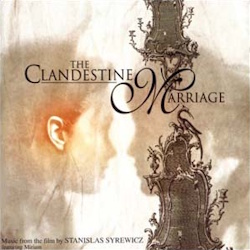 Original Review by Jonathan Broxton
A renaissance-era comedy brought deftly to life by director Christopher Miles and screenwriter Trevor Bentham, The Clandestine Marriage stars Nigel Hawthorne, Timothy Spall, familiar TV faces Natasha Little, Paul Nicholls and Emma Chambers, and, marking her return to the silver screen after a lengthy absence, that last bastion of shoulder pads and big hair, Joan Collins. It is a comedy of errors about two families – the Stirlings, who have buckets of money but no “class”, and the Oglebys, who have breeding in spades but no cash to match. In desperation, the two families strike up a deal to solve both their monetary and social problems – but have to gain agreement from an unlikely source. Unfortunately, at the time of writing, The Clandestine Marriage has still not been released in the UK, so I cannot effectively comment on the film itself. What I can comment on, however, it the surprisingly attractive and enjoyable score by Stanislas Syrewicz.
Stanislas Syrewicz is yet another member of the Polish film scoring fraternity, albeit the least well-known member of the club that currently comprises Zbigniew Preisner, Wojciech Kilar and Jan Kaczmarek. His career to date has been accomplished but somewhat undistinguished – songwriting in his native country, work for theatre and television, and scores for films such as Lair of the White Worm, Stalin, True Blue and Shooting Fish. He won a major music prize in the UK for his work on the TV series “The Choir”, and has also worked with artists such as Marianne Faithfull.
 Syrewicz’s music for The Clandestine Marriage is a three-way combination of contemporary orchestral romance, classical pastiche, and some peculiar but rather amusing music and dialogue tracks featuring Nigel Hawthorne incoherently babbling away to himself, and even humming along to the music. Although these tracks (‘Grand Canal’, ‘Rustic Dance’ and the 6-minute ‘Pageant’) add absolutely nothing to the album in terms of musical excellence, it’s an intriguing and rather clever use of sampling, and although I continually berate the inclusion of dialogue tracks on film score CDs, I have to admit that these made me laugh.
A haunting, Celtic-style string and voice combination ushers in the opening track, ‘Clandestine Marriage’, before the first performance of the main melody is allowed to swell grandly and proudly, marking one of the score’s best moments. The theme is recapitulated in several further cues, notably as a tender but brief harp solo in ‘Love Minuet’, as a heartbreaking viola performance in ‘Love Hurts’, and with superb orchestral balance and classical guitar in ‘Secret Revealed’.
Mock baroque dances and classical scherzos appear during cues such as ‘Time Flies’, ‘Promenade’, ‘Courtship Baroque’, ‘Happily Married’ and ‘Dance Gavotte’, and here the music takes on a strong resemblance to that of George Fenton and Patrick Doyle. It’s innocent, effortless, beautifully orchestrated for harpsichord and other period instruments, and is incredibly expressive, conjuring a feeling of time and place, but not so much as to be alienating to a contemporary audience. This is a gift that Syrewicz shares with Doyle and Fenton – their respective music is directly drawn from the classical repertoire and sounds authentic, but whereas the Handels and Haydns concentrated on music for music’s sake, today’s composers increase the emotional kick in their scores, and thus generate a bigger reaction from the listener. This is also one of the reasons why I would rather listen to a modern film score than Handel or Haydn any day of the week.
Rouding off the score is ‘Secret’, a song which is heard twice on the album. ‘Secret’ is surprisingly lovely – a lush, longing ballad with beautiful vocals by Miriam, and a gorgeous, sweeping orchestral accompaniment arranged by Syrewicz, co-writer Julia Taylor-Stanley and Ian Lynn. Overall, The Clandestine Marriage is a highly agreeable selection of film music, and one which will likely satisfy those with a special affinity for pseudo-classical scores. The album runs for a decent length and the liner notes are excellent, featuring as they do a note from Bentham, a biography of Syrewicz, and some clever sepia photos of the cast. There is just one thing that bothers me… what on earth is that pear doing on the back cover?
Track Listing:
- Clandestine Marriage (2:01)
- Time Flies (1:34)
- Love Minuet (1:14)
- Love Hurts (2:32)
- Promenade (1:26)
- Secret Revealed (2:33)
- Courtship Baroque (1:27)
- Grand Canal (2:41)
- Dance Gavotte (2:16)
- Secret (written by Stanislas Syrewicz, Julia Taylor-Stanley and Trevor Bentham, performed by Miriam) (3:53)
- Happily Married (1:44)
- Rustic Dance (1:39)
- Dead of Night (2:07)
- Pursuit of Love (1:36)
- Love Theme 1 (2:55)
- Pageant (6:15)
- Love Theme 2 (0:23)
- Secret (End Title) (written by Stanislas Syrewicz, Julia Taylor-Stanley and Trevor Bentham, performed by Miriam) (3:28)
Running Time: 42 minutes 04 seconds
Virgin CDVE-949 (1999)
Music composed by Stanislas Syrewicz. Conducted by Nic Raine. Performed by The Academy of St. Martin in the Fields. Orchestrated by Nic Raine. Recorded and mixed by Mike Ross-Trevor. Edited by Jonathan Cooke. Album produced by Stanislas Syrewicz.

Shop at the Movie Music UK Store

Member of the


