Archive
THE ACCIDENTAL TOURIST – John Williams
 THROWBACK THIRTY
Original Review by Jonathan Broxton
The Accidental Tourist is a romantic drama film directed by Lawrence Kasdan, adapted from the acclaimed novel by Anne Tyler. It stars William Hurt as Macon Leary, an introverted travel writer whose relationship with his wife Sarah (Kathleen Turner) begins to break down after the death of their son. Sarah eventually leaves him and moves out, pending a divorce, and when Macon breaks his leg after tripping over his disobedient dog and falling down the stairs, he moves back into his childhood home with his eccentric siblings to recuperate. After a while, Macon hires the quirky Muriel Pritchett (Geena Davis) as a dog obedience trainer; despite the enormous differences in their personalities, a spark of attraction develops between the two, and they begin a relationship. However, Macon’s new life is thrown into turmoil when Sarah returns, wanting to re-kindle their marriage, forcing Macon to make some difficult decisions. The film was an enormous critical success, earning Academy Award nominations for Best Picture and Best Adapted Screenplay, and winning Geena Davis an Oscar for Best Supporting Actress. Read more…
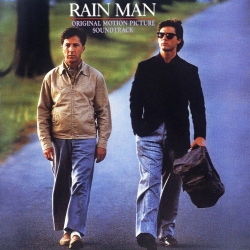
RAIN MAN – Hans Zimmer
 THROWBACK THIRTY
Original Review by Jonathan Broxton
There is a great serendipity in how Hans Zimmer became the film music megastar he is. Back in 1985 Zimmer co-scored the film My Beautiful Launderette with his mentor, Stanley Myers, when he was still a fresh-faced youngster working in London. That film was produced by Sarah Radclyffe, the co-founder of Working Title Pictures, who in 1988 produced A World Apart, the directorial debut feature of acclaimed cinematographer Chris Menges. That film was the first significant solo project of Zimmer’s career, and it just so happens that the film was seen by Diana Rhodes, the wife of director Barry Levinson, just as Levinson was working on his latest film, Rain Man. Rhodes recommended Zimmer to Levinson, and Zimmer received what he now refers to as ‘the call,’ which secured him the job, took him to Los Angeles, and utterly changed his life. Read more…
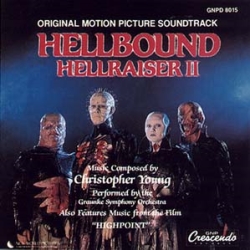
HELLBOUND: HELLRAISER II – Christopher Young
 THROWBACK THIRTY
GREATEST SCORES OF THE TWENTIETH CENTURY
Original Review by Jonathan Broxton
The 1987 film Hellraiser, based on the novella The Hellbound Heart by British horror author Clive Barker, was an unexpected critical and commercial success at the box office, and as such an immediate sequel was commissioned to cash in on the new popularity of Pinhead and his merry band of ‘cenobite’ demons, who live in a realm of hell where pleasure, pain, and suffering are one. The resulting film, titled Hellbound: Hellraiser II, takes place in the immediate aftermath of the first film, and finds protagonist Kirsty (Ashley Laurence) – having escaped from Pinhead (Doug Bradley) – recovering in a mental institution under the care of Dr Channard (Kenneth Cranham). However, it is revealed that Channard is secretly obsessed with cenobites, and has been searching for the ‘lament configuration’ puzzle box that summons them for years. Despite Kirsty’s desperate pleas, Channard recovers the bloody mattress that Kirsty’s stepmother Julia (Clare Higgins) died on in the last film, and uses it to resurrect her; so begins a gruesome, desperate game, as Channard and Julia explore the realms of hell together, while Kirsty tries to stop the cenobites once and for all. The film was written by Peter Atkins and is directed by journeyman Tony Randel, taking over duties from Barker. Read more…
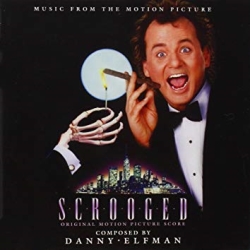
SCROOGED – Danny Elfman
 THROWBACK THIRTY
Original Review by Jonathan Broxton
There have been so many different cinematic versions and variations on Charles Dickens’s A Christmas Carol over the years, its amazing that people keep coming up with ways to make them new and fresh. In the winter of 1988, however, director Richard Donner and screenwriters Mitch Glazer and Michael O’Donoghue did just that with Scrooged, which re-imagined the story as a comedic tale of redemption set in the world of network television. Bill Murray plays Frank Cross, a morality-free and highly cynical TV studio executive who takes perverse delight in designing increasingly tasteless programming while tormenting his employees. After one particularly heartless episode when he forbids his secretary from leaving work on Christmas Eve to take care of her sick son, Frank is visited by a series of ghosts, each of whom show him the error of his ways, teach him to be a better person, and allow him to feel the true spirit of Christmas. The film co-stars Karen Allen, John Forsyth, Carol Kane, Robert Mitchum, and Bobcat Goldthwaite, and has since gone on to be considered a seasonal classic which was somewhat ahead of its time. Read more…
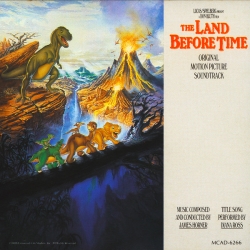
THE LAND BEFORE TIME – James Horner
 THROWBACK THIRTY
GREATEST SCORES OF THE TWENTIETH CENTURY
Original Review by Jonathan Broxton
The Land Before Time is an animated feature film for children, directed by Don Bluth and produced by Steven Spielberg and George Lucas. It’s set in the late cretaceous period, and follows the adventures of a group of orphaned dinosaurs searching for a fabled oasis where there is food, water, and safety. The main character is Littlefoot, a young Apatosaurus, who along with his friends – each of whom is a different species, such as a triceratops or a pteranodon – find themselves having to escape from numerous dangers, not least of which is a deadly ‘sharptooth’ Tyrannosaurus Rex that is hunting them. The film was incredibly popular at the time, and it works on multiple levels. Firstly, it is a fun story for children, with playful characters and a friendly cartoonish animation style. However, it also has some deeper meaning, addressing issues of racism (some of the adult dinosaurs are prejudiced against different species), climate change (the dinosaurs don’t know it, but they are living through a famine that heralds the beginning of their extinction event), friendship, and family. There is also some surprisingly dark material too, including some quite intense and frightening sequences involving the Tyrannosaurus, as well as character deaths which left real emotional scars on an entire generation of kids. Amazingly, the film spawned an incredible thirteen direct-to-video sequels and even a TV series, although none of them reached the level of acclaim the original had. Read more…
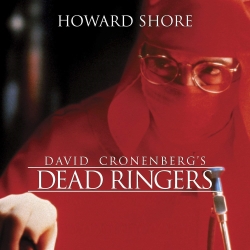
DEAD RINGERS – Howard Shore
 THROWBACK THIRTY
Original Review by Jonathan Broxton
As a follow-up to the massively successful and popular The Fly, Canadian director David Cronenberg chose Dead Ringers, adapted from the novel ‘Twins’ by Bari Wood and Jack Geasland, to be his next film. The film stars Jeremy Irons playing a duel role as Elliot and Beverly Mantle, identical twin brothers, both gynecologists, who run a successful medical practice in Toronto. The more charming and confident Elliot seduces women who come to him for fertility treatment, and ‘shares’ them with the more shy and introverted Beverly, without the women realizing that they are sleeping with two different men. Things change when a new patient, actress Claire Niveau (Geneviève Bujold), comes to their clinic. Claire is extremely sexually liberated, but is also addicted to prescription drugs; despite this, Beverly falls in love with her, and is shattered when she finds out about their duplicity and breaks off the relationship. Before long, Beverly’s world is crumbling in a mass of drug abuse, paranoid delusions, and horrific visions of mutated female genitalia – which causes Elliot to take drastic action to save him. Read more…
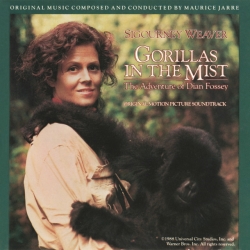
GORILLAS IN THE MIST – Maurice Jarre
 THROWBACK THIRTY
Original Review by Jonathan Broxton
Dian Fossey was a conservationist and animal expert whose special focus was to study and protect African mountain gorillas. Having been inspired by another famous anthropologist, Louis Leakey, Fossey left her job in San Francisco and relocated to the remote jungles of Congo and Rwanda, where she established a research center in order to study these endangered creatures. As the years passed Fossey made several important breakthroughs and became world famous for her work, but also made many enemies, including poachers who hunted for gorilla artifacts, and members of the Rwandan government who opposed her increasingly violent responses to the poaching. Eventually, after more than twenty years working in Africa, Fossey was found dead in her cabin, apparently having been murdered; her assailants still have never been positively identified or tried. The film Gorillas in the Mist tells the true story of Fossey’s life and death; it stars Sigourney Weaver in the lead role, features Bryan Brown and Julie Harris in supporting roles, and is directed by Michael Apted. Read more…
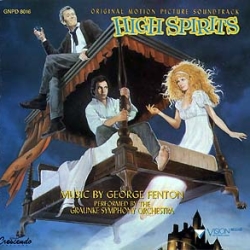
HIGH SPIRITS – George Fenton
 THROWBACK THIRTY
Original Review by Jonathan Broxton
There are some movies where, when you see their plot summary written down, you wonder how they ever got made. One of those is the 1988 movie High Spirits, a bizarre comedy-adventure-romance about Irish ghosts. The film stars Peter O’Toole as Plunkett, the owner of a dilapidated castle in Ireland who comes up with a money-making scheme whereby he will convert the castle into a hotel, pretend that it is ‘the most haunted castle in Europe,’ and sell the idea to gullible American tourists. The scam is a success and the first group of unsuspecting vacationers – Steve Guttenberg, Beverly d’Angelo, Peter Gallagher, Jennifer Tilly – arrives, beguiled by the tales of Gaelic ghosties. However, to everyone’s utter shock, two real ghosts (played by Liam Neeson and Daryl Hannah) actually appear, and start becoming romantically attracted to two of the holidaymakers. The film was written and directed by Neil Jordan, the man behind such serious works as The Company of Wolves and Mona Lisa, and who would later go on to direct The Crying Game, Interview With the Vampire, and Michael Collins. Read more…
MAGDALENE – Cliff Eidelman
 THROWBACK THIRTY
Original Review by Jonathan Broxton
Do you remember what you were doing when you were 24? Maybe you were just starting out at your first proper job, maybe you just got your first apartment, maybe you were embarking on your first relationship. Maybe you were even still at university, dreaming of what your future life might bring once you leave academia and head out into the big wide world. Whatever you were doing, I’m pretty sure you weren’t doing what Cliff Eidelman was doing when he was 24 – which was conducting 120 musicians of the Munich Symphony Orchestra for his debut film score, Magdalene. To say that Eidelman’s rise was meteoric is an enormous understatement; just a year prior to scoring Magdalene he was still a student at the University of Southern California, but this all changed when German film director Monica Teuber somehow heard a performance recording of a ballet score Eidelman had written on commission for Santa Monica City College. On the strength of that music alone Teuber hired Eidelman to score her film; after it came out the score was so well received that it immediately led to other assignments, and within three years he was scoring major studio blockbusters like Star Trek VI: The Undiscovered Country – and a career was born. Read more…
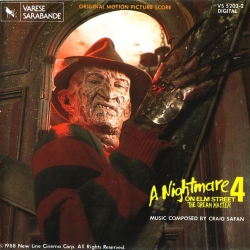
A NIGHTMARE ON ELM STREET 4: THE DREAM MASTER – Craig Safan
 THROWBACK THIRTY
Original Review by Jonathan Broxton
The fourth movie in the massively successful Nightmare on Elm Street horror franchise was A Nightmare on Elm Street 4: The Dream Master; it’s a direct continuation of the story from 1987’s Nightmare on Elm Street 3, in which the survivors of that film have been released from the psychiatric hospital, but still find themselves being stalked by the horribly disfigured child killer Freddy Krueger, who has the ability to murder people in their dreams. The film stars Lisa Wilcox, Danny Hassel, Tuesday Knight, and Robert Englund in his iconic role as Krueger, and was directed by Renny Harlin, who was helming his first major studio feature film following the success of his 1987 English-language debut, the low-budget horror movie Prison. The film was actually one of the best reviewed films of the series, with special praise being given to the surprisingly insightful screenplay by Brian Helgeland, and especially the special effects and design; the critic in the Los Angeles Times wrote at the time that the film was ‘by far the best of the series, a superior horror picture that balances wit and gore with imagination and intelligence’. Read more…
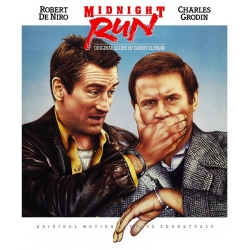
MIDNIGHT RUN – Danny Elfman
 THROWBACK THIRTY
Original Review by Jonathan Broxton
Midnight Run was one of the best buddy action comedies of the 1980s, and was one of the first films to showcase the hitherto untapped comedy potential of the great dramatic actor Robert De Niro. De Niro plays Jack Walsh, a bounty hunter working for bail bondsman Eddie Moscone (Joe Pantoliano), who is hired to find mob accountant Jonathan Mardukas (Charles Grodin) in New York and bring him back to Los Angeles; Mardukas had embezzled $15 million from Chicago mob boss Jimmy Serrano (Dennis Farina) before skipping on the bail Moscone had posted for him. What initially appears to be an easy task – Mardukas is annoying but generally compliant – quickly turns into a nightmare when Serrano’s henchmen, FBI agent Alonso Mosley (Yaphet Kotto), and rival bounty hunter Marvin Dorfler (John Ashton) all converge on Walsh, wanting Mardukas for themselves. Thinking on his feet, Walsh finds himself taking Mardukas on an epic road trip, trying to stay one step ahead of his pursuers, while keeping ‘The Duke’ under control. The film was written by George Gallo and directed by Martin Brest, and was a critical and commercial success, with special praise being given to the chemistry between De Niro and Grodin. Read more…
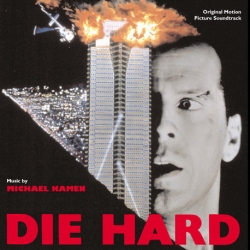
DIE HARD – Michael Kamen
 THROWBACK THIRTY
Original Review by Jonathan Broxton
Die Hard is one of the most iconic, enduring, and ground-breaking action films ever made; it made an action star of former TV leading man Bruce Willis, launched the cinematic career of the late great Alan Rickman, and set the high benchmark for all the action movies that would follow it. The film is directed by John McTiernan and written by Steven de Souza and Jeb Stuart, based on the novel ‘Nothing Lasts Forever’ by Roderick Thorp. Willis plays John McClane, a New York cop who has travelled to Los Angeles for his Christmas vacation, where he intends to try to reconcile with his estranged wife Holly (Bonnie Bedelia). He arrives at his wife’s office skyscraper building, Nakatomi Plaza, where a Christmas party is underway. The party is disrupted by the arrival of a German terrorist group led by the suave but ruthless Hans Gruber (Rickman), which takes all the party-goers hostage – except for McClane, who escapes undetected onto a different floor. After Gruber brutally executes the company CEO, McClane becomes involved in a game of cat-and-mouse with the terrorists, picking them off one by one in an attempt to rescue the hostages. The film co-stars Alexander Godunov, Reginald Veljohnson, and Hart Bochner, and remains to this day one of my all-time favorite action movies. Read more…
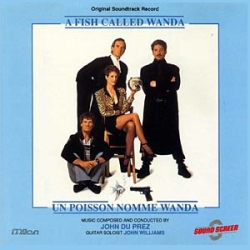
A FISH CALLED WANDA – John Du Prez
 THROWBACK THIRTY
Original Review by Jonathan Broxton
A Fish Called Wanda is one of the best comedies of the 1980s – one part romance, one part crime caper, one part English farce – which teams several members of the classic Monty Python comedy troupe with several popular American stars. Jamie Lee Curtis and Kevin Kline play Wanda and Otto, American jewel thieves in London who, along with stuttering getaway driver Ken (Michael Palin) and East End gangster George (Tom Georgeson), plan an elaborate diamond heist. However, in-fighting and double-crossing within the gang leads to George being arrested, which proves to be a problem for everyone else as he is the only one who knows where the loot has been stashed. In order to get information about the location of the diamonds, Wanda decides to seduce George’s barrister, Archie Leach (the irrepressible John Cleese), a repressed middle-class Englishman stuck in a loveless marriage. Archie, flattered by the attention, immediately falls for Wanda, but shockingly Wanda also finds herself genuinely attracted in return – which causes more friction within the gang, not least because Otto and Wanda are also secretly lovers themselves. Read more…
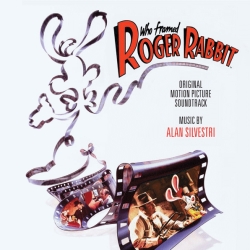
WHO FRAMED ROGER RABBIT – Alan Silvestri
 THROWBACK THIRTY
Original Review by Jonathan Broxton
When cinematic scholars make lists of truly groundbreaking films, very few of them ever mention Who Framed Roger Rabbit, but in my opinion they absolutely should. It’s an anarchic action-comedy-murder mystery directed by Robert Zemeckis, adapted from a novel by Gary K. Wolf. Set in Los Angeles in the 1940s, the film stars Bob Hoskins as Eddie Valiant, a down-on-his-luck private detective who is hired by the head of a movie studio to investigate the wife of one of its box office stars; there are rumors that she is having an affair, and the studio feels that the scuttlebutt is affecting their star’s performances. But here’s the catch: the star in question is a cartoon rabbit named Roger, and this version of Los Angeles is an alternate universe where all the classic animated characters from Disney and Warner Brothers’ Looney Tunes live side-by-side with humans. As the plot progresses Eddie and Roger team up when Roger is accused of murder; as Eddie tries to exonerate the bothersome bunny he crosses paths not only with Roger’s sensationally seductive wife Jessica, but a creepy law enforcement officer named Judge Doom, who has a pathological hatred of cartoons, and wants Roger to pay the ultimate price for his alleged crime. The film co-stars Christopher Lloyd and Joanna Cassidy, as well as the voices of Charles Fleischer and Kathleen Turner. Read more…
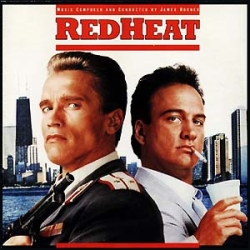
RED HEAT – James Horner
 THROWBACK THIRTY
Original Review by Jonathan Broxton
The action comedy buddy-cop movie reached new heights in the summer of 1988 with the release of Red Heat, which was a vehicle for the increasing box office power of action star Arnold Schwarzenegger. In this film directed by Walter Hill, Schwarzenegger plays Ivan Danko, a captain in the Moscow police, whose partner is killed by drug dealer and crime boss Rostavili (Ed O’Ross). Rostavili flees to the United States and disappears into the Chicago underworld; he is arrested by local cop Art Ridzik (Jim Belushi) in connection with several murders, and Danko arrives from Moscow to oversee his extradition back to the Soviet Union. However, when Rostavili escapes again, Danko and Ridzik are paired with each other as partners and tasked with catching him again and bringing him to justice. In addition to the usual fight scenes where Schwarzenegger was able to show off his impressive physique, Red Heat was interesting because of its Cold War overtones. In 1988 the Berlin Wall was still up, the Soviet Union was still a world superpower, and the idea of pairing a traditional wise-cracking donut-munching beat cop with a stoic, by-the-book Soviet detective allowed the filmmakers to use them as a microcosm to explore the political tensions of the era, as well as to inject some fish-out-of-water social commentary as Danko observes and criticizes American consumerism and decadence from a communist point of view. Read more…

Shop at the Movie Music UK Store

Member of the


