Archive
MEMOIRS OF A GEISHA – John Williams
 Original Review by Jonathan Broxton
One of 2005’s most prestigious film projects, Memoirs of a Geisha is a lavish cinematic version of Arthur Golden’s popular novel of the same name. Originally slated to be directed by Steven Spielberg, the film was eventually taken over by Chicago director Rob Marshall, but not before Spielberg had secured the services of his long-time collaborator John Williams to write the film’s score. As regular readers of this site will know, scores which combine oriental sensibilities with western orchestras often receive high ratings and glowing plaudits. Unsurprisingly, Memoirs of a Geisha is not going to buck that trend. Read more…
PRIDE & PREJUDICE – Dario Marianelli
 Original Review by Jonathan Broxton
Jane Austen wrote her timeless classic of love and longing Pride & Prejudice in 1813, and in doing so introduced to the world what would in time become a classic of English literature. Austen’s story has been adapted for both the big and small screen on several occasions, arguably the most popular and acclaimed being the 1995 BBC mini-series starring Colin Firth and Jennifer Ehle, with music by Carl Davis. This new version directed by Joe Wright stars Keira Knightly as the ‘quick minded, sharp witted’ Elizabeth Bennet, who in order to keep her family home secure and provide a future for her mother and sisters, is betrothed to the wealthy but passionless Mr. Bingley (Simon Woods). However, just as her family’s fortunes look as they are finally going to take a turn for the better, Elizabeth unexpected finds herself falling for the dour, taciturn Mr. Darcy (Matthew MacFadyen), with whom she clashes both on a number of occasions… The film features an exceptional supporting cast, boasting the likes of Judi Dench, Donald Sutherland and Brenda Blethyn, makes wonderful use of English locations (such as Chatsworth House in Derbyshire), and looks set to become one of the year’s most critically acclaimed motion pictures. Read more…
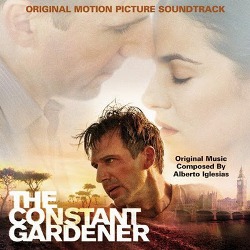
THE CONSTANT GARDENER – Alberto Iglesias
 Original Review by Jonathan Broxton
A taut political thriller from the pen of John Le Carré, about the pharmaceutical industry and human rights violations in central Africa, The Constant Gardener is the latest film from acclaimed Brazilian director Fernando Meirelles. Ralph Fiennes stars as Justin Quayle, a soft-spoken British diplomat in Kenya, who learns that his young wife, Tessa (Rachel Weisz), has been killed while traveling in a jeep along a lonely stretch of highway. The official cause of death is a ‘bandit raid’, but Justin suspects a cover-up. As he delves deeper into his wife’s past, he discovers some disturbing truths about her life as a human rights activist, and the work of a shady drug company who are testing a new vaccine for tuberculosis amongst the local population. The film, which also stars Danny Huston, Bill Nighy, Pete Postlethwaite, Gerard McSorley and Hubert Koundé, has been generally lauded by film critics, and looks to be a major player at awards ceremonies in the near future. Read more…
LEMONY SNICKET’S A SERIES OF UNFORTUNATE EVENTS – Thomas Newman
 Original Review by Jonathan Broxton
In what can almost be seen as an extension of the playfulness he showed in writing Finding Nemo in 2003, Thomas Newman has written the score for Lemony Snicket’s A Series of Unfortunate Events, the first big-screen adaptation of the popular children’s stores by author Daniel Handler. Essentially a distillation of three of the Lemony Snicket books – The Bad Beginning”, “The Reptile Room”, and “The Wide Window” – director Brad Silberling’s film stars child actors Emily Browning and Liam Aiken as the Baudelaire children, made orphans in a mysterious fire and sent to live with their thespian uncle, Count Olaf (Jim Carrey). What results are – as the title suggests – a series of unfortunate events as Olaf hatches plot after plot to bump off the children and get his hands on their inheritance. With a supporting cast that includes Meryl Streep, Billy Connolly and Timothy Spall, Lemony Snicket looks set to rival Harry Potter in the coming years as the “literary franchise for children” – especially with another ten stories from which to choose future film storylines. Read more…
THE VILLAGE – James Newton Howard
 Original Review by Jonathan Broxton
With the exception of The Sixth Sense, which was brilliant on all fronts, I have never been that fond of M. Night Shyamalan’s slow-moving thrillers, or of the scores his regular composer James Newton Howard wrote for them. Unbreakable was sub-par, and Signs was a fairly good film but I was one of the few who did not connect with the score. Shyamalan’s fourth and latest film is The Village, a mysterious tale set in Covington, a hamlet in 19th century Pennsylvania. Creatures dwell in the woods near the village, and an unspoken truce has existed between the humans and the creatures for decades – essentially, we won’t disturb you, if you don’t disturb us. However, things change for the worse when young Lucius Hunt (Joaquin Phoenix) ventures beyond the boundaries and into the domain of ‘Those We Don’t Speak Of’ and incites their wrath. With a cast that includes Sigourney Weaver, William Hurt and Adrien Brody, the film has the right credentials to be a success, while the score is a rarity in that, already, it is by far the best for a Shyamalan film to date. Read more…
THE PASSION OF THE CHRIST – John Debney
 Original Review by Jonathan Broxton
The furore surrounding Mel Gibson’s The Passion of the Christ began almost before a shot was filmed, and continued unabated through principal photography, post-production, and the publicity process. In a nutshell, the crux of the matter was that several prominent Jewish groups accused the cast and crew, and especially Gibson, of intentionally inciting anti-Semitic feelings by portraying the Pharisees of the Jewish Temple in old Jerusalem as the ones who were ultimately responsible for causing the death of Christ (something made worse following some rather off the wall comments from Gibson’s father). As this is a soundtrack review, I’m not going to go into a great deal of detail as to why this film has become one of the most controversial in recent memory, but I do want to say this in regard to my own faith, and my view of the film: Read more…
THE LORD OF THE RINGS: THE RETURN OF THE KING – Howard Shore
 Original Review by Jonathan Broxton
And so, five years after his journey began, Howard Shore’s travels through the musical word of Middle Earth and the spectacular Lord of Rings trilogy comes to an end with The Return of the King, the final installment of Peter Jackson’s groundbreaking adaptation of the classic fantasy novel by J.R.R. Tolkein. To say that Shore has come a long way is understatement indeed. Before Lord of the Rings, Howard Shore was “the David Cronenberg guy” who specialized in dark, tortured scores for dark tortured movies. Now, he is the undisputed king of the epic adventure, with the potential to become the benchmark by which all future sword-and-sorcery scores are measured. Before Lord of the Rings, Howard Shore was a well-respected, but largely unheralded member of the film music world. Now, he is a household name, with an Oscar on his mantle, who sells out concert halls worldwide. It’s been one massive ride for the quiet, unassuming Canadian – and with the strength of this final score, his stock can only rise. Read more…
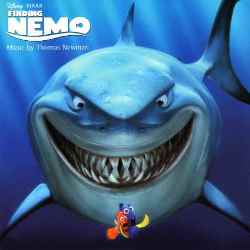
FINDING NEMO – Thomas Newman
 Original Review by Jonathan Broxton
The last person you would expect to score a Disney family movie would be Thomas Newman; the last person you would expect to score a Pixar movie would be Thomas Newman, especially when the monopoly on these has hitherto been held by his cousin Randy. But, in an attempt to break away from the usual sound and go down a different road, Pixar and director Andrew Stanton asked Newman to score Finding Nemo, the excellent animation studio’s offering for summer 2003. The truly unexpected thing about the end result is twofold: firstly, it has provided Newman with a perfect opportunity to employ the services of a much larger orchestra, and to write broad themes and largely more upbeat music. The surprising thing is that, by and large, is also a little disappointing. Read more…
THE HOURS – Philip Glass
 Original Review by Jonathan Broxton
In film music circles, Philip Glass is the victim of a certain degree of “reverse-snobbishness” that is rather unusual. As a classical composer, some of his film music work lacks the same depth of emotion as those by his contemporaries – not because he cannot write in this way but because, as he still maintains a high standing in the classical music world, he seems to embrace the “technique over emotion” standpoint favored by the classical glitterati. It is surprising, therefore, to discover that The Hours is by far his most emotional film score to date. Sadly, it sounds broadly like every other score he has written, and is repetitive to a point where you almost want to pull out your hair. Read more…
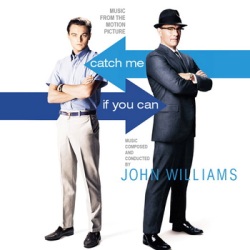
CATCH ME IF YOU CAN – John Williams
 Original Review by Jonathan Broxton
Steven Spielberg and John Williams have been working together since 1974, when the then-young director hired Williams to score The Sugarland Express. Their subsequent creative collaboration has become near-legendary, spanning almost 20 movies in as many years. Catch Me If You Can, their latest offering, is something of a departure for both of them: a) because Spielberg has made his first “light hearted” movie since the lamentable 1941, and b) because John Williams has given it a jazz score. The film is based on the true life story of Frank Abagnale Jr, who in the 1960s became the youngest person to be placed on the FBI’s most wanted list after committing a series of elaborate confidence tricks. Leonardo Di Caprio stars as the eponymous Abagnale, oozing bravado and charisma, while all the while being shadowed but never quite outwitted by FBI Agent Carl Hanratty (Tom Hanks, in an unusually low-key and monochrome role). Christopher Walken co-stars as Abagnale’s father, with Martin Sheen and Jennifer “Alias” Garner in extended cameos. Read more…
ROAD TO PERDITION – Thomas Newman
 Original Review by Jonathan Broxton
One thing that cannot be taken away from Thomas Newman is the fact that (with the possible exception of Elliot Goldenthal) he is, by far, the most original voice working in film music today. Newman has, literally, created a style of writing that no-one has heard before, and through recent films like American Beauty and Erin Brockovich and In the Bedroom, given Hollywood a unique musical perspective on modern life. Imitators follow his lead, but Newman’s unique brand of quirky rhythmic techniques and innovative orchestrations remain as one of today’s truly distinctive voices. What people tend to forget, though, is that for all his marimbas and sazes and funky monkeys, Newman is equally excellent at the “big orchestral thing”. Road to Perdition, his latest work, reaffirms that. Read more…
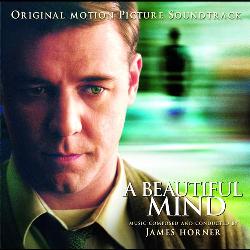
A BEAUTIFUL MIND – James Horner
 Original Review by Jonathan Broxton
A Beautiful Mind, directed by Ron Howard, has become one of the most critically successful movies of 2001. Telling the true-life story of Nobel Prize winning genius John Forbes Nash Jr. and his battle with schizophrenia, A Beautiful Mind has been nominated for multiple Academy Awards in 2002 and looks set to go-head with The Lord of the Rings for top honors on Oscar night. Russell Crowe stars as Nash, a brilliant mathematician and innovative thinker, whose groundbreaking work at Princeton and MIT in the 1940s and 1950s made him the cause celebre of the academic world. Before long, Nash is approached by the military to work on a top secret code-breaking operation run by the mysterious and sinister William Parcher (Ed Harris), and his success in the field indirectly leads to him meeting and marrying the love of his life, the beautiful and equally talented Alicia Larde (Jennifer Connelly). However, as time passes, Nash’s behavior becomes more and more erratic, it becomes apparent that Nash is suffering from increased paranoia and a persecution complex than can mean only one thing – that his beautiful mind is being attacked by schizophrenia. Read more…
THE LORD OF THE RINGS: THE FELLOWSHIP OF THE RING – Howard Shore
 Original Review by Jonathan Broxton
To say that Peter Jackson took on a mammoth task in undertaking a 9-hour, three-film cinematic version of The Lord of the Rings is an understatement indeed. Adapting J.R.R. Tolkien’s mammoth literary work for the screen took three years of the affable New Zealander’s life, and as the first part of the trilogy hits the world’s multiplexes, his vision and talent are for all to see. The Fellowship of the Ring is quite possibly the best fantasy film ever made, putting to shame Ralph Bakshi’s lamentable 1978 attempt to tell the same story through animation. Read more…
MALÉNA – Ennio Morricone
 Original Review by Jonathan Broxton
Ennio Morricone’s fifth and final score of 2000 is for the Italian romantic-comedy-drama Maléna, directed by Giuseppe Tornatore, for whom Morricone has written several classic scores, not least the incredible Cinema Paradiso. What’s interesting about Maléna is the fact that, unlike 99% of Morricone’s output of late, it has been the recipient of quite a bit of publicity, mainly through its association with the Miramax marketing machine. A second Golden Globe Best Score nomination in a row has been secured for the Italian maestro – following his success with The Legend of 1900 last year – and is backed up by a high profile soundtrack release. The only difference between this and 1900, though, is that Maléna is worthy of the praise. Read more…
CROUCHING TIGER, HIDDEN DRAGON – Tan Dun
 Original Review by Jonathan Broxton
After spending much of its history consigned to art-houses, lauded by critics but unseen by the masses, Chinese cinema is suddenly big business. The emigration west of some of its biggest names, notably action stars such as Jackie Chan and Chow Yun Fat, has undoubtedly paved the way for Chinese-language movies to reach a wider audience, and now the first true crossover hit seems to have come: Ang Lee’s Crouching Tiger Hidden Dragon. Director Lee has, of course, been making critically popular films in English for a number of years, from the Oscar winning costume drama Sense & Sensibility to the drama The Ice Storm and the civil war epic Ride With The Devil. Throughout his career, though, Lee has harbored a desire to make a wuxia pian, a Chinese costume drama combining traditional drama with martial arts. Lee has described Crouching Tiger Hidden Dragon as “Jane Austen meets Bruce Lee”. Read more…

Shop at the Movie Music UK Store

Member of the


