Archive
APOCALYPTO – James Horner
 Original Review by Jonathan Broxton
What with all the furore surrounding Mel Gibson, his DUI arrest on the Pacific Coast Highway in Malibu, and his subsequent drunken anti-Semitic rant to the highway patrol officers, it’s easy to forget that he remains a truly tremendous filmmaker. Apocalypto is Gibson’s fourth film as director, after The Man Without a Face, Braveheart and The Passion of the Christ. Filmed entirely in the Yukatek language of the ancient Mayans, who inhabited what is now Mexico, Belize and Guatemala for millennia prior to the arrival of the Europeans in the late 1400s, Apocalypto is a detailed look at the lives, cultures and traditions of that ancient civilisation, dressed up as an exciting chase-fuelled action movie. Read more…
ALL THE KING’S MEN – James Horner
 Original Review by Clark Douglas
When it was originally slated for a late 2005 release, “All the King’s Men” was being touted as one of those “can’t-miss” Oscar nominees, with a good director and a cast that Academy members couldn’t help but drool over. Then it disappeared. Many rumors surfaced, as they always do, the most prominent one being that it was feared “All the King’s Men” couldn’t hold up against the 2005 competition. After a year of retooling and new marketing, it’s finally here, and despite the relatively weaker movie crop of 2006, “All the King’s Men” doesn’t stand a chance. The film is based on the 1946 novel of the same name, which was made into an Oscar-winning 1949 film. Our narrator and central figure, Jack Burden (Jude Law) tells us a familiar story… an idealistic, charming politician (Sean Penn) with big goals who was hindered by his weaknesses… most notably, his weakness for women. If Bill Clinton’s name is coming to mind, it should come as no surprise that James Carville played a major role in helping get this film off the ground. Read more…
THE NEW WORLD – James Horner
 Original Review by Jonathan Broxton
James Horner’s fourth and final score for 2005 is without doubt his most prestigious: The New World, directed by Terrence Malick, tells a new dramatic version of the familiar story of Native American princess, Pocahontas (newcomer Q’Orianka Kilcher), and her first encounter with John Smith (Colin Farrell), the leader of the first English Settlers to land on the shores of what is now the United States of America. Despite the misgivings of Pocahontas’s tribal elders, Smith’s colleagues, and the girl’s age (she was just 14) the pair fall deeply in love – but it soon becomes apparent that their relationship cannot last, and that their forbidden romance will have terrible repercussions for both sides. The film, which also stars Christian Bale, Christopher Plummer, Ben Chaplin, David Thewlis, and Native American character actors Wes Studi, August Schellenberg and Irene Bedard, is about as far from the Disney animated feature as it is possible to be, concentrating on the reality of what life in Virginia in 1607 was like, and the hardships faced by the new settlers in a dangerous and unfamiliar land. Read more…
THE LEGEND OF ZORRO – James Horner
 Original Review by Jonathan Broxton
Considering its $94 million success at the box office in 1998, it’s rather surprising that it’s taken Hollywood seven years to make a sequel to The Mask of Zorro, the film which turned Antonio Banderas into a swashbuckling heartthrob and introduced to the world a little-known Welsh actress called Catherine Zeta-Jones. With director Martin Campbell once again at the helm, the film takes place ten years after the events in Mask of Zorro. Don Alejandro de la Vega (the real identity of Zorro) and his wife Elena are now the parents of a ten year old son, Joaquin (Adrian Alonso). With California on the verge of joining the United States of America, Alejandro keeps the promise he made to his wife and agrees to hang up his cape and end his swashbuckling lifestyle forever to spend more time with his family. However, his retirement is prematurely ended by the nefarious Armand (Rufus Sewell), whose labyrinthine plot involves sabotaging California’s plans for statehood and could lead to civil war… Read more…
FLIGHTPLAN – James Horner
 Original Review by Jonathan Broxton
Up until now, James Horner has had a quiet 2005: with no films since the forgettable The Forgotten last September, he’s done what he invariably tends to do and done nothing, then ended up having six films come out at the end of the year in the space of three months. Discounting the low-budget independent The Chumscrubber, the first of these is Flightplan, a high-concept action thriller set on a sophisticated aeroplane, directed by German debutant Robert Schwentke. The film stars Jodie Foster as Kyle Pratt, an aeronautics engineer who is traveling from Berlin to New York with her young daughter Julia (Marlene Lawston) on a state-of-the-art airliner she helped design. Shortly after takeoff, Kyle drifts into a deep sleep, and when she awakens three hours later, the plane is over the Atlantic Ocean, and Julia is missing. Read more…
THE FORGOTTEN – James Horner
 Original Review by Peter Simons
Having one of the year’s more interesting premises, The Forgotten tells the story of Telly Paretta (Julianne Moore), a mother who is told that her recently deceased son never even existed, and that she merely imagined nine years of her life with him. Unwilling to accept this shocking news and firmly believing that the truth is out there, Telly embarks on a personal quest for her lost child. Written by Gerald Di Pego, the film has a promising scenario, but critics derided it for making a few too many unwelcome plot turns, and eventually leaving the realms of the “intriguing” and becoming “ridiculous”. Nevertheless, the film performed rather well at the box office, taking over $60 million in its first six weeks. Read more…
TROY – James Horner
 Original Review by Peter Simons
In what was one of this years most upsetting events in film music, Gabriel Yared’s powerful score for Troy got rejected and was replaced by one from James Horner. After Yared had been fine-tuning his work for almost a year, it was suddenly up to Horner to write ‘something better’, i.e. something better fitting the studio’s wishes, in a mere two weeks. Such a task is nearly impossible and, needless to say, Horner’s work sounds less inspired and thought-through than Yared’s does. That doesn’t mean it isn’t a good score. On the contrary, it’s a surprisingly fine effort featuring some of Horner’s most rousing material since Enemy at the Gates. One would just wish that the composer was given more time to explore and elaborate on his ideas. Read more…
BOBBY JONES: STROKE OF GENIUS – James Horner
 Original Review by Jonathan Broxton
American golfer Bobby Jones was one of the pioneers of the game; the winner of thirteen major tournaments, including the 1923 US Open at Inwood, the 1926 British Open, the 1926 US Open at Scioto, the 1927 British Open, the 1929 US Open at Winged Foot, and the “grand slam”– all four majors in a season – in 1930, he is regarded as one of the all-time greats, and stands in second place behind Jack Nicklaus in the list of champions. Jones retired from golf after this incredible feat to concentrate on a career in law, but not before helping design the world famous Augusta gold course in his home state of Georgia. Jones died in 1971 aged 69. Rowdy Herrington’s film Bobby Jones: Stroke of Genius is a straightforward biopic starring Jim Caviezel (hot from The Passion of the Christ) as Jones, Claire Forlani as his wife Mary, Jeremy Northam as fellow golfer Walter Hagen, and Malcolm McDowell as O.B. Keeler, the man who would eventually go on to write Jones’s biography. Read more…
THE MISSING – James Horner
 Original Review by Jonathan Broxton
After sitting out the entire summer of 2003, James Horner has exploded back onto the scene with four new scores in less than two months. The third of the four (the others being Radio, Beyond Borders and the Oscar-tipped House of Sand and Fog) is The Missing, a truly remarkable work which brings back wonderful memories of classic Horner scores from the early 1990s. And, although the stylistic elements of a dozen or so scores from his past are readily identifiable, in many ways it’s like revisiting an old friend. Yes, I have criticized other composers for doing the exact same thing in the past, but with Horner, it’s like coming home. Directed by Ron Howard and based on the novel “The Last Ride” by Thomas Eidson, The Missing stars Tommy Lee Jones as Samuel Jones, a father who returns to his home in 19th-century New Mexico, hoping to reconcile with his estranged adult daughter Maggie (Cate Blanchett). However, when Maggie’s young daughter (Evan Rachel Wood) is kidnapped by a psychopathic leader of a cult with mysterious powers, who has been kidnapping young girls all over the American south west, father and daughter must put aside their differences and work together to get her back. Read more…
WINDTALKERS – James Horner
 Original Review by Jonathan Broxton
It’s getting more and more difficult to review James Horner scores objectively these days – and everyone knows why. Listening to and writing about Horner’s music is a bit like having an itch you’re not supposed to scratch – you know it’ll do you no good in the long run but, by God, it irritates you so much, you just can’t help yourself – and the short term relief is worth it. I am almost at pains to say so, but on the whole Windtalkers bored me. Horner rarely does this; if nothing else, Horner’s music is usually interesting and worth taking the time to listen to. But, here, its as though he intentionally drew the majority the heart and color from his score, leaving instead a soulless musical shell that is technically sound but bereft of anything remotely resembling emotion. Read more…
A BEAUTIFUL MIND – James Horner
 Original Review by Jonathan Broxton
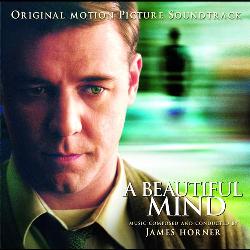
A Beautiful Mind, directed by Ron Howard, has become one of the most critically successful movies of 2001. Telling the true-life story of Nobel Prize winning genius John Forbes Nash Jr. and his battle with schizophrenia, A Beautiful Mind has been nominated for multiple Academy Awards in 2002 and looks set to go-head with The Lord of the Rings for top honors on Oscar night. Russell Crowe stars as Nash, a brilliant mathematician and innovative thinker, whose groundbreaking work at Princeton and MIT in the 1940s and 1950s made him the cause celebre of the academic world. Before long, Nash is approached by the military to work on a top secret code-breaking operation run by the mysterious and sinister William Parcher (Ed Harris), and his success in the field indirectly leads to him meeting and marrying the love of his life, the beautiful and equally talented Alicia Larde (Jennifer Connelly). However, as time passes, Nash’s behavior becomes more and more erratic, it becomes apparent that Nash is suffering from increased paranoia and a persecution complex than can mean only one thing – that his beautiful mind is being attacked by schizophrenia. Read more…
IRIS – James Horner
 Original Review by Jonathan Broxton
In collaborating with the virtuoso violinist Joshua Bell on his latest score, Iris, it would seem that James Horner is developing a reputation akin to that of John Williams in the way that he is attracting top-quality classical talent with whom to work. With Charlotte Church also working with him on A Beautiful Mind, these two latest scores could be taken as an indication that Horner’s standing in the crossover classical music world is growing at a steady rate, after the commercial successes and album sales his scores have enjoyed of late. It is perhaps worth noting that Horner, Bell and Church are all contracted Sony Classical artists, and it is no coincidence that Sony are marketing both scores by heavily publicizing the soloists, but the optimist in me would like to think that it is Horner’s creativity rather than a marketing strategy who have brought them together. Nevertheless, an artist as talented as Bell brings a definite sense of class to the project – and it doesn’t hurt that Horner’s music is superb in its own right. Read more…
HOW THE GRINCH STOLE CHRISTMAS – James Horner
 Original Review by Jonathan Broxton
The problem with reviewing this kind of album is whether to review the score, or the package as presented to us by the record label. Interscope Records’ release is a curious hybrid of pop, dialogue and score that never quite gels together as a product – although the three elements, in themselves, are good, the end result of an album that falls short on virtually all levels, each part never quite complementing each other, and leaving score fans with a definite sense of being short-changed. How the Grinch Stole Christmas, shortened to simply “The Grinch” over here, is the first live-adaptation of the classic children’s story by Theodor S. Geisel, aka Dr Seuss. The story was famously rendered in cartoon form by the legendary Chuck Jones in 1966, and went on to become a perennial Yuletide favorite in the United States, but has never captured the imagination of children in the UK in quite the same way. We know who Dr Seuss was, and all about The Cat in the Hat and so forth… it just never really caught on. Besides, we’ve got Raymond Briggs and The Snowman to keep up happy over the festive period. It’s actually rather surprising, therefore, that the movie has gone on to become a massive smash in this country, sitting at the number one slot for several weeks and taking in millions of pounds at the box office. Read more…
THE PERFECT STORM – James Horner
 Original Review by Jonathan Broxton
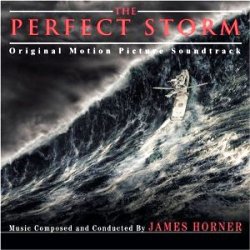
James Horner, of late, seems to have developed an affinity for disasters of one sort or another. Space disasters (Apollo 13), meteorite disasters (Deep Impact), disasters at sea (Titanic)… nowadays, it seems that if Horner is scoring the movie you can virtually guarantee that something awful is about to happen to a lot of people. The Perfect Storm, 2000’s big disaster movie, continues the trend, right down to the fact that it again concerns the sinking of a ship. But, whereas Titanic combined a terrible tragedy with wish-fulfilling romantic fantasy, The Perfect Storm is a serious, harrowing, and all-too true story. The film, which is directed by Wolfgang Petersen and stars George Clooney, Mark Wahlberg, Diane Lane and Mary Elizabeth Mastrantonio, takes place in 1994 in the small port of Gloucester, Massachusetts. Hearing news that a potentially fruitful shoal of fish has been spotted off the New England coast, the crew of the trawler Andrea Gail head off into the North Atlantic to take advantage. But what none of the crew ever imagined was that, far out to sea, a freak of nature was generating a weather phenomenon that had never before been encountered in recorded history: a perfect storm, which would envelop everything in its path. Read more…
BICENTENNIAL MAN – James Horner
 Original Review by Jonathan Broxton
In the past, under pain of death and despite the protestations of many film music aficionados, I have always fervently defended the musical style of James Horner. “A modicum of self-referencing is unavoidable as a composer develops a musical style,” I would say. “He doesn’t do it any more or any less than the other composers.” “It’s the effect on the audience that counts. The genuine emotion in Horner’s music is what’s important.” And, for the majority of his considerable output, I still believe this to be true. However, the amount of self-referencing that goes on in Bicentennial Man is simply beyond a joke. Read more…

Shop at the Movie Music UK Store

Member of the


