Archive
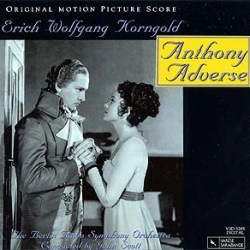
ANTHONY ADVERSE – Erich Wolfgang Korngold
 GREATEST SCORES OF THE TWENTIETH CENTURY
Original Review by Craig Lysy
Warner Brothers Studio was in the market for a period piece romance and found its inspiration in Harvey Allen’s massive 1200 page novel “Anthony Adverse” (1933), paying an amazing $40,000 for the screen rights. Veteran director Mervyn LeRoy was hired to manage the project with Sheridan Gibney and Milton Krims tasked with adapting the mammoth novel for the big screen. The stellar cast included Frederic March as Anthony Adverse, Olivia de Havilland as Angela Giuseppe, Donald Woods as Vincent Nolte, Anita Louise as Maria Bonnyfeather, Edmund Gwenn as John Bonnyfeather and Claude Rains as Marquis Don Luis. Read more…
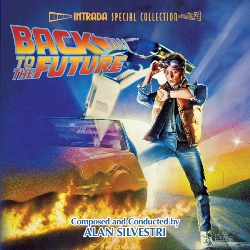
BACK TO THE FUTURE – Alan Silvestri
 THROWBACK THIRTY
GREATEST SCORES OF THE TWENTIETH CENTURY
Original Review by Jonathan Broxton
In the spring of 1985, Robert Zemeckis was a young up-and-coming director who had enjoyed some success with the Michael Douglas-Kathleen Turner adventure flick Romancing the Stone the year before, but for the most part was still largely an unknown quantity. His breakthrough came with the release of Back to the Future, a classic time-travelling comedy adventure which went on to become the biggest grossing film of the year, made Michael J. Fox a movie star, and cemented the much-derided DeLorean automobile into cinematic folklore forever. Fox stars as Marty McFly, a typical 1980s kid from suburban California, who is accidentally sent back to the year 1955 by his friend, scientist and inventor Doc Brown (Christopher Lloyd), who has built a time machine out of the aforementioned DeLorean. Stranded in time and without enough fuel to return home, Marty must seek help from the 1955 version of Doc – but, unfortunately, he inadvertently puts his own future at risk when the teenage version of his mother Lorraine (Lea Thompson) meets and develops a crush on him rather than George (Crispin Glover), the man destined to be his father… Read more…
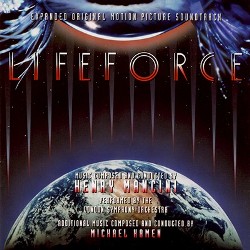
LIFEFORCE – Henry Mancini
 THROWBACK THIRTY
GREATEST SCORES OF THE TWENTIETH CENTURY
Original Review by Jonathan Broxton
What do you think of when you think of the music of Henry Mancini? The gentle romance of Breakfast at Tiffany’s? The effortlessly cool jazz of Peter Gunn or The Pink Panther? The forbidden passion of The Thorn Birds? The playful “Baby Elephant Walk” from Hatari? I’d bet my bottom dollar that most people would come up with those classics long before they thought of an epic orchestral sci-fi horror score, but that’s exactly what Mancini wrote for Lifeforce, a British-American production directed by Tobe Hooper and produced by the notorious Yoram Globus and Menahem Golan for Cannon Films. The film is a loose adaptation of Colin Wilson’s 1976 novel The Space Vampires, and stars Steve Railsback as the head of a multi-national space exploration team sent to investigate Halley’s Comet as it makes one of it’s regular 75-year passes past Earth. The team finds a space craft concealed inside the comet’s corona, and inside the space craft they find the preserved bodies of three seemingly humanoid aliens in suspended animation, including one incredibly beautiful female. However, when the space exploration team’s ship returns home, Mission Control in London finds it empty, save for the three aliens, which soon awake and begin draining ‘life force’ energies from every human they encounter. The film co-starred Peter Firth, Frank Finlay, Patrick Stewart, and Mathilda May, who spends almost the entire film completely naked; despite this obvious selling point, the film was a disaster, recouping less than half of its $25 million budget, and receiving terrible reviews from most critics of the time. Read more…
COCOON – James Horner
 THROWBACK THIRTY
GREATEST SCORES OF THE TWENTIETH CENTURY
Original Review by Jonathan Broxton
Cocoon was one of the major box-office successes of 1985, a winning combination of science fiction adventure and family drama directed by Ron Howard. The film stars Don Ameche, Wilford Brimley and Hume Cronyn as three old-timers living in a retirement community in Florida; part of their daily routine is to sneak into an unoccupied house next door and swim in its swimming pool. One day they find a number of strange, rock-like objects at the bottom of the water, but after checking them out, decide to swim there anyway; following their swim, the three geezers suddenly find themselves rejuvenated with a vigorous, youthful energy, and they share their discovery with their respective wives and lady friends, played by Gwen Verdon, Maureen Stapleton, and Jessica Tandy. However, much to the shock of the senior citizens, the ‘rocks in the pool’ turn out to be cocoons containing dozens of sick aliens, left behind by friendly extra-terrestrials centuries ago, and which were about to be returned to their home planet by their leader, Brian Dennehy, with the help of a local ship captain, played by Steve Guttenberg – until the pool was drained of its life force by the old folks. As such, the sextet of retirees must work with the aliens to help them find a way home, without revealing the secret of the pool. The film earned two Academy Awards – one for Best Supporting Actor for Don Ameche, and one for Best Visual Effects – and boasted a magnificent score by the then 32-year-old James Horner. Read more…
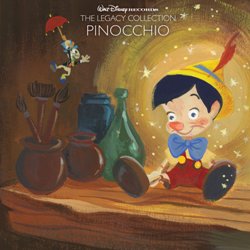
PINOCCHIO – Leigh Harline, Paul J. Smith, Ned Washington
 GREATEST SCORES OF THE TWENTIETH CENTURY
Original Review by Craig Lysy
After reading the novel “The Adventures of Pinocchio” by Carlo Collodi, Walt Disney felt it could be made into a fine Disney animated feature. When he picked up his honorary Oscar for “Snow White and the Seven Dwarfs” in 1937, he advised the Academy of his intent to bring Pinocchio to the big screen. The film became a passion project and its budget ballooned from $500,000 to $2.5 million, with several major rewrites. The voice cast included Dickie Jones as Pinocchio and (Alexander the Donkey, Cliff Edwards as Jiminy Cricket, Evelyn Venable as the Blue Fairy), Christian Rub as Geppetto, Walter Catlett as John Worthington Foulfellow the Red Fox, Charles Judels as Stromboli, Frankie Darro as Lampwick and Thurl Ravenscroft as Monstro the Whale. This film offers the classic tale of Geppetto the woodworker, who makes a wooden marionette, whom he names Pinocchio. He has no son and when he goes to bed he makes a wish that Pinocchio become a real boy. His wish is heard, and the Blue Fairy comes during his sleep, and brings Pinocchio to life, but he is not yet fully human. She advises Pinocchio that if he is brave, truthful and unselfish, he will become a real boy. She assigns Jiminy Cricket to be his conscience. Well, after a long adventure, with many struggles along the way, Pinocchio succeeds, becomes a real boy, and he and Geppetto live happily ever after. The film resonated with the public and was a commercial success. It also received critical acclaim and secured two Academy Awards for best Original Score, and Best Song “When You Wish Upon A Star”. This was the first time a film secured these two wins together. Read more…
THE SAND PEBBLES – Jerry Goldsmith
 GREATEST SCORES OF THE TWENTIETH CENTURY
Original Review by Craig Lysy
Director Robert Wise recognized the epic potential of The Sand Pebbles when he read Richard McKenna’s novel, and commissioned Robert Anderson to adapt it for the screen. He assembled a stellar cast, which included hero Jake Holman (Steve McQueen), his love interest Shirley Eckhart (Candice Bergen), his friend Frenchie Burgoyne (Richard Attenborough), the honorable Captain Collins (Richard Crenna) and his apprentice Po-Han (Mako). The film’s setting is colonial China circa 1926 where the gunboat U.S.S. San Pablo patrols a tributary of the Yangtze River. China is in tumult as Nationalists, Communists and feudal warlords all compete for land, money and power. Jake, a laconic loner and iconoclast, joins the crew and immediately clashes with the “rice-bowl” coolie system, which runs the ship. In so doing he alienates both the captain and his crewmates. He meets Shirley, a missionary, and we see a spark of romance. Yet their relationship is doomed as war against all westerners erupts and the San Pablo must fight for its life as it sails upriver to rescue missionaries at the China Light Mission. The film was a commercial and a critical success earning eight Oscar nominations including Best Score, which Goldsmith lost out to John Barry’s Born Free. Read more…
THE BRIDGE ON THE RIVER KWAI – Malcolm Arnold
 GREATEST SCORES OF THE TWENTIETH CENTURY
Original Review by Craig Lysy
One day, out of curiosity, producer Sam Spiegel happened to purchase the novel “Le Pont de la Rivière Kwaï” by Pierre Boulle, which was, at the time, the talk of the day. He read the novel on a plane flight and by the time he arrived in London, he was determined to bring the story to the big screen. Complications arose immediately as his trusted screenwriters, Michael Wilson and Carl Foreman, were on the infamous McCarthy blacklist of people accused of Communist sympathies, and were forced to ghost-write, while Boulle, who could not speak, let alone write in English, was assigned the sole writing credit. Spiegel brought in David Lean to direct the film and they assembled a stellar cast for the project, including Alec Guinness as Colonel Nicholson, Jack Hawkins as Major Warden, William Holden as Captain Shears and Sessue Hayakawa as the brutal Colonel Saito. Read more…
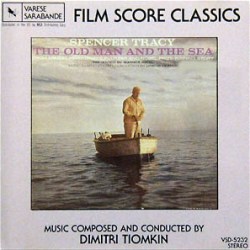
THE OLD MAN AND THE SEA – Dimitri Tiomkin
 GREATEST SCORES OF THE TWENTIETH CENTURY
Original Review by Craig Lysy
The Old Man and the Sea was a novel written by Ernest Hemmingway in 1951 during his stay in Cuba. Warner Brothers Studio purchased the film rights, selected Fred Zinnemann to direct, hired Paul Osborne to adapt it to the big screen and used Hemmingway as a technical consultant. When live sea filming failed and Hemmingway raged against both the script and marlin prop, Zinnemann and Osborne resigned from the project. John Sturges took over directing and at Hemmingway’s insistence Peter Viertel reworked the script. Given that this was an intimate story of a man’s personal struggle, veteran actor Spencer Tracy was hired to play the lead role of Santiago, with Felipe Pazos Jr. playing the boy Manolin. Read more…
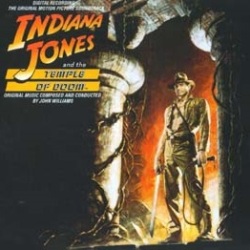
INDIANA JONES AND THE TEMPLE OF DOOM – John Williams
 THROWBACK THIRTY
GREATEST SCORES OF THE TWENTIETH CENTURY
Original Review by Jonathan Broxton
Fortune and glory, kid. Fortune and glory.
Even after thirty years, Indiana Jones and the Temple of Doom remains one of the most iconic and beloved action films of the 1980s. A darker, scarier prequel to Raiders of the Lost Ark, Steven Spielberg’s film has Harrison Ford returning as the archaeologist-adventurer Indiana Jones, crossing paths with Chinese jewel smugglers in Shanghai in 1934. After his deal with the Triads goes wrong, Indy flees on a plane with his diminutive sidekick Short Round (Ke Huy Quan) and nightclub singer Willie Scott (Kate Capshaw), only to crash over the Himalayas, washing up in a remote Indian village. Before long, Indy is embroiled in yet another adventure, this time involving missing children, ancient mystical stones said to have magic powers, and a terrifying cult that worships the Hindu goddess Kali. The film was a massive commercial success, ending up the third highest grossing film of 1984 with an adjusted-for-inflation gross of almost $436 million, and received two Academy Award nominations, including one for its score by John Williams. Read more…
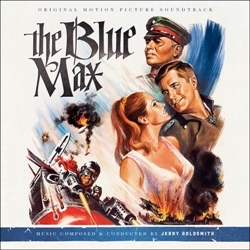
THE BLUE MAX – Jerry Goldsmith
 GREATEST SCORES OF THE TWENTIETH CENTURY
Original Review by Craig Lysy
Director John Guillermin was inspired by the Jack Hunter novel “The Blue Max” and so adapted it for film. He assembled a stellar cast, which included George Peppard as Bruno Stachel, James Mason as General Count von Klugermann, Ursula Andress as Countess Kaeti von Klugermann and Jeremy Kemp as Willi von Klugermann. Set in the waning year of World War I on the Western front, it tells the story of a young man’s rise to glory and his tragic end. Stachel, is a classic anti-hero, a member of the lower cast who is driven by blind ambition. As such he leaves the Wehrmacht to join the Luftwaffe in search of personal glory – Germany’s most prestigious medal, Pour le Mérite, or the Blue Max. The prized medal is bestowed upon pilots for meritorious service and requires 20 dog fight kills. Driven with a grim, and relentless determination Stachel will allow nothing to stand in his way. His raw and unchivalrous demeanor offends his fellow pilots who hail from the German aristocracy and disdain this commoner among their ranks. Stachel’s rise is noticed by General von Klugermann, who seeks to exploit him as a national symbol in an effort to rally a weary public tiring of war. A tryst with the General’s wife only adds to Stachel’s ego and notoriety. While he ultimately succeeds in gaining the coveted prize, he does so by defiantly disobeying orders to defend ground troops. Von Klugermann does not wish to disgrace his ‘hero’ with a court marshal and so selects him to fly a proto-type mono-wing plane whose support struts he knows will not hold up. When Stachel dies in a crash von Klugermann’s dilemma is solved, he gains his “man of the people” hero and his air corps is not disgraced by scandal. The film was both a critical and commercial success. Read more…
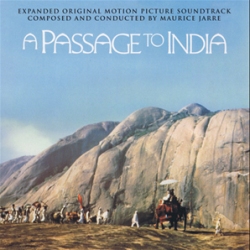
A PASSAGE TO INDIA – Maurice Jarre
 GREATEST SCORES OF THE TWENTIETH CENTURY
Original Review by Craig Lysy
A Passage to India is a novel by English author E. M. Forster, which unfolds against the backdrop of the British Raj and the Indian independence movement in the 1920s. David Lean became enamored after watching the stage presentation of the story and immediately sought and obtained the movie rights. He adapted the screenplay himself and secured a stellar cast, which included; Judy Davis (Adela), Alec Guiness (Godbole), James Fox (Fielding), Peggy Ashcroft (Mrs. Moore) and Victor Bannerjee (Dr. Aziz). The story revolves a fateful trip to the Marabar Caves where a recently engaged Adela finds herself captivated and aroused by the beauty and sensuality of Indian culture. One day on a day trek and while alone with Dr. Aziz in one of the caves, she experiences conflicting emotions towards Dr. Aziz, panics and flees. It is assumed that Dr. Aziz had attempted to assault her and he is brought up to trial for charges of rape. The trial serves as both a commentary and a volatile catalyst that unleashes the pent up racial tensions long simmering between the indigenous Indians and the British colonialists who rule India. When Adela finally relents and withdraws her charges, Aziz is set free, but friendships are ruptured and Aziz seems irreparably harmed. Years later Aziz and his dear friend James reconcile, which brings the sad tale to a pleasing closure. The film was both a critical and commercial success, earning eleven Academy Award nominations, which included a Best Score Oscar for Maurice Jarre. Read more…
MURDER ON THE ORIENT EXPRESS – Richard Rodney Bennett
 GREATEST SCORES OF THE TWENTIETH CENTURY
Original Review by Craig Lysy
Producer Richard Goodwin secured film rights for Murder on the Orient Express from author Agatha Cristie, determined to create a “glamorous star-studded film that was gay in spirit… a soufflé.” He recruited some of the finest stars of the day, which included Albert Finney (Hercule Poirot), Lauren Bacall (Mrs. Hubbard), Ingrid Bergman (Greta), Sir John Gielgud (Beddoes), Sean Connery (Col. Arbuthnot) and Venessa Redgrave as Mary Debenham. The famous Orient Express was a train that ran from Istanbul to Calais and provided transit from Europe to the Middle East. Set in 1935, the story finds renowned and fastidious Belgian detective, Hercule Poirot, as a late addition passenger who needs to get back to London immediately. As fate would have it a fellow passenger is found murdered in his stateroom. As Poirot questions the train’s valet, the victim’s accompanying staff, and the first class passengers he finds that many have both opportunity and motive. He soon realizes that several passengers have a connection to the Armstrong family kidnapping and thus he begins to solve a very complex crime. The film had sensational success commercially and received critical acclaim. Richard Rodney Bennett’s score was nominated for both Academy and BAFTA awards, and secured the BAFTA Anthony Asquith Award for Film Music award. Read more…
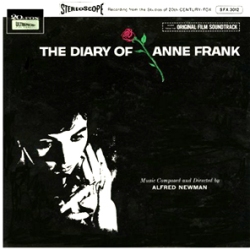
THE DIARY OF ANNE FRANK – Alfred Newman
 GREATEST SCORES OF THE TWENTIETH CENTURY
Original Review by Craig Lysy
Francis Goodrich and Albert Kackett successfully adapted the novel Anne Frank: The Diary of a Young Girl for the Broadway stage. When it secured both a Tony award and a Pulitzer prize Warner Brothers bought the film rights and hired George Stevens to produce and direct a film adaptation. Unknown Millie Perkins was hired for the title role and was supported by Otto Schilkraut (her father Otto), Gusti Huber (her mother Edith), Richard Beymer (her boyfriend Peter Van Daan) and Shelly Winters (Petronella Van Daan). The story is set in Nazi occupied Holland where Otto Frank and his family have decided to go into hiding, because of the increasing persecutions against Jews. A sympathetic local businessman Kraler and his assistant Miep prepare a hiding place in the rooms above their place of business, and arrange for the Franks and another family, the Van Daans, to stay there. Later on, they are joined by the dentist Dussel. Together, living in isolation, they try to avoid detection while praying for Holland to be liberated by the Allies. This poignant story explores the life of persecuted people living in constant fear as seen through the eyes of Anne. The film was a stunning commercial success and won critical acclaim, securing eight Academy nominations including best score for Alfred Newman, who lost to Rozsa’s magnificent effort Ben-Hur: A Tale of the Christ. Read more…
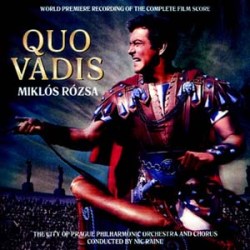
QUO VADIS – Miklós Rózsa
 GREATEST SCORES OF THE TWENTIETH CENTURY
Original Review by Craig Lysy
Producer Sam Zimbalist and director Mervyn LeRoy saw an opportunity to create a grand epic by adapting Henryk Sienkiewicz’s 1896 novel Quo Vadis. They hired a fine cast, which included Robert Taylor (Marcus Vinicius), Deborah Kerr (Lygia), Peter Ustinov (Nero) and Leo Glenn (Petronius). Set in imperial Rome during the reign of the maniacal emperor Nero (54 – 68 C.E.) we see a love story unfold between the pagan Marcus and the Christian Lygia. Our lovers are caught in the tide of history as an increasingly mad Nero terrorizes his court and ultimately sets Rome aflame in a stunning horrific conflagration. To cover his guilt Nero falsely blames the Christians and unleashes a reign of terror with gruesome executions in the Coliseum. Through their ensuing travails, Marcus converts and our lovers manage an escape to Sicily as an avenging mob, now aware that Nero burned Rome, storms the palace and brings Nero to a well-deserved end. The film was both a commercial and critical success, earning eight Academy Award nominations. Read more…
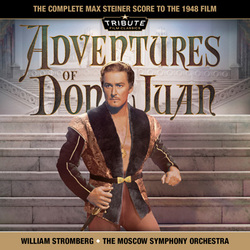
THE ADVENTURES OF DON JUAN – Max Steiner
 GREATEST SCORES OF THE TWENTIETH CENTURY
Original Review by Craig Lysy
Warner Brothers had long been attracted to the idea of filming a tale of the legendary lover Don Juan. After six years and countless revisions, screenwriter George Oppenheimer finally completed a script that satisfied Warner Brothers executives. Director Vincent Sherman was able to secure a fine cast that included the mercurial Errol Flynn (Don Juan de Maraña), Viveca Lindfors (Queen Margaret), Alan Hale (Leporello) and Robert Douglas (Duke de Lorca). The story concerns Don Juan de Maraña, Spain’s ambassador to the English court, who has damaged the prestige of the Spanish King with his blatant and insatiable womanizing. Discredited in diplomatic circles, Don Juan attempts to restore his standing after he meets the beautiful Queen Margaret, with whom he falls in love for the first time of his life. Although Margaret is trapped in a loveless marriage with King Philip III, she strives to resist Don Juan’s alluring and seductive advances. In a bold move to restore his honor Don Juan uncovers a plot by the King’s ruthless minister Duke de Lorca, to usurp the King’s authority. Regretfully he is outmaneuvered after De Lorca intimidates the cowardly king into compliance and threatens to execute the Margaret. Yet all is not lost as Don Juan with the assistance of his servant Leporello, fencing master Don Serafino, and court jester Sebastian have the last word. In a series of fierce battles he saves the day with an epic final sword duel with Duke de Lorca. The film was a critical success earning two Oscars, but only a modest commercial success. Read more…

Shop at the Movie Music UK Store

Member of the

 MOVIE MUSIC UK