FANTASTIC BEASTS: THE CRIMES OF GRINDELWALD – James Newton Howard
 Original Review by Jonathan Broxton
WARNING: THIS REVIEW CONTAINS PLOT SPOILERS. IF YOU HAVE NOT YET SEEN THE FILM, YOU MIGHT WANT TO CONSIDER WAITING UNTIL AFTER YOU HAVE DONE SO TO READ IT.
J. K. Rowling’s Wizarding World is expanding further beyond the confines of Harry Potter with Fantastic Beasts: The Crimes of Grindelwald, the second movie in a planned series of five which looks at the life of a wizard who lived more than 60 years before Harry was even born. It builds on the events seen in the 2016 film Fantastic Beasts and Where to Find Them and follows Newt Scamander, a magical zoologist who cares for a vast array of curious creatures. Having been integral in the capturing of the dark wizard Gellert Grindelwald at the end of the first film, Newt is unexpectedly called back into action again after Grindelwald escapes and flees to Paris. Responding to a personal plea from Albus Dumbledore, his former teacher at Hogwarts Wizarding School, Newt is tasked with stopping Grindelwald from amassing an army of followers – something which brings him back into contact with numerous figures from his past, including the Obscurial Credence Barebone, who was believed to have died during the events in New York, but who is rumored to have survived . The film stars Eddie Redmayne, Jude Law, Johnny Depp, Katherine Waterston, Dan Fogler, Alison Sudol, and Ezra Miller, and is directed by David Yates; this is now the sixth ‘Wizarding Film’ Yates has helmed. Read more…
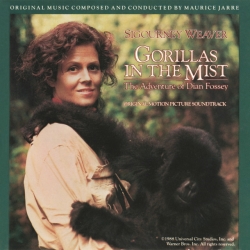
GORILLAS IN THE MIST – Maurice Jarre
 THROWBACK THIRTY
Original Review by Jonathan Broxton
Dian Fossey was a conservationist and animal expert whose special focus was to study and protect African mountain gorillas. Having been inspired by another famous anthropologist, Louis Leakey, Fossey left her job in San Francisco and relocated to the remote jungles of Congo and Rwanda, where she established a research center in order to study these endangered creatures. As the years passed Fossey made several important breakthroughs and became world famous for her work, but also made many enemies, including poachers who hunted for gorilla artifacts, and members of the Rwandan government who opposed her increasingly violent responses to the poaching. Eventually, after more than twenty years working in Africa, Fossey was found dead in her cabin, apparently having been murdered; her assailants still have never been positively identified or tried. The film Gorillas in the Mist tells the true story of Fossey’s life and death; it stars Sigourney Weaver in the lead role, features Bryan Brown and Julie Harris in supporting roles, and is directed by Michael Apted. Read more…
THE GIRL IN THE SPIDER’S WEB – Roque Baños
 Original Review by Jonathan Broxton
Back in the early 2000s Steig Larsson’s Swedish-language novel Män Som Hatar Kvinnor – translated into English as The Girl With the Dragon Tattoo – was a bonafide phenomenon. It introduced the world to the character Lisbeth Salander, the socially awkward punk computer hacker who became an unlikely crusader for women’s justice, enacting revenge upon men who hate women, while getting involved in a labyrinthine plot of murder, sex, and death. Sadly, Larsson didn’t live to see his success – he died of a heart attack before the novels were even published – and so obviously he did not live to see his works transition to the big screen either. Adaptations of his three Salander novels (Män Som Hatar Kvinnor, Flickan Som Lekte Med Elden/The Girl Who Played With Fire, and Luftslottet Som Sprängdes/The Girl Who Kicked the Hornet’s Nest) were made in Sweden starring Noomi Rapace and Michael Nyqvist, and became instant international successes; an American remake of The Girl With the Dragon Tattoo then emerged in 2011, directed by David Fincher and starring Rooney Mara and Daniel Craig. Unfortunately, that film was not as successful as many hoped, and plans for English-language adaptations of Fire and Hornet’s Nest were shelved. However, the series has now been revived by Uruguayan director Fede Álvarez in the shape of The Girl in the Spider’s Web, which is an adaptation of the fourth Salander novel Det Som Inte Dödar Oss, which was written by David Lagercrantz. Read more…
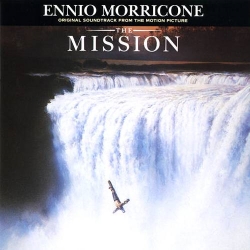
THE MISSION – Ennio Morricone
 GREATEST SCORES OF THE TWENTIETH CENTURY
Original Review by Craig Lysy
Producer David Putnam and director Roland Joffe were seeking to sustain the acclaim of their last collaboration, The Killing Fields (1984), and so recruited renowned screenwriter Robert Bolt to compose a compelling historical drama. The independent British production company Goldcrest Films financed the project, providing a generous budget, and a fine cast was assembled, which included Robert De Niro as Captain Rodrigo Mendoza, Jeremy Irons as Father Gabriel, Ray McAnally as Cardinal Altamirano, Aidan Quinn as Felipe Mendoza, Cherie Lunghi as Carlotta, Ronald Pickup as Don Hatar, Chuck Low as Don Cabeza and Liam Neeson as Father John Fielding. The film offers a classic morality play, which explores the tragic events surrounding the 1750 Treaty of Madrid. The Spanish and Portuguese are warring along the Brazil and Paraguayan border and the treaty ended the conflict by requiring Spain to cede territory south and east of the Rio Uruguay to Portugal. This would require the seven Jesuit missionaries to leave and place the Guarani inhabitants in peril as Portugal, unlike Spain, used slavery to man their plantations. The film opens in 1740 with Jesuit missionary Father Gabriel seeking to convert the Guarani to Catholicism. The opening scene of a Jesuit cast over the waterfall tied to a cross reveals the Guarani’s hostility to outsiders. He is joined by slaver Rodrigo Mendoza who seeks repentance following the murder of his brother, who he caught sleeping with his fiancée. Father Gabriel gains the trust of the Guarani through his oboe playing and they over time convert. Rodrigo finds new meaning to his life, abandons weapons, and commits to joining the priesthood. Read more…
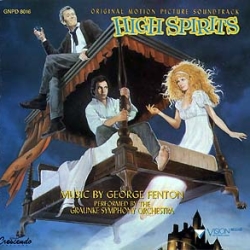
HIGH SPIRITS – George Fenton
 THROWBACK THIRTY
Original Review by Jonathan Broxton
There are some movies where, when you see their plot summary written down, you wonder how they ever got made. One of those is the 1988 movie High Spirits, a bizarre comedy-adventure-romance about Irish ghosts. The film stars Peter O’Toole as Plunkett, the owner of a dilapidated castle in Ireland who comes up with a money-making scheme whereby he will convert the castle into a hotel, pretend that it is ‘the most haunted castle in Europe,’ and sell the idea to gullible American tourists. The scam is a success and the first group of unsuspecting vacationers – Steve Guttenberg, Beverly d’Angelo, Peter Gallagher, Jennifer Tilly – arrives, beguiled by the tales of Gaelic ghosties. However, to everyone’s utter shock, two real ghosts (played by Liam Neeson and Daryl Hannah) actually appear, and start becoming romantically attracted to two of the holidaymakers. The film was written and directed by Neil Jordan, the man behind such serious works as The Company of Wolves and Mona Lisa, and who would later go on to direct The Crying Game, Interview With the Vampire, and Michael Collins. Read more…
SUSPIRIA – Thom Yorke
 Original Review by Jonathan Broxton
Giallo – a popular Italian cinematic sub-genre comprising dark, violent, erotic horror and thriller films – arguably reached its creative peak in 1977 with the release of director Dario Argento’s Suspiria. The story followed a young American dancer named Susie Bannion, who arrives in Berlin to audition for a world-renowned ballet company. However, as she becomes more involved in the work of the company and the lives of the dancers, she begins to realize that the studio is a front for a coven of powerful evil witches. The original Suspiria was a groundbreaking success, and is now considered one of the greatest examples of its genre. This new film, directed by Luca Guadagnino as a follow-up to Call Me By Your Name, takes the story of the original film and its grisly violence and adds a new level of socially aware commentary about female empowerment and politics. It stars Dakota Johnson as Susie, the naïve and wide-eyed all-American girl whose descent into fear and madness is charted by the film, and features Tilda Swinton and Mia Goth in supporting roles. Read more…
Francis Lai, 1932-2018
 Composer Francis Lai died on November 7, 2018, at home in Paris, France, after a short illness. He was 86.
Francis Albert Lai was born in Nice, France, in April 1932. He moved to Paris in his twenties and began composing songs while working with lyricist Bernard Dimey. He accompanied Édith Piaf and wrote songs for French singers such as Mireille Mathieu and Yves Montand before transitioning into film scoring in the mid-1960s. His breakthrough came in 1966 with Un Homme et Un Femme [A Man and a Woman], directed by Claude Lelouch. The film won the Palme d’Or at Cannes, and Lai’s score – particularly its vocal theme – became a major success. He would go on to score more than 30 of Lelouch’s films, notably .
Lai’s most widely recognized international work came in 1970 with Love Story, starring Ryan O’Neal and Ali MacGraw. Its theme became a chart-topping hit in both instrumental and vocal versions, and Lai received the Academy Award and a Golden Globe for the score. His other notable works include Mayerling (1968), Rider on the Rain (1970), Emmanuelle II (1975), Bilitis (1977), and International Velvet (1978). He also composed for television and collaborated with artists such as Carly Simon. Read more…
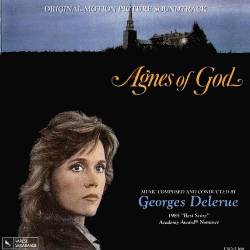
AGNES OF GOD – Georges Delerue
 GREATEST SCORES OF THE TWENTIETH CENTURY
Original Review by Craig Lysy
John Pielmeier’s play 1979 Agnes of God was both a commercial and critical success, achieving a respectable run on Broadway. Norman Jewison convinced Columbia Pictures that the story had big screen potential, and secured backing for the project. He would both produce and direct the film, and brought in Pielmeier to adapt his play for the cinema. Crucial to the film’s success would be finding three actresses to fill the trio of roles on which the story unfolds. Jane Fonda was cast as Dr. Martha Livingston. Joining her would be Anne Bancroft as Mother Superior Miriam Ruth, and Meg Tilly as Sister Agnes Devereaux. The film offers a murder mystery where science and faith intersect and clash. The story reveals nuns rushing from evening prayers to Sister Agnes’s room in answer to her screaming. They discover her bleeding profusely and a dead baby lying in a basket strangled by its umbilical cord. The court assigns Dr. Livingston to assess Sister Agnes for competency to stand trial. A clash of wills unfolds between Dr. Livingston efforts to discover the truth, and Mother Superior efforts to protect her niece, who she believes is innocent. What results is a classic confrontation of science and faith, with both sides working with the best of intentions. Read more…
FIRST MAN – Justin Hurwitz
 Original Review by Jonathan Broxton
Since almost the beginning of human civilization, man has had a special relationship with the moon. For millennia it fascinated and lured thinkers and scholars, all of whom theorized about what was up there, what it was made of, how did it get there, and – eventually – whether we would ever visit it. Many of those questions were answered on July 20, 1969, when three brave American astronauts – Neil Armstrong, Buzz Aldrin, and Michael Collins – touched down on the lunar surface as part of NASA’s Apollo 11 mission, and Armstrong himself became the first human in history to set foot on our celestial partner in the sky. Director Damien Chazelle’s film First Man tells the story of these events, with Ryan Gosling playing Armstrong, Claire Foy playing his wife Janet, and character actors such as Jason Clarke, Kyle Chandler, Corey Stoll, Ciarán Hinds, Christopher Abbott, Patrick Fugit, and Lukas Haas in supporting roles. Read more…
MAGDALENE – Cliff Eidelman
 THROWBACK THIRTY
Original Review by Jonathan Broxton
Do you remember what you were doing when you were 24? Maybe you were just starting out at your first proper job, maybe you just got your first apartment, maybe you were embarking on your first relationship. Maybe you were even still at university, dreaming of what your future life might bring once you leave academia and head out into the big wide world. Whatever you were doing, I’m pretty sure you weren’t doing what Cliff Eidelman was doing when he was 24 – which was conducting 120 musicians of the Munich Symphony Orchestra for his debut film score, Magdalene. To say that Eidelman’s rise was meteoric is an enormous understatement; just a year prior to scoring Magdalene he was still a student at the University of Southern California, but this all changed when German film director Monica Teuber somehow heard a performance recording of a ballet score Eidelman had written on commission for Santa Monica City College. On the strength of that music alone Teuber hired Eidelman to score her film; after it came out the score was so well received that it immediately led to other assignments, and within three years he was scoring major studio blockbusters like Star Trek VI: The Undiscovered Country – and a career was born. Read more…
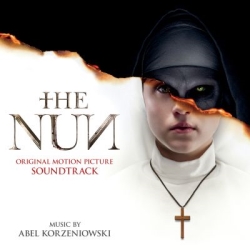
THE NUN – Abel Korzeniowski
 Original Review by Jonathan Broxton
One of the constant battles I have as a film music reviewer is between music I like and music that is good. Sometimes it’s easy, because the two are the same thing. Often I listen to a score and there are great memorable themes and big sweeping orchestras and powerful lush arrangements; there is a gorgeous love theme, and sometimes bold and exciting action music. This is the stuff I like. Then you get into the meat of it and it’s filled with really cool compositional ideas and contrapuntal writing and rhythmic devices, interesting ways of using the instruments through the orchestrations and via extended performance techniques, clever thematic interplay, and so on. This is when you know it’s good in purely musical terms – and that’s before you even get into things like in-film effectiveness. The problem arises when there’s a conflict, when the music is undeniably superb from a technical and compositional point of view, but it’s something I don’t particularly like listening to, and for me that arises most often in music for horror films. The latest score to give me that problem is The Nun, which is by the outrageously talented Polish composer Abel Korzeniowski. Read more…
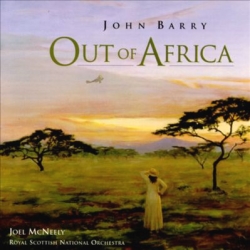
OUT OF AFRICA – John Barry
 GREATEST SCORES OF THE TWENTIETH CENTURY
Original Review by Craig Lysy
Notable directors such as Orson Welles, David Lean and Nicolas Roeg had long sought to bring to the big screen the 1937 novel Out of Africa by Isak Dinesan (Karen Blixen). None were successful in adapting the story into a cogent screenplay. Sydney Pollack however was determined to succeed, and after two years of struggle managed with the assistance of screenwriter Kurt Luedtke to fashion a screenplay drawing from Blixen’s “Out of Africa”, but also her novel “Shadows on the Grass” and Elsbeth Huxley’s novel, “The Flame Trees of Thika”. Mirage Enterprises agreed to fund the project, which would be produced by Kim Jurgensen and Sydney Pollack, who would also direct. A fine cast was assembled, which included the dashing Robert Redford as Denys Hatton, Meryl Streep as Karen Blixen, and Klaus Maria Brandauer as Baron Bror von Blixen. The story offers a sad testament to the life of a wealthy Danish woman Karen Blixen, and the love of her life, Denys Hatton. After she is spurned by her Swedish lover, Karen relocates to British East Africa and enters into a loveless marriage of convenience with his brother, Baron Bror Blixen. They plan to start a dairy cattle farm, but on the wedding day Bror informs her that he plans to instead start a coffee plantation. His infidelity leads to her contracting syphilis, which requires that she return to Denmark for treatment. She returns to find Bror more interested in Safaris than her and they separate. Read more…
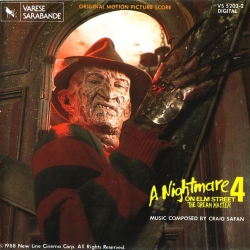
A NIGHTMARE ON ELM STREET 4: THE DREAM MASTER – Craig Safan
 THROWBACK THIRTY
Original Review by Jonathan Broxton
The fourth movie in the massively successful Nightmare on Elm Street horror franchise was A Nightmare on Elm Street 4: The Dream Master; it’s a direct continuation of the story from 1987’s Nightmare on Elm Street 3, in which the survivors of that film have been released from the psychiatric hospital, but still find themselves being stalked by the horribly disfigured child killer Freddy Krueger, who has the ability to murder people in their dreams. The film stars Lisa Wilcox, Danny Hassel, Tuesday Knight, and Robert Englund in his iconic role as Krueger, and was directed by Renny Harlin, who was helming his first major studio feature film following the success of his 1987 English-language debut, the low-budget horror movie Prison. The film was actually one of the best reviewed films of the series, with special praise being given to the surprisingly insightful screenplay by Brian Helgeland, and especially the special effects and design; the critic in the Los Angeles Times wrote at the time that the film was ‘by far the best of the series, a superior horror picture that balances wit and gore with imagination and intelligence’. Read more…
BLACKKKLANSMAN – Terence Blanchard
 Original Review by Jonathan Broxton
Spike Lee doesn’t make subtle movies. He never has. He makes films about race and politics and social injustices and relationships and American life, and then hammers the point home, so that even the most culturally unaware viewer will be left with no doubt as to what his film is saying and – more importantly – why we need to listen. Films like Do the Right Thing, Malcolm X, and Jungle Fever established his credentials as an important filmmaker, while films like Inside Man, 25th Hour, and He Got Game cemented his box office potential. His latest film, Blackkklansman, is the first Spike Lee joint in quite some time to combine commercial success with a major cultural statement, and it has become a significant talking point in a year where race and politics have become vitally important in American society. The film tells the embellished but mostly true story of Ron Stallworth, a black cop in the Colorado Springs Police Department in the early 1970s, who successfully leads an investigation to infiltrate a local chapter of the Ku Klux Klan by posing as a white supremacist – at least on the phone – while a white Jewish colleague, Flip Zimmerman, stands in for him when the time comes for Ron to meet the Klan in person. The film stars John David Washington and Adam Driver as the cops leading the charge; they are ably supported by Laura Harrier as Ron’s student activity girlfriend Patrice, Topher Grace as KKK Grand Wizard David Duke, and Ryan Eggold and Jasper Pääkkönen as local Klan members, with powerful cameos from Corey Hawkins, Alec Baldwin, and Harry Belafonte. Read more…
RAN – Tôru Takemitsu
 GREATEST SCORES OF THE TWENTIETH CENTURY
Original Review by Craig Lysy
Ran, which translates as Chaos, was a passion project for the legendary Japanese director Akira Kurosawa, and most critics believe it to be his last great film. He had envisioned the film for many years, and he even made detailed paintings of the castles and sets he hoped to one day construct. He began writing the screenplay in 1976 but production was delayed by Tōhō Studios executives who balked at the estimated $5 million price tag, which would have made it the most expensive Japanese film ever made. The fact that his last film, Dodes’kaden, was a box office flop also served to harden studio resistance. Fortunately the great success of his film Kagemusha restored studio confidence in Kurosawa, and he was able to forge a partnership, securing funds from French producer Serge Silberman. There are recognizable parallels between Ran and Shakespeare’s King Lear, although Kurosawa related that the similarities did not become apparent to him until after he had conceived his script. Ran was Kurosawa’s last great epic film, one that offers a classic morality play, which affirms the truism that the road to Hell is paved with good intentions. We are offered an excruciating tragedy, which reveals deception, envy, treachery, betrayal and hubris. Read more…

Shop at the Movie Music UK Store

Member of the

 MOVIE MUSIC UK