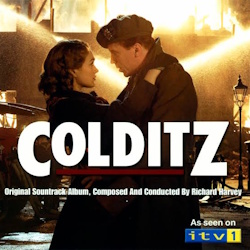
COLDITZ – Richard Harvey
 Original Review by Peter Simons
A remake of the classic 1970s television series, Colditz is a gripping World War II drama about British soldier Jack Rose (Tom Hardy) who is planning his escape from Germany’s infamous Colditz prison. His attempts to make a getaway have less to do with the actual imprisonment, and more with the news that his best friend Nicholas (Damian Lewis) is having an affair with his wife Lizzie (Sophia Myles) back in London. The show premiered on the UK channel ITV1 on 27th March 2005 to much critical and popular acclaim. Read more…
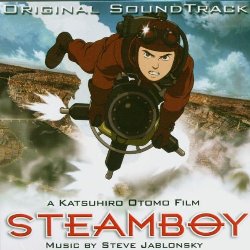
STEAMBOY – Steve Jablonsky
 Original Review by Jonathan Broxton
Isn’t it funny how sometimes the best music comes from the most unlikely of places? Steamboy is the latest Anime adventure from legendary director Katsuhiro Otomo, the man who brought the groundbreaking Akira to the world back in 1988. The film follows the adventures of Ray, a young inventor living in the England in the middle of the 19th century. Shortly before the first ever World Expo, an incredible invention called the Steam Ball arrives at his door – a present from his eccentric grandfather in the USA. However, the nefarious Ohara Foundation has discovered the vast power the Steamball contains, and send men from Japan to the Expo to recover the invention from Ray – at any cost. Read more…
THE RING/THE RING 2 – Hans Zimmer, Henning Lohner, Martin Tillman
 Original Review by Jonathan Broxton
When novelist Koji Suzuki and director Hideo Nakata first came together to make the Japanese film Ringu in 1998, they could scarcely imagine the world wide impact their collaboration would make. The resulting movie was a domestic smash, and an enormous cult success, and has since seen numerous variations-on-a-theme in Asian cinema, as well as the inevitable Hollywood remakes. Essentially a film exploring the horrific potential of modern electrical appliances, the American remake – The Ring – was directed by Gore Verbinski, and starred Naomi Watts as journalist Rachel Keller, who stumbles across a mystery surrounding a video tape which causes the deaths of anyone who watches it. When her own niece falls victim to the video curse, and when her young son Aidan (David Dorfman) begins to behave oddly, Keller digs deeper – and uncovers the horrific history of a young girl named Samara Morgan, an isolated horse farm, terrible telekinetic powers, and an old dark well… Read more…
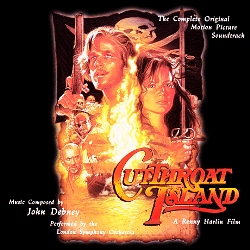
CUTTHROAT ISLAND – John Debney
 MOVIE MUSIC UK CLASSICS
Original Review by Jonathan Broxton
In the decade that has passed since the original release of Cutthroat Island, several things have happened. Firstly, the studio which financed the film – Carolco – was bankrupted and went out of business, predominantly due to the failure of this film. Cutthroat Island cost approximately $92 million to make, and recouped just $10 million at the US box office, making it one of the most spectacular financial flops in cinematic history. Secondly, the film’s stars – Geena Davis and Matthew Modine – have virtually disappeared from our screens: Davis had made just three films since this one (The Long Kiss Goodnight and two Stuart Littles), while Modine has been reduced to starring in movies of the week, although he was nominated for a TV Golden Globe in 1998. Thirdly, and possibly most important in terms of this review, the international profile of John Debney has skyrocketed. Read more…
HOSTAGE – Alexandre Desplat
 Original Review by Jonathan Broxton
March 11th 2005 was unofficially “Alexandre Desplat Day” in US cinemas, when his first two major Hollywood studio films – Hostage and The Upside of Anger – opened in theatres across the country. The 44-year-old Parisian has crept up on the world of film music; having worked solidly in Europe since the early 1990s, people first sat up and took notice following his Golden Globe nomination for Girl With a Pearl Earring in 2003, a success which he capitalized on with the controversial but critically acclaimed Birth in 2004. With the exception of Gabriel Yared, there hasn’t been a French composer in the Hollywood mainstream since Maurice Jarre retired, and before that since the death of Georges Delerue. Desplat more than has the talent to fill their considerable shoes. And, with Hostage, he also shows a great deal of range. Read more…
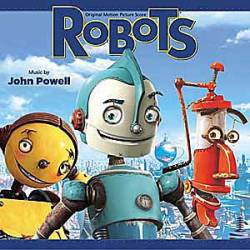
ROBOTS – John Powell
 Original Review by Jonathan Broxton
The first time I sat and listened to John Powell’s score for Robots the two words which immediately sprang to mind were “un-focused” and “schizophrenic”. I had planned for this review to say things like “it’s a score in need of a point”, and talk about how the whole thing lacked coherency and a sense of itself, how it jumped from style to style and genre to genre with such reckless abandon that it rendered the whole thing almost redundant, a chaotic mess of clashing approaches. However, as I have listened to it more and more, my attitude towards it has changed considerably, to the point where I now think it comes close to being one of the best scores Powell has yet written. Read more…
Academy Award Winners 2004
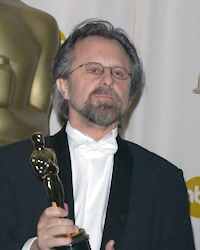 The Academy of Motion Picture Arts and Sciences (AMPAS) have announced the winners of the 77th Academy Awards, honoring the best in film in 2004.
In the Best Original Score category, Polish composer Jan A. P. Kaczmarek won the Academy Award for his score for Marc Forster’s Finding Neverland, which looked at the life of author J. M. Barrie and the creation of his character Peter Pan. In his acceptance speech Kaczmarek said:
I cannot tell you how happy I am, and thank you, Academy. “Finding Neverland” was a great adventure and I’m so proud to be part of it. Marc Forster, he should be here. Marc, thank you for your subtle mind, for your incredible talent. Also Richard is here, Richard Gladstein, a man who truly understands the power of music. I’m very thankful for this as well. And then my wife Elzbieta, who always surprises me with her intellectual passion and incredible taste. She’s responsible for many good notes I’ve written. And to my friend and agent Anita Greenspan, thank you so much.
The other nominees for Best Original Score were John Williams for Harry Potter and the Prisoner of Azkaban, Thomas Newman for Lemony Snicket’s A Series of Unfortunate Events, John Debney for The Passion of the Christ, and James Newton Howard for The Village.
In the Best Original Song category, Uruguayan singer-songwriter Jorge Drexler won the Academy Award for “Al Otro Lado del Río” from Walter Salles’s The Motorcycle Diaries. The victory was historic as “Al Otro Lado del Río” became the first song performed entirely in a language other than English to win the Academy Award for Best Original Song.
The other nominees for Best Original Song were Adam Duritz, Charles Gillingham, Jim Bogios, David Immergluck, Matthew Malley, David Bryson and Daniel Vickrey for “Accidentally in Love” from Shrek 2; Glen Ballard and Alan Silvestri for “Believe” from The Polar Express; Andrew Lloyd Webber and Charles Hart for “Learn to Be Lonely” from The Phantom of the Opera; and Bruno Coulais and Christophe Barratier for “Look to Your Path (Vois Sur Ton Chemin)” from The Chorus (Les Choristes).
THE DEADLY SPAWN – Michael Perilstein
 Original Review by Jonathan Broxton
When I was about nine or ten years old, my best friend at school had one of those Casio keyboards – the kind of inexpensive ones you bought a nine year old so they would have something to do when the weather was bad outside. I distinctly remember being at my friend’s house one time, playing with the keyboard, and improvising some stupid little melody using one finger. Now bearing in mind that I cannot read music, cannot write music, and never graduated beyond one-fingered keyboard tapping, you will begin to understand what I mean when I say that my amateur plonkings that day were, on the whole, better than Michael Perilstein’s score for The Deadly Spawn. Read more…
DER UNTERGANG/DOWNFALL – Stephan Zacharias
 Original Review by Jonathan Broxton
One of the most critically acclaimed – and controversial – films to come out of Germany in recent years is Oliver Hirschbiegel’s Der Untergang (Downfall). The first German production to feature Adolf Hitler as a central figure, Der Untergang is based on the memoirs of Hitler’s secretary, Traudl Junge (played by Alexandra Maria Lara), and tells of the final days of the life of the Führer, deep within his bunker beneath Berlin, as the Russian troops close in. Not afraid to exploit the long-standing fascination with one of the most hated men of the 20th century, Hirschbiegel has nevertheless been criticized in some circles for presenting a portrait of Hitler that is “too sympathetic” – a claim which he vehemently denies. The film is blessed with a powerhouse performance by Bruno Ganz as Hitler, and features sterling support from Corinna Harfouch and Ulrich Matthes as the doomed Goebbels family, and Julianne Köhler as Hitler’s mistress Eva Braun. The film played at the Toronto Film Festival in 2004, and is scheduled for release in major cities world-wide in 2005. Read more…
CONSTANTINE – Brian Tyler, Klaus Badelt
 Original Review by Jonathan Broxton
The latest in a long line of comic book adaptations to hit the silver screen, director Francis Lawrence’s film Constantine is based on the classic Hellblazer story by Jamie Delano and Garth Ellis, transposed from Liverpool to contemporary Los Angeles. Keanu Reeves stars as John Constantine, a man cursed with the awareness that a war between angels and demons is taking place on Earth. Having been driven insane by his visions, he committed suicide as a youth, but was sent back by the angel Gabriel (Tilda Swinton) and charged with destroying as many demons as possible, in order to atone for his sins and be able to enter Heaven again when he finally dies for the second time. However, as the story begins, Constantine finds himself facing his biggest challenge yet: with the help of a similarly gifted Los Angeles cop (Rachel Weisz), Constantine must thwart the plans of Satan’s son, who is planning to be re-born on Earth himself. Read more…
Academy Award Nominations 2004
 The Academy of Motion Picture Arts and Sciences (AMPAS) have announced the nominations for the 77th Academy Awards, honoring the best in film in 2004.
In the Best Original Score category, the nominees are:
- JOHN DEBNEY for The Passion of the Christ
- JAMES NEWTON HOWARD for The Village
- JAN A. P. KACZMAREK for Finding Neverland
- THOMAS NEWMAN for Lemony Snicket’s A Series of Unfortunate Events
- JOHN WILLIAMS for Harry Potter and the Prisoner of Azkaban
These are the first Oscar nominations for Debney and Kaczmarek. This is the 4th nomination for Howard, the 8th nomination for Newman, and the 38th nomination for Williams. Williams previously won for Fiddler on the Roof in 1971, Jaws in 1975, Star Wars in 1977, E.T. the Extra Terrestrial in 1982, and Schindler’s List in 1993.
In the Best Original Song category, the nominees are:
- BRUNO COULAIS and CHRISTOPHE BARRATIER for “Look to Your Path” from The Chorus
- JORGE DREXLER for “Al Otro Lado del Río” from The Motorcycle Diaries
- ADAM DURITZ, CHARLIE GILLINGHAM, JIM BOGIOS, DAVID IMMERGLÜCK, MATT MALLEY, DAVID BRYSON, and DAN VICKREY for “Accidentally in Love” from Shrek 2
- ANDREW LLOYD-WEBBER and CHARLES HART for “Learn to Be Lonely” from The Phantom of the Opera
- ALAN SILVESTRI and GLENN BALLARD for “Believe” from The Polar Express
The winners of the 77th Academy Awards will be announced on February 27, 2005.
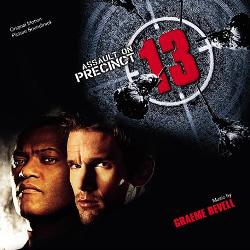
ASSAULT ON PRECINCT 13 – Graeme Revell
 Original Review by Peter Simons
A remake of John Carpenter’s 1976 classic western-meets-urban ghetto thriller, Assault on Precinct 13 stars Ethan Hawke as police officer Roenick, whose precinct is used to shelter a group of policemen and criminals, including crime lord Bishop (Lawrence Fishburne), when their convoy is forced to stop overnight at the precinct due to bad weather, despite the fact that the building has just been closed down for good, and has been cut off from power and communications. Things take an even nastier turn when the precinct is surrounded by an unknown, but heavily armed group ready to kill everybody inside – thereby forcing the cops and the prisoners into an uneasy alliance as they fight off a common enemy. Heralded by most critics as a surprisingly good remake of the 1976 version, other reviewers have slammed director Jean-François Richet’s film for lacking the eerie tension that made Carpenter’s movie a classic. Read more…
BAFTA Nominations 2004
 The British Academy of Film and Television Arts (BAFTA) has announced the nominations for the 58th British Academy Film Awards, honoring the best in film in 2004.
In the Best Original Music category, which is named in memory of the film director Anthony Asquith, the nominees are:
- CRAIG ARMSTRONG for Ray
- BRUNO COULAIS for The Chorus
- JAN A. P. KACZMAREK for Finding Neverland
- GUSTAVO SANTAOLALLA for The Motorcycle Diaries
- HOWARD SHORE for The Aviator
These are the first nominations for Coulais, Kaczmarek, and Santaolalla. It is the third nomination for Armstrong, and the fifth nomination for Shore. Armstrong previously won for William Shakespeare’s Romeo + Juliet in 1997 and Moulin Rouge! in 2001.
The winners of the 58th BAFTA Awards will be announced on February 12, 2005.
LES CHORISTES/THE CHORUS – Bruno Coulais
 Original Review by Peter Simons
France’s submission for this year’s Best Foreign Language Film at the Oscars, The Chorus (Les Choristes) tells the somber story of music teacher Clement Mathieu (Gerard Jugnot) accepting a position at a remote school for difficult students. While the school’s headmaster believes in strict discipline and runs the place like a prison, the new teacher believes that a little love and goodwill can go a long way. As Mathieu succeeds in bringing his deviant pupils together in a choir, they discover a hidden talent within themselves. Read more…

Shop at the Movie Music UK Store

Member of the


