STARGATE – David Arnold
 THROWBACK THIRTY
GREATEST SCORES OF THE TWENTIETH CENTURY
Original Review by Jonathan Broxton
One of the most enduring conspiracy theories in the world is the notion of ‘ancient astronauts,’ which suggests that extraterrestrial beings were responsible for building some of Earth’s ancient structures, including the pyramids of Giza. This idea plays a central role in the plot of Stargate, providing an interesting twist on Egyptian mythology and history. The film is a sci-fi action-adventure directed by German filmmaker Roland Emmerich, whose previous works included the 1990 sci-fi Moon 44, and the 1992 action thriller Universal Soldier; it stars James Spader as Daniel Jackson, a linguist and Egyptologist, who is recruited by the U.S. military to help decipher a series of symbols on an ancient artifact which was discovered in Egypt many years previously. Jackson determines that the artifact is a portal – a ‘star gate’ – that can transport people across vast distances of space to another planet; following this discovery the military sends Jackson and a team of soldiers led by the taciturn Colonel Jack O’Neil (Kurt Russell) through the star gate to assess any potential threats. Once on the other side they find themselves on a desert-like planet, where they encounter a civilization that appears to be influenced by ancient Egyptian culture, and learn that the planet is ruled by an alien posing as the Egyptian sun god Ra (Jaye Davidson), who uses advanced technology to enslave the inhabitants.
Stargate is one of my favorite popcorn movies of the 1990s, a rip-roaring adventure that unfolds in a way that can be described as ‘Star Wars meets Lawrence of Arabia’. I found the ideas, the concepts, and the world-building to be first rate, and the film is visually spectacular, a superb combination of massive desert landscapes and futuristic alien technology. The film was a huge commercial success, grossing nearly $200 million worldwide on a $55 million budget, and it was popular enough with fans that it developed a cult following and launched a franchise that expanded into three successful TV series: Stargate SG-1, Stargate Atlantis, and Stargate Universe.
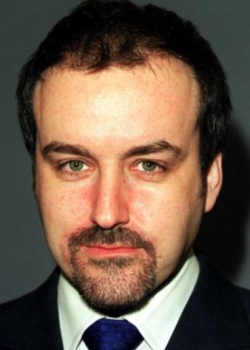 The score for Stargate was by the then 32-year-old British composer David Arnold, who at the time he was hired was a virtual unknown. His only prior film work had been on the 1993 low-budget British crime thriller The Young Americans, which very few people saw, but which had an unusually popular soundtrack, thanks mostly to the success of the song “Play Dead” by Björk, which Arnold produced and co-wrote. Via a circuitous route involving one of the executive producers on The Young Americans, Mario Kassar of the film studio Canal+, and an executive at Carolco Pictures, Arnold’s music ended up in the hands of director Emmerich and his producing partner Dean Devlin, and following some discussions between them and the film’s music supervisor they took a chance and hired Arnold to write the score. In an interview with Variety in 2019, Arnold recalls that the job couldn’t have come at a better time for him, as he had just applied for a job in a video rental store to make ends meet in between writing scores for student films. This would be the last time that Arnold had to worry about anything like that.
Stargate is, along with things like Patrick Doyle’s Henry V, one of the greatest debut breakout scores of the entire decade. It’s a huge, sweeping adventure score for a full symphony orchestra and chorus, a glorious throwback to classic Hollywood, and is filled with memorable themes, spectacular action sequences, tender romance, and moments of mystery and horror. It was recorded in the UK with the Sinfonia of London and the Chameleon Arts Chorus, with special vocal performances by of Egyptian-Belgian singer Natacha Atlas, and some elements of Egyptian percussion courtesy of virtuoso percussionist Hossam Ramzy.
Structurally, the score is built around several recurring themes, almost all of which are introduced in the opening “Stargate Overture”. The first performance of the main theme emerges from out of a lilting flute accompanied by unusual, menacing growls, swelling into the first statement at the 0:40 mark. It’s a massive, epic, sweeping theme for the full orchestra, full of grandeur and a sense of adventure, and which is led by a notably bright brass part that just sings. There is a secondary B-phrase part to the main theme, first heard at the 1:15 mark, which is lighter and more optimistic and, as the score develops, tends to speak to the sense of awe and wonderment that Jackson feels when making his discoveries. The 1:55 mark sees the score switch to the Ra Theme, a dark and eerie motif for keening strings and brass accompanied by sinister whispering, which eventually becomes a powerful and dominant choral chant, a perfect musical reflection of the villain of the piece.
The rest of the score develops mostly through statements of, and variations on, those themes, but what’s really impressive is how Arnold is constantly able to extract little elements from one or more of these main ideas, and use them in fascinating ways. He changes the orchestration constantly, not only shifting around between brass and strings and woodwinds, but also arranging them for Egyptian flutes, to give the score a more exotic sound. He will take the underlying rhythmic ideas of the themes and make them the centerpiece of a later cue, and then blend that with the countermelody of a different theme, to create an entirely new sound, but one which is still derived from the same building blocks. He changes the key to add a sense of tragedy and loss, and then elsewhere he re-arranges the whole thing as an action track to underscore a moment of heroism. It’s really, really sophisticated, and quite astonishing that he would be able to pull all this off in what was just his second ever full-length score.
Several cues stand out to me as being especially notable. “Giza, 1928” offers an exotic version of the main Stargate theme bolstered with Arabic percussion and the vocal stylings Atlas, to underscore the flashback scene where the star gate is discovered during an archaeological dig just outside Cairo; the massive choral statement of the ‘awe and wonderment’ B-phrase at the end of the cue is especially satisfying. Both “Unstable” and “Orion” feature a twinkling ‘discovery motif’ for piano, harp, and celesta, that accompanies Daniel’s revelations about what the star gate is and what it does. The end of “Orion” and most of “You’re On The Team” is built around a militaristic variation on one of the rhythmic parts of the main theme, used as a marker for O’Neil and his platoon of marines.
“The Stargate Opens” could be described as a fantasy on the ‘awe and wonderment’ B-phrase, as it accompanies the scene where – thanks to Jackson’s discovery – different parts of the device lock into place, and the star gate opens for the first time. There is a superb warm horn motif, several gorgeous orchestration touches for strings and woodwinds, an especially dramatic rendering of the main theme as the whole thing builds up to the moment of truth, and then a bank of angelic choral work as Jackson, O’Neil, and the scientists see the working device for the first time. Then, “Entering the Stargate” underscores the scene where Jackson, O’Neil, and the platoon of soldiers make their journey from Earth, through the star gate, to who knows where. This cue is a perfect depiction of how Arnold delineates the personalities of the two main characters: as O’Neil goes through the music is nervous, a little trepidatious, but with an underlying sense of militaristic clenched-teeth grit that eventually becomes dissonant and twisted as the soldiers disappear through the gate one by one; I especially like how Arnold subtly foreshadows the Ra theme here, hinting at the danger to come. However, when Jackson heads through the gate, it is the beautiful ‘awe and wonderment’ B-phrase that takes precedence, clearly showing that Jackson sees this as a magical adventure. It’s a great musical illustration of how the two men see the entire project entirely differently – and how those differences will affect everything later.
“The Other Side” subtly references the Ra Theme again, before slowly building to a huge fanfare that accompanies the revelation of the fact that the star gate leads to an alien pyramid on a vast, desert world. The brilliant “Mastadge Drag” is a brief but magnificently joyous scherzo variation on the main theme, accompanying a humorous scene where Jackson gets accidentally caught in the harness of a camel-like alien creature and is hoisted off his feet and through some sand dunes.
This leads into the one-two punch of “The Mining Pit” and “King of the Slaves,” which offers a musical introduction to the inhabitants of the planet, humans who work as slaves for Ra, and who are watched by what appear to be robot versions of the Egyptian gods Horus and Anubis. Arnold scores this with a superb minor-key variation on the main theme for brass and choir, underpinned by dour anvil clanks, plus a lilting new theme which appears to be recurring motif for Kasuf, the de-facto leader of the slaves. Arnold’s use of Egyptian and other Arabic woodwinds here gives it an authentic flavor, while his (possibly unintentional) melodic reference to the song ‘Over the Rainbow’ at 0:55 in “The Mining Pit” hammers home the fact that we’re definitely not in Kansas anymore.
“Caravan to Nagada” contains several terrific, sweeping statements of the main theme as Jackson, O’Neil, and the soldiers follow Kasuf and the slaves across the desert to their home city of Nagada. This is Arnold’s Lawrence of Arabia moment, where he gets to fully immerse himself in the beauty and grandeur of the landscape, and he nails it. The statements of the theme are accompanied by huge rolling gong crashes, and the orchestrations are almost impossibly lush. This cue also marks the first playful appearance of the love theme for Jackson and Shauri, Kasuf’s beautiful daughter, and this is explored further in the subsequent “Daniel and Shauri”. The love theme is playful, bashful, hesitant, and a little comedic, with some especially lovely writing for twittering woodwinds, dreamy harp glissandi, and warm strings.
From this point on the score switches and comes to be dominated by Ra’s Theme, and by action. Ra himself first appears in “Sarcophagus Opens,” rising from the depths of his palace draped in gold and wearing a Tutankhamun-like mask; Arnold’s unsettlingly atonal brass writing, brutal cascading strings, eerie voices, and chromatic dancing woodwinds give Ra a threatening aura of God-like power that is just outstanding.
Later cues follow a similar approach; both “Ra – The Sun God” and “Myth, Faith, Belief” offer dark and ominous statements of the malevolent Ra theme, dripping with menace, keening strings and guttural brasses dominating throughout. Both cues also end with an explosion of rich action – “Ra – The Sun God” has an especially vicious-sounding trumpet motif that continues to build throughout the track – that acts as a superb precursor to the action to come. The brutal action piece “Leaving Nagada” shifts easily between muscular action, tender woodwind writing, unsettling choral textures, and dark and insistent references to the Ra Theme, as the scorned pharaoh delivers retribution on the slaves that defied him by sending his war planes to bomb the city. The subsequent “The Destruction of Nagada” underscores the aftermath of that attack, and is an outstanding moment of musical drama which sees Arnold offering a heavily tragic version of Kasuf’s theme as the distraught old man stumbles through the rubble of his city.
The 20-minute finale of the score begins with the “Procession,” which accompanies the scene of Ra emerging from his pyramid with his entourage to re-assert his dominance over the slaves, and to eliminate both Jackson and O’Neil. Arnold scores Ra’s procession with a massive dirge-like march variation on the Ra theme for orchestra and chorus, and which includes some terrific impressionistic string writing at the very end of the cue. However, Jackson and O’Neil have a trick up their sleeve, and initiate a “Slave Rebellion,” encouraging Kasuf and the inhabitants of Nagada to rise up and rid themselves of Ra once and for all. Arnold captures this moment with a huge and explosive statement of the main theme, similar to the version heard in “Mastadge Drag,” plus a sort of action arrangement of Kasuf’s theme.
The “Battle at the Pyramid” is the score’s key action sequence, a three-pronged attack which sees Jackson attempting to infiltrate the pyramid and rescue an injured Shauri from Ra, Kasuf and the slaves attacking Ra’s army, and O’Neil attempting to plant and arm a bomb which will hopefully explode, killing Ra and destroying the pyramid. Arnold completely lets rip with his orchestra here, incorporating action arrangements of the main theme, the Ra theme, and even Kasuf’s motif into the body of his scintillating orchestral runs. The score reverberates to pounding percussion ostinatos, slashing strings, and bold exclamations of brass power, and for the first time Arnold really shows what a tremendous action composer he will become – this is the blueprint for his later work on Independence Day, Godzilla, and his Pierce Brosnan James Bond films.
 What’s amazing, though, is that he had all this in his pocket right from the get-go: the orchestration, the intelligent integration of themes, the complicated internal rhythms, the counterpoint. Some commentators have attributed much of Arnold’s early success to Nicholas Dodd’s orchestrations, and suggested that the outstanding depth and complexity of the action music is solely down to him. While its true that Dodd would later bring a similar sound to the work of other composers not previously known for their rousing orchestral action – I’m thinking specifically of Mychael Danna’s Ride With the Devil, and Clint Mansell’s Sahara – and while it’s also true that what many consider to be Arnold’s career best scores are ones where they worked together, to suggest that Dodd is responsible for Arnold’s success is unfair to both men, and likely offers an inaccurate picture of their collaboration.
The conclusive cues, “The Surrender” and “Kasuf Returns,” further build on that same action style. The former features some especially thrilling and vivid brass flourishes, while the latter offers a fantastic statement of Kasuf’s theme as he leads a charge of slave warriors down a sand dune and into battle, includes a superb action version of the ‘awe and wonderment’ main theme B-phrase with full orchestral tutti counterpoint, and ends with a darkly cataclysmic choral version of Ra’s Theme as he desperately tries to take off in his pyramid spaceship – only for O’Neil’s nuclear bomb to destroy it, and Ra along with it, freeing the slaves once and for all. The whole thing ends happily in “Going Home,” with several stately and noble performances of the main theme, and a sweet recapitulation of the love theme for Jackson and Shauri, before the whole thing gradually builds into a gigantic fanfare that ends with a grand crescendo.
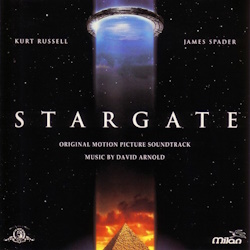
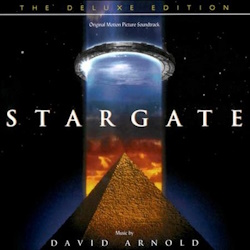
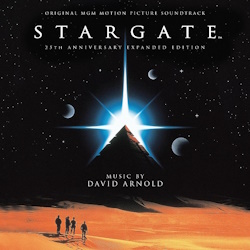 The original Stargate album contained just under 65 minutes of score, not quite in chronological order but good enough, and I have always found it to be an excellent, wholly satisfying representation of the best parts of the score. However, as collectors are always thirsty for more, there have been several subsequent expanded releases. In 2006 Varèse Sarabande issued a “deluxe edition” of the score, which included nine additional cues, and a stricter chronological film order. The album does have improved sound quality, and some of the new cues are excellent, notably a trio of action cues (“Execution,” “Against the Gods,” and “Transporter Horror”). Then in 2019 La-La Land Records released an even longer product in recognition of the film’s 25th anniversary; this 2-CD set expanded the running time to almost 2 hours, and included several film version/alternate version takes on the same cue, plus one or two of the score’s more abrasive cues that were omitted from the first two albums. While the expansions are worthwhile for their outstanding liner notes, I have personally always found the original album to deliver exactly what I need from the score, so take from that what you will.
As I mentioned earlier at the beginning of the review, Stargate is, for me, one of the greatest debut breakout scores of the entire decade. It’s the score which introduced David Arnold as a great new talent in the film music world, and would set him up to eventually become the best James Bond composer not named John Barry. For fans of rousing, adventurous, classically orchestral action and sci-fi scores, Stargate is an essential purchase, and remains one of the best scores of 1994.
Buy the Stargate soundtrack from the Movie Music UK Store
Track Listing:
- 1994 ORIGINAL MILAN RELEASE
- Stargate Overture (3:01)
- Giza, 1928 (2:10)
- Unstable (2:07)
- The Coverstones (0:58)
- Orion (1:29)
- The Stargate Opens (3:58)
- You’re On The Team (1:55)
- Entering The Stargate (2:57)
- The Other Side (1:44)
- Mastadge Drag (0:56)
- The Mining Pit (1:34)
- King of the Slaves (1:15)
- Caravan to Nagada (2:16)
- Daniel and Shauri (1:53)
- Symbol Discovery (1:15)
- Sarcophagus Opens (0:55)
- Daniel’s Mastadge (0:49)
- Leaving Nagada (4:09)
- Ra – The Sun God (3:22)
- The Destruction of Nagada (2:08)
- Myth, Faith, Belief (2:18)
- Procession (1:43)
- Slave Rebellion (1:00)
- The Seventh Symbol (0:57)
- Quartz Shipment (1:27)
- Battle at the Pyramid (5:02)
- We Don’t Want To Die (1:57)
- The Surrender (1:44)
- Kasuf Returns (3:06)
- Going Home (3:09)
- 2006 VARESE SARABANDE EXPANDED RELEASE
- Stargate Overture (3:03)
- Wild Abduction (1:19)
- Giza, 1928 (2:11)
- Unstable (2:08)
- The Coverstones (0:59)
- Translation and Orion (1:49)
- The Stargate Opens (3:58)
- You’re On The Team (1:57)
- Entering the Stargate (2:57)
- The Other Side (1:45)
- Bomb Assembly (1:09)
- Mastadge Drag (0:57)
- The Mining Pit (1:36)
- King of the Slaves (1:16)
- Caravan to Nagada (2:17)
- The Eye of Ra (0:41)
- Daniel and Shauri (1:53)
- Symbol Discovery (1:14)
- Sarcophagus Opens (0:57)
- Daniels Mastadge (0:49)
- Leaving Nagada (4:11)
- Ra – The Sun God (3:23)
- The Destruction of Nagada (2:09)
- Myth, Faith, Belief (2:19)
- Procession (1:44)
- Slave Rebellion (1:01)
- We Don’t Want to Die (1:58)
- Execution (1:16)
- The Kiss/The Seventh Symbol (1:50)
- Against the Gods (0:34)
- Quartz Shipment (1:28)
- Battle at the Pyramid (5:03)
- Surrender (1:45)
- Transporter Horror (1:49)
- Kasuf Returns (3:06)
- Going Home (3:10)
- Closing Titles (Intro) (1:13)
- 2019 LA-LA LAND 25TH ANNIVERSARY EXPANDED EDITION
- Stargate Overture (3:03)
- Abduction (1:18)
- Giza, 1928 (2:12)
- Unstable (2:44)
- The Coverstones (1:00)
- Translation/In Case You Succeed (0:52)
- Orion (1:30)
- The Stargate Opens (3:58)
- Send In The Probe (2:08)
- You’re On The Team (1:57)
- Entering The Stargate (3:00)
- The Other Side (1:46)
- Bomb Assembly (1:09)
- Mastadge Drag (0:57)
- The Mining Pit (1:34)
- King of the Slaves (1:21)
- Caravan To Nagada (2:14)
- The Eye of Ra (0:41)
- Daniel and Sha’uri (1:55)
- Spread Out (1:52)
- Skaara and Gun (0:44)
- Symbol Discovery (1:13)
- Sarcophagus Opens (0:58)
- Daniel’s Mastadge (0:50)
- Leaving Nagada (4:13)
- Ra – The Sun God (3:22)
- The Destruction of Nagada (2:09)
- Myth, Faith, Belief (2:22)
- Procession (1:45)
- Slave Rebellion (1:02)
- We Don’t Want To Die (2:00)
- Execution (1:18)
- The Kiss (0:38)
- The Seventh Symbol (1:19)
- Against The Gods (0:35)
- Quartz Shipment (1:31)
- Battle At The Pyramid (5:27)
- The Surrender (1:45)
- Transporter Horror (1:49)
- Kasuf Returns (3:07)
- Going Home (3:10)
- End Credits (1:13)
- Unstable (Alternate) (2:11) BONUS
- Orion (Alternate) (1:31) BONUS
- The Stargate Opens (Alternate Excerpt) (1:15) BONUS
- Entering The Stargate (Alternate) (2:58) BONUS
- King of the Slaves (Alternate) (1:17) BONUS
- The Eye of Ra (With Choir) (0:41) BONUS
- Sarcophagus Opens (Alternate) (0:57) BONUS
- Daniel’s Mastadge (Alternate) (0:50) BONUS
- Leaving Nagada (Alternate) (4:11) BONUS
- Ra – The Sun God (Alternate) (3:24) BONUS
- Ra – The Sun God (Film Version Excerpt, No Choir) (2:16) BONUS
- The Seventh Symbol (Alternate) (0:58) BONUS
- Battle at the Pyramid (Alternate) (5:03) BONUS
- End Credits (Alternate Take) (1:15) BONUS
Milan Records 35697-2 (1994)
Varese Sarabande VSD-673 (1994/2006)
La-La Land Records LLLCD1511 (1994/2019)
Running Time: 63 minutes 14 seconds – Milan
Running Time: 72 minutes 54 seconds – Varese Sarabande
Running Time: 118 minutes 28 seconds – La-La Land
Music composed by David Arnold. Conducted by Nicholas Dodd. Performed by The Sinfonia of London and the Chameleon Arts Chorus. Orchestrations by Nicholas Dodd. Special vocal performances by Natacha Atlas. Recorded and mixed by Geoff Foster. Edited by Laurie Higgins. Score produced by David Arnold. 1994 Varese album produced by Robert Townson. 2019 La-La Land album produced by David Arnold, Neil S. Bulk, M.V. Gerhard and Matt Verboys.

Shop at the Movie Music UK Store

Member of the


