THE HOUSE OF THE SPIRITS – Hans Zimmer
 THROWBACK THIRTY
Original Review by Jonathan Broxton
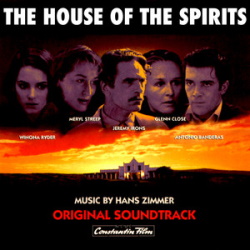
The House of the Spirits is an epic family drama based on Isabel Allende’s novel, a seminal work in Latin American literature, renowned for its magical realism and rich storytelling. Set in an unnamed South American country, widely believed to be inspired by Allende’s native Chile, the story spans several generations of the Trueba family as they experience the complex history and social dynamics of the country, beginning with the family patriarch, Esteban Trueba, his wife Clara, and their descendants. Esteban is a self-made man who amasses wealth and power through his land holdings, but his authoritarian nature and violent tendencies tend to alienate him from his family. Meanwhile, Clara possesses supernatural gifts and serves as a counterbalance to Esteban’s brutality with her gentle and intuitive nature. Years pass and the political and social upheaval in the country deeply affects the Truebas; in particular their daughter Blanca is forced to navigate the tumultuous political landscape of their country, which is marked by social injustice, oppression, and revolution. The film was directed by Bille August, has an exceptional cast including Meryl Streep, Jeremy Irons, Glenn Close, Winona Ryder, and Antonio Banderas, and has a score by Hans Zimmer.
In 1994 Zimmer was very much a composer who was dabbling in every genre and every style – his work that year not only included this score but also I’ll Do Anything, Renaissance Man, Drop Zone, and The Lion King, the latter of which won him his first Oscar. All of these are very different scores with very different sounds, encompassing everything from light comedy to masculine action and, of course, the grand sounds of the African savannah, but for The House of the Spirits Zimmer went down a mainly traditional route.
 The score was recorded in Germany with the Philharmonic Film Orchestra Munich and is a large scale orchestral work filled with deeply romantic passages of lush melodrama. Considering the nature of the story, the music tends to be very serious and at times quite tragic, but this does not mean that the score is depressing; on the contrary, Zimmer punctuates his work with moments of great beauty, and often combines his orchestra with electronic elements to beef up the sound, while also using some subtle regional instruments to give the music a touch of South American color. As was the case with many of his soundtrack albums at the time, the music is arranged into five lengthy suites, each of which are made up of several smaller cues edited together.
The opening suite, “The House of the Spirits,” introduces the score’s main theme, an elegant and romantic anthem that acts as an overarching musical identity for the Trueba family as a whole. However, rather than remaining lush and positive, the theme quickly changes its emotional content, and for the remainder of the piece tends to be somewhat more reserved and perhaps even a little melancholy, exploring the idea that this family will suffer great tragedy amid all the country’s social and political upheaval. There is some lovely writing for solo trumpet which foreshadows some of the work Zimmer would do on Crimson Tide in 1995, as well as some sophisticated writing for woodwinds amid the darkly-hued strings that may remind some listeners of later scores like Gladiator and even Hannibal. These are accentuated by quite a bit of bass-heavy rhythmic electronic/synth coloring, as was Zimmer’s preferred sound at that time. This has long been one of my favorite ‘serious’ Zimmer cues of the period, and it continues to be so today.
The subsequent “Clara” explores the identity of Meryl Streep’s character, whose loving nature and tendency towards magical spirituality marks her as a contrast to her more serious, sometimes violent husband. Her music is built around a gorgeous classical piano melody performed by none other than Nick Glennie-Smith, one of Zimmer’s most traditionally romantic, but even here the melody is underpinned with a sense of anxiety and earnestness, underlining the tone of dark melodrama that permeates the entire score, which is mostly achieved by backing the other instruments with a bank of unnervingly high strings.
“Coup” offers what appear to be thematic variations on both the main House of the Spirits theme and the theme for Clara, but which are arranged to offer emotional feelings of desperation and grief, as Esteban and Clara witness firsthand the impact of their country’s political turmoil. A dramatic mid-section includes what is the score’s only concession to action music, but it isn’t one of the hyper-masculine power anthems that one usually associates with 1990s Zimmer; instead, it is often quite understated, but it is also laced with a sense of real fear and anxiety that is achieved through some occasionally quite fierce compositional dissonance. As if that wasn’t enough, Zimmer utilizes the sound of gunshots within his snare riff percussion rhythms, hammering home just what sort of experiences the Truebas are living through.
“Pedro and Blanca” musically explores the relationship between Esteban and Clara’s willful and headstrong daughter, Blanca, and Pedro Tercero, the son of Esteban’s foreman who grows up to be a passionate revolutionary. It starts out quietly, subtly, with some lovely if perhaps downbeat writing for woodwinds and Spanish guitars, but gradually it grows to become more passionate through the addition of lively percussion patterns, stoking the flames not just of their passions, but of their thirst for political insurgency.
The finale cue, “Clara’s Ghost/La Paloma/Closing Titles,” opens with a delicate, almost fragile version of Clara’s theme for whispery strings and soft woodwinds, which quickly segues into a vintage recording performance of the period-authentic Spanish language tune “La Paloma” sung by popular Chilean singer Rosita Serrano. One other song, “La Cumparsita,” appears prominently in the film. It’s a classic Uruguayan tango tune performed by German bandleader Adalbert Lutter and his orchestra, but this piece does not appear on the soundtrack album. Eventually the score moves back to Zimmer, and the “Closing Titles” offers a gorgeous and sweeping rendition of the main theme to close the album. Personally, I would have preferred the performance of “La Paloma” to be separated out from the score as it does tend to break the flow, but it’s a small criticism and not a big deal in the bigger scheme of things.
The House of the Sprits is not a happy score, but personally I have always found the darkly dramatic tone of this score to be exceptionally compelling, and I wish that this ‘brooding romance’ approach was something that Zimmer explored more frequently today, because he is excellent at it. It has a sophisticated sound, an emotionally complex framework, memorable thematic ideas, and features some excellent performances for woodwinds, piano, and guitars, amid the heavy sweep of the strings. I personally think that The House of the Spirits is one of Zimmer’s best straight dramatic scores, and it’s a shame that it often seems to get overlooked on lists of his most impressive works.
Buy the House of the Spirits soundtrack from the Movie Music UK Store
Track Listing:
- The House of the Spirits (10:02)
- Clara (6:31)
- Coup (9:34)
- Pedro and Blanca (9:50)
- Clara’s Ghost/La Paloma/Closing Titles (La Paloma written by Sebastian de Yradier, performed by Rosita Serrano) (7:24)
Virgin Records 7243-8-39219-2-8 (1994)
Running Time: 43 minutes 21 seconds
Music composed by Hans Zimmer. Conducted by Fiachra Trench. Performed by Philharmonic Film Orchestra Munich. Orchestrations by Nick Glennie-Smith and Fiachra Trench. Featured musical soloists Jürgen Musser, Martin Spanner, Richard Stuart, Douglas Myers, Michael Stevens, and Nick Glennie-Smith. Recorded and mixed by Malcolm Luker. Edited by XXXX. Album produced by Hans Zimmer and Bille August.

Shop at the Movie Music UK Store

Member of the


