John Cacavas, 1930-2014
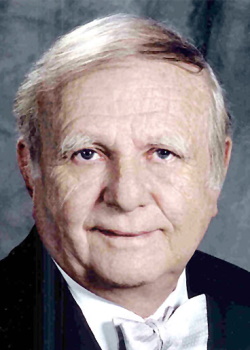 Composer, arranger and conductor John Cacavas died at his home in Beverly Hills, California, on January 28, 2014, at the age of 83, following a period of declining health.
A prolific figure in American film and television music, Cacavas scored hundreds of television episodes, numerous television movies and a smaller but memorable group of feature films, including Horror Express, Airport 1975 and Airport ’77. He remains especially associated with Kojak, for which he composed music for more than 100 episodes.
Cacavas was born in Aberdeen, South Dakota, on August 13, 1930, into a Greek-American family. He became interested in music as a teenager, taught himself saxophone and was leading his own dance band by the age of 14. After studying at Northern State College, he transferred to Northwestern University, where he studied composition and theory. Military service subsequently took him to Washington, D.C., where he worked as an arranger for the United States Army Band.
After leaving the Army, Cacavas moved to New York and worked as an arranger, songwriter and conductor, eventually joining CBS. During this period he collaborated frequently with broadcaster Charles Osgood. Among their projects was Senator Everett Dirksen’s spoken-word recording Gallant Men, which became a major success and won the Grammy Award for Best Spoken Word Recording in 1967.
His move into film music came through actor Telly Savalas, whom Cacavas met while working in London during the early 1970s. Savalas helped him secure assignments on Horror Express (1972) and the western Pancho Villa (1972), both starring the actor. Horror Express, which also featured Christopher Lee and Peter Cushing, allowed Cacavas to combine orchestral suspense writing with unusual colors appropriate to its mixture of period adventure, science fiction and horror.
Cacavas remained in the horror genre for The Satanic Rites of Dracula (1973), one of Hammer Films’ final Christopher Lee Dracula pictures. He soon moved into larger-scale Hollywood productions with Airport 1975 (1974), providing the disaster sequel with a broad symphonic score combining suspense, action and romantic material. He returned to the franchise for Airport ’77 (1977), and these two scores remain his most prominent feature-film work.
Television, however, became the center of Cacavas’s career. Beginning in 1973 he became one of the principal composers for Kojak, starring Savalas as New York detective Theo Kojak, eventually scoring more than 100 episodes and writing a new main-title theme for the final season. His music combined brassy urban action writing, jazz influences and a strong melodic sense, and his work on the series earned him an Emmy nomination.
Cacavas’s television résumé was enormous. He contributed music to series including Hawaii Five-O, The Bionic Woman, Mrs. Columbo, The Equalizer, Matlock, Columbo and Murder, She Wrote. His many television movies and miniseries included The Elevator, SST: Death Flight, The Executioner’s Song, A Death in California and Perfect Murder, Perfect Town. He received a second Emmy nomination for the police drama Eischied.
Other feature assignments included the science-fiction thriller Hangar 18 (1980), Gangster Wars (1981) and They’re Playing with Fire (1984), but television remained his natural home. Away from the screen, Cacavas wrote extensively for concert bands and educational ensembles and published books on composition and arranging, including Music Arranging and Orchestration.

Shop at the Movie Music UK Store

Member of the


