Remembering Hans J. Salter, 1896-1994
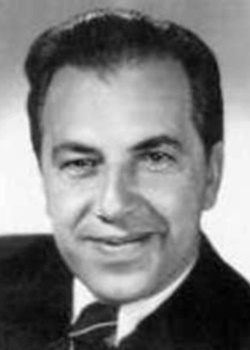 Composer, conductor and musical director Hans J. Salter died at his home in Studio City, California, ten years ago today, on July 23, 1994, at the age of 98.
An Austrian émigré who became one of the principal architects of the classic Universal horror sound, Salter worked on more than 200 films during nearly three decades at the studio. His music accompanied werewolves, vampires, Frankenstein monsters, Sherlock Holmes adventures, westerns and musicals, and brought him six Academy Award nominations.
Hans Julius Salter was born in Vienna on January 14, 1896. He studied at the University of Vienna and Vienna Music Academy with teachers including Guido Adler, Franz Schreker, Felix Weingartner and, briefly, Alban Berg. After working in opera, Salter moved into cinema during the late 1920s, first conducting in Berlin movie theatres and then composing for UFA. As a Jewish musician he was forced out of the German film industry after the Nazi rise to power and eventually emigrated to the United States in 1937.
Universal hired Salter initially as an orchestrator in 1938, but he was soon promoted to composer and became one of the studio’s busiest musical craftsmen. Working frequently with Frank Skinner and other staff composers, he supplied music for everything from Deanna Durbin musicals and Abbott and Costello comedies to serials, melodramas and horror pictures. Much of this work went uncredited or was subsequently recycled as stock music throughout Universal’s productions.
It was horror that ultimately defined his reputation. Salter and Skinner created much of the music for The Wolf Man (1941), starring Lon Chaney Jr., developing a dark orchestral language of ominous motifs, surging strings and dramatic brass that became inseparable from Universal’s Gothic world. Music from these scores was frequently reused in subsequent monster films, helping establish a coherent musical identity across the studio’s horror cycle.
Salter subsequently contributed to Frankenstein Meets the Wolf Man (1943) and House of Frankenstein (1944), as well as numerous other horror and mystery films. His later genre work extended into the science-fiction era with Creature from the Black Lagoon (1954), on which he shared scoring duties with Henry Mancini, Herman Stein and others, and Jack Arnold’s The Incredible Shrinking Man (1957), whose music combined menace with an unexpectedly melancholy quality.
His career was by no means confined to monsters. Salter scored Fritz Lang’s Scarlet Street (1945), the swashbuckler Against All Flags (1952), Anthony Mann’s western Bend of the River (1952), The Black Shield of Falworth (1954), and numerous Audie Murphy westerns and Universal adventure films. He also supplied music for most of the Basil Rathbone-Nigel Bruce Sherlock Holmes series and many Abbott and Costello pictures.
Salter received six Academy Award nominations between 1942 and 1945, for It Started with Eve, The Amazing Mrs. Holliday, Christmas Holiday, The Merry Monahans, This Love of Ours and Can’t Help Singing. None resulted in a win, but the nominations reflected the breadth of his work far beyond the horror films for which he later became famous.
Salter retired in 1967, after completing more than 200 scores, and later received lifetime achievement recognition from organizations devoted to horror, science fiction and film-music preservation.

Shop at the Movie Music UK Store

Member of the


