Archive
Under-the-Radar Round Up 2017, Part 5
 Original Reviews by Jonathan Broxton
The fifth installment in my annual series of articles looking at the best “under the radar” scores from around the world sees us in one of my favorite film music countries, Spain. I have long been a vocal promoter Spanish film music which, over last ten years or so, has become a soundtrack powerhouse filled with composers who – in terms of the number of excellent scores per film – are probably writing the highest quality film music in the world. 2017 was no exception, with dozens of excellent scores emerging from the country during the calendar year. This article contains the scores which, in my opinion, are the eight best, which encompass both film and television, span multiple genres, and are written both by familiar favorites and exciting newcomers.
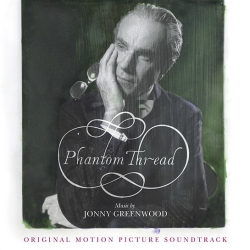
PHANTOM THREAD – Jonny Greenwood
 Original Review by Jonathan Broxton
Phantom Thread is a period romantic drama film written and directed by Paul Thomas Anderson. Set in England in the 1950s, it stars Daniel Day-Lewis as Reynolds Woodcock, a fashion designer and exquisite dressmaker, who runs a high-end haute couture business with his sister Cyril (Lesley Manville), and whose regular clients include the cream of European royalty. Reynolds is brilliant, an artist of tremendous skill and taste, but is also neurotic, difficult, irritable, and unhealthily obsessed with his late mother; he also frequently embarks on fiery relationships with women that fizzle out as soon as he gets bored, upon which he begins treating them with casual disdain. One day Reynolds meets Alma (Vicky Krieps), a shy waitress, to whom he is unexpectedly attracted. Before long Reynolds has moved Alma into his house in London, and she quickly becomes his muse, challenging him, confounding him, but also inspiring greatness in his work. However, their relationship is tempestuous, and before long it is heading down an unexpectedly dark path which may have serious repercussions for everyone involved. Read more…
DOWNSIZING – Rolfe Kent
 Original Review by Jonathan Broxton
Downsizing is the latest film from director Alexander Payne. It has a fascinating premise; in a research lab in Norway a team of scientists led by Dr. Jørgen Asbjørnsen (Rolf Lassgård) finds a way to shrink a human being from full size, down to about five inches tall – perfectly safe, no side effects, but irreversible – as a way to halt humanity’s over-consumption of the planet’s natural resources . Within a decade the new technology – known as ‘downsizing’ – has become incredibly popular, with hundreds of thousands of people undergoing the procedure and moving to brand new, specially built communities for small people, which offer every luxury imaginable. Into this world comes Paul Safranek (Matt Damon), who agrees to undergo the downsizing procedure with his wife Audrey (Kristen Wiig) as a way to escape from their dull life in the real world. However, before long, Paul finds that the ‘small world’ has its own set of problems, and after he meets a Serbian playboy businessman (Christophe Waltz) and a former Vietnamese political activitist (Hong Chau), his life changes in more ways than he could have ever anticipated. Read more…
Under-the-Radar Round Up 2017, Part 4
Original Reviews by Jonathan Broxton
The fourth installment in my annual series of articles looking at the best “under the radar” scores from around the world sees us back in France, with a look at a wonderful octet of scores from films made in one of the world’s great cinematic nations. This set of scores ranges across every genre imaginable, and includes one by a controversial double Oscar-winner, two by beloved staples of classic French cinema, and two by one of the most impressive newcomers to emerge in 2017.
THE POST – John Williams
 Original Review by Jonathan Broxton
In 1971 the Washington Post was still a comparatively small-scale regional newspaper, lagging behind such behemoths as the New York Times in terms of prestige and influence. That all changed when the Post’s hard boiled news editor Ben Bradlee found himself in possession of what became known as The Pentagon Papers: a leaked classified report which proved that the US government had lied to the American people about the scope of its involvement in the Vietnam War, and that multiple US presidents were involved in the cover-up. Director Steven Spielberg’s film The Post tells the story of how the newspaper came into possession of the Papers, and the subsequent protracted legal and ethical battles that ensued over whether or not to publish; it stars Tom Hanks as Bradlee, Meryl Streep as the Post’s owner Kay Graham, and has a stellar supporting cast including Bob Odenkirk, Bruce Greenwood, Tracy Letts, Bradley Whitford, Matthew Rhys, Carrie Coon, Michael Stuhlbarg, and Sarah Paulson. Read more…
Under-the-Radar Round Up 2017, Part 3
Original Reviews by Jonathan Broxton
The third installment in my annual series of articles looking at the best “under the radar” scores from around the world returns to the United Kingdom, with a look at a half dozen or so more outstanding scores from films made in Britain. This set of scores from comprises comedies, dramas, and even a horror movie, and includes one by an Oscar-winner, one by a well-loved multiple Oscar nominee, and one by one of the most impressive newcomers to emerge in 2017.
DARKEST HOUR – Dario Marianelli
 Original Review by Jonathan Broxton
There are few twentieth century political and military leaders as respected and admired as Sir Winston Churchill. An army officer, Nobel prize winning writer, and artist, he served two terms as Prime Minister of the United Kingdom, from 1940 to 1945, and again from 1951 to 1955. He, along with his comrades Josef Stalin and Franklin Roosevelt, led the Allies to victory in World War II, and in so doing became one of the most well-known and recognizable figures in the world, with his iconic hat, jowls, and cigar. As an orator, he was patriotic and inspirational, and several of his most famous speeches – “we shall fight them on the beaches,” “never in the field of human conflict was so much owed by so many to so few” – are legendary. But he was also a complex, conflicted man, who failed to be as effective a governor in peacetime as he was in war. He has been portrayed on film many times over the years, but the performance given by actor Gary Oldman in director Joe Wright’s film Darkest Hour, may be the most acclaimed to date. Read more…
STAR WARS: THE LAST JEDI – John Williams
 Original Review by Jonathan Broxton
WARNING: THIS REVIEW CONTAINS PLOT SPOILERS. IF YOU HAVE NOT YET SEEN THE FILM, YOU MIGHT WANT TO CONSIDER WAITING UNTIL AFTER YOU HAVE DONE SO TO READ IT.
With George Lucas’s prequel trilogy having received almost universal critical disdain in the decade that followed the release of Revenge of the Sith, it took the 2015 film The Force Awakens to re-ignite the Star Wars franchise and bring back the love that so many millions had for the original trilogy that began in 1977. Luxuriating in $2 billion worldwide grosses, and having introduced a cache of interesting new characters to sit alongside the story stalwarts, The Force Awakens allowed Lucasfilm and the Walt Disney company to push forward with their plans for new sequels, as well as several standalone side-stories, confident that people were happy to come back to the galaxy far, far away. The first side-story, Rogue One, premiered in 2016, and a second movie looking at the early years of Han Solo is scheduled for 2018. But before we get into that, 2017’s most anticipated film is Star Wars: The Last Jedi, written and directed by Rian Johnson, which is the second film of the third trilogy, and the eighth ‘main story’ Star Wars film overall. Read more…
Under-the-Radar Round Up 2017, Part 2
Original Reviews by Jonathan Broxton
The second installment in my annual series of articles looking at the best “under the radar” scores from around the world concentrates on music from films from the land of Delerue, Jarre, and Desplat: la belle France! There has been an embarrassment of riches emanating from French cinema in 2017, and this first set of six reviews encompasses a number of outstanding scores, including two by one of Composers of the Year, Cyrille Aufort.
Under-the-Radar Round Up 2017, Part 1
Original Reviews by Jonathan Broxton
The first installment in my annual series of articles looking at the best “under the radar” scores from around the world concentrates on music from films from my home country, the United Kingdom. There has been a wealth of riches from all four parts of the country – England, Scotland, Wales, and Northern Ireland – and this first set of reviews encompasses a rich and varied set of scores from Oscar winning favorites and talented newcomers, dramas, documentaries, comedies, and even a groundbreaking animation. There will be more to come from the UK later!
THE SHAPE OF WATER – Alexandre Desplat
 Original Review by Jonathan Broxton
The Shape of Water is a science fiction fairy tale written and directed by Guillermo del Toro, starring Sally Hawkins, Richard Jenkins, Octavia Spencer, Michael Shannon, Michael Stuhlbarg, and Doug Jones. It’s an odd mishmash of a film – it’s one part romantic drama, one part monster movie, one part spy thriller, and it explores additional themes that range from one character’s closeted homosexuality to another’s love of classic Hollywood musicals – but somehow it all works beautifully. Hawkins plays Elisa, a shy mute woman who works as a cleaner on the night shift at a military research facility in the 1960s. One night Elisa meets a mysterious but highly intelligent amphibious humanoid creature (Jones) that has been captured in a remote part of the Amazon and brought to the facility for study by the ruthless Colonel Strickland (Shannon). Unexpectedly, Elisa and the Amphibious Man meet and begin to bond, and form the beginnings of an almost romantic relationship; however, when she hears of the government’s plans to kill and dissect the Amphibious Man to study it’s biology, Elisa vows to save him, and with the help of her sassy co-worker Zelda (Spencer) and her next door neighbor Giles (Jenkins), comes up with a plan to break him out. Read more…
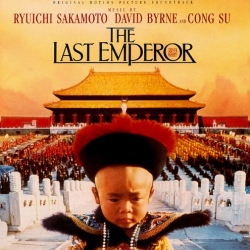
THE LAST EMPEROR – Ryuichi Sakamoto, David Byrne, Cong Su
 THROWBACK THIRTY
Original Review by Jonathan Broxton
They don’t make movies like The Last Emperor anymore. A lavish historical epic directed by the great Italian filmmaker Bernardo Bertolucci and starring John Lone, Joan Chen, and Peter O’Toole, the film tells the life story of Pu Yi, the last monarch of the Chinese Qing dynasty prior to the republican revolution in 1911. It is set within a framing story wherein the adult Pu Yi – a political prisoner of communist leader Mao Zedong – looks back on his life, beginning with his ascent to the throne aged just three in 1908, and continuing through his early life growing up in the Forbidden City in Beijing, and the subsequent political upheaval that led to his overthrow, exile, and eventual imprisonment. It’s an enormous, visually spectacular masterpiece that balances great pageantry and opulence with the very personal story of a man trying to navigate his life as a figurehead and monarch, and how he balances that with his private life and his political and social importance. It was the overwhelming critical success of 1987, and went on to win nine Oscars, including Best Picture, Best Director, and Best Adapted Screenplay, as well as a slew of technical awards for Art Direction, Cinematography, Editing, Costume Design, and Score. Read more…
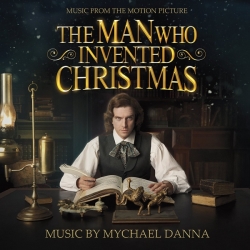
THE MAN WHO INVENTED CHRISTMAS – Mychael Danna
 Original Review by Jonathan Broxton
The words ‘Dickensian Christmas’ often conjure up specific imagery. Crisply snow-covered cobbled streets, gentlemen and ladies dressed in their finery, handsome houses bedecked with wreathes and candles, great feasts centered around a roasted game bird. It’s fascinating to realize that much of the festive iconography we take for granted was popularized, if not outright invented, by the author Charles Dickens in his 1843 story A Christmas Carol. Even the phrase ‘Merry Christmas’, despite the words themselves obviously pre-dating Dickens, was only adopted as a common seasonal greeting following their liberal use by the story’s central character, Ebenezer Scrooge. In fact, the very concept of Christmas being a time for family gatherings, specific seasonal food and drink, and a festive generosity through present-giving, was not commonplace at that time, and it is only in the period since the novel’s publication that this aspect of the holiday has been given equal importance to the original religious meaning. Read more…
IL BUONO, IL BRUTTO, IL CATTIVO/THE GOOD THE BAD AND THE UGLY – Ennio Morricone
 GREATEST SCORES OF THE TWENTIETH CENTURY
Original Review by Craig Lysy
The commercial success of the Spaghetti Westerns A Fistful of Dollars and For A Few More Dollars caught the eyes of studio executives at United Artists. They contacted Italian screenwriter Luciano Vincenzoni, offered him a contract, and expressed a desire to purchase film rights for the next installment. The Italian creative team of producer Alberto Grimaldi, director Sergio Leone and Vincenzoni met and agreed to collaborate. They proposed a story set during the American Civil War, where three rogues join in an uneasy alliance in search of buried treasure. United Artists agreed to the storyline and provided a generous budget of $1.2 million. Vincenzoni joined with Leone, Agenore Incrocci, and Furio Scarpelli to create the screenplay that was not without controversy, in that it eschewed the traditional Americana romanticism. It instead offered a potent social commentary on capitalism, greed, as well as the destructiveness and absurdity of war. Its heroes are less pure, less righteous and more morally ambiguous, where the clear lines between hero and villain are blurred. Read more…
THREE BILLBOARDS OUTSIDE EBBING MISSOURI – Carter Burwell
 Original Review by Jonathan Broxton
There’s a line in writer/director Martin McDonagh’s Three Billboards Outside Ebbing Missouri, spoken by a fairly minor character, which says “anger begets anger,” and this is the basic crux of what the story is about: how a single event can release years of pent up anger and hate in an entire community, and how that community then deals with the aftermath. The brilliant Frances McDormand stars as Mildred Hayes, a woman from the eponymous small town in Missouri, whose teenage daughter Angela was raped and murdered seven months previously. Frustrated by the police’s failure to track down her daughter’s killer, Mildred rents three disused billboards outside town and posts three enormous posters which read: RAPED WHILE DYING / AND STILL NO ARRESTS / HOW COME, CHIEF WILLOUGHBY. This single act is the catalyst for a series of events that irrevocably changes the lives of dozens in the town. Read more…

Shop at the Movie Music UK Store

Member of the

 MOVIE MUSIC UK