Archive
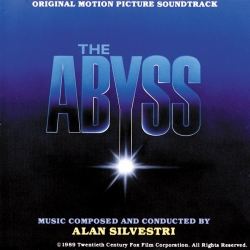
THE ABYSS – Alan Silvestri
 THROWBACK THIRTY
Original Review by Jonathan Broxton
The third and best of 1989’s claustrophobic underwater action thrillers, The Abyss was director James Cameron’s long-awaited follow up to Aliens. It stars Ed Harris and Mary Elizabeth Mastrantonio as Bud and Lindsey Brigman, an estranged husband-and-wife who work on a hi-tech underwater oil drilling platform which sits along the lip of a massive marine trench deep beneath the Caribbean Sea. When a military submarine sinks in mysterious circumstances near the platform, the government sends a team of Navy SEALS in to investigate, using the platform as a base of operations. There is immediate tension between the rough-and-ready oil drillers and the aggressive and testosterone-fuelled soldiers, and this is exacerbated even more when they encounter a mysterious creature that can seemingly manipulate and control water. The film co-starred Michael Biehn, J. C. Quinn, and Leo Burmester, and was both a critical success and a box office hit; it received special attention for its then-groundbreaking use of CGI special effects, which won its creative team an Academy Award. However, the film production itself was notoriously troubled; the shoot went massively over-budget, and the actors were subjected to near-torturous conditions by Cameron, who made them spend literally hours on end in freezing cold underwater temperatures. Cameron also spent a great deal of time editing the film, removing whole swathes of footage to try to create a more coherent cut, including the original ending which featured enormous special FX shots of tsunamis (although much of this was restored in a subsequent director’s cut). Read more…
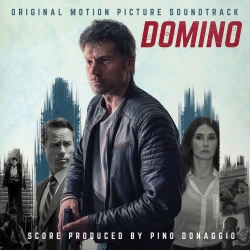
DOMINO – Pino Donaggio
 Original Review by Jonathan Broxton
Once upon a time, Brian de Palma was one of the most respected directors in Hollywood. From the late 1970s, all the way up through the mid 1990s, he made a series of critically acclaimed and commercially successful dramas, action movies, and thrillers, many of which starred the most popular box office draws of the day. Films like Obsession, Carrie, The Fury, Dressed to Kill, Scarface, Body Double, The Untouchables, Carlito’s Way, Mission Impossible. These films won Oscars, and took home prestigious trophies from film festivals in Berlin and Venice. However, recently, the luster has begun to wear off of De Palma’s career; he hasn’t directed a real box office success since 1996, and with each successive film dropping further and further down the prestige pecking order, he now finds himself consigned to making films like this one – Domino – a terrorism-themed thriller which apparently had its budget slashed during filming, and was edited against the director’s wishes during post-production to such an extent that the finished product barely makes sense. The film, such as it is, stars Nikolaj Coster-Waldau from Game of Thrones as a detective from Denmark seeking vengeance for the murder of his partner, apparently at the hands of an ISIS militant. Although he can clearly still attract top notch casts to work with – Domino co-stars Guy Pearce and Carice van Houten – De Palma’s work here has been critically mauled, and has suffered the further ignominy of being consigned to ‘straight to streaming’ VOD services. How the mighty have fallen. Read more…
THE LION KING – Hans Zimmer
 Original Review by Jonathan Broxton
Nants ingonyama bagithi baba! Sithi q!uhm, ingonyama. Nants ingonyama bagithi baba! Sithi q!uhm, ingonyama; Siyo n!qoba; Ingonyama nengw’enamabala, ingonyama nengw’enamabala…
When Lebo M’s plaintive cry in his native Zulu rang out across the savannah, informing the animals of the plain that a newborn lion, destined for greatness, had been born, one of the most memorable moments in film music history was born along with him. The Lion King, originally directed by Roger Allers and Rob Minkoff, did pretty brisk business at the box office when it was released in the summer of 1994, raking in almost $1 billion at the global box office, and quickly becoming an enormous cultural phenomenon too. The film spawned a massively successful stage show that ran for many years on Broadway, several animated spinoffs, and single-handedly introduced the phrase ‘hakuna matata’ into the American lexicon. With Disney in the middle of making live-action versions of several of their classic animated films – we have already had Beauty and the Beast and Aladdin, among others – it stands to reason that The Lion King would be in line for the same treatment, given the improvements in digital computer technology since the original was released. Read more…
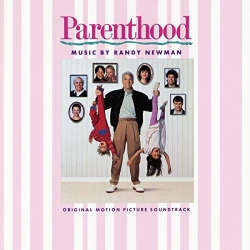
PARENTHOOD – Randy Newman
 THROWBACK THIRTY
Original Review by Jonathan Broxton
Parenthood was a successful and popular comedy-drama film directed by Ron Howard, based on the actual child-rearing experiences of Howard and his screenwriting partners Lowell Ganz and Babaloo Mandel, who between them had 17 children in 1989. The film starred Steve Martin and Mary Steenburgen as married couple Gil and Karen Buckman, and looks at the various trials and tribulations of their extended family, especially as the story relates to parent-child relationships, romantic problems, sibling rivalries, and the pressures that careers have on family lives. The film had an outstanding supporting ensemble cast, including Jason Robards, Rick Moranis, Tom Hulce, Martha Plimpton, 25-year-old Keanu Reeves, 15-year-old Joaquin Phoenix, and Dianne Weist, who received a Supporting Actress Academy Award nomination for her performance. It is also worth noting that, more than 20 years later, the movie was loosely adapted into a popular TV series of the same name, which ran on the NBC network for six seasons, although many of the characters and situations were different. Read more…
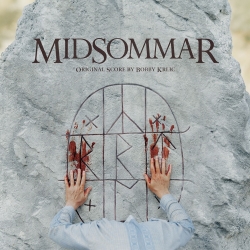
MIDSOMMAR – Bobby Krlic
 Original Review by Jonathan Broxton
Although horror movies are pervasive and very popular in cinematic culture, one particular sub-genre of horror is not explored with as much frequency as others, and that is ‘folk horror,’ where the crux of the plot is derived from characters’ adherences to ancient pagan rituals in an otherwise contemporary setting. The most popular and well-known of these prior to this year was probably the 1973 British film The Wicker Man (we’re forgetting the risible Nicolas Cage remake), but director Ari Aster’s Midsommar looks set to challenge its status as the pre-eminent example of its genre. Whereas Aster’s debut film Hereditary explored the dark corners of devil worship in contemporary America, Midsommar takes place in the bright sunshine of Sweden. Florence Pugh plays Dani, a college student struggling to cope with the murder-suicide of her sister and parents, and whose boyfriend Christian (Jack Reynor) is distant and disinterested. Christian and two of his friends, Mark and Josh, are invited by another friend, Pelle, to spend the summer at Pelle’s home in Sweden; Pelle grew up on a small isolated commune, and his family continues to observe ancient ‘midsummer’ rituals. Despite his initial reluctance, Christian allows Dani to come with them, and before long the friends are happily taking part in psychedelic mushroom trips, experiencing the commune’s curious customs, and wearing a nice line in white linen smocks. Of course, as always happens in films like this, the charming quaintness quickly descends into chaos, as the true nature of the commune and its inhabitants is revealed. Read more…
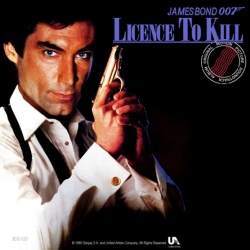
LICENCE TO KILL – Michael Kamen
 THROWBACK THIRTY
Original Review by Jonathan Broxton
The second – and last – James Bond film to star Timothy Dalton was 1989’s Licence to Kill, directed by John Glen from a screenplay by Michael G. Wilson and Richard Maibaum. I have long been of the opinion that Dalton was a hugely underrated Bond who should have been given more opportunities to succeed and develop his gritty version of the character, and that Licence to Kill is one of the best of the entire series. In it, Bond finds himself disavowed by British secret service agency MI6 and ‘going rogue’ after his best friend, CIA agent Felix Leiter, and his new bride Della are viciously attacked on their wedding day. The perpetrator is Franz Sanchez, a drug lord and ruthless cartel boss in a fictional Central American country; seeking personal vengeance, Bond teams up with Pam Bouvier, an ex Army-pilot with a vendetta against Sanchez of her own, and crosses paths with two very different members of Sanchez’s entourage: the beautiful Lupe Lamora, and the sadistic henchman Dario. The film co-stars Robert Davi, Carey Lowell, Talisa Soto, and a very young Benicio del Toro, but unfortunately the film was not a commercial success; adjusted for inflation. It remains the lowest-grossing Bond film of all time, something which, sadly, hastened to the end of Dalton’s tenure and his subsequent replacement with Pierce Brosnan in Goldeneye in 1995. Read more…
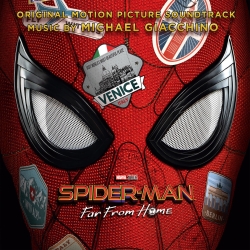
SPIDER-MAN: FAR FROM HOME – Michael Giacchino
 Original Review by Jonathan Broxton
With Avengers Endgame having smashed almost every box office record in existence, it was always going to be difficult for Marvel to build on that movie’s enormous success. The two-part Avengers finale was one of those rare things that is both a commercial and cultural touchstone; it also marked the end of the ‘Third Phase’ of the Marvel Cinematic Universe, in which the existential threat of Thanos was finally eliminated, and the circle of movies that began with Iron Man in 2008 ended with Iron Man’s death. Spider-Man: Far From Home, despite being officially the last part of Phase III and the 23rd Marvel film overall, is actually something of a coda, acting both as a rumination on the events of Endgame and as a bridge to the Phase IV series which is scheduled to begin in 2020; it also seems to have successfully maintained the interest that peaked with Avengers, enjoying huge box office takings and good critical reviews. The film is set 8 months after Endgame and again stars Tom Holland as Peter Parker/Spider-Man; he is still coming to terms with Tony Stark’s death and longs just to be a normal teenager again. As such, he agrees to go on a trip to Europe with his high school classmates, including his potential girlfriend MJ (Zendaya); unfortunately, Peter can’t escape from his responsibilities even there, and is called upon by Nick Fury (Samuel L. Jackson) to assist a multi-dimensional warrior named Quentin Beck/Mysterio (Jake Gyllenhaal) in saving the world from creatures that wreak havoc by controlling the power of the four elements. The film is directed by Jon Watts and has an original score by Michael Giacchino. Read more…
GOOD OMENS – David Arnold
 Original Review by Jonathan Broxton
I have been a fan of the late great British author Sir Terry Pratchett ever since I was a kid. Titles like The Color of Magic, The Light Fantastic, Mort, and Pyramids were among my most treasured literary discoveries in the 1980s and 90s; the combination of fantasy, science-fiction, and historical adventure with a distinctly Pythonesque brand of English humor and wit appealed to my sensibility greatly. Interestingly, and perhaps surprisingly, very few of his works have been translated into film or television projects, and even fewer of them have been seen outside of the UK, which means that while he remains massively popular at home, he is something of an unknown quantity to the rest of the world. This is why I’m so pleased that Good Omens has been so well received; it’s a 6-part TV adaptation of the novel Pratchett wrote with sci-fi author Neil Gaiman in 1990, and is a comedy about the end of the world. Michael Sheen and David Tennant star as Aziraphale, an angel, and Crowley, a demon, who have been living on Earth since the beginning of time as the official representatives of God and Satan. When they learn that the son of Satan has been born – an event which will in time trigger the apocalypse – Aziraphale and Crowley team up to stop it happening. It turns out that, over the millennia, the pair have become unlikely friends, and are not willing to give up their pleasant and comfortable lives in England – even if Armageddon is part of God’s ineffable plan. Read more…
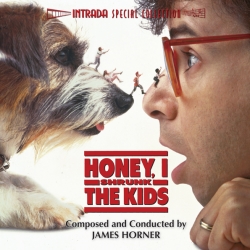
HONEY, I SHRUNK THE KIDS – James Horner
 THROWBACK THIRTY
Original Review by Jonathan Broxton
One of the most popular and successful children’s adventure films of 1989, Honey I Shrunk the Kids starred Rick Moranis as Wayne Szalinsky, a scientist and inventor who makes a machine capable of shrinking objects down to miniscule size. One day, Wayne accidentally shrinks his son Nick, his daughter Amy, and the two brothers who live next door, and throws them out in the trash. Stranded at the bottom of their back yard – which, due to their size, is now the equivalent of several miles away from their house and looks like the Amazon rain forest– the children must fight their way through this jungle of plants and enormous insects in order to return home; meanwhile, Wayne has realized what he has done, and desperately begins searching for his kids so he can restore them to their regular size. The film co-starred Thomas Brown, Amy O’Neill, Robert Oliveri, and Jared Rushton as the kids, and marked the directorial debut of Joe Johnston, a special effects genius who had previously worked on several Star Wars and Indiana Jones films. Read more…
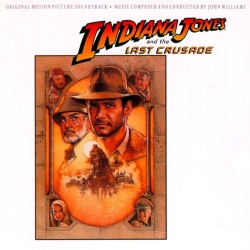
INDIANA JONES AND THE LAST CRUSADE – John Williams
 THROWBACK THIRTY
GREATEST SCORES OF THE TWENTIETH CENTURY
Original Review by Jonathan Broxton
The third movie in director Steven Spielberg’s Indiana Jones series was Indiana Jones and the Last Crusade, and whereas 1984’s Temple of Doom was a prequel to Raiders of the Lost Ark, Last Crusade was a direct sequel, set just two years later in 1938. Harrison Ford returns as the titular archaeologist-adventurer, who is sent off on a globe-trotting escapade when he receives news from American billionaire Walter Donovan (Julian Glover) that his long-estranged father Henry Jones (Sean Connery) has gone missing while searching for the holy grail. Jones teams up with his old friends and colleagues Marcus Brody (Denholm Elliott) and Sallah (John Rhys-Davies) on the quest to find his father, and quickly becomes embroiled in a vast labyrinthine plot involving ancient myths and legends, a brotherhood of religious warriors, way too many Nazis, and a beautiful Austrian art professor named Elsa Schneider (Alison Doody) to whom there is more than meets the eye. The whole thing is a delight from start to finish, with several wonderfully exciting action set pieces, and beautiful location settings, but the cornerstone of the film is the father-and-son chemistry between Ford and Connery, whose outward gruffness and constant bickering masks a deep love and affection. Whereas Ford is an all-action matinee idol hero, Connery is a slightly bumbling academic, more at home with books and libraries than punching Nazis in the face, but who is still able to make his son feel like a 12-year old when he calls him ‘junior’. Read more…
CHERNOBYL – Hildur Guðnadóttir
 Original Review by Jonathan Broxton
On April 26, 1986, the Chernobyl Nuclear Power Plant, close to the Ukraine-Belarus border in what was then the Soviet Union, suffered a catastrophic accident in which one of the plant’s four nuclear reactor cores exploded. The explosion started a fire and released massive amounts of nuclear radiation into the atmosphere and across most of Eastern Europe; it entirely irradiated the nearby city of Pripyat and, although official totals are much lower, may have directly and indirectly lead to the deaths of hundreds of thousands of people. The new mini-series Chernobyl, produced jointly by HBO in the United States and Sky in the UK, is a detailed look at what happened: the events leading up to the disaster, the work of the emergency services in the immediate aftermath, the work of the scientists tasked with finding out what happened, and the fates of those directly affected. Many people have taken Chernobyl to be a cautionary tale about the dangers of nuclear power, but director Johan Renck and screenwriter Craig Mazin say that is not what the show is about at all. Instead, it’s supposed to be a damning indictment of government corruption, lies, and abuse of power, with parallels echoing the current situation involving global warming and climate change. Read more…
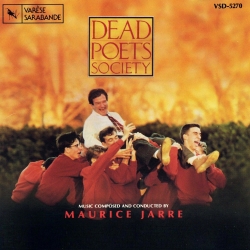
DEAD POETS SOCIETY – Maurice Jarre
 THROWBACK THIRTY
Original Review by Jonathan Broxton
There have been a lot of great movies about inspirational teachers over the years, from Goodbye Mr. Chips in 1939 (and its musical remake in 1969), to Dangerous Minds and Mr. Holland’s Opus in the 1990s, but for my money the best of them all is Dead Poets Society. Directed by Peter Weir and written by Tom Schulman, the film is set at an elite all-male New England prep school in 1959, a stuffy establishment whose school motto – tradition, honor, discipline, excellence – tells you everything you need to know about the faculty. Everything changes when a new English teacher, John Keating, joins the school, bringing with him a brash and innovative philosophy that teaches students to think for themselves. Keating has a particular influence on a group of seven young men who, having been inspired by Keating’s love of classic poetry, form the eponymous society and begin to embrace their lives, loves, and ambitions more than they had ever done before. The film is anchored by an utterly astonishing lead performance by Robin Williams as Keating, who brings depth and emotion and sincerity and manic energy to what is, to my mind, the greatest role of his entire career. The young men of the society are also superb, notably Robert Sean Leonard as a boy whose passion for acting is constantly crushed by his overbearing father, and Ethan Hawke, who overcomes his crippling shyness as a result of Keating’s encouragement. Read more…
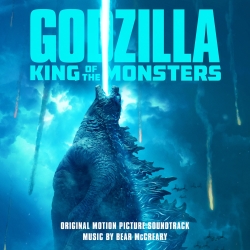
GODZILLA: KING OF THE MONSTERS – Bear McCreary
 Original Review by Jonathan Broxton
Ever since he first appeared on film in 1954 in director Ishiro Honda’s classic film Gojira, the gigantic amphibious reptile known in the West as Godzilla has become something of an icon, an instantly recognizable element of Japanese pop culture. Godzilla has appeared in an astonishing 32 films in Japan, plus a number of associated video games, novels, comic books, and television shows, but did not make his American debut until the 1998 film directed by Roland Emmerich. When that film was a comparative financial flop, audiences would have to wait a further 16 years for director Gareth Edwards’s 2014 film of the same name. The success of that film solidified Warner Brother’s plans for a future franchise, and now we have the first sequel – Godzilla: King of the Monsters – directed by Michael Dougherty from a screenplay by Dougherty, Max Borenstein, and Zach Shields. Read more…
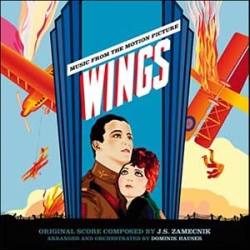
WINGS – J. S. Zamecnik
 GREATEST SCORES OF THE TWENTIETH CENTURY
Original Review by Craig Lysy
John Monk Saunders served in the US Air Corp during WWI as a flight instructor in Florida. He had lifelong regrets that he was never able to serve his country in combat, and so conceived a story, which would allow him to realize that ambition in film. He pitched his idea to producer Jessie Lasky who was unreceptive due to the logistics required to film aerial combat. Yet Saunders would not be denied and secured support from the War Department, which included 220 planes, and airmen, artillery, tanks, trucks and troops. Lasky was impressed and decided to proceed with his Famous Players-Lasky company financing the project and Paramount Studio securing distribution rights. A massive budget of $2 million was budgeted and Louis Lighton and Hope Loring were hired to write the screenplay. Lasky and four others would produce the film, and William Wellman was tasked with directing as he was the only director in Hollywood who had actual combat pilot experience. Securing a cast was an adventure however when Paramount’s greatest star Clara Bow, demanded a rewrite stating “Wings is a man’s picture and I am just the whipped cream on top of the pie”. Her demands were met and the story evolved into a war time romance. She would star as Mary Preston, with Charles “Buddy” Rogers as Jack Powell, Richard Arlen as David Armstrong, Gary Cooper as Cadet White, and Jobyna Ralston as Sylvia Lewis. Read more…
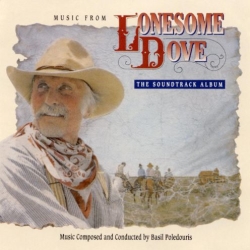
LONESOME DOVE – Basil Poledouris
 THROWBACK THIRTY
Original Review by Jonathan Broxton
Lonesome Dove, an epic western mini-series based on the Pulitzer Prize-winning novel by Larry McMurtry, was one of the television successes of the year after it premiered on CBS in the spring of 1989. Directed by Simon Wincer and starring Robert Duvall and Tommy Lee Jones, and set in the closing years of the Old West, the story focused on the relationship between Gus (Duvall) and Call (Jones), two retired Texas Rangers who decide to leave their quiet town on the Mexican border and drive a herd of cattle north to Montana. McMurtry’s original novel – which explores themes of old age, death, unrequited love, and friendship – was based on a screenplay that he had co-written with Peter Bogdanovich for a movie that was intended to star John Wayne, James Stewart, and Henry Fonda, but the project collapsed when John Ford advised Wayne to reject the script. Prior to its airing, the ‘classic western’ was considered to be a virtually dead genre, but Lonesome Dove almost singlehandedly re-vitalized it. The series drew staggering viewership numbers of more than 20 million homes, went on to win 7 Emmys from 18 nominations (including Best Director and a slew of technical awards), and paved the way for the cinematic resurrection of the genre with Kevin Costner’s Dances With Wolves in 1990 and Clint Eastwood’s Unforgiven in 1992. Read more…

Shop at the Movie Music UK Store

Member of the

 MOVIE MUSIC UK