IVANHOE – Miklós Rózsa
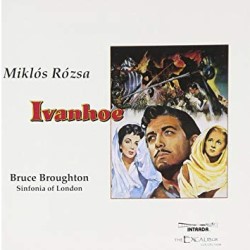 GREATEST SCORES OF THE TWENTIETH CENTURY
Original Review by Craig Lysy
In 1935 MGM Studio sought to bring Sir Walter Scott’s epic Medieval Knight tale Ivanhoe (1819) to the big screen. After crafting a screenplay, the project never got off the ground as production delays resulted in selecting two different casts, one in 1935 starring Fredric March, Loretta Young and Gary Cooper, and another in 1938 starring Robert Taylor, Myrna Loy and Clark Gable. Another setback to production occurred with the onset of WWII, which caused filming on location in England to be put hold. New energy for the project arose in 1946 when Æneas MacKenzie crafted a new script, which satisfied MGM executives. Pandro S. Berman was given a very generous budget to produce the film and he brought in Richard Thorpe to direct. A third stellar cast was hired, which included; Robert Taylor as Ivanhoe, Elizabeth Taylor as Rebecca, Joan Fontaine as Rowena, George Sanders as Sir Brian De Bois-Guilbert, Emlyn Williams as Wamba and also the Narrator, Felix Aylmer as Isaac, Finlay Currie as Cedric, and Guy Rolfe as Prince John. Read more…
Academy Award Winners 2019
 The Academy of Motion Picture Arts and Sciences (AMPAS) have announced the winners of the 92nd Academy Awards, honoring the best in film in 2019.
In the Best Original Score category composer Hildur Guđnadóttir won the award for her score for the dark comic book origin story Joker, directed by Todd Phillips, and starring Joaquin Phoenix. With this win Guđnadóttir became the first female composer to win an Oscar since Anne Dudley for The Full Monty in 1997, and became the first composer in history, of any gender, to win all the big five composing awards – Oscar, Globe, Emmy, Grammy, BAFTA – in the same awards cycle. In accepting her award, Guđnadóttir said:
“Wow. This is so touching. Thank you to the Academy for welcoming me so warmly, it’s just… I don’t know what to say! My fellow nominees, masters of the craft, it’s been such an honor to get to know you all, so special. A film composer is only as creative as the dialogue with the director. Todd Phillips was so generous to invite me on this journey, and listen to me the whole way, so attentively, and I thank you for that, so deeply. And Bradley [Cooper] as well! Thank you Bradley. My family, my beautiful family, who are here with me tonight. My incredible husband Sam, my love, my best friend, my other set of ears, I’d be lost without you. My, mother, my son Cody, I can’t see you, but I love you so much! I love you. To the girls, to the women, to the mothers, to the daughters, who hear the music bubbling within: please speak up. We need to hear your voices.”
The other nominees were Alexandre Desplat for Little Women, Randy Newman for Marriage Story, Thomas Newman for 1917, and John Williams for Star Wars: The Rise of Skywalker.
In the Best Original Song category, the winners were Elton John and Bernie Taupin for “I’m Gonna Love Me Again” from the Elton John biopic Rocketman.
The other nominees were Kristen Anderson-Lopez and Robert Lopez for “Into The Unknown” From Frozen II; Joshuah Brian Campbell and Cynthia Erivo for “Stand Up” from Harriet; Randy Newman for “I Can’t Let You Throw Yourself Away” from Toy Story 4; and Diane Warren for “I’m Standing With You” from Breakthrough.
BAD BOYS FOR LIFE – Lorne Balfe
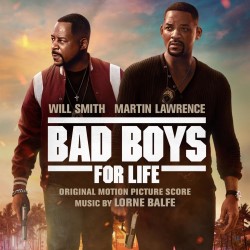 Original Review by Jonathan Broxton
Back in the spring of 1995, director Michael Bay and producers Don Simpson and Jerry Bruckheimer brought the world Bad Boys, a buddy-cop action comedy starring Martin Lawrence and Will Smith, who at that point was still best known for his role in the TV sitcom The Fresh Prince of Bel-Air, and was making his ‘leading role’ debut. Lawrence and Smith played Marcus Burnett and Mike Lowrey, hotshot Miami detectives who leave a trail of bullets, bodies, and profane one-liners wherever they go. The film was a massive financial success at the time, and spawned a sequel in 2003, but no-one expected the boys to return for a third outing – and yet here we are, 25 years removed from the original, with Bad Boys For Life, directed by Adil El Arbi and Bilall Fallah. Lawrence and Smith return to the roles which made them famous; the plot revolves around Burnett, who wants to retire from police work, teaming up with Lowrey one final time as they investigate the murders of numerous people involved in an old drug cartel case. Read more…
IFMCA Award Nominations 2019
 INTERNATIONAL FILM MUSIC CRITICS ASSOCIATION AWARD NOMINATIONS ANNOUNCED; HILDUR GUÐNADÓTTIR RECIEVES FIVE NOMINATIONS; MULTIPLE NOMINATIONS FOR ALEXANDRE DESPLAT, BEAR McCREARY, THOMAS NEWMAN, JOHN WILLIAMS
FEBRUARY 6, 2020. The International Film Music Critics Association (IFMCA) announces its list of nominees for excellence in musical scoring in 2019, for the 16th annual IFMCA Awards. For the first time in IFMCA history a female composer leads the field, with Icelandic composer and cellist Hildur Guðnadóttir receiving five separate nominations for her work on the critically acclaimed comic-book drama “Joker,” and for the devastating HBO television series “Chernobyl”. These are the first nominations for Guðnadóttir, who is nominated in the categories for Film Score of the Year, Composer of the Year, Drama Score, Television Score, and Film Music Composition of the Year. IFMCA member James Southall was particularly complementary about “Joker,” describing it as having ‘complexity in its extraordinary emotional depth,’ and calling it a ‘primal’ score which ‘made him think’.
Also nominated for both Score of the Year and Composer of the Year are veteran composers Alexandre Desplat, Thomas Newman, and John Williams. French composer Desplat’s most lauded score of 2019 is the one he wrote for director Greta Gerwig’s new adaption of the classic American novel “Little Women,” which is also nominated for Drama Score. IFMCA member Jon Broxton said that the score ‘overflows with gorgeous orchestrations, sublime instrumental combinations and harmonies,’ and has ‘a dramatic sense of freedom and movement, effortless elegance, and lush emotional content’. Desplat’s other major scores in 2019 include the French drama “Adults in the Room,” the animated sequel “The Secret Life of Pets 2,” and director Roman Polanski’s look at the Dreyfus Affair of 1906 in “J’accuse”. Desplat previously won the IFMCA Score of the Year award in 2008 for “The Curious Case of Benjamin Button”. Read more…
BAFTA Winners 2019
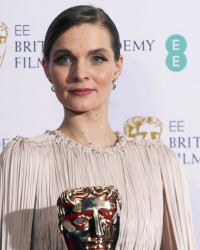 The British Academy of Film and Television Arts (BAFTA) have announced the winners of the 73rd British Academy Film Awards, honoring the best in film in 2019.
In the Best Original Music category, the winner was Hildur Guđnadóttir, who took home the award for her work on the dark comic book drama Joker, directed by Todd Phillips, and starring Joaquin Phoenix. With this victory Guđnadóttir became the first female winner of the award in BAFTA history. Accepting her award, Guđnadóttir said:
“Thank you BAFTA. I think my English in-laws are pretty proud of me right now, so I’d like to thank them! Joker… working on Joker was a journey of a lifetime, really, and Todd is a master for having steered that ship, and it was such an incredible, incredible honor to work on this film and create it with so many amazing artists that are here tonight who did such an incredible job, and I just really, really would like to share this with all of you. I’m such a fan of your work, and you are incredible. Thank you so much. Thank you”
The other nominees were Alexandre Desplat for Little Women, Michael Giacchino for Jojo Rabbit, Thomas Newman for 1917, and John Williams for Star Wars: The Rise of Skywalker.
THE LAST FULL MEASURE – Philip Klein
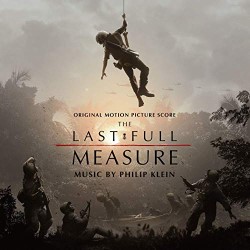 Original Review by Jonathan Broxton
The Last Full Measure is a military-themed drama film written and directed by Todd Robinson. It tells the true story of William H. Pitsenbarger, a sergeant in the US Air Force, who flew rescue missions to save downed soldiers and pilots during the Vietnam War. Pitsenbarger was killed during the Battle of Xa Cam My in April 1966, and the film tells the story of the 34-year struggle to have him awarded the Medal of Honor. The film stars Sebastian Stan as Scott Huffman, the Pentagon official charged with investigating the Medal of Honor request, and has an astonishing supporting cast that includes Christopher Plummer, William Hurt, Ed Harris, Samuel L. Jackson, Diane Ladd, Amy Madigan, Bradley Whitford, John Savage, and the late Peter Fonda, in what turned out to be his final screen role. Conceptually the film is very much in the vein of those earnest military dramas like Men of Honor, and especially Courage Under Fire, and those comparisons continue into its music too. Read more…
ALWAYS – John Williams
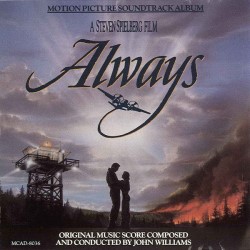 THROWBACK THIRTY
Original Review by Jonathan Broxton
Always is the Steven Spielberg film most people tend to forget. Sandwiched between such classics as Indiana Jones and the Last Crusade, Schindler’s List, and Jurassic Park, it came during the period where Spielberg was alternating between making major box office blockbusters and smaller, more personal films that tackled intimate themes and emotions. Always is a remake of the 1943 Spencer Tracy film A Guy Named Joe, which was written by Dalton Trumbo. Richard Dreyfuss stars in the Tracy role as Pete Sandich, a daredevil pilot who works putting out forest fires; his long-time girlfriend Dorinda (Holly Hunter) and best friend Al (John Goodman) fear that his recklessness in the air will lead to tragedy. Their worst fears come true when Pete is killed in a plane crash saving Al’s life; in the afterlife, Pete is given guidance by an angel-like figure (Audrey Hepburn, in her final screen role), and told that he has one last life to save before he can move on to heaven – Dorinda’s, who has become overwhelmingly grief stricken and suicidal as a result of Pete’s death. Read more…
DRACULA – David Arnold, Michael Price
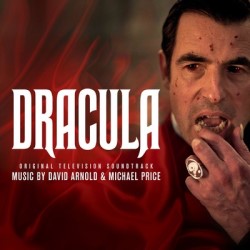 Original Review by Jonathan Broxton
There have been literally dozens and dozens of adaptations of and variations on the Dracula story in the years since Bram Stoker wrote it in 1897. The most recent version is this BBC mini-series developed by Mark Gatiss and Steven Moffat, the brains behind such successful shows as Doctor Who, Sherlock, and The League of Gentleman. Danish actor Claes Bang is the latest to star in the title role as the undead aristocrat from Eastern Europe who drinks human blood to survive; the show begins with a fairly conventional re-telling of the Dracula myth – castles and brides, voyages to Whitby, Lucy and Mina and Jonathan Harker – but ends with a very unconventional contemporary twist that places Dracula in modern society and completely upends vampire lore. The show has not been entirely successful, but it certainly has handsome and impressive production values, which extend to its score by composers David Arnold and Michael Price. Read more…
ODNA/ALONE – Dmitri Shostakovich
 GREATEST SCORES OF THE TWENTIETH CENTURY
Original Review by Craig Lysy
Film-making in the 1930s Soviet Union was very tightly regulated by the state to ensure fidelity to the ideals of the revolution. Directors Leonid Trauberg and Grigori Kozintsev found inspiration in news reports of the dire challenges faced by two teachers. They conceived their film to address three political issues of the day; the State’s promotion of education, the elimination of the kulaks (land owning peasants), and the introduction of modern technology. The film was originally conceived as a silent film, but was later changed to include dialogue and music by composer Dmitri Shostakovich. With the additional demand by the State for realism in film, each actor would use their real names as the characters. Yelena Kuzima would star in the lead role as the school teacher Joining her would be Pyotr Sobolevsky as her husband, Sergey Gerasimov as the local Council Chairman and Mariya Babanova as the Chairman’s wife. Read more…
DOLITTLE – Danny Elfman
 Original Review by Jonathan Broxton
Whimsical fantasy adventure scores have been bread and butter for Danny Elfman for more than thirty years, ever since he first burst onto the scene and wowed us with his magical, maniacal musical talents. His latest effort in the genre is Dolittle, a new adaptation of the famous stories by Hugh Lofting about an eccentric, reclusive doctor in Victorian England who has a somewhat unique gift – he can talk to animals! The role was made famous by Rex Harrison in a 1967 screen musical, and then by Eddie Murphy in a very different approach in 1998; this new version returns (mostly) to its roots and stars Robert Downey Jr. in the title role, setting sail on a fantastical adventure to find a cure for Queen Victoria, who is suffering from a mysterious illness. The film is adapted from Lofting’s 1922 novel The Voyages of Doctor Dolittle, is directed by Stephen Gaghan, and has an astonishing all-star supporting cast both corporeal and vocal, including Antonio Banderas, Emma Thompson, Ralph Fiennes, Tom Holland, Rami Malek, and Octavia Spencer. Read more…
DIAL M FOR MURDER – Dimitri Tiomkin
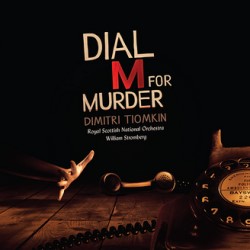 MOVIE MUSIC UK CLASSICS
Original Review by Craig Lysy
English playwright Frederick Knott introduced his story “Dial M For Murder” in 1952 as a play for television. Its popularity led to stage productions in London and New York that were also successful. Renowned producer Alexander Korda saw opportunity and purchased the film rights, and after the success of the stage productions sold them to Warner Brothers for a handsome profit. Warner Brothers Studios had Alfred Hitchcock under contract and when his effort to film “The Bramble Bush” failed to get off the ground they directed him to begin production on “Dial M For Murder”. Hitchcock would produce and direct the film with a modest budget of $1.4 million. His first choices for the lead roles did not pan out. Cary Grant would not accept the role of a villain, and Olivia de Havilland demanded too much money for his modest budget. Despite these setbacks he never the less secured a fine cast which included Ray Milland as Tony Wendice, Grace Kelly as Margot Mary Wendice, Robert Cummings as Mark Halliday, John Williams as Chief Inspector Hubbard, and Anthony Dawson as Alexander Swann. Read more…
Movie Music UK Awards 2019
 Popular opinion among the film music community has posited that 2019 was the worst year of the decade for new original scores, and while that may be the case for the majority of mainstream Hollywood, that is absolutely not the case for the wider film music world. Yet again, I have to stress that there is some absolutely tremendous film music being written out there by a plethora of young, ambitious, supremely talented composers – if only people are prepared to step from out of their comfort zones and actually seek it out.
My choices for the Scores of the Year all meet the criteria of what I believe makes for outstanding film music: rich, varied ensembles that blend orchestras with electronics, vocals, and soloists in interesting ways; compelling musical architecture which tells a story and supports the visuals in a way which draws the viewer and/or listener into the film’s narrative; inventive writing which uses different themes, interesting compositional ideas, and clever techniques; and strong emotional content which connects the audience with the film it is accompanying.
Four of my five nominees for Score of the Year are indeed from mainstream American productions – one of which is from the granddaddy of all blockbuster franchises – but as you go further and further down the list you will find several works from Asia (Japan, China, Vietnam), as well as contemporary fantasy dramas from Germany, historical biopics from Switzerland, romantic comedies from Sweden and France, historical war movies from Spain, documentaries from Romania, and animated films from all across the globe! So, without further ado, here are my choices… Read more…
Academy Award Nominations 2019
 The Academy of Motion Picture Arts and Sciences (AMPAS) have announced the nominations for the 92nd Academy Awards, honoring the best in film in 2019.
In the Best Original Score category, the nominees are:
- ALEXANDRE DESPLAT for Little Women
- HILDUR GUÐNADÓTTIR for Joker
- RANDY NEWMAN for Marriage Story
- THOMAS NEWMAN for 1917
- JOHN WILLIAMS for Star Wars: The Rise of Skywalker
This is the first Oscar nomination for Guðnadóttir, and the eleventh nomination for Desplat, who previously won for The Grand Budapest Hotel in 2014, and for The Shape of Water in 2017. The Newman cousins now have 22 nominations between them – nine for Randy, and thirteen for Thomas – but neither have previously had a Best Score win.
Incredibly, this is the 52nd Oscar nomination for John Williams, which breaks his own record for the most nominated living person, and maintains his position as the second most nominated person of all time after Walt Disney (who had 59). He previously won Academy Awards for Fiddler on the Roof in 1971, Jaws in 1975, Star Wars in 1977, E. T. The Extra-Terrestrial in 1982, and Schindler’s List in 1993.
In the Best Original Song category, the nominees are:
- KRISTEN ANDERSON-LOPEZ and ROBERT LOPEZ for “Into the Unknown” from Frozen II
- JOSHUAH BRIAN CAMPBELL and CYNTHIA ERIVO for “Stand Up” from Harriet
- ELTON JOHN and BERNIE TAUPIN for “I’m Gonna Love Me Again” from Rocketman
- RANDY NEWMAN for “I Can’t Let You Throw Yourself Away” from Toy Story 4
- DIANE WARREN for “I’m Standing With You” from Breakthrough
The winners of the 92nd Academy Awards will be announced on February 9, 2020.
1917 – Thomas Newman
 Original Review by Jonathan Broxton
1917 is an astonishing, emotionally overwhelming, technical masterpiece of a film set in northern France during World War I. Directed by Sam Mendes and based in part on the experiences of his own grandfather during the war, the film stars George Mackay and Dean-Charles Chapman as Schofield and Blake, two young English soldiers serving in the trenches on the front lines. When some vitally important military intelligence is conveyed to their commanding officer, Schofield and Blake are tasked with delivering a message to another unit half a dozen miles away, with orders that would stop a platoon of 1,600 soldiers – including Blake’s brother – from falling into a German trap and being massacred. In order to deliver the message the pair must journey on foot deep into enemy territory, overcoming obstacles and enduring incredible physical and mental hardships, in a manner which illustrates how devastating war is for everyone involved. Read more…

Shop at the Movie Music UK Store

Member of the


