ANIMAL CRACKERS – Bear McCreary
 Original Review by Jonathan Broxton
Animal Crackers is an animated adventure film for children, directed by Scott Christian Sava and Tony Bancroft (who co-directed Mulan), which is somewhat astonishingly inspired by the animal-shaped biscuits/cookies of the same name. It’s a surprisingly convoluted story but, basically, the plot boils down to a family of circus owners who are given a magical box of Animal Crackers which temporarily turns people into whatever animal shape they eat, and which they use to save their livelihood and thwart the plans of their evil uncle, who wants to take the circus over for his own nefarious purposes. The film has an astonishing voice cast – John Krasinski, Emily Blunt, Ian McKellen, Danny DeVito, Sylvester Stallone – and premiered at the prestigious Annecy International Animation Film Festival in 2017 prior to debuting in cinemas in China in 2018. It was slated for release in the United States later that same year but financial issues involving the distributor led to it being delayed and delayed, and then with all the issues surrounding the COVID-19 pandemic, it eventually skipped theaters altogether, and was finally released on Netflix in July 2020. Read more…
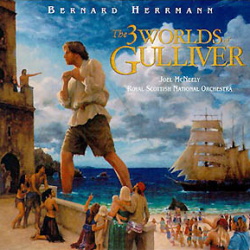
THE THREE WORLDS OF GULLIVER – Bernard Herrmann
 GREATEST SCORES OF THE TWENTIETH CENTURY
Original Review by Craig Lysy
After the critical and financial success of The Seventh Voyage of Sinbad in 1958, Charles Schneer and Ray Harryhausen decided to further explore the fantasy genre drawing inspiration from a literary classic, Jonathan Swift’s 1726 novel Gulliver’s Travels. Columbia Pictures would finance and distribute the film, with Schneer again producing. Harryhausen would again oversee the Dynamation stop-motion animation and special visual effects. Jack Sher was tasked with directing, and he would collaborate with screenwriter Arthur Ross to write the screenplay, which would be loosely based on Swift’s novel. For the cast, Kerwin Matthews would again play the titular role, supported by Jo Morrow as Gwendolyn, June Thorburn as Elizabeth, Basil Sydney as the Emperor of Liliput, Sheri Aberoni as Glumdalclitch, Lee Patterson as Reldresal, and Gregoire Aslan as King Brob. Read more…
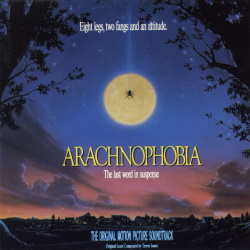
ARACHNOPHOBIA – Trevor Jones
 THROWBACK THIRTY
Original Review by Jonathan Broxton
Arachnophobia was one of the most fun comedy-horror films of the early 1990s, which played on one of the most prevalent human fears: spiders. Directed by Frank Marshall, the film starred Jeff Daniels as Ross Jennings, the town doctor in an idyllic California coastal community. Things begin to go awry in the town when the desiccated corpse of Jerry Manley (Mark L. Lester), a local nature photographer, is brought to the funeral home for autopsy; Jerry had died while on an assignment deep in the jungles of Venezuela, accompanying entomologist Dr James Atherton (Julian Sands) on a trip to discover and study rare spiders. It quickly becomes apparent that Jerry died of a spider bite, and that the venomous arachnid hitched a ride in his coffin. Before long the entire community is under siege from thousands of deadly eight-legged invaders, and it’s up to Jennings, his wife Molly (Harley Jane Kozak), and local exterminator Delbert McClintock (John Goodman), to stop the infestation. Read more…
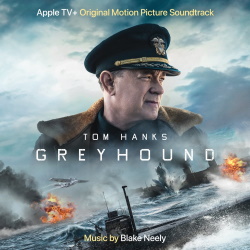
GREYHOUND – Blake Neely
 Original Review by Jonathan Broxton
Greyhound is a World War II action thriller directed by Aaron Schneider, and written by Tom Hanks, who adapted the novel The Good Shepherd by C. S. Forester, the creator of the great fictional British naval hero Captain Horatio Hornblower. Hanks himself plays Ernest Krause, a commander in the United States Navy, who is charged with escorting and protecting a multi-national fleet of ships across the Atlantic, while it is under attack from Nazi German U-Boats. The film co-stars Stephen Graham, Rob Morgan, and Elisabeth Shue, and is a classic claustrophobic cat-and-mouse naval thriller in the tradition of Das Boot, Run Silent Run Deep, and Sink the Bismarck, the latter of which was also based on a Forester novel. The film was initially scheduled to be released in cinemas in June 2020 but was delayed due to the COVID-19 pandemic, and eventually premiered straight-to-streaming on the Apple TV+ platform. Read more…
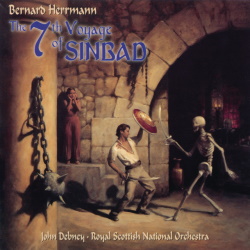
THE SEVENTH VOYAGE OF SINBAD – Bernard Herrmann
 GREATEST SCORES OF THE TWENTIETH CENTURY
Original Review by Craig Lysy
In the 1950s, a collaboration between producer Charles Schneer and special animation effects artist Ray Harryhausen resulted in a trio of very successful science fiction films; It Came From Beneath the Sea (1955), Earth vs. The Flying Saucers (1956) and 20 Million Miles to Earth (1957). They decided that they wanted to explore a new genre, which had always fascinated Harryhausen – mythological fantasies. He had a story already envisioned for Sinbad the Sailor and Schneer decided to use his production company Morningside Productions partnering with Columbia Pictures to finance and distribute the film. Harryhausen would again create and manage the Dynamation special effects. Nathan Juran was tasked with directing, and he cast two young stars for the principle roles; studio contract player Kerwin Matthews as Sinbad, and Kathryn Grant as Princess Parisa. Joining them would be Richard Eyre as the Genie, Torin Thatcher as Sokurah, Alec Mango as the Caliph of Bagdad, and Harold Kasket as the Sultan. It would take Harryhausen eleven months to complete the filming of all the widescreen stop-motion animation scenes, which included the use of a flamethrower to simulate the dragon’s fiery breath. His iconic scene where Sinbad fights a skeleton continues to awe audiences to this day. Read more…
ENNIO MORRICONE REVIEWS, Part IV
Original Reviews by Jonathan Broxton
In this fourth installment of my series looking at the early career of some iconic composers, we take a look at ten more scores written by the legendary Ennio Morricone between 1962 and 1967, most of which are among the most obscure of his early years. This group of reviews includes a couple of great spaghetti westerns, several influential pop-psychedelia scores, several lounge music scores accompanying movies bolstering the acting careers of singers, his final score for director Marco Bellocchio, and his first score for horror director Lucio Fulce!
GHOST – Maurice Jarre
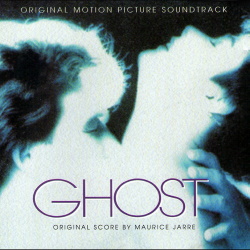 THROWBACK THIRTY
Original Review by Jonathan Broxton
The unexpected box office smash hit of 1990, Ghost is a supernatural romantic drama-thriller about the power of love transcending death, which had millions of people weeping in cinemas across the world. Patrick Swayze stars as Sam Wheat, a successful banker in New York City, who has just moved into a new apartment with his beautiful girlfriend Molly (Demi Moore), and is renovating it with the help of his best friend and co-worker Carl (Tony Goldwyn). Life is perfect for Sam – until he is shot and killed on the street during a mugging gone wrong. Sam discovers he is now a ghost, invisible and unable to interact with the mortal world; after trying and failing multiple times to contact Molly from beyond the grave, Sam instead tries to solve his own murder – which leads him to a startling revelation, and renews his need to contact Molly. To this end, Sam begins to ‘haunt’ Oda Mae Brown (Whoopi Goldberg), a fake psychic medium, who is shocked to discover that she can really hear Sam; eventually, Sam convinces Oda Mae to talk to Molly on his behalf, to warn her that she too is in danger. The film was written by Bruce Joel Rubin and was directed by Jerry Zucker, making his solo directing debut after a decade of comedy work as part of the Zucker-Abrahams-Zucker trio. As I mentioned it was an enormous commercial success, grossing more than $500 million at the US box office; it was also critically successful, and went on to receive five Oscar nominations, winning for Best Original Screenplay and Best Supporting Actress for Goldberg. Read more…
EUROVISION SONG CONTEST: THE STORY OF FIRE SAGA – Atli Örvarsson
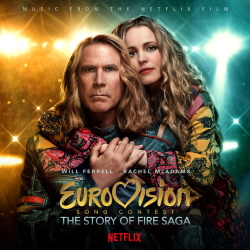 Original Review by Jonathan Broxton
So, I have something of a confession to make. I love the Eurovision Song Contest. For those who don’t know what this is – most of whom will be American – it is an annual music contest/festival in which all the countries of Europe (plus a few occasional non-European guests) put forward a song to represent their nation, and then after a huge live TV music extravaganza lasting several hours, all the competing nations vote for a winner. This has happened every year since 1956, and it’s fantastic. It’s a celebration of music and culture, yes, but it’s also a celebration of kitsch, where the wild and the wacky and the downright bizarre compete on equal terms with genuine musical excellence in the service of pan-continental friendship. Lots of famous faces have competed in the competition – ABBA famously won for Sweden in 1974, beating Olivia Newton-John. Céline Dion won singing for Switzerland in 1988. And over the years several artists cut their teeth on the show as youngsters, many of whom may be famous to those outside the Euro-bubble, including Cliff Richard, Nana Mouskouri, Matt Monro, Sandie Shaw, Lulu, Dana, Julio Iglesias, Brotherhood of Man, Bucks Fizz, Ofra Haza, and Katrina and the Waves. Read more…
THE MOST DANGEROUS GAME – Max Steiner
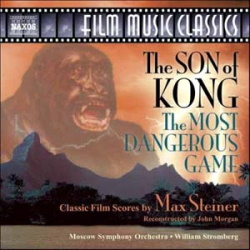 MOVIE MUSIC UK CLASSICS
Original Review by Craig Lysy
RKO Radio Pictures executives saw the popularity of the 1924 short story The Most Dangerous Game by Richard Connell, which was published by Collier’s Magazine and decided that it should be adapted to the big screen. They purchased the film rights, and assigned Merian Cooper, Ernest Schoedsack, and David O. Selznick to produce. The team of Irving Pichel and Ernest Schoedsack would direct the film with a budget of $220,000. James Ashmore Creelman was hired to write the screenplay, and a fine cast was assembled, which included Joel McCrea as Robert Rainsford, Fay Wray as Eve Trowbridge, Leslie Banks as Count Zaroff, Robert Armstrong as Ivan, Steve Clemente as Tartar, Dutch Hendrian as Servant, and William Davidson as the Captain. The story is set in 1932 off the western coast of South America. Renowned big game hunter and author Bob Rainsforth is enjoying a cruise on a luxury yacht through a channel in the remote Tierra Del Fuego. The Captain raises concerns when the channel lights vary from his charts but is ordered to proceed by the yacht’s owner. The yacht runs aground upon a shoal, sinks, and explodes, with Rainsforth the only survivor. Read more…
Under-the-Radar Round Up 2020, Part 2
 Original Reviews by Jonathan Broxton
With the COVID-19 Coronavirus continuing to decimate the 2020 theatrical movie schedule, as well as the general mood of the world, good music is more important than ever when it comes to getting is all through these difficult times. As such (and as I did last year under much different circumstances) I am very pleased to present the latest installment in my ongoing series of articles looking at the best “under the radar” scores from around the world – this time concentrating on the second quarter of 2020! The titles include an intense action drama from Egypt, a charming romantic drama from Italy, a German version of a classic children’s story, and two titles from the Netherlands – one of which reboots a beloved 1970s British TV series!
Ennio Morricone, 1928-2020
 Composer Ennio Morricone died on July 6, 2020, in hospital in Rome, Italy, after suffering complications following a fall at his home, in which he broke his leg. He was 91.
Ennio Morricone was born in Rome, Italy, in November 1928. He studied at the Conservatory of the National Academy of Santa Cecilia, where he specialized in trumpet performance and composition. During the 1950s Morricone orchestrated and arranged pop songs for the RCA record label, including some for artists such as Paul Anka, Chet Baker and Mina. While working for RCA Morricone also wrote theater music and classical pieces, eventually going on to form Gruppo di Improvvisazione Nuova Consonanzsa, an avant-garde musical improvisation group considered to be one of the first experimental composers collectives.
Morricone began ghostwriting for composers such as Armando Trovajoli and Mario Nascimbene in the late 1950s, before making his credited film debut in 1961 for director Luciano Salce’s Il Federale (The Fascist). He worked almost exclusively in Italian cinema in the 1960s, but started to gain some international prominence for his work with director Sergio Leone, a former classmate, whose ‘spaghetti westerns’ starring a young American actor named Clint Eastwood became unexpected hits. A Fistful of Dollars (1964), For a Few Dollars More (1965), The Good the Bad and the Ugly (1966) and Once Upon a Time in the West (1968), as well as the Burt Reynolds vehicle Navajo Joe (1966), introduced the world to his idiosyncratic personal style, mixing a traditional orchestra with unusual percussion effects, gruff chanting voices, unusual whistles courtesy of Alessandro Alessandroni, and the soaring beauty of the voice of his friend, soprano Edda dell’Orso. These scores became hugely influential and massively popular, quickly cementing his reputation as one of Europe’s leading film composers. Read more…
PRINCE VALIANT – Franz Waxman
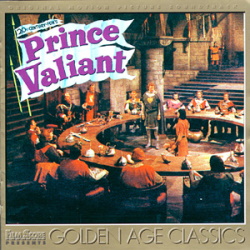 GREATEST SCORES OF THE TWENTIETH CENTURY
Original Review by Craig Lysy
MGM studios had purchased the film rights to the legendary comic book saga but was never able to reduce the sprawling story into a discreet screenplay. After languishing on the shelf for many years MGM allowed its option to lapse. Robert Jacks, who was the son in law of studio executive Darryl F. Zanuck of 20th Century Fox secured the film rights, sensing an opportunity given that swashbuckler films had been experiencing a resurgence in popularity after Ivanhoe (1952). Robert L. Jacks was given a generous budget of nearly $3 million to produce the film, which would be shot in CinemaScope. Dudley Nichols was hired to condense Hal Foster’s comic book tale into a more concise and cogent screenplay, and Henry Hathaway was tasked with directing. A stellar cast was assembled with 24-year-old heartthrob Robert Wagner playing the titular role. Joining him would be James Mason as the villain Sir Brack, Janet Leigh as love interest Princess Aleta, Debra Paget as Princess Irene, Sterling Hayden as Sir Gawain, Victor McLaglen as Boltar, Donald Crisp as King Aguar, Brian Aherne as King Arthur, and Primo Carnera as Sligon. Read more…
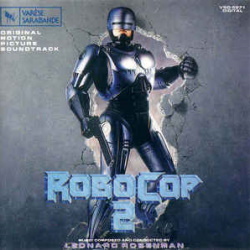
ROBOCOP 2 – Leonard Rosenman
 THROWBACK THIRTY
Original Review by Jonathan Broxton
After the unexpected critical and commercial success of Paul Verhoeven’s Robocop in 1987, it was inevitable that a sequel would be produced, and so in June 1990 Robocop 2 debuted in cinemas. Peter Weller returned to don the chrome armor for a second time as Alex Murphy, a detective in the futuristic Detroit Police Department who, after being murdered by criminals while on duty, is transformed into a half human-half machine cyborg crimefighter. The original movie was a violent action story that masked Verhoeven’s critiques of American hyper-consumerism and corporate corruption; Robocop 2 is a much more straightforward (although perhaps more graphically violent) story that sees Murphy trying to bring down a gang of drug dealers that are flooding the city with Nuke, a synthetic and highly addictive narcotic. Meanwhile, rampant corruption within the police department and its corporate owner, OCP, causes more issues with policing in the city, including mass strikes by cops. In order to address the problems city officials try to strike a deal with Cain, a vicious drug kingpin with a messiah complex. What could go wrong? The film co-stars Nancy Allen, Tom Noonan, and Belinda Bauer, was co-written by cult comic book creator Frank Miller, and was directed by The Empire Strikes Back’s Irvin Kershner, in what turned out to be his last film prior to his death. Read more…
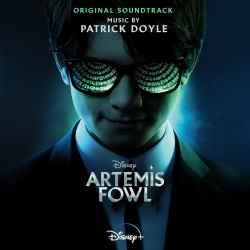
ARTEMIS FOWL – Patrick Doyle
 Original Review by Jonathan Broxton
After being in production since 2013, and then languishing in distribution hell for well over a year after it was completed, Artemis Fowl has finally staggered into the world as a straight-to-streaming product on Disney+ in June 2020, having had its theatrical release cancelled due to the COVID-19 outbreak. It’s a fantasy-adventure film for children, based on the massively popular series of novels by Eoin Colfer, and tells the story of a 12-year old genius named Artemis Fowl, who is the heir to the vast fortune accumulated by his father, a criminal mastermind. However, when his father is kidnapped, young Artemis is tasked with rescuing him, and is thrust into an adventure involving ancient artifacts, mythical hidden cities, and creatures from Irish folklore – fairies and leprechauns and the like – some of whom are intent on apparently starting a war between them and humans. The film stars Colin Farrell, Josh Gad, Judi Dench, and young Ferdia Shaw (the grandson of Jaws actor Robert Shaw) in the title role, and is directed by Kenneth Branagh. Read more…

Shop at the Movie Music UK Store

Member of the

 MOVIE MUSIC UK