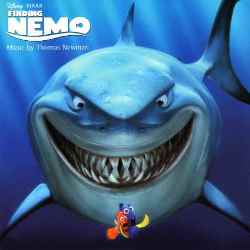
FINDING NEMO – Thomas Newman
 Original Review by Jonathan Broxton
The last person you would expect to score a Disney family movie would be Thomas Newman; the last person you would expect to score a Pixar movie would be Thomas Newman, especially when the monopoly on these has hitherto been held by his cousin Randy. But, in an attempt to break away from the usual sound and go down a different road, Pixar and director Andrew Stanton asked Newman to score Finding Nemo, the excellent animation studio’s offering for summer 2003. The truly unexpected thing about the end result is twofold: firstly, it has provided Newman with a perfect opportunity to employ the services of a much larger orchestra, and to write broad themes and largely more upbeat music. The surprising thing is that, by and large, is also a little disappointing. Read more…
THE MATRIX RELOADED – Don Davis
 Original Review by Jonathan Broxton
The original Matrix movie was a bona-fide phenomenon when it was released in 1999, breaking new ground in many areas: the level and depth of the story by directors Andy and Larry Wachowski; the mysticism and theology that peppers the story; the fetish chic “look” of the film; the once-innovative special effects, with the now passé bullet-time slow motion sequences; and Don Davis’s lavish, electronically enhanced orchestral score, which was lauded by fans but which I personally didn’t care for. Whatever your feelings about its artistic merits, the impact of The Matrix was and is impossible to ignore – and the sequel raises the bar again. Beginning where the original movie left off, The Matrix Reloaded sees Neo (Keanu Reeves) now an established member of the crew of the Nebuchadnezzar, one of many ships under the control of human freedom fighters who are striving to rid the world of the race of machines who have enslaved humanity and tricked them into thinking they are free by creating “the matrix”, a vast computer programme designed to simulate reality. Along with crewmembers Morpheus (Laurence Fishburne), Trinity (Carrie Anne Moss) and Link (Harold Perrineau), the crew seek to fulfill the prophecy of “The One” by tracing the Matrix to its source and freeing humanity… but this is only the beginning. Read more…
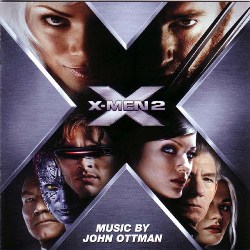
X-MEN 2 – John Ottman
 Original Review by Jonathan Broxton
Following the musical debacle of the original X-men movie in 2000, in which the studio heads at Fox meddled so much with Michael Kamen’s score it rendered it almost redundant, it stands to reason that director Bryan Singer would return to composer John Ottman, for the sequel. Ottman, who had worked with Singer previously on The Usual Suspects and Apt Pupil, had been away making his own movie, Urban Legends: Final Cut, and was unavailable to score X-Men 1. His efforts here bear all the hallmarks of a composer trying to stamp his own musical authority upon a series, and establish himself as the obvious composer of choice for future movies in the franchise. He has only partly been successful. X-Men 2 picks up where the original movie left off: the evil Magneto (Ian McKellen) is incarcerated in a plastic prison; Wolverine (Hugh Jackman) is scouring the globe trying to unravel the mysteries of his past; and the various other mutant members of the X-Men continue to fight the fight against evil, under the benign authority of Dr. Xavier (Patrick Stewart). However, when a renegade mutant attempts to assassinate the President of the United States, it becomes apparent that past differences must be put aside, and the mutants loyal to Magneto and Xavier must join forces to stop a new enemy which could destroy all mutants. Read more…
Johnny Douglas, 1920-2003
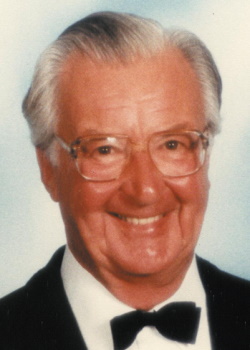 Composer, arranger and conductor Johnny Douglas died at his home in Bognor Regis, West Sussex, England, on April 20, 2003, at the age of 82, following a battle with prostate cancer.
One of the stalwarts of British light music, Douglas wrote scores for around three dozen feature films while maintaining an enormous career in radio, recordings and television. He is remembered above all for Lionel Jeffries’s The Railway Children, whose warmly nostalgic score earned him a BAFTA nomination.
John Henry Douglas was born in Hackney, London, on June 19, 1920, and grew up in Bermondsey. A musical prodigy, he began piano lessons at four and was studying arranging and orchestration before his teens. He formed a dance band while still at school and made his professional debut in 1939 with the Neville Hughes Sextet. During World War II he served in the RAF, where an arm injury temporarily prevented him from playing and encouraged him to concentrate on arranging and composition.
After the war Douglas arranged for bandleaders including Ambrose, Ted Heath and Edmundo Ros before becoming heavily involved in recording. He provided hundreds of arrangements for Decca and in 1958 began a long association with RCA’s Living Strings series, ultimately arranging and conducting more than 80 albums for the label. His polished string writing and gift for melody made him one of Britain’s busiest practitioners of easy-listening orchestral music. Read more…
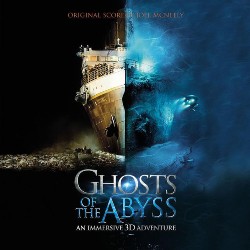
GHOSTS OF THE ABYSS – Joel McNeely
 Original Review by Jonathan Broxton
Following his Oscar winning 1997 movie Titanic, director James Cameron has since become very interested in the shipwreck of the real life ocean liner, which struck an iceberg on 14 April 1912, while on its maiden voyage from Southampton to New York, and sunk beneath the freezing waters of the north Atlantic, killing almost 1,500 passengers. In Ghosts of the Abyss, Cameron, along with a team of the world’s foremost historic and marine experts and his friend, actor Bill Paxton, embarks on an unscripted adventure back to where some of the footage for his dramatic film was shot. Using state-of-the-art technology and new 3-D IMAX cameras developed expressly for this expedition, Cameron and his crew explore virtually all of the wreckage, inside and out, as never before. In addition, actors re-create key moments from the Titanic’s last moments (in a way similar to Discovery Channel documentaries), breathing life and immediacy to the science. Read more…
Academy Award Winners 2002
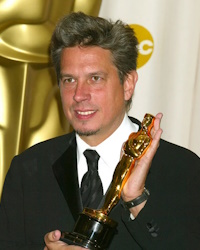 The Academy of Motion Picture Arts and Sciences (AMPAS) have announced the winners of the 75th Academy Awards, honoring the best in film in 2002.
In the Best Original Score category, American composer Elliot Goldenthal won the Academy Award for his score for Julie Taymor’s Frida, the biopic of artist Frida Kahlo. In his acceptance speech Goldenthal said:
Wow. To be around such remarkable women: Julie Taymor, Salma Hayek, Sarah Green, Margie Perenchio. Thank you, Miramax. But what I really want to say, and I’ll do it quickly, is I want to dedicate this award to the bridges that we try to build, to the people of Mexico, to the artistic tradition and legacy of personal and political art. For you, Mexico.
The other nominees for Best Original Score were John Williams for Catch Me If You Can, Elmer Bernstein for Far from Heaven, Philip Glass for The Hours, and Thomas Newman for Road to Perdition.
In the Best Original Song category, Marshall Mathers III (Eminem), Jeff Bass and Luis Resto won the Academy Award for “Lose Yourself” from the hip-hop themed drama 8 Mile. The victory made “Lose Yourself” the first rap song to win the Academy Award for Best Original Song.
The other nominees for Best Original Song were Elliot Goldenthal and Julie Taymor for “Burn It Blue” from Frida; Paul Simon for “Father and Daughter” from The Wild Thornberrys Movie; Bono, The Edge, Adam Clayton and Larry Mullen from U2 for “The Hands That Built America” from Gangs of New York; and John Kander and Fred Ebb for “I Move On” from Chicago.
NIRGENDWO IN AFRIKA/NOWHERE IN AFRICA – Niki Reiser
 Original Review by Peter Simons
Nowhere In Africa (or, in its native German, “Nirgendwo In Afrika”) tells the tragic story of a Jewish family that moves from Germany to Kenya just before WWII in 1938. There, in Africa, they start a farm, but not all members of the family can get used to their new lives. However, the war in Europe makes it impossible for them to return back home. So, all anyone can do is try and make the best out of things. The film was written and directed by Caroline Link, who based her screenplay on the book by Stefanie Zweig. Quite surprisingly, this German film nabbed the Oscar for Best Foreign Language Film at this year’s ceremony. This is the third time Swiss composer Niki Reiser composed a score for director Link. They previously worked together on Jenseits Der Stille (Beyond The Silence, 1996) and Pünktchen Und Anton (Annaluise & Anton, 1999). The soundtrack for Nowhere In Africa is a lovely combination of European and African music. There are bittersweet string chords that could have sprung from the minds of James Horner or Rachel Portman, a theme for oboe that’s quite reminiscent of the theme from The English Patient and there’s quite a bit of mellow African percussion and chanting. There are, unfortunately, a few things working against this score, but ultimately the music is just too darn nice to be really upset by its shortcomings. Read more…
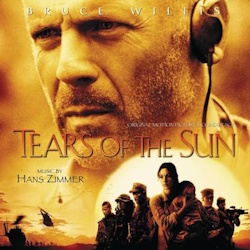
TEARS OF THE SUN – Hans Zimmer
 Original Review by Jonathan Broxton
War movies seem to be the new oeuvre at Media Ventures, especially war movies which take place in far-flung corners of the world. Following their contribution to Terence Malick’s Thin Red Line, Ridley Scott’s Black Hawk Down, their latest project is Tears of the Sun, which basically tells the same story of American soldiers caught in the crossfire of a bloody civil war – but this time the setting is the inhospitable jungles of west Africa as opposed to the dusty streets of Mogadishu. Directed by Antoine “Training Day” Fuqua, Tears of the Sun stars Bruce Willis as Lt. Waters, the leader of an American special-ops group who are sent into the dense jungles of Nigeria to rescue Médecins Sans Frontières doctor Lena Kendricks (Monica Bellucci), who finds herself in danger when rebels overthrow the Government. However, Kendricks refuses to leave her isolated hospital unless Waters and his men agree to help transport 70 refugees to the nearby Cameroonian border, else they be slaughtered by the vicious, unforgiving rebel army. Reluctantly, Waters agrees, and soon he and his men are trekking through the forest with a large group of scared Nigerian men and women – all the while being pursued by the rebels. Read more…
Walter Scharf, 1910-2003
 Composer, arranger and conductor Walter Scharf died at his home in Brentwood, Los Angeles, on February 24, 2003, at the age of 92, from heart failure.
One of Hollywood’s most versatile musical craftsmen, Scharf worked on more than 250 film and television productions during a career spanning more than half a century. His credits ranged from Hans Christian Andersen, Funny Girl and Willy Wonka & the Chocolate Factory to The Nutty Professor, Ben and the documentaries of Jacques Cousteau, earning him ten Academy Award nominations, an Emmy and a Golden Globe.
Walter Scharf was born in Manhattan, New York City, on August 1, 1910. His mother, Bessie Zwerling, was a performer in the Yiddish theatre, giving him an early introduction to show business. After studying at New York University he entered professional music as a pianist, arranger and orchestrator, working on Broadway productions including George Gershwin’s Girl Crazy and accompanying singer Helen Morgan. He later joined Rudy Vallée as pianist and arranger.
Scharf moved to Hollywood in 1934 and quickly became part of the studio music establishment, arranging for performers including Al Jolson, Alice Faye and Bing Crosby. He worked on numerous films without screen credit and helped orchestrate Irving Berlin’s “White Christmas” for Holiday Inn (1942). From 1942 to 1946 he served as music director at Republic Pictures, where his ability to compose, arrange and conduct made him invaluable on productions requiring large amounts of music on demanding schedules. Read more…
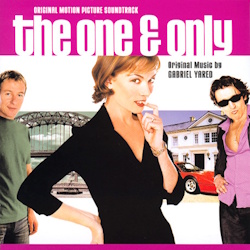
THE ONE & ONLY – Gabriel Yared
 Original Review by Jonathan Broxton
Think of Gabriel Yared, and you would probably automatically think of the lush strings, high dramatics and gut-wrenching melodies heard in scores such as City of Angels, Message in a Bottle and the Oscar-winning The English Patient. The French/Lebanese composer has made a profitable, and successful, Hollywood career scoring cinematic tear-jerkers and heartbreakers in this manner, which makes his work here all the more unexpected – a) because it’s a million miles removed from that style of scoring and, b) because on the whole, its awful. Read more…
GODS AND GENERALS – John Frizzell, Randy Edelman
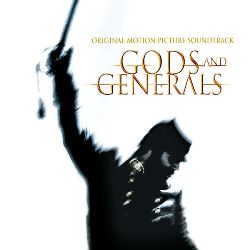 Original Review by Jonathan Broxton
After the massive success of Randy Edelman’s Gettysburg score in 1993, it was only natural that he should be involved in the music for the sequel. However, whereas most of the music in Gettysburg made surprisingly good use of an anachronistic synthesiser and string amalgam, the music for Gods and Generals is more traditionally orchestral, employing powerful instrumental and choral forces without anything remotely electronic to be heard. The most surprising – and pleasing – thing about it is that it was written by John Frizzell, who is enjoying something of a career renaissance with what is easily his most high-profile and accomplished score since Alien Resurrection. Rather than being an actual sequel to Gettysburg, Gods and Generals actually covers much of the same ground, but from different perspectives and points of view, notably that of the legendary General Thomas “Stonewall” Jackson (Stephen Lang) and the events of 1861-1863, leading up to the legendary battle at Gettysburg. Gods and Generals is directed by Robert F. Maxwell, from the book by Jeff Shaara, features a star-studded supporting cast including Jeff Daniels, Mira Sorvino, Kevin Conway, Bill Campbell, and Robert Duvall as General Robert E. Lee, and clocks in at a staggering 3 hours 40 minutes running time. Read more…
DAREDEVIL – Graeme Revell
 Original Review by Peter Simons
In many ways, 2003 has become the year of the comic book revival, with movies inspired by characters including The Incredible Hulk, the X-Men and even The League of Extraordinary Gentlemen hitting cinema screen’s throughout the year. Stan Lee’s Daredevil is another to add to this list. Directed by Mark Steven Johnson, whose previous movies include the syrupy drama Simon Birch, and whose screenplay credits include Jack Frost and the Grumpy Old men films, Daredevil tells the tale of attorney Matt Murdock (Ben Affleck), blinded by toxic waste as a child, whose lack of sight increases his remaining senses to such an extent that he find he has the ability to become a superhero and fight crime. Before long, Murdock finds himself up against New York’s number one crime lord The Kingpin (Michael Clarke Duncan) and his newest apprentice Bullseye (Colin Farrell) – and crossing paths with the sexy, leather-clad Elektra (Jennifer Garner), who has an agenda of her own. A triumph of style and atmosphere over plot and performance, director Johnson said he wanted to make a movie similar to The Crow – which he lists as one of his favourite films – in both look and feel. Unsurprisingly, given this fact, he turned to Graeme Revell for the music. Read more…
Academy Award Nominations 2002
 The Academy of Motion Picture Arts and Sciences (AMPAS) have announced the nominations for the 75th Academy Awards, honoring the best in film in 2002.
In the Best Original Score category, the nominees are:
- ELMER BERNSTEIN for Far from Heaven
- PHILIP GLASS for The Hours
- ELLIOT GOLDENTHAL for Frida
- THOMAS NEWMAN for Road to Perdition
- JOHN WILLIAMS for Catch Me If You Can
This is the 10th Oscar nomination for Bernstein, the 2nd nomination for Glass, the 3rd nomination for Goldenthal, the 5th nomination for Newman, and the 37th nomination for Williams, Bernstein previously won for Thoroughly Modern Millie in 1967. Williams previously won for Fiddler on the Roof in 1971, Jaws in 1975, Star Wars in 1977, E.T. the Extra Terrestrial in 1982, and Schindler’s List in 1993.
In the Best Original Song category, the nominees are:
- ELLIOT GOLDENTHAL and JULIE TAYMOR for “Burn It Blue” from Frida
- PAUL HEWSON (BONO), DAVID EVANS (THE EDGE), ADAM CLAYTON, and LARRY MULLEN for “The Hands That Built America” from Gangs of New York
- JOHN KANDER and FRED EBB for “I Move On” from Chicago
- MARSHALL MATHERS III (EMINEM), JEFF BASS, and LUIS RESTO for “Lose Yourself” from 8 Mile
- PAUL SIMON for “Father and Daughter” from The Wild Thornberrys Movie
The winners of the 75th Academy Awards will be announced on March 23, 2003.
THE RECRUIT – Klaus Badelt
 Original Review by Peter Simons
Ever since John Powell and Harry Gregson-Williams left the Media Ventures studio, Klaus Badelt has been busier than ever. We are barely halfway through 2003 and already the young composer has scored five movies, including the Aussie drama Ned Kelly, the Matrix rip-off Equilibrium, and the swashbuckler Pirates of the Caribbean. And then there is this one: The Recruit. A thriller directed by Roger Donaldson, starring Colin Farrell as a brilliant CIA-trainee who is asked by his mentor (Al Pacino) to detect a mole operating within the Agency. If nothing more, Donaldson has created an entertaining movie. Donaldson is a bit of a stealthy director in Hollywood, despite several entertaining high-profile movies such as Species, Dante’s Peak and Thirteen Days. For the music Donaldson has turned to a different composer for every new movie, creating an impressive track record of having worked with the likes of Vangelis, Maurice Jarre, Mark Isham, Chris Young and Trevor Jones. For The Recruit, he turned to Klaus Badelt. Read more…
BAFTA Nominations 2002
 The British Academy of Film and Television Arts (BAFTA) has announced the nominations for the 56th British Academy Film Awards, honoring the best in film in 2002.
In the Best Original Music category, which is named in memory of the film director Anthony Asquith, the nominees are:
- JOHN KANDER, FRED EBB, and DANNY ELFMAN for Chicago
- PHILIP GLASS for The Hours
- WOJCIECH KILAR for The Pianist
- HOWARD SHORE for Gangs of New York
- JOHN WILLIAMS for Catch Me If You Can
These are the first nominations for Ebb, Elfman, Glass, Kander, and Kilar. It is the third nomination for Shore, and the tenth nomination for Williams. Williams previously won for Jaws and The Towering Inferno in 1975, Star Wars in 1978, The Empire Strikes Back in 1980, E.T. the Extra-Terrestrial in 1982, Empire of the Sun in 1988, and Schindler’s List in 1993.
The winners of the 56th BAFTA Awards will be announced on February 23, 2003.

Shop at the Movie Music UK Store

Member of the


