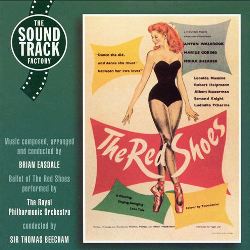
THE RED SHOES – Brian Easdale
 GREATEST SCORES OF THE TWENTIETH CENTURY
Original Review by Craig Lysy
Following their success with Black Narcissus in 1947 the directorial team of Michael Powell and Emeric Pressburger decided to adapt the fairy tale “The Red Shoes” by Hans Christian Anderson for the big screen. The story tells of the girl who dons beautiful red shoes, which danced away with her, through the streets, into a dark nether land and eventually, to her death. They created the screenplay and brought in renowned choreographer Jack Cardiff to choreograph the ballet. Powell and Pressburger sought authentic artistry for their film and so decided early on that they would use professional dancers who could act, rather than actors who could dance. They also wanted to create a realistic feeling of a ballet troupe and so included a fifteen-minute ballet as the high point of the film. Worth noting was the brilliance of the film’s cinematography, particularly its use of color. Ballerina Moira Shearer was brought in for the lead role of Vicky Page, with Marius Goring (Julian Craster) playing her love interest and Anton Walbrook (Boris Lermontov) as her ruthless authoritarian impresario. Read more…
Golden Globe Winners 2015
 The Hollywood Foreign Press Association (HFPA) have announced the winners of the 73rd Golden Globe Awards, honoring the best in film and American television of 2015.
In the Best Original Score category legendary composer Ennio Morricone won the award for his score for The Hateful Eight. Morricone was not present at the ceremony, and his award was accepted by the film’s director, Quentin Tarantino. In his acceptance speech, Tarantino said:
“Thank you! Wow, this is really cool. Do you realize that Ennio Morricone – who, as far as I am concerned is my favorite composer, and when I say favorite composer, I don’t mean movie composer, that ghetto, I’m talking about Mozart, I’m talking about Beethoven, I’m talking about Schubert, that’s who I’m talking about – and Ennio Morricone has never won an award for any one individual movie that he has done. He has in Italy! But not in America – and this is I know not America, it’s the Hollywood Foreign Press Association – but, I have to say – please wrap it up, I will – I have to say that I directed the movie that the great Ennio Morricone, at 87 years of age, did an original score for and won the Golden Globe. For Ennio, and his wife, I say thank you, and grazie. Grazie!”
The other nominees were Carter Burwell for Carol, Alexandre Desplat for The Danish Girl, Daniel Pemberton for Steve Jobs, and Ryuichi Sakamoto and Alva Noto for The Revenant.
In the Best Original Song category, the winners were Sam Smith and James Napier for their song “Writing’s On the Wall” from the James Bond movie Spectre.
The other nominees were Justin Franks, Andrew Cedar, Charlie Puth and Cameron Thomaz (Wiz Khalifa) for “See You Again” from Furious 7, David Lang for “Simple Song #3” from Youth, Max Martin, Savan Kotecha, Ilya Salmanzadeh, Ali Payami and Tove Nilsson for “Love Me Like You Do” from Fifty Shades Of Grey, and Brian Wilson and Scott Bennett for “One Kind Of Love” from Love and Mercy.
SANADA MARU – Takayuki Hattori
 Original Review by Jonathan Broxton
The annual NHK Taiga drama is a year-long television series broadcast on Japan’s main television network, NHK, and has been a staple of Japanese television since the first one was broadcast in 1963. It is widely considered to be one of the most prestigious television events of the Japanese calendar, attracting the cream of Japan’s dramatic talent, actors, writers, directors and composers. The 2016 NHK Taiga drama is Sanada Maru, which tells the life story of Sanada Yukimura, one of the last great historical samurai warriors in the “Warring States” period, and who is famous for successfully withstanding a great military siege in Osaka in 1615. Directed by Takafumi Kumira, it stars Masato Sakai in the leading role, and has an original score by composer Takayuki Hattori, who despite being a prominent figure in Japanese film music for more than 20 years may still be best known in the West for his monster movie score Godzilla Millennium from 1999. Read more…
Under-the-Radar Round Up 2015, Part 3
 Original Reviews by Jonathan Broxton
The third installment in my series of articles looking at the best “under the radar” scores from around the world concentrates on music from films from mainland Europe. I know this is a very ‘broad brush’ description, but there are a number of countries this year where there are just one or two standout works which couldn’t justify an entire article to themselves, so I decided to present you with this bumper crop from across the entire continent instead! The scope is quite wide-ranging, and includes everything from French documentaries to Polish serial killer thrillers, Russian adventure movies, and Greek romantic dramas, by written Oscar-winners and exciting newcomers alike.
BAFTA Nominations 2015
 The British Academy of Film and Television Arts (BAFTA) has announced the nominations for the 69th British Academy Film Awards, honoring the best in film in 2015.
In the Best Original Music category, which is named in memory of the film director Anthony Asquith, the nominees are:
- JÓHANN JÓHANNSSON for Sicario
- ENNIO MORRICONE for The Hateful Eight
- THOMAS NEWMAN for Bridge of Spies
- RYUICHI SAKAMOTO and ALVA NOTO for The Revenant
- JOHN WILLIAMS for Star Wars: The Force Awakens
This is the second BAFTA nomination for Jóhannsson; the 6th BAFTA nomination for Morricone (who won the award every time he was previously nominated: for Days of Heaven in 1979, Once Upon a Time in America in 1984, The Mission in 1986, The Untouchables in 1987, and Cinema Paradiso in 1999); the 5th BAFTA nomination for Newman, who won in 1999 for American Beauty and again in 2012 for Skyfall; the 3rd BAFTA nomination for Sakamoto, who won in 1983 for Merry Christmas Mr. Lawrence; and the 16th nomination for Williams, who has won on seven previous occasions: for Jaws in 1975, Star Wars in 1978, The Empire Strikes Back in 1980, E.T. The Extra-Terrestrial in 1982, Empire of the Sun in 1988, Schindler’s List in 1993, and Memoirs of a Geisha in 2005.
The winners of the 69th BAFTA Awards will be announced on February 14, 2016.
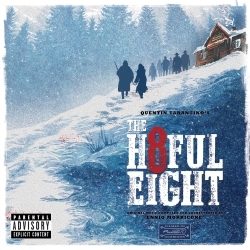
THE HATEFUL EIGHT – Ennio Morricone
 Original Review by Jonathan Broxton
Ennio Morricone has been providing music for Quentin Tarantino’s films for a long time, but it is only recently that he has done so intentionally. Tarantino’s first six films – Reservoir Dogs, Pulp Fiction, Jackie Brown, Kill Bill, Death Proof, and Inglourious Basterds – featured an eclectic, hand-picked selection of music comprising classic rock songs and score cuts from Tarantino’s favorite movies. Kill Bill and Inglourious Basterds most notably made use of music from several classic Morricone scores, including tracks from films such as Navajo Joe, The Good the Bad and the Ugly, The Big Gundown, Revolver, and Allonsanfàn, among others. Tarantino has been both praised and criticized for this approach; some love his idiosyncratic re-purposing of this music in a new and vital setting, while others say that their familiarity with some of the pieces causes a disconnect, diminishing their impact in their new context. Years ago, when questioned about his musical ideology, Tarantino said that he didn’t trust any composer enough to understand, and then musically reinterpret, his cinematic visions – the “soul of his movie”. Tarantino’s stance on this matter began to soften somewhat prior to his seventh film, Django Unchained, and at one point the rumor was that Ennio Morricone had agreed to score it – if anyone could get Tarantino to change his mind about the impact and importance of an original score, it would be Morricone. However, circumstances led to this not happening, and the final soundtrack featured an original Morricone song, “Ancora Qui,” but no original score. Read more…
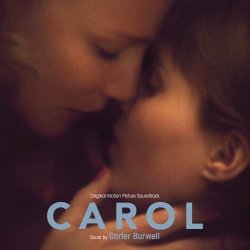
CAROL – Carter Burwell
 Original Review by Jonathan Broxton
A romantic drama based on the novel The Price of Salt by Patricia Highsmith, and directed by Todd Haynes, Carol is a melodrama with a very modern slant. The film stars Cate Blanchett and Rooney Mara as Carol and Therèse, two women living in New York in the 1950s, both of whom are struggling in their relationships. Carol is estranged from her husband Harge (Kyle Chandler) after she had an affair with another woman, Abby (Sarah Paulson), and Harge is threatening to take away custody of their child. Meanwhile, Therèse is dissatisfied with her relationship with her boyfriend Richard (Jake Lacy), and dreams of something more fulfilling. Their lives intersect when Carol accidentally leaves her gloves at the department store where Therèse works while Christmas shopping; when Therèse returns them, Carol insists on buying her a drink to thank her, and the subsequent sexual tension between them is palpable, but the age gap between the two, as well as their gender, threatens to break the rigid social and moral taboos of the era. Read more…
Under-the-Radar Round Up 2015, Part 2
Original Reviews by Jonathan Broxton
The second installment in my series of articles looking at the best “under the radar” scores from around the world concentrates on music from films from Scandinavia. This year’s crop of outstanding scores from the far north of Europe features an animated film from Denmark, a wry comedy-drama from Iceland, a pair of historical dramas from Finland, and a wonderful children’s score from Norway written by one of that country’s most talented young composers!
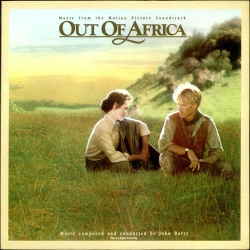
OUT OF AFRICA – John Barry
 THROWBACK THIRTY
GREATEST SCORES OF THE TWENTIETH CENTURY
Original Review by Jonathan Broxton
The winner of seven Academy Awards – including Best Picture, Best Director, Best Screenplay, and Best Cinematography – Out of Africa is generally considered one of the greatest romantic dramas in cinema history. Directed by Sydney Pollack, it is based on the semi-autobiographical writings of aristocratic Danish author Karen Dinesen, specifically the period in the 1910s when she moved to live on a coffee plantation in colonial Kenya with her then-husband, Baron Bror von Blixen-Finecke, and had an affair with a rugged and handsome big game hunter, Denys Finch Hatton. The film is a sumptuous, visually magnificent love letter to the unspoiled African savannah, reveling in the majestic vistas of the country, and using them as a backdrop to the affair Karen engages in, as her husband becomes increasingly distant and neglectful. Anchored by the three central performances of Meryl Streep as Karen, Robert Redford as Denys, and Klaus-Maria Brandauer as Bror, the film explores such challenging themes as marital fidelity, the expectations and conventions of aristocratic society, the role of women in the 1910s, and the differences between European and African tribal cultures, as well as the threat of World War I that loomed over everything. Read more…
STAR WARS: THE FORCE AWAKENS – John Williams
 Original Review by Jonathan Broxton
WARNING: THIS REVIEW CONTAINS PLOT SPOILERS. IF YOU HAVE NOT YET SEEN THE FILM, YOU MIGHT WANT TO CONSIDER WAITING UNTIL AFTER YOU HAVE DONE SO TO READ IT.
When John Williams first sat down to write the score for the original Star Wars over the winter of 1976, I doubt that even he could have imagined that he would still be writing music for those characters, and that universe, some 39 years later. There aren’t many film scores you can point to as being an actual turning point, a watershed moment in the history of the genre, but Star Wars was unquestionably one of those, and it went on to inspire a generation of filmmakers, composers, and fans. To say that The Force Awakens, the seventh film in the Star Wars franchise, is an eagerly awaited film would perhaps be one of the greatest understatements of all time – I don’t think I have ever seen a film with this much marketing, pre-release hype, and fevered anticipation – and, thankfully, it does not disappoint in any way. More than any installment in the prequels did, The Force Awakens feels like a proper Star Wars movie, a return to the fun and crowd-pleasing filmmaking of the original trio, and director J. J. Abrams should be congratulated for returning the franchise to its roots, and going some way to banishing the ghost of Jar Jar Binks forever. Read more…
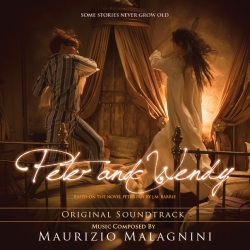
PETER AND WENDY – Maurizio Malagnini
 Original Review by Jonathan Broxton
J. M. Barrie’s story of Peter Pan has inspired numerous adaptations and spin-offs since it was first performed as a stage play in London in 1904. The latest of those is Peter and Wendy, a British TV movie directed by industry veteran Diarmuid Lawrence. Framed within a more contemporary setting, it tells the story of a young girl named Lucy who is about to receive open heart surgery at the famed Great Ormond Street Hospital. To help assuage her fears about her upcoming procedure, Lucy’s mother reads her the classic Peter Pan novel, and the famous story of Neverland, Captain Hook, Tinkerbell, Lost Boys, and the Boy Who Wouldn’t Grow Up unfolds inside her imagination, with herself as the heroine. The film, which airs in the UK on Christmas Day, stars Stanley Tucci as Captain Hook, Paloma Faith as Tinker Bell, Laura Fraser as Mrs. Darling, and newcomers Zac Sutcliffe and Hazel Doupe as Peter and Wendy respectively. Read more…
THE DANISH GIRL – Alexandre Desplat
 Original Review by Jonathan Broxton
Gender identity issues have been a major social topic in 2015, encompassing everything from Caitlin Jenner to the acclaimed TV series Transparent, so it is perhaps unsurprising that a film like The Danish Girl should be released this year. Directed by Oscar-winner Tom Hooper (The King’s Speech), it looks at the life of Einar Wegener, a young Danish man living in Copenhagen in the 1920s, who became the first ever recipient of male-to-female sex reassignment surgery. Lead actor Eddie Redmayne is heavily tipped for a second consecutive Academy Award for his performance as Einar and his alter ego, Lili, and he is ably supported by Alicia Vikander as his wife, Gerda. Also receiving a great deal of critical acclaim has been the score, written by French composer Alexandre Desplat, who has already received Golden Globe and Satellite Award nominations for his work. This is the fifth and final Desplat score of 2015, whose output in general has been disappointing compared to his usual stellar standards: Suffragette came and went without much fanfare, Everything Will Be Fine was barely released in the United States, and neither Il Racconto dei Racconti nor Une Histoire de Fou have been released outside their native countries at all. Read more…
Under-the-Radar Round Up 2015, Part 1
Original Reviews by Jonathan Broxton
The first installment in my series of articles looking at the best “under the radar” scores from around the world concentrates on music from films from Spain and Portugal. I have been very vocal in the past about my admiration for the music coming out of the Iberian peninsula, and this year just reinforces my view that some of the best film music in the world right now is being written there. My first look at the area features new scores by some of my favorite contemporary composers, including Federico Jusid and Nuno Malo, and there will be more to come later!
Golden Globe Nominations 2015
 The Hollywood Foreign Press Association (HFPA) has announced the nominations for the 73rd Golden Globe Awards, honoring the best in film and American television of 2015.
In the Best Original Score category, the nominees are:
- CARTER BURWELL for Carol
- ALEXANDRE DESPLAT for The Danish Girl
- ENNIO MORRICONE for The Hateful Eight
- DANIEL PEMBERTON for Steve Jobs
- RYUICHI SAKAMOTO and ALVA NOTO for The Revenant
These are the first major film music award nominations for both Pemberton and Noto, although Pemberton has received two BAFTA nominations for his work in video games. Noto is the stage name of German musician and artist Carsten Nicolai, an influential experimental electronic composer who has worked with Michael Nyman and Blixa Bargeld, among others.
This is the 2nd nomination for Burwell, the 8th nomination for Desplat (who won the Globe in 2006 for The Painted Veil), the 9th nomination for Morricone (who previously won Globes for The Mission in 1986 and The Legend of 1900 in 1999), and the third nomination for Sakamoto (who previously won Globes for The Last Emperor in 1987 and The Sheltering Sky in 1990).
In the Best Original Song category, the nominees are:
- JUSTIN FRANKS, ANDREW CEDAR, CHARLIE PUTH and CAMERON THOMAZ (WIZ KHALIFA) for “See You Again” from Furious 7
- DAVID LANG for “Simple Song #3” from Youth
- MAX MARTIN, SAVAN KOTECHA, ILYA SALMANZADEH, ALI PAYAMI and TOVE NILSSON for “Love Me Like You Do” from Fifty Shades of Grey
- SAM SMITH and JAMES NAPIER for “Writing’s On the Wall” from Spectre
- BRIAN WILSON and SCOTT BENNETT for “One Kind of Love” from Love and Mercy
The winners of the 73rd Golden Globe Awards will be announced on January 10, 2016.
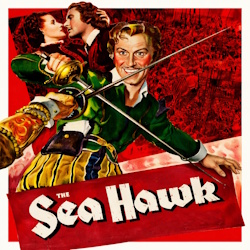
THE SEA HAWK – Erich Wolfgang Korngold
 GREATEST SCORES OF THE TWENTIETH CENTURY
Original Review by Craig Lysy
Warner Brothers Studios was very much interested in remakes of author Rafael Sabatini’s two seafaring novels The Sea Hawk (1915) and Captain Blood (1922). After acquiring the Vitagraph company, which produced the earlier Silent Era films, the studio set in motion its plan. Captain Blood (1935) was a stunning success, which propelled Errol Flynn to stardom, however the studio shelved The Sea Hawk in favor of starring Flynn in The Adventures Of Robin Hood (1938) and The Private Lives Of Elizabeth And Essex (1939). Upon completion of filming the Studio assigned Henry Blanke and Hal Wallis to produce The Sea Hawk and Michael Curtiz to direct. Howard Koch and Seton Miller were tasked with writing a swashbuckling epic to showcase Flynn’s charisma and talent. Supporting Erroll Flynn as Geoffrey Thorpe would be Henry Daniell as Lord Wolfingham, Brenda Marshall as Doña María, Claude Rains as Don José Álvarez de Córdoba, Donald Crisp as Sir John Burleson, Flora Robson as Queen Elizabeth I, Alan Hale as Carl Pitt and Una O’Connor as Miss Latham. Read more…

Shop at the Movie Music UK Store

Member of the


