KRAMPUS – Douglas Pipes
 Original Review by Jonathan Broxton
Having grown up in the UK, Christmas for me has always been a time of joyous innocence, especially for children. Religious considerations aside, the season is dominated by the figure of Santa Claus, that jolly, rosy-cheeked old fellow who drives a magical sleigh pulled by reindeer and brings presents to children who are on his ‘good list’. Not much thought is given here to what happens to those on the ‘naughty list’, but that’s not the case in other parts of the world. In the Netherlands, for example, there is Zwarte Piet, who accompanies Santa around the world, and while the big guy is handing out gifts to the good kids, he is flogging the bad ones with a rod of birch twigs. Then, in the German-speaking areas of Austria and Switzerland, there is Krampus: a terrifying demon-like creature with cloven hooves and the horns of a goat, who carries chains, bells, and a sack on his back, into which he puts naughty children, so that he can eat them later, or transport them to Hell. The new film Krampus transposes this legend to contemporary America, and tells the story of a dysfunctional family who are forced to do battle with Krampus when he comes to visit… The comedy-horror is directed by Michael Dougherty and stars Adam Scott, Toni Collette, David Koechner, Allison Tolman, Conchata Ferrell, and Emjay Anthony. Read more…
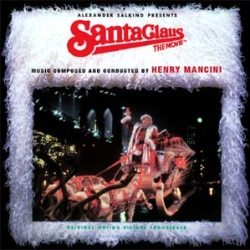
SANTA CLAUS: THE MOVIE – Henry Mancini
 THROWBACK THIRTY
Original Review by Jonathan Broxton
The winter of 1985 saw the release of one of the strangest holiday films of all time: Santa Claus: The Movie, which purportedly told the ‘real’ story of the origin of the Santa Claus legend. However, instead of actually going into the history of the Turkish bishop Saint Nicholas, the Sinterklaas story from traditional Dutch folklore, and how the two were blended with elements of Norse and Pagan mythology, and Clement Clarke Moore’s classic poem ‘The Night Before Christmas,’ to create the contemporary Christmas icon – a movie I would actually like to see, for real! – the film invents an original story about a kind-hearted 14th century woodcutter and his wife, who are caught in a blizzard while delivering toys to local children. Magically transported to the North Pole, the woodcutter and his wife are greeted by elves, who convince the man that it is his destiny to deliver toys to the children of the world every Christmas Eve, which the elves will make in their large workshops. At the same time, the film also tells a contemporary story set in modern day New York, in which Patch – one of Santa’s elves – decides to strike out on his own and set up his own toy-making business, but unwittingly joins forces with an unscrupulous millionaire who wants to “take over” Christmas for himself. Read more…
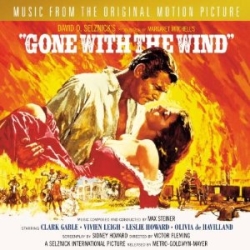
GONE WITH THE WIND – Max Steiner
 GREATEST SCORES OF THE TWENTIETH CENTURY
Original Review by Craig Lysy
Margaret Mitchell’s 1936 novel Gone With The Wind caught legendary producer David O. Selznick’s eye and he saw destiny in the making. At his bidding MGM purchased the film rights for an unprecedented $50,000. This was a passion project for Selznick and no expense would defer him from realizing his vision. Screenwriter Sidney Howard was hired to do the impossible – adapt the massive 1,037-page story to the big screen. Victor Fleming was tasked with directing and a cast that has become legend were hired including Clark Gable as Rhett Butler, Vivien Leigh as Scarlet O’Hara, Leslie Howard as Ashley Wilkes, Olivia de Havilland as Melanie Hamilton, Thomas Mitchell as Gerald O’Hara, Barbara O’Neil as Ellen O’Hara and Hattie McDaniel as Mammy. No movie to this date provided such a grand and epic sweep, and in the end six hours of film were shot, which featured thousands of actors. Read more…
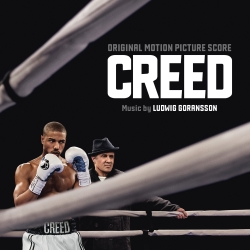
CREED – Ludwig Göransson
 Original Review by Jonathan Broxton
The seventh film in the iconic Rocky series of boxing-themed movies, Creed continues the story of Philly pugilist Rocky Balboa, who fought his way from nothing to become Heavyweight Champion of the World. Nine years after the events of the last film, Rocky is still in Philadelphia, running the restaurant named after his late wife Adrian, and generally staying out of the limelight. Things change when he is approached by a young fighter from Los Angeles named Adonis ‘Donny’ Johnson, who is actually the long-estranged son of Rocky’s former rival and great friend Apollo Creed, who had been killed in the ring thirty years previously (during Rocky IV). Rocky reluctantly agrees to train Adonis, and the two develop a father-son bond; simultaneously, Adonis begins a relationship with an aspiring singer-songwriter named Bianca. However, things change on several fronts when Adonis is challenged by the British world light heavyweight champion Ricky Conlan, and when Rocky develops health problems and is forced to confront his own mortality. Read more…
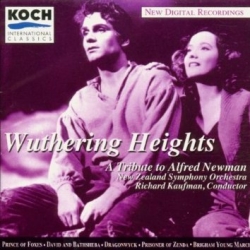
WUTHERING HEIGHTS – Alfred Newman
 GREATEST SCORES OF THE TWENTIETH CENTURY
Original Review by Craig Lysy
In 1938 studio executive Samuel Goldwyn was intent on finding a new project for his studio’s star Merle Oberon. By coincidence William Wyler was seeking financial backing for his next film, which would adapt Emily Bronte’s 1847 novel Wuthering Heights. He argued to Goldwyn that it would be a perfect tragic romantic tale to showcase Oberon’s talents. Goldwyn agreed and decided he would produce the film, with Wyler tasked with directing. He provided a generous budget and brought in screenwriters Charles MacArthur, Ben Hecht and John Huston to write the screenplay. They drew inspiration from the first sixteen chapters of the 34-chapter novel, and changed the setting from the 18th to the 19th Century. For their cast, Merle Oberon would take on the starring role of Catherine Earnshaw, joined by Laurence Olivier as Heathcliff. David Niven would play Edgar Linton and Geraldine Fitzgerald, Isabella Linton. Read more…
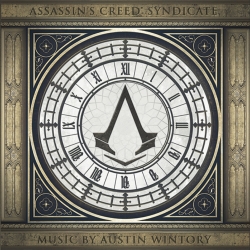
ASSASSIN’S CREED: SYNDICATE – Austin Wintory
 GAME ZONE REVIEW
Original Review by Jonathan Broxton
The ninth entry in the main series of Ubisoft’s Assassin’s Creed video games, Assassin’s Creed: Syndicate is one of the most eagerly-awaited game titles of 2015. Set in London in 1868 during the Industrial Revolution, the story follows twins Jacob and Evie Frye as they navigate the corridors of organized crime during the Victorian era. The story relates to the overarching narrative of the entire series, which primarily revolves around the rivalry between two ancient secret societies – the Assassins and the Knights Templar. The Fryes are members of the Assassins, seeking to take down the Templars who occupy the majority of the positions of power in society, and are aided in their quest by notable figures of the era including Charles Dickens, Charles Darwin, Karl Marx, Florence Nightingale, and even Queen Victoria herself. Read more…
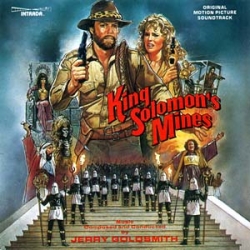
KING SOLOMON’S MINES – Jerry Goldsmith
 THROWBACK THIRTY
Original Review by Jonathan Broxton
With the massive box office success of the two Indiana Jones films, Raiders of the Lost Ark and The Temple of Doom, several film producers sought to bring to the silver screen a ‘rugged historical adventurer’ of their own. Cannon Films had acquired the rights to H. Rider Haggard’s classic novel King Solomon’s Mines and its main character Allan Quatermain, and put into production a light, family-friendly version of the tale, with J. Lee Thompson directing, and Richard Chamberlain in the lead role. The film is set in the early 1900s and follows Quatermain, who is hired by the beautiful Jesse Huston (Sharon Stone) to find her father, who has disappeared in central Africa while searching for the fabled mines of the title. The expedition brings Quatermain in contact with numerous dangers and enemies, not least of which is a rival expedition led by the ruthless Colonel Bockner (Herbert Lom), who will stop at nothing to find the mines himself. Read more…
SPOTLIGHT – Howard Shore
 Original Review by Jonathan Broxton
In 2002 four journalists with the Boston Globe newspaper – Walter “Robby” Robinson, Michael Rezendes, Sacha Pfeiffer, and Matt Carroll – uncovered a massive scandal involving the Catholic church in Massachusetts, specifically relating to the fact that the diocesan hierarchy in the city knew about, and helped cover up the acts of, dozens and dozens of priests who sexually abused literally hundreds of children over the course of several decades. The fallout from the investigation was known as the Massachusetts Catholic Sex Abuse Scandal, led to the trial and subsequent imprisonment of dozens of priests, and rocked the hierarchy within the Catholic church, in America, and across the world. Tom McCarthy’s film Spotlight looks at how the four journalists – who went on to win the Pulitzer Prize for Public Service – broke the story. It stars Michael Keaton, Mark Ruffalo, Rachel McAdams and Brian d’Arcy James as the journalists, and has a wonderful supporting cast of character actors, including Stanley Tucci, Liev Schreiber, John Slattery, Jamey Sheridan, Paul Guilfoyle, and Billy Crudup. Read more…
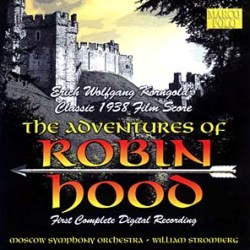
THE ADVENTURES OF ROBIN HOOD – Erich Wolfgang Korngold
 GREATEST SCORES OF THE TWENTIETH CENTURY
Original Review by Craig Lysy
In 1935 Warner Brothers Studio sought to bring an epic swashbuckling film to the big screen and William Keighley was hired to direct. Screenwriters Norman Reilly Raine and Seton Miller were brought in to write the script, for which they drew inspiration from the Medieval Robin Hood legends. A stellar cast was assembled including; Errol Flynn (Sir Robin of Locksley AKA Robin Hood), Olivia de Havilland (Lady Marian Fitzwalter), Basil Rathbone (Sir Guy of Gisbourne), Claude Reins (Prince John), Patrick Knowles (Will Scarlett), Eugene Pallette (Friar Tuck), Alan Hale Sr. (Little John) and Melville Cooper (High Sheriff of Nottingham). Read more…
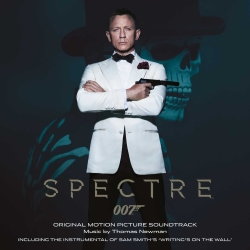
SPECTRE – Thomas Newman
 Original Review by Jonathan Broxton
The 24th official James Bond film, the fourth starring Daniel Craig, and the second directed by Sam Mendes, Spectre apparently concludes a four-movie storyline, bringing together the plots of the three preceding films – Casino Royale, Quantum of Solace, and Skyfall – and re-introducing Bond to his greatest nemesis. As he globe-trots around the world from Mexico to Rome, to Austria, and beyond, Bond gradually discovers the existence of a shadowy organization which appears to be orchestrating a series of terrorist events, including the ones Bond investigated in the previous films, and whose leader may be a figure from his own past. The film co-stars Christoph Waltz, Léa Seydoux, Ben Whishaw, Naomie Harris, Dave Bautista, Monica Bellucci, and Ralph Fiennes, and in many ways is a love letter to the entire James Bond franchise. Not only is this Bond a touch more light-hearted, with a little more emphasis on the gadgets and the girls than the previous films, there are innumerable nods and winks and in-jokes for the Bond connoisseur: the mountaintop clinic is straight out of On Her Majesty’s Secret Service, the “hollowed out volcano” in the desert is from You Only Live Twice, the car from Goldfinger makes a spectacular return, the fight on the train has echoes of both From Russia With Love and Live and Let Die, the “funhouse” in the remains of the MI6 building recalls The Man With the Golden Gun, and the monosyllabic henchman Hinx is clearly modeled after the similarly taciturn Jaws. The whole film is a loving homage to everything preceding it, and delighted this long-time fan of the genre, although of course you have to overlook the contrivances and plot holes that always come with this territory. Read more…
REVELATION – Neal Acree
 GAME ZONE REVIEW
Original Review by Jonathan Broxton
Revelation is a MMORPG (Massively Multiplayer Online Role-Playing Game) from the Chinese video game studio NetEase. I really don’t know much about the game itself; it seems to be one of those fantasy-based games where players create and design playable characters in a variety of classes and embark on various quests against a backdrop of beautifully-designed landscapes. The game apparently has a major focus on the concept of flight, using wings that characters have as well as flying mounts such as dragons. It’s also only playable in Chinese, making it a somewhat obscure title to western audiences, and it would likely have remained so had it not been for the fact that the score is by the superb young American video game composer Neal Acree. Read more…
EN MAI FAIS CE QU’IL TE PLAÎT/COME WHAT MAY – Ennio Morricone
 Original Review by Jonathan Broxton
If the information on the Internet Movie Database is correct, En Mai Fais Ce Qu’il te Plaît is the 521st score of Ennio Morricone’s career, which stretches back to his first score, Il Federale, in 1961. In the intervening 54 years the Italian has written some of the most iconic music in the history of cinema; En Mai Fais Ce Qu’il te Plaît will likely not be remembered as one of his standout works but, considering the fact that he is now aged 86, that he is writing film music at all is a minor miracle. That it’s still this good is nothing short of astonishing. The film – the title of which translates to Darling Buds of May in English – is a French drama written and directed by Christian Carion, who previously directed the well regarded films Une Hirondelle a Fait le Printemps and Joyeux Noël. Set during the early days of World War II, the story follows a group of people from a small village in Pas-de-Calais in northern France, who flee from the advancing German troops, and essentially become homeless, traversing the French countryside trying to avoid the Nazis, while trying to retain some semblance of a normal life under new, terrible circumstances. Read more…
ALEXANDER NEVSKY – Sergei Prokofiev
 GREATEST SCORES OF THE TWENTIETH CENTURY
Original Review by Craig Lysy
Film director Sergei Eisenstein had secured the favor of Soviet dictator Stalin with two films, which extolled the revolution and Communist party; The Battleship Potemkin (1925) and October: Ten Days That Shook The World (1928). Unfortunately, a misguided foray to the West to make films unrestrained by the demands of Soviet Realism caused him to fall out of favor. Upon returning to the Soviet Union in 1932 he was slowly rehabilitated and fortune smiled upon him when Stalin approved production of a film about Alexander Nevsky. Dimitri Vasilyev was assigned by the Ministry of Culture to keep Eisenstein on schedule and budget. The screenplay would be written by Eisenstein and Pyotyr Pavlenko. The telegenic Nikolay Cherkasov would play the titular role and be supported by Nikolay Okhlopkov as Vasili Buslaev and Andrei Abrikosov as Gavrilo Oleksich. Sergei Eisenstein made Alexander Nevsky during the dark pall of the Stalinist era. The film offers an obvious allegory on the historic Germanic-Russian animus, as well as the escalating distrust and tension felt with the Nazi regime. The story celebrates Prince Alexander Nevsky, who achieves an apotheosis, passing unto legend after he leads the armies of Holy Mother Russia to victory over the crusading Catholic Teutonic Knights. Read more…
SECRETS OF A PSYCHOPATH – Scott Glasgow
 Original Review by Jonathan Broxton
I apologize in advance for what this review is about to become, because I know many of you will see it as a rant, but it’s something that’s been bothering me for quite a while and I need to get it off my chest. But first, the basics: Secrets of a Psychopath is a low budget horror-thriller starring Kari Wuhrer and Mark Famiglietti as Katherine and Henry, two siblings who lure unsuspecting victims to their house via an online dating site, and then subject the hapless women who respond their ad to increasingly gruesome games of torture and, eventually, murder, all in an apparent attempt to ‘heal’ Henry’s sexual dysfunction. It’s directed by 93-year old Bert Gordon, the man behind such cult shockers as The Amazing Colossal Man, Earth vs. the Spider, Empire of the Ants, and The Food of the Gods, and has an original score by the super talented Scott Glasgow, who has shown his skill at crafting memorable scores in this genre through previous titles like Lo and Riddle. Read more…
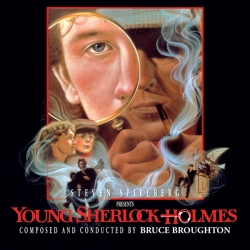
YOUNG SHERLOCK HOLMES – Bruce Broughton
 THROWBACK THIRTY
Original Review by Jonathan Broxton
The fascination with Sir Arthur Conan Doyle’s great fictional detective Sherlock Holmes has often been such that people have ventured beyond the realms of the original 60 stories, and written extrapolations investigating both Holmes’s childhood and his life after his career ended, as well as re-imaginings of the character in more contemporary settings. The 1985 film Young Sherlock Holmes is one such tale, an original story chronicling the supposed first meeting between Sherlock Holmes and his long-suffering friend John Watson, and their first adventure together. Written by Chris Columbus and directed by Barry Sonnenfeld, the film stars Nicholas Rowe as Holmes and Alan Cox as Watson, who meet as teenagers at London’s Brompton Academy in the 1870s. After a series of murders in which the victims – one of whom is Holmes’s mentor and former professor Rupert Waxflatter – experience terrifying hallucinations before they die, and after having his suspicions rebuffed by an incompetent police chief, Holmes and Watson begin to investigate the case themselves, and uncover a secret cult of Egyptian god worshippers who appear to be responsible for the deaths. The film co-stars Anthony Higgins, Sophie Ward, and Nigel Stock, and received generally positive reviews, especially for its special effects: the film is notable for including the first fully computer-generated animated character in the shape of a knight made of stained glass, and was one of the first films worked on by pioneering animator John Lasseter, who would later go on to found Pixar. Read more…

Shop at the Movie Music UK Store

Member of the


