Masaru Sato, 1928-1999
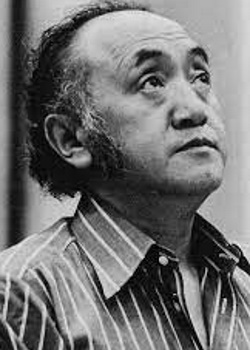 Composer Masaru Sato died in Tokyo on December 5, 1999, at the age of 71, after collapsing at a celebration held in his honor.
One of the most prolific composers in Japanese cinema, Sato wrote more than 300 film scores during a career spanning almost five decades. He is best remembered internationally for his ten-year collaboration with Akira Kurosawa, including Throne of Blood, The Hidden Fortress, Yojimbo, Sanjuro, High and Low and Red Beard, as well as for several entries in the Godzilla series.
Sato was born in Rumoi, Hokkaido, on May 29, 1928, the youngest of six brothers in a music-loving family. He studied at the National Music Academy in Tokyo and became particularly inspired by fellow Hokkaido composers Akira Ifukube and Fumio Hayasaka. After seeing Kurosawa’s Rashomon, Sato sought out Hayasaka personally and became his pupil and assistant, eventually helping orchestrate Hayasaka’s monumental score for Seven Samurai (1954).
Sato’s first major independent assignment was Godzilla Raids Again (1955), the sequel to Toho’s original Godzilla. That same year Hayasaka died suddenly while working on Kurosawa’s I Live in Fear, and Sato was asked to complete the score. Kurosawa was sufficiently impressed that Sato became his regular composer for the following decade.
Their collaboration began properly with Throne of Blood (1957), Kurosawa’s adaptation of Macbeth. Sato used sparse flute, drums and ominous brass to reinforce the film’s ritualistic atmosphere, while The Hidden Fortress (1958) required a broader mixture of adventure, humor and spectacle. For the contemporary thrillers The Bad Sleep Well (1960) and High and Low (1963), his music became more urban and Western-influenced.
His most distinctive Kurosawa scores were arguably Yojimbo (1961) and Sanjuro (1962). Sato deliberately avoided traditional samurai scoring, combining percussion, sarcastic brass, harpsichord, jazz colors and Western instrumentation with an irreverent swagger that perfectly matched Toshiro Mifune’s wandering swordsman. His music often punctuated action rather than continuously underscoring it, giving individual gestures enormous impact.
The partnership ended after Red Beard (1965), following disagreements over Kurosawa’s unusually detailed involvement in the musical process. Sato nevertheless remained one of Japan’s busiest composers, working extensively with directors including Kihachi Okamoto, Hideo Gosha, Ishirō Honda and Jun Fukuda. His credits included The Sword of Doom (1966), Samurai Rebellion (1967), Japan’s Longest Day (1967), Kill! (1968) and numerous crime films, war pictures and historical dramas.
Sato also returned repeatedly to Toho’s monster cinema, scoring Half Human (1955), The H-Man (1958), Ebirah, Horror of the Deep (1966), Son of Godzilla (1967) and Godzilla vs. Mechagodzilla (1974). Compared with Ifukube’s monumental approach, Sato often brought a lighter, jazzier and more contemporary sound to the genre.
His final score was for After the Rain (1999), directed by Takashi Koizumi from an unfilmed Kurosawa screenplay, providing an appropriate final connection to the filmmaker who had shaped his career. That same year Sato was awarded the Order of the Rising Sun for his contribution to Japanese culture. He is survived by his wife Chieko.

Shop at the Movie Music UK Store

Member of the


