Archive
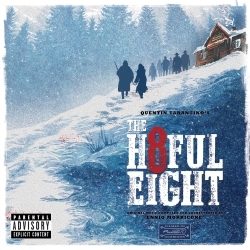
THE HATEFUL EIGHT – Ennio Morricone
 Original Review by Jonathan Broxton
Ennio Morricone has been providing music for Quentin Tarantino’s films for a long time, but it is only recently that he has done so intentionally. Tarantino’s first six films – Reservoir Dogs, Pulp Fiction, Jackie Brown, Kill Bill, Death Proof, and Inglourious Basterds – featured an eclectic, hand-picked selection of music comprising classic rock songs and score cuts from Tarantino’s favorite movies. Kill Bill and Inglourious Basterds most notably made use of music from several classic Morricone scores, including tracks from films such as Navajo Joe, The Good the Bad and the Ugly, The Big Gundown, Revolver, and Allonsanfàn, among others. Tarantino has been both praised and criticized for this approach; some love his idiosyncratic re-purposing of this music in a new and vital setting, while others say that their familiarity with some of the pieces causes a disconnect, diminishing their impact in their new context. Years ago, when questioned about his musical ideology, Tarantino said that he didn’t trust any composer enough to understand, and then musically reinterpret, his cinematic visions – the “soul of his movie”. Tarantino’s stance on this matter began to soften somewhat prior to his seventh film, Django Unchained, and at one point the rumor was that Ennio Morricone had agreed to score it – if anyone could get Tarantino to change his mind about the impact and importance of an original score, it would be Morricone. However, circumstances led to this not happening, and the final soundtrack featured an original Morricone song, “Ancora Qui,” but no original score. Read more…
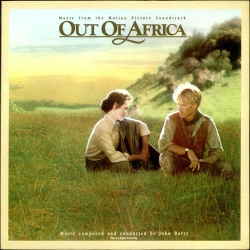
OUT OF AFRICA – John Barry
 THROWBACK THIRTY
GREATEST SCORES OF THE TWENTIETH CENTURY
Original Review by Jonathan Broxton
The winner of seven Academy Awards – including Best Picture, Best Director, Best Screenplay, and Best Cinematography – Out of Africa is generally considered one of the greatest romantic dramas in cinema history. Directed by Sydney Pollack, it is based on the semi-autobiographical writings of aristocratic Danish author Karen Dinesen, specifically the period in the 1910s when she moved to live on a coffee plantation in colonial Kenya with her then-husband, Baron Bror von Blixen-Finecke, and had an affair with a rugged and handsome big game hunter, Denys Finch Hatton. The film is a sumptuous, visually magnificent love letter to the unspoiled African savannah, reveling in the majestic vistas of the country, and using them as a backdrop to the affair Karen engages in, as her husband becomes increasingly distant and neglectful. Anchored by the three central performances of Meryl Streep as Karen, Robert Redford as Denys, and Klaus-Maria Brandauer as Bror, the film explores such challenging themes as marital fidelity, the expectations and conventions of aristocratic society, the role of women in the 1910s, and the differences between European and African tribal cultures, as well as the threat of World War I that loomed over everything. Read more…
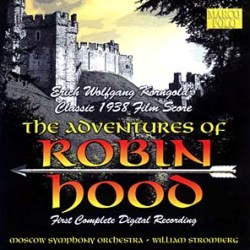
THE ADVENTURES OF ROBIN HOOD – Erich Wolfgang Korngold
 GREATEST SCORES OF THE TWENTIETH CENTURY
Original Review by Craig Lysy
In 1935 Warner Brothers Studio sought to bring an epic swashbuckling film to the big screen and William Keighley was hired to direct. Screenwriters Norman Reilly Raine and Seton Miller were brought in to write the script, for which they drew inspiration from the Medieval Robin Hood legends. A stellar cast was assembled including; Errol Flynn (Sir Robin of Locksley AKA Robin Hood), Olivia de Havilland (Lady Marian Fitzwalter), Basil Rathbone (Sir Guy of Gisbourne), Claude Reins (Prince John), Patrick Knowles (Will Scarlett), Eugene Pallette (Friar Tuck), Alan Hale Sr. (Little John) and Melville Cooper (High Sheriff of Nottingham). Read more…
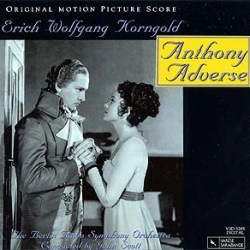
ANTHONY ADVERSE – Erich Wolfgang Korngold
 GREATEST SCORES OF THE TWENTIETH CENTURY
Original Review by Craig Lysy
Warner Brothers Studio was in the market for a period piece romance and found its inspiration in Harvey Allen’s massive 1200 page novel “Anthony Adverse” (1933), paying an amazing $40,000 for the screen rights. Veteran director Mervyn LeRoy was hired to manage the project with Sheridan Gibney and Milton Krims tasked with adapting the mammoth novel for the big screen. The stellar cast included Frederic March as Anthony Adverse, Olivia de Havilland as Angela Giuseppe, Donald Woods as Vincent Nolte, Anita Louise as Maria Bonnyfeather, Edmund Gwenn as John Bonnyfeather and Claude Rains as Marquis Don Luis. Read more…
PINOCCHIO – Leigh Harline, Paul J. Smith
 GREATEST SCORES OF THE TWENTIETH CENTURY
Original Review by Craig Lysy
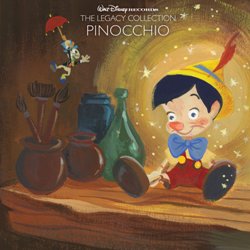
After reading the novel “The Adventures of Pinocchio” by Carlo Collodi, Walt Disney felt it could be made into a fine Disney animated feature. When he picked up his honorary Oscar for “Snow White and the Seven Dwarfs” in 1937, he advised the Academy of his intent to bring Pinocchio to the big screen. The film became a passion project and its budget ballooned from $500,000 to $2.5 million, with several major rewrites. The voice cast included Dickie Jones as Pinocchio and (Alexander the Donkey, Cliff Edwards as Jiminy Cricket, Evelyn Venable as the Blue Fairy), Christian Rub as Geppetto, Walter Catlett as John Worthington Foulfellow the Red Fox, Charles Judels as Stromboli, Frankie Darro as Lampwick and Thurl Ravenscroft as Monstro the Whale. This film offers the classic tale of Geppetto the woodworker, who makes a wooden marionette, whom he names Pinocchio. He has no son and when he goes to bed he makes a wish that Pinocchio become a real boy. His wish is heard, and the Blue Fairy comes during his sleep, and brings Pinocchio to life, but he is not yet fully human. She advises Pinocchio that if he is brave, truthful and unselfish, he will become a real boy. She assigns Jiminy Cricket to be his conscience. Well, after a long adventure, with many struggles along the way, Pinocchio succeeds, becomes a real boy, and he and Geppetto live happily ever after. The film resonated with the public and was a commercial success. It also received critical acclaim and secured two Academy Awards for best Original Score, and Best Song “When You Wish Upon A Star”. This was the first time a film secured these two wins together. Read more…
SINCE YOU WENT AWAY – Max Steiner
 MOVIE MUSIC UK CLASSICS
Original Review by Craig Lysy
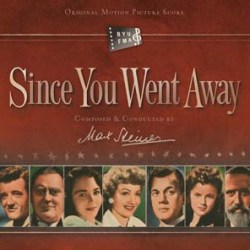
Legendary producer David O. Selznick wanted to make a film, which demonstrated his patriotic support for the war effort. However, he was adamant that he did not want to make a traditional war movie. As such he personally adapted the screenplay from the 1943 novel “Since You Went Away: Letters to a Soldier from His Wife” by Margaret Buell Wilder. Selznick hired veteran director John Cromwell with whom he had collaborated on nine prior films, and then assembled a quality cast including; Claudette Colbert (Mrs. Anne Hilton), Jennifer Jones (Jane Deborah Hilton), Joseph Cotton (Lieutenant Commander Tony Willett), Shirley Temple (Bridget ‘Brig’ Hilton), Monty Woolley (Colonel William G. Smollett) and Lionel Barrymore as Clergyman. The movie is set in a typical American town located near a military base, where people with loved ones serving in the armed forces struggle to cope with their absence. The main storyline concerns Anne, a housewife whose husband is fighting overseas. She struggles with his absence as she tries to meet the challenges of youthful romance from their two daughters who are growing into womanhood. The film overflows with sentimentality against the somber backdrop of families coping with grief, loneliness or fear for the future. I believe Selznick achieved his ambition, as the film was both a commercial and critical success, earning nine Academy Award nominations, winning one for Best Score. Read more…
THE BRIDGE ON THE RIVER KWAI – Malcolm Arnold
 GREATEST SCORES OF THE TWENTIETH CENTURY
Original Review by Craig Lysy
One day, out of curiosity, producer Sam Spiegel happened to purchase the novel “Le Pont de la Rivière Kwaï” by Pierre Boulle, which was, at the time, the talk of the day. He read the novel on a plane flight and by the time he arrived in London, he was determined to bring the story to the big screen. Complications arose immediately as his trusted screenwriters, Michael Wilson and Carl Foreman, were on the infamous McCarthy blacklist of people accused of Communist sympathies, and were forced to ghost-write, while Boulle, who could not speak, let alone write in English, was assigned the sole writing credit. Spiegel brought in David Lean to direct the film and they assembled a stellar cast for the project, including Alec Guinness as Colonel Nicholson, Jack Hawkins as Major Warden, William Holden as Captain Shears and Sessue Hayakawa as the brutal Colonel Saito. Read more…
LOVE IS A MANY-SPLENDORED THING – Alfred Newman
 MOVIE MUSIC UK CLASSICS
Original Review by Craig Lysy
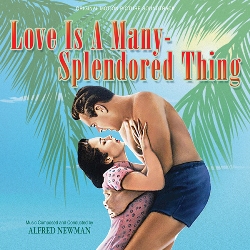
Buddy Adler, the Production Head of Fox Studios saw money to be made by the hit novel “A Many Splendored Thing” by Han Suyin. He purchased the film rights an hired trusted screenwriter John Patrick to adapt it for the big screen. The story offers a potent commentary on an inter-racial romance set in Hong Kong during the waning days of the 1940s. American reporter Mark Elliot (William Holden), who is estranged from his wife, falls passionately in love with widowed Eurasian doctor Han Suyin (Jennifer Jones). For a short time they manage to find happiness together, but events soon overtake them. Mark’s wife refuses his request for a divorce, and their romance precipitates a palpable prejudice from both her family and Hong Kong society. Han is eventually ostracized from the community and loses her position at the hospital. As Mark ships out to cover the Korean War they desperately write each other in hope of maintaining a connection and salvaging their relationship, but alas, it is to no avail as Mark gets killed during the war. Han does not relent in her love and the story ends with her visiting the green hill where they used to meet. The film was both a commercial and critical success, earning eight Academy Awards nominations, winning three for Best Costume Design, Best Song and Best Score. Read more…
THE OLD MAN AND THE SEA – Dimitri Tiomkin
 GREATEST SCORES OF THE TWENTIETH CENTURY
Original Review by Craig Lysy
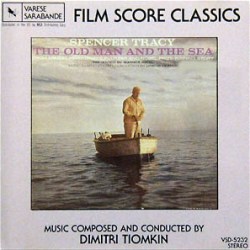
The Old Man and the Sea was a novel written by Ernest Hemmingway in 1951 during his stay in Cuba. Warner Brothers Studio purchased the film rights, selected Fred Zinnemann to direct, hired Paul Osborne to adapt it to the big screen and used Hemmingway as a technical consultant. When live sea filming failed and Hemmingway raged against both the script and marlin prop, Zinnemann and Osborne resigned from the project. John Sturges took over directing and at Hemmingway’s insistence Peter Viertel reworked the script. Given that this was an intimate story of a man’s personal struggle, veteran actor Spencer Tracy was hired to play the lead role of Santiago, with Felipe Pazos Jr. playing the boy Manolin. Read more…
LILI – Bronislau Kaper
 MOVIE MUSIC UK CLASSICS
Original Review by Craig Lysy
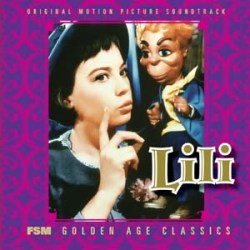
MGM producer Edwin Knopf hired director Charles Walters to bring to life Lili, a fantasy tale based on a Saturday Evening Post short story “The Man Who Hated People” by Paul Gallico. For the film a talented cast was chosen; Lili Daurier (Leslie Caron), Paul Berthalet (Mel Ferrer), Marc (Jean-Pierre Aumont), Rosalie (Zsa Zsa Gabor) and Jacquot (Kurt Kaznar). In our story Lili, a naive country girl travels to a small provincial town in hopes of locating an old friend of her late father’s. When she discovers that he has died, a shopkeeper offers her employment as a guise to take sexual advantage of her. Marc, a handsome carnival magician whose Nome de plume is “Marcus the Magnificent” perceives her danger, covets her for himself and comes to her rescue. Yet her purity of heart dissuades his intentions and through him she gains work at the carnival assisting its master puppeteer Paul. Her wonderment and childlike innocence supports just endearing story-telling through his puppets; a brash red-haired boy named Carrot Top, Reynardo, a sly fox, Marguerite, a vain ballerina, and lastly Golo, a cowardly giant. Paul begins to fall in love with Lili but is embittered with life due to a leg injury he suffered during the war that ended his career in the ballet. We sadly see him reduced to expressing his true feelings for Lili through his puppets, while being mean-spirited when out of character. Lili eventually leaves Paul’s torment and while walking out of town, imagines the three puppets, now life-size, joining her as she finds a new life path. As she celebrates by dancing with each puppet, they all magically transform one by one into Paul. Lili realizes through each of them that they are a facet of Paul. She realizes her love for Paul and runs back to the carnival where they embrace and kiss passionately as the puppets applaud. The film was a critical success, earning composer Bronislau Kaper an Academy Award for Best Score. Read more…
THE GRAND BUDAPEST HOTEL – Alexandre Desplat
 Original Review by Jonathan Broxton
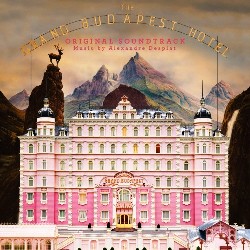
The latest film from the polarizing hipster director Wes Anderson is The Grand Budapest Hotel, a slightly farcical comedy-drama set 100 years ago in the fictional country of Zubrowka – a place Anderson describes as “part Czech, part Hungarian, part Polish, part Russian, part German, and a little bit 1930’s movie-studio in Culver City”. Ralph Fiennes stars as Gustave H, a legendary concierge at the famous European hotel of the title, and Tony Revolori as Zero Moustafa, the lobby boy who becomes his most trusted friend. Following the death of a wealthy elderly female guest Gustave and Zero become embroiled in a plot concerning the theft and recovery of a priceless Renaissance painting and the battle for an enormous family fortune. The film features an enormous supporting cast drawn from Anderson’s ever-increasing roster of repertory players – F. Murray Abraham, Adrien Brody, Willem Dafoe, Jeff Goldblum, Jude Law, Harvey Keitel, Bill Murray, Edward Norton, Saoirse Ronan, Jason Schwartzman, Tilda Swinton, Tom Wilkinson, and Owen Wilson among them – and has an original score by composer Alexandre Desplat, working with Anderson for the third time.
Read more…
A PASSAGE TO INDIA – Maurice Jarre
 GREATEST SCORES OF THE TWENTIETH CENTURY
Original Review by Craig Lysy
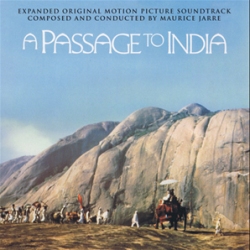
A Passage to India is a novel by English author E. M. Forster, which unfolds against the backdrop of the British Raj and the Indian independence movement in the 1920s. David Lean became enamored after watching the stage presentation of the story and immediately sought and obtained the movie rights. He adapted the screenplay himself and secured a stellar cast, which included; Judy Davis (Adela), Alec Guiness (Godbole), James Fox (Fielding), Peggy Ashcroft (Mrs. Moore) and Victor Bannerjee (Dr. Aziz). The story revolves a fateful trip to the Marabar Caves where a recently engaged Adela finds herself captivated and aroused by the beauty and sensuality of Indian culture. One day on a day trek and while alone with Dr. Aziz in one of the caves, she experiences conflicting emotions towards Dr. Aziz, panics and flees. It is assumed that Dr. Aziz had attempted to assault her and he is brought up to trial for charges of rape. The trial serves as both a commentary and a volatile catalyst that unleashes the pent up racial tensions long simmering between the indigenous Indians and the British colonialists who rule India. When Adela finally relents and withdraws her charges, Aziz is set free, but friendships are ruptured and Aziz seems irreparably harmed. Years later Aziz and his dear friend James reconcile, which brings the sad tale to a pleasing closure. The film was both a critical and commercial success, earning eleven Academy Award nominations, which included a Best Score Oscar for Maurice Jarre. Read more…
GRAVITY – Steven Price
 Original Review by Jonathan Broxton
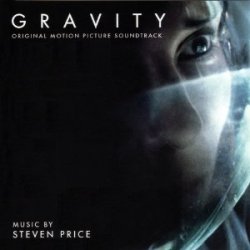
There has never quite been a film like Gravity. In terms of plot, it’s fairly thin – two astronauts, played by George Clooney and Sandra Bullock, suffer a disaster while repairing the Hubble space telescope, and are left floating stranded in space, desperately trying to find a way to safety, and to home. Instead, it is the scope and majesty of Alfonso Cuarón’s film that takes audiences to a completely new sensory place. Space has never seemed so vast, so vivid, so beautiful, so terrifying. The cinematography and design of the film makes the viewer feel like it was genuinely shot in space, such is the sense of realism. Much more will be written about the film to convey how stellar it is, but I’m here to talk about the music, which also plays an enormous part in the success of the entire project. Read more…
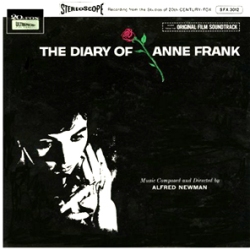
THE DIARY OF ANNE FRANK – Alfred Newman
 GREATEST SCORES OF THE TWENTIETH CENTURY
Original Review by Craig Lysy
Francis Goodrich and Albert Kackett successfully adapted the novel Anne Frank: The Diary of a Young Girl for the Broadway stage. When it secured both a Tony award and a Pulitzer prize Warner Brothers bought the film rights and hired George Stevens to produce and direct a film adaptation. Unknown Millie Perkins was hired for the title role and was supported by Otto Schilkraut (her father Otto), Gusti Huber (her mother Edith), Richard Beymer (her boyfriend Peter Van Daan) and Shelly Winters (Petronella Van Daan). The story is set in Nazi occupied Holland where Otto Frank and his family have decided to go into hiding, because of the increasing persecutions against Jews. A sympathetic local businessman Kraler and his assistant Miep prepare a hiding place in the rooms above their place of business, and arrange for the Franks and another family, the Van Daans, to stay there. Later on, they are joined by the dentist Dussel. Together, living in isolation, they try to avoid detection while praying for Holland to be liberated by the Allies. This poignant story explores the life of persecuted people living in constant fear as seen through the eyes of Anne. The film was a stunning commercial success and won critical acclaim, securing eight Academy nominations including best score for Alfred Newman, who lost to Rozsa’s magnificent effort Ben-Hur: A Tale of the Christ. Read more…
LIFE OF PI – Mychael Danna
 Original Review by Jonathan Broxton
Once in a while a film comes along which seems predestined to be scored by a certain composer; in 2012, that film is Life of Pi and that composer is Mychael Danna. Based on the successful novel by Yann Martel, and directed by Ang Lee, Life of Pi is a film which asks all the big questions – about life, death, religion, fate, identity, reality – and answers them through an incredible story told by Piscine Molitor Patel (Irfan Khan), commonly known as Pi, an Indian immigrant to Canada, who relates his life story to an enraptured journalist (Rafe Spall), who is researching a book. Born into a relatively wealthy family in Pondicherry, India, where his father owned a zoo, Pi’s life is thrown into chaos after the family decides to emigrate to Canada; the boat they are traveling on capsizes in a storm, leaving 16-year old Pi (Suraj Sharma) the only survivor – except for a zebra, a hyena, an orangutan, and an ill-tempered Bengal tiger named Richard Parker, who all are forced to share the same tiny lifeboat. What follows is an extraordinary story of friendship, trust, survival, faith and belief, as Pi must overcome his greatest fears and the overpowering forces of nature to reach safety. Read more…

Shop at the Movie Music UK Store

Member of the

 MOVIE MUSIC UK