Archive
MOONLIGHT – Nicholas Britell
 Original Review by Jonathan Broxton
Moonlight is a critically acclaimed drama film from director Barry Jenkins, which follows the life of a young black man growing up under difficult circumstances in contemporary America. As a child, “Little” Chiron deals with bullies, and a an abusive relationship with his crack-addicted mother, but finds a father figure in the shape of Juan, a crack dealer who takes him under his wing and shows him more love and compassion than his family. Later, as a teenager, Chiron continues to suffer an abusive home life, while simultaneously struggling to find himself as he experiences the ecstasy, pain, and beauty of falling in love while grappling with his own sexuality. The film is based on the stage play “In Moonlight Black Boys Look Blue” by Tarell Alvin McCraney, and stars Trevante Rhodes, Ashton Sanders, Alex Hibbert, Janelle Monáe, Naomie Harris, and Mahershala Ali, who appears to be the front runner for the 2016 Academy Award for Best Supporting Actor. Read more…
LA LA LAND – Justin Hurwitz, Benj Pasek, Justin Paul
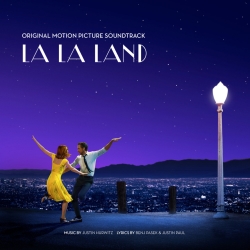 Original Review by Jonathan Broxton
There has been so much cynicism and negativity in the news in 2016, that a film like La La Land is not so much a breath of fresh air, but a necessary antidote to the political and social upheaval that has swept across far too much of the world. It’s a sincere, optimistic love letter to the power of dreams and the joy of romance, an homage to classic Hollywood musicals, and a celebration of art and dance and music that wears its heart on its sleeve and looks you straight in the eye as it does so. Directed by Damien Chazelle, it stars Ryan Gosling and Emma Stone as Sebastian and Mia, two struggling artists trying to make it in contemporary Los Angeles. Sebastian is a jazz pianist frustrated by his lack of opportunities and the fact that no one seems to love the music he loves any more; Mia is an aspiring actress working in a coffee shop on a studio lot whose dreams are continually crushed by an endless parade of failed auditions. A series of chance meetings between the two slowly leads to a romantic relationship, and together the pair seeks to find a way through the perils and pitfalls of being young and creative in the City of Angels. Read more…
THE WIZARD OF OZ – Herbert Stothart, Harold Arlen, E. Y. Harburg
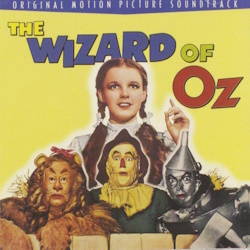 GREATEST SCORES OF THE TWENTIETH CENTURY
Original Review by Craig Lysy
Following the enormous commercial success of Walt Disney’s “Snow White And The Seven Dwarfs” (1937), MGM Studio Executive Louis Mayer was determined to cash in and duplicate its success. He found the story he felt was needed and purchased the rights to L. Frank Baum’s novel, “The Wonderful Wizard of Oz” (1900). Noel Langley, Florence Ryerson and Edgar Allan Woolf were tasked with writing the screenplay. Veteran director Victor Fleming was hired for the project and he assembled a cast, which is now legend; Judy Garland (Dorothy), Frank Morgan (Professor Marvel/Wizard of Oz), Ray Bolger (Hunk/Scarecrow), Jack Haley (Hickory/Tin Man), Bert Lahr (Zeke/Cowardly Lion), Billie Burke (Glinda) and Margaret Hamilton (Miss Gulch and the Wicked Witch of the West). Read more…
THE HATEFUL EIGHT – Ennio Morricone
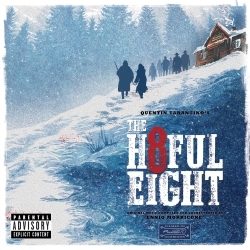 Original Review by Jonathan Broxton
Ennio Morricone has been providing music for Quentin Tarantino’s films for a long time, but it is only recently that he has done so intentionally. Tarantino’s first six films – Reservoir Dogs, Pulp Fiction, Jackie Brown, Kill Bill, Death Proof, and Inglourious Basterds – featured an eclectic, hand-picked selection of music comprising classic rock songs and score cuts from Tarantino’s favorite movies. Kill Bill and Inglourious Basterds most notably made use of music from several classic Morricone scores, including tracks from films such as Navajo Joe, The Good the Bad and the Ugly, The Big Gundown, Revolver, and Allonsanfàn, among others. Tarantino has been both praised and criticized for this approach; some love his idiosyncratic re-purposing of this music in a new and vital setting, while others say that their familiarity with some of the pieces causes a disconnect, diminishing their impact in their new context. Years ago, when questioned about his musical ideology, Tarantino said that he didn’t trust any composer enough to understand, and then musically reinterpret, his cinematic visions – the “soul of his movie”. Tarantino’s stance on this matter began to soften somewhat prior to his seventh film, Django Unchained, and at one point the rumor was that Ennio Morricone had agreed to score it – if anyone could get Tarantino to change his mind about the impact and importance of an original score, it would be Morricone. However, circumstances led to this not happening, and the final soundtrack featured an original Morricone song, “Ancora Qui,” but no original score. Read more…
CAROL – Carter Burwell
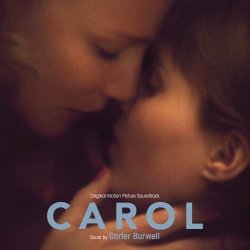 Original Review by Jonathan Broxton
A romantic drama based on the novel The Price of Salt by Patricia Highsmith, and directed by Todd Haynes, Carol is a melodrama with a very modern slant. The film stars Cate Blanchett and Rooney Mara as Carol and Therèse, two women living in New York in the 1950s, both of whom are struggling in their relationships. Carol is estranged from her husband Harge (Kyle Chandler) after she had an affair with another woman, Abby (Sarah Paulson), and Harge is threatening to take away custody of their child. Meanwhile, Therèse is dissatisfied with her relationship with her boyfriend Richard (Jake Lacy), and dreams of something more fulfilling. Their lives intersect when Carol accidentally leaves her gloves at the department store where Therèse works while Christmas shopping; when Therèse returns them, Carol insists on buying her a drink to thank her, and the subsequent sexual tension between them is palpable, but the age gap between the two, as well as their gender, threatens to break the rigid social and moral taboos of the era. Read more…
STAR WARS: THE FORCE AWAKENS – John Williams
 Original Review by Jonathan Broxton
WARNING: THIS REVIEW CONTAINS PLOT SPOILERS. IF YOU HAVE NOT YET SEEN THE FILM, YOU MIGHT WANT TO CONSIDER WAITING UNTIL AFTER YOU HAVE DONE SO TO READ IT.
When John Williams first sat down to write the score for the original Star Wars over the winter of 1976, I doubt that even he could have imagined that he would still be writing music for those characters, and that universe, some 39 years later. There aren’t many film scores you can point to as being an actual turning point, a watershed moment in the history of the genre, but Star Wars was unquestionably one of those, and it went on to inspire a generation of filmmakers, composers, and fans. To say that The Force Awakens, the seventh film in the Star Wars franchise, is an eagerly awaited film would perhaps be one of the greatest understatements of all time – I don’t think I have ever seen a film with this much marketing, pre-release hype, and fevered anticipation – and, thankfully, it does not disappoint in any way. More than any installment in the prequels did, The Force Awakens feels like a proper Star Wars movie, a return to the fun and crowd-pleasing filmmaking of the original trio, and director J. J. Abrams should be congratulated for returning the franchise to its roots, and going some way to banishing the ghost of Jar Jar Binks forever. Read more…
GONE WITH THE WIND – Max Steiner
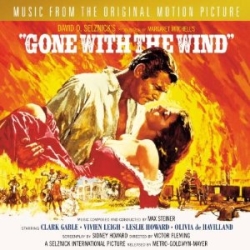 GREATEST SCORES OF THE TWENTIETH CENTURY
Original Review by Craig Lysy
Margaret Mitchell’s 1936 novel Gone With The Wind caught legendary producer David O. Selznick’s eye and he saw destiny in the making. At his bidding MGM purchased the film rights for an unprecedented $50,000. This was a passion project for Selznick and no expense would defer him from realizing his vision. Screenwriter Sidney Howard was hired to do the impossible – adapt the massive 1,037-page story to the big screen. Victor Fleming was tasked with directing and a cast that has become legend were hired including Clark Gable as Rhett Butler, Vivien Leigh as Scarlet O’Hara, Leslie Howard as Ashley Wilkes, Olivia de Havilland as Melanie Hamilton, Thomas Mitchell as Gerald O’Hara, Barbara O’Neil as Ellen O’Hara and Hattie McDaniel as Mammy. No movie to this date provided such a grand and epic sweep, and in the end six hours of film were shot, which featured thousands of actors. Read more…
WUTHERING HEIGHTS – Alfred Newman
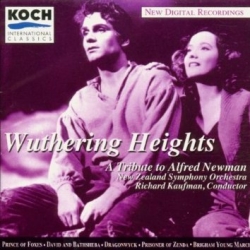 GREATEST SCORES OF THE TWENTIETH CENTURY
Original Review by Craig Lysy
In 1938 studio executive Samuel Goldwyn was intent on finding a new project for his studio’s star Merle Oberon. By coincidence William Wyler was seeking financial backing for his next film, which would adapt Emily Bronte’s 1847 novel Wuthering Heights. He argued to Goldwyn that it would be a perfect tragic romantic tale to showcase Oberon’s talents. Goldwyn agreed and decided he would produce the film, with Wyler tasked with directing. He provided a generous budget and brought in screenwriters Charles MacArthur, Ben Hecht and John Huston to write the screenplay. They drew inspiration from the first sixteen chapters of the 34-chapter novel, and changed the setting from the 18th to the 19th Century. For their cast, Merle Oberon would take on the starring role of Catherine Earnshaw, joined by Laurence Olivier as Heathcliff. David Niven would play Edgar Linton and Geraldine Fitzgerald, Isabella Linton. Read more…
THE ADVENTURES OF ROBIN HOOD – Erich Wolfgang Korngold
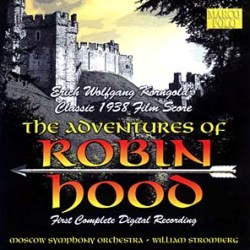 GREATEST SCORES OF THE TWENTIETH CENTURY
Original Review by Craig Lysy
In 1935 Warner Brothers Studio sought to bring an epic swashbuckling film to the big screen and William Keighley was hired to direct. Screenwriters Norman Reilly Raine and Seton Miller were brought in to write the script, for which they drew inspiration from the Medieval Robin Hood legends. A stellar cast was assembled including; Errol Flynn (Sir Robin of Locksley AKA Robin Hood), Olivia de Havilland (Lady Marian Fitzwalter), Basil Rathbone (Sir Guy of Gisbourne), Claude Reins (Prince John), Patrick Knowles (Will Scarlett), Eugene Pallette (Friar Tuck), Alan Hale Sr. (Little John) and Melville Cooper (High Sheriff of Nottingham). Read more…
SNOW WHITE AND THE SEVEN DWARFS – Frank Churchill, Leigh Harline, Paul J. Smith, Larry Morey
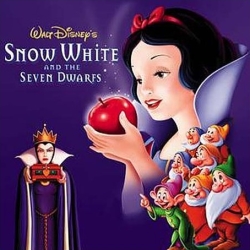 GREATEST SCORES OF THE TWENTIETH CENTURY
Original Review by Craig Lysy
Walt Disney Productions had been very successful in producing animated short subject films such as Mickey Mouse and the Silly Symphonies. In 1934 CEO Walt Disney believed it was time to move his studio into the realm of producing feature films. To that end he resolved to inaugurate a new era by producing a feature animated film based on the fairytale of Snow White and the Seven Dwarfs by the Brothers Grimm. Disney would produce the film and he tasked screenwriter Richard Creedon and a team of seven writers to come up with the screenplay. David Hand was hired as supervising Director for a team of five directors. For the cast Adriana Caselotti would voice for the titular role. Joining her would be Lucille La Verne as Queen Grimhilde (the witch), Henry Stockwell as the Prince, Stuart Buchanan as the Huntsman, and Moroni Olsen as The Magic Mirror. For the seven dwarfs we have Roy Atwell as Doc, Pinto Colvig as both Grumpy and Sleepy, Otis Harlan as Happy, Scotty Mattraw as Bashful, Billy Gilbert as Sneezy, and Eddie Collins as Dopey. Read more…
BRIDGE OF SPIES – Thomas Newman
 Original Review by Jonathan Broxton
Steven Spielberg’s latest film, Bridge of Spies, is a cold war thriller set in 1957 starring Tom Hanks as James Donovan, an insurance lawyer who is unexpectedly hired by the US Government to represent Rudolf Abel (Mark Rylance), an unassuming middle-aged artist accused of being a Russian spy. Although the evidence against Abel is overwhelming – and even though Abel himself does not deny the charges – Donovan mounts a spirited defense, arguing that the US constitution affords everyone due process to a fair trial. Months later, Donovan is called upon once again when a U-2 spy plane operating over Russia is shot down, and its young pilot is arrested by the Soviets. Realizing that Abel can be used as a bargaining chip, the CIA sends Donovan to East Berlin, just as the Wall is being erected, to negotiate a trade. The screenplay, by Matt Charman, Ethan Coen and Joel Coen, is based on real events, and allows the narrative to unfold at a measured pace. This is a film about conversations, negotiations, political ideologies, and ethical dilemmas, and there is nary an action sequence in the entire film, which will alienate those who need more ‘stuff happening’, but which drew me into its intricacies. Tom Hanks is superb in the lead role, serious and honorable, while Mark Rylance is relaxed and unexpectedly funny in his role as the accused spy with an artistic flair. The film is also notable for another reason: it’s the first Steven Spielberg film in 30 years not to feature a John Williams score. Read more…
SICARIO – Jóhann Jóhannsson
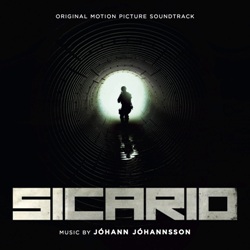 Original Review by Jonathan Broxton
The rise to power of the Mexican drug cartels has caused immeasurable damage to the cities of northern Mexico over the last couple of decades, as rival groups battle to control the distribution of illegal narcotics across the border and into the United States. Murder, extortion, kidnapping, and corruption are all becoming increasingly commonplace, leaving the good people of border cities like Tijuana, Mexicali, Nogales, and Nuevo Laredo fearful for their lives in the face of the deadly violence all around them. Most dangerous of all is the city of Juárez, across the border from El Paso, Texas, which in the past decade has become the headquarters of the Sinaloa cartel, who notoriously leave the headless corpses of their dead enemies dangling from bridges in the city. The new movie Sicario, directed by Denis Villeneuve, is an uncensored journey into that world from the point of view of FBI agent Kate Macer (Emily Blunt), who is asked to join a special team by mysterious government official Matt Graver (Josh Brolin), and his equally mysterious advisor Alejandro (Benicio Del Toro), with a view to apprehending one of Juárez’s most powerful and notorious bosses. Read more…
ANTHONY ADVERSE – Erich Wolfgang Korngold
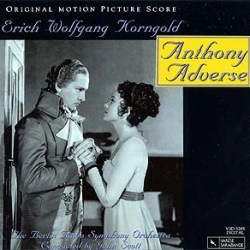 GREATEST SCORES OF THE TWENTIETH CENTURY
Original Review by Craig Lysy
Warner Brothers Studio was in the market for a period piece romance and found its inspiration in Harvey Allen’s massive 1200 page novel “Anthony Adverse” (1933), paying an amazing $40,000 for the screen rights. Veteran director Mervyn LeRoy was hired to manage the project with Sheridan Gibney and Milton Krims tasked with adapting the mammoth novel for the big screen. The stellar cast included Frederic March as Anthony Adverse, Olivia de Havilland as Angela Giuseppe, Donald Woods as Vincent Nolte, Anita Louise as Maria Bonnyfeather, Edmund Gwenn as John Bonnyfeather and Claude Rains as Marquis Don Luis. Read more…
MR. TURNER – Gary Yershon
 Original Review by Jonathan Broxton
Joseph Mallord William “JMW” Turner is one of the greatest and most respected British painters, a mercurial figure in British society in the mid-1800s who hobnobbed with royalty, frequented brothels, and famously had himself strapped to the mast of a ship so he could accurately paint an approaching storm. Some of his works, notably masterpieces such as ‘Modern Rome-Campo Vaccino’, ‘Dutch Boats in a Gale’, ‘Ivy Bridge’, and ‘Calais Pier’, elevated the art of landscape painting to new heights, and his legacy lives on today through the Turner Prize, the most prestigious British art award, which is granted annually by the Tate Gallery in London. Director Mike Leigh’s film Mr. Turner is a fairly straightforward biopic of Turner’s life, starring Timothy Spall in the title role, and featuring supporting performances from Dorothy Atkinson, Marion Bailey, Paul Jesson and Lesley Manville. Read more…
INTERSTELLAR – Hans Zimmer
 Original Review by Jonathan Broxton
Christopher Nolan’s Interstellar is a science fiction epic on a grand scale. Set in a future where life on Earth is in jeopardy due to a series of environmental disasters, the film follows Cooper (Matthew McConaughey), a former pilot turned corn farmer, whose precocious daughter Murph (Mackenzie Foy) believes she is receiving messages written in dust from a ghost in her bedroom. One of these messages eventually leads Cooper to a secret NASA installation where, under the radar and away from the public eye, Professor Brand (Michael Caine) and astronauts Amelia (Anne Hathaway) and Doyle (Wes Bentley) have been working on a project to save humanity. Their plan involves piloting a ship to the space around Saturn, where friendly ‘fifth-dimensional beings’ have placed a wormhole to the far side of the galaxy. The hope is that, on the other side of the wormhole, a new planet capable of sustaining human life can be found and colonized. Read more…

Shop at the Movie Music UK Store

Member of the


