Archive
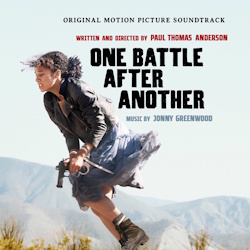
ONE BATTLE AFTER ANOTHER – Jonny Greenwood
 Original Review by Jonathan Broxton
One of the most popular and critically acclaimed movies of 2025, One Battle After Another is a black comedy action-thriller written and directed by Paul Thomas Anderson, loosely inspired by Thomas Pynchon’s 1990 novel Vineland. The film stars Leonardo DiCaprio as Bob Ferguson, a former left-wing political revolutionary from an underground militant group called the French 75. Early in the film, the French 75 carry out a bold operation at the Mexico–US border, freeing apprehended immigrants and sparking conflict with ruthless military officer Steven Lockjaw (Sean Penn), who has a bizarre sexual obsession with Bob’s partner Perfidia Beverly Hills (Teyana Taylor). After Perfidia is arrested for murder, Lockjaw arranges for her to avoid prison in exchange for ratting out her comrades, forcing Bob to flee. Sixteen years later, Bob is living off-grid, paranoid, and raising his teenage daughter Willa (Chase Infiniti) far from the revolution. Things change for Bob when a still-obsessed Lockjaw discovers his location, and he and Willa are separated. Desperately trying to rescue his daughter, Bob is forced to get back in touch with his old French 75 compatriots – including Sergio St. Carlos (Benicio del Toro), a martial arts instructor who also runs underground support networks – before Lockjaw finds her. Read more…
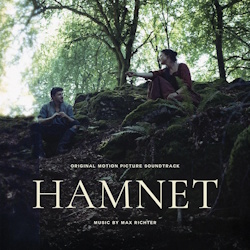
HAMNET – Max Richter
 Original Review by Jonathan Broxton
Director Chloe Zhao’s film Hamnet, which is based on the 2020 novel by Maggie O’Farrell, is a lyrical reimagining of the brief life and death of Hamnet Shakespeare, the son of the legendary poet and writer William Shakespeare and his wife Agnes “Anne” Hathaway, musing on the fact that his passing may have inspired the creation of one of the greatest works of literature in history. The story centers mostly on Agnes, who is portrayed as a perceptive, intuitive woman with a deep connection to nature; the first half of the film looks at Agnes and William’s early courtship, their subsequent marriage, and offers a portrait of family life in Elizabethan England circa 1580, following the birth of their twin children Hamnet and Judith. In time William begins traveling to London to write and perform his plays, but eventually the spread of plague brings sickness to the Shakespeare household, and Judith falls gravely ill. Hamnet, who has been charged by his father with looking after the family in his absence, desperately attempts to help her, and asks God if he can swap places with her; Judith eventually recovers, but Hamnet contracts the plague too, and dies aged just eleven. After Hamnet’s death, the story then explores how Agnes and William grieve differently: Agnes’s sorrow is visceral and consuming, while William channels his grief into his work. Read more…
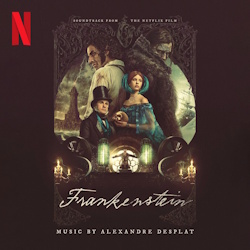
FRANKENSTEIN – Alexandre Desplat
 Original Review by Jonathan Broxton
It’s astonishing to think that there have been more than 50 cinematic adaptations of the story of Frankenstein since it was first penned, one haunted summer in 1818, by the then 20-year-old English author Mary Shelley. In writing Frankenstein Shelley essentially invented the science fiction literary genre as we know it; before Frankenstein, stories about the unnatural or the fantastic were usually supernatural, rooted in magic, myth, or divine intervention. Shelley’s innovation was to ground the creation of life in the science of the time, and it changed everything. On film, adaptations have differed wildly in tone and approach, from the early classic James Whale films starring Boris Karloff, to the Hammer horror films of the 1950s and 60s with Christopher Lee and Peter Cushing, Mel Brooks’s campy comedy Young Frankenstein, and director Kenneth Branagh’s Gothic take from 1994. This new version, by the Oscar-winning Mexican director Guillermo del Toro, may be the best of them all. Read more…
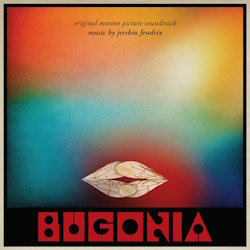
BUGONIA – Jerskin Fendrix
 Original Review by Jonathan Broxton
The term ‘bugonia’ comes from Latin and Greek, and relates to an ancient concept or myth describing the spontaneous generation of bees from the carcass of a dead ox. Philosophically and symbolically, bugonia reflects beliefs in the idea that living creatures can arise from non-living matter, as well as themes of death, rebirth, and transformation. In literary and religious contexts, it often serves as a metaphor for resurrection, drawing parallels between natural cycles and human or divine renewal. All this explains perfectly many of the underlying themes of director Yorgos Lanthimos’s new film, Bugonia. The film stars Jesse Plemons as disaffected conspiracy theorist Teddy Gatz, who has persuaded his autistic cousin Don (newcomer Aidan Delbis) to help him kidnap Michelle Fuller (Emma Stone), the wealthy and powerful CEO of a pharmaceutical megacorporation. Teddy has convinced himself that Michelle is secretly an alien from Andromeda who wants to destroy Earth, and he is determined to make her admit her true identity, and then take him to meet her ‘emperor’ so that he can initiate peace talks with them. Read more…
SINNERS – Ludwig Göransson
 Original Review by Jonathan Broxton
There’s a moment in Sinners, director Ryan Coogler’s outstanding new horror-drama, where the lead characters in the ‘juke joint’ are listening to live blues music, rich and authentic. As the crowd becomes entranced by the performances, overcome by the songs, something magical happens: slowly, almost imperceptibly, avatars representing the entire history of black American music emerge from within the massed dancers, ghosts of the past and foreshadowings of the future of what this music would eventually become over the span of multiple subsequent generations. There are tribal drummers and Zaouli dancers from Côte d’Ivoire, who brought their music and their traditions with them when they were forcibly removed from Africa as slaves, and which eventually became the work songs and ‘Negro spirituals’ of the plantations and the cotton fields. There is 1940s jazz, and 1950s rock and roll. There are 1980s breakdancers, 1990s DJs and rappers, and references to contemporary hip-hop and R&B. It’s a brilliant distillation of one of the major things that Coogler is trying to say with his film – that African music and Black music is at the core of so much of modern American culture, and that that history remains very much overlooked and under-appreciated by too much of the mainstream. Read more…
EMILIA PÉREZ – Clément Ducol, Camille Dalmais
 Original Review by Jonathan Broxton
One of the most acclaimed films of 2024, and the recipient of 13 Oscar nominations, is Emilia Pérez. Directed by the French auteur Jacques Audiard and filmed almost entirely in Spanish, it is a genre-bending mix of ideas: it explores themes involving Mexican drug cartels, political corruption, and transgender issues; it is about redemption and forgiveness; tonally, it veers from heavy drama to absurd comedy, and even includes some action sequences; and, most importantly from the point of view of this review, it is also a fully sung musical containing almost twenty originals songs, each performed by different members of the cast. Read more…
THE BRUTALIST – Daniel Blumberg
 Original Review by Jonathan Broxton
There’s a famous quote – which no-one seems to want to take credit for – which states that ‘writing about music is like dancing about architecture’. It basically means that it’s impossible, and probably futile, to try to encapsulate in words what is, at its core, an entirely subjective response to art. As I have spent almost 30 years writing about music I disagree with this sentiment, and that is even more true when it comes to this review of The Brutalist, in which I will attempt to write about the music for a film which is in part about architecture, among many other things. Read more…
WICKED, PART ONE – John Powell, Stephen Schwartz
 Original Review by Jonathan Broxton
I don’t think a stage musical had captured the attention of mainstream American society the way that Wicked did since the heyday of Andrew Lloyd Webber in the 1980s. It’s interesting how over the last thirty years or so, for the most part, Broadway and West End shows have started to slide out of popular culture and into a niche. It used to be that a new work by Rodgers and Hammerstein, or Stephen Sondheim, or indeed Lloyd Webber, would be big news. The showstopping main number would probably top the charts, and the music would quickly become part of public consciousness and the cultural lexicon. However, and with the obvious exception of Hamilton, the last time this really happened was when Wicked premiered on Broadway in 2004. It was a bonafide smash, making stars out of its two leads Kristin Chenoweth and Idina Menzel, and thrusting composer Stephen Schwartz back into the spotlight in a way he hadn’t been since his successes with Godspell and Pippin in the early 1970s. And now, twenty years after its stage premiere, Wicked has finally been turned into a movie. Read more…
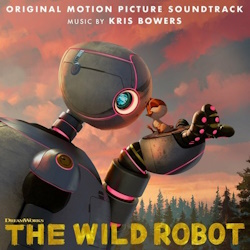
THE WILD ROBOT – Kris Bowers
 Original Review by Jonathan Broxton
The Wild Robot is a new animated science fiction adventure film, based on the 2016 children’s novel of the same name by Peter Brown, and directed by Chris Sanders, one of the co-directors of How to Train Your Dragon. The story follows the life of Roz, a highly sophisticated service robot who is shipwrecked on an uninhabited island and who must quickly adapt to her surroundings. Over time she builds relationships with the local wildlife, including befriending a fox named Fink, and becoming the adoptive mother of an orphaned goose named Brightbill; however, she soon finds that her new idyllic life as a ‘wild robot’ is under threat from the company that built her. The film has an enormously impressive voice cast led by Lupita Nyong’o as Roz, Pedro Pascal as Fink, and Kit Connor as Brightbill, plus Bill Nighy, Stephanie Hsu, Mark Hamill, Catherine O’Hara, Matt Berry, and Ving Rhames. The film is a beautifully drawn, artistically rendered, funny, moving exploration of numerous concepts related to environmentalism and nature, consumerism, motherhood, adaptability and building relationships, and it has been an enormous box office success, grossing more than $270 million, and sequels based on Brown’s other Roz novels are already in the works. Read more…
CONCLAVE – Volker Bertelmann
 Original Review by Jonathan Broxton
Conclave is the latest film from German director Edward Berger, whose last film All Quiet on the Western Front won the Oscar for Best Foreign Language Film, and was nominated for Best Picture, in 2022. It is based on the 2016 novel of the same name by Robert Harris and stars Ralph Fiennes, Stanley Tucci, John Lithgow, Sergio Castellitto, and Isabella Rossellini. Fiennes plays Cardinal Thomas Lawrence, an English catholic priest who is called into action by the Vatican when the Pope dies of a heart attack. Lawrence is charged with organizing and overseeing the papal conclave – a gathering of the Roman Catholic cardinals from around the world which is convened to elect the next pope – but quickly finds himself at the center of a firestorm, investigating allegations and scandals inside the church, while also navigating his own personal crisis of faith. Read more…
AMERICAN FICTION – Laura Karpman
 Original Review by Jonathan Broxton
American Fiction is a brilliant satire on literature, race, and family dynamics in contemporary society. Written and directed by Cord Jefferson, who is making his directorial debut here, and based on the 2001 novel ‘Erasure’ by Percival Everett, the film stars Jeffrey Wright as African-American author and English professor Thelonious “Monk” Ellison. Monk is having quite a few problems; his novels receive academic praise, but sell poorly, and publishers reject his most recent manuscript for not being “black enough”. His mother is developing Alzheimer’s disease, his extended family is highly dysfunctional, and he is increasingly annoyed by a fellow writer whose recent bestselling novel apparently panders to ‘ghetto’ black stereotypes but is feted by white literary critics. Frustrated, and needing to raise money for his mother’s medical bills, Monk swallows his pride, adopts the pseudonym ‘Stagg R. Leigh,’ and intentionally writes what he considers a ‘bad novel’ called My Pafology, which also panders to the same black/urban stereotypes of gang violence, drugs, and estranged families. To his increasing shock and exasperation, My Pafology becomes enormously popular and critically acclaimed, and Monk is forced to adopt the ‘gangbanger’ persona of Leigh to maintain the ruse, while also trying to juggle his personal and family issues. Read more…
POOR THINGS – Jerskin Fendrix
 Original Review by Jonathan Broxton
The latest film from the unconventional cinematic mind of director Yorgos Lanthimos is Poor Things, which if you were to distill it down to its core could be best described as a feminist take on the Frankenstein story. The film is set in Victorian London and stars Emma Stone as Bella Baxter, a child-like young woman in the care of Godwin Baxter, an eminent surgeon with horrific facial scars (played by Willem Defoe, doing an excellent Edinburgh accent). It is revealed to Godwin’s student Max McCandles (Rami Youssef) that Bella is actually a resurrected suicide victim whom Godwin revived by transplanting her brain with that of her unborn child, resulting in her literally being a baby in a woman’s body. Initially Godwin and McCandles teach Bella as one would an infant, and McCandles falls in love with her and asks for her hand in marriage; however, as Bella matures, she starts to desire more freedom, and eventually leaves on a grand tour of Europe with Godwin’s lawyer Duncan Wedderburn (Mark Ruffalo). This leads Bella on a journey of philosophical and sexual self-discovery – a journey which is interrupted when her past begins to catch up with her. Read more…
KILLERS OF THE FLOWER MOON – Robbie Robertson
 Original Review by Jonathan Broxton
Killers of the Flower Moon is the latest film from revered director Martin Scorsese. It tells the true, but mostly unknown, story of the so-called ‘Osage Indian Murders,’ which happened in Oklahoma over the course of many years in the 1910s and 20s. The Osage Native American tribe, having forcibly been removed from their ancestral homeland to a dusty, barren area of Oklahoma, became fabulously wealthy almost overnight when oil was discovered on their land. Naturally, the white men of the time couldn’t just let the Osage be rich and live in peace – the concept of ‘manifest destiny’ and racism against the ‘redskins’ has a lot to answer for – and so they started moving into the area, trying to think of ways to take control of the oil for themselves. The most evil and twisted plot they concocted was the one cooked up by cattle baron Bill ‘King’ Hale that forms the core of this film: he and his nephews Ernest Burkhart and Byron Burkhart would insidiously earn the trust of the Osage elders, seduce and marry the women of one of the wealthiest families, and then over time murder the women so that the oil rights eventually passed to the white men. The film stars Robert De Niro as Hale, Leonardo Di Caprio as Ernest, and the brilliant Lily Gladstone as Ernest’s Osage wife Millie, with Tantoo Cardinal, John Lithgow, and Brendan Fraser in supporting roles, Jesse Plemons as the FBI man sent in to solve the crime, and many real members of the current Osage nation playing their own ancestors. Read more…
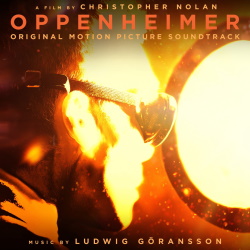
OPPENHEIMER – Ludwig Göransson
 Original Review by Jonathan Broxton
Now I am become death, the destroyer of worlds.
In lesser hands, a movie about the life of J. Robert Oppenheimer could have been a dusty, staid affair. Oppenheimer, for those who don’t know, was a theoretical physicist who, in 1942, was recruited by the US government to lead the Manhattan Project, a top-secret military program created with one goal: to design and build a nuclear weapon before Adolf Hitler and the Nazis did the same, so that they could bring about the end of World War II. Oppenheimer and his colleagues successfully built several bombs over the course of many years, culminating in the detonation of two such devices over the Japanese cities of Nagasaki and Hiroshima in 1945. However, despite his ‘success’ and initial celebrity, Oppenheimer was haunted by the ethical questions that surrounded his creation, and suffered a great deal of personal and political turmoil in the years that followed. This latter issue was compounded by the fact that, early in his life, Oppenheimer had pro-communist opinions, and was friendly with many members of the US Communist Party – something that certainly wouldn’t fly with the House Un-American Activities Committee and the McCarthy-era politics of the 1950s. Read more…
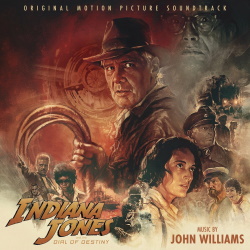
INDIANA JONES AND THE DIAL OF DESTINY – John Williams
 Original Review by Jonathan Broxton
WARNING: THIS REVIEW CONTAINS PLOT SPOILERS. IF YOU HAVE NOT YET SEEN THE FILM, YOU MIGHT WANT TO CONSIDER WAITING UNTIL AFTER YOU HAVE DONE SO TO READ IT.
When you look back at the film series that John Williams has been involved with over the course of his astonishing career, his musical legacy starts to come into sharp relief. Nine Star Wars movies. Two Jaws movies, with his themes used in multiple further sequels scored by other composers. The original Superman, plus themes in sequels. Two Home Alone movies, plus themes in sequels. Two Jurassic Park movies, plus themes in sequels. Three Harry Potter movies, plus themes in sequels. However, other than the three Star Wars ‘main trilogies,’ the only film series that John Williams has scored in its entirety is the Indiana Jones series, which began with Raiders of the Lost Ark in 1981, and continued through Temple of Doom in 1984, Last Crusade in 1989, and Kingdom of the Crystal Skull in 2008. His iconic Raiders March has underscored the escapades of the titular archaeologist and adventurer for more than 40 years, and has seen him clashing with death-worshipping cults, psychic communists, and far too many Nazis. Indiana Jones and the Dial of Destiny is the fifth film in the series and – if reports are to believed – will be the final cinematic adventure for the character. Read more…

Shop at the Movie Music UK Store

Member of the

 MOVIE MUSIC UK