Archive
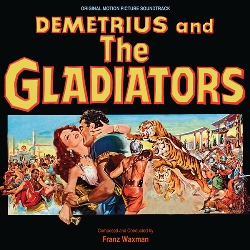
DEMETRIUS AND THE GLADIATORS – Franz Waxman
 MOVIE MUSIC UK CLASSICS
Original Review by Craig Lysy
Demetrius and the Gladiators was the sequel to the first CinemaScope picture, “The Robe”. Twentieth Century Fox chief, Darryl F. Zanuck, decided that there was money to be made with the new revolutionary format and so production was already under way as “The Robe” premiered. Of the original cast, Victor Mature (Demetrius), Michael Rennie (Peter), and Jay Robinson (Caligula) returned to reprise their roles and were joined by newcomers Susan Hayward (Messalina) and Debra Paget (Lucia). The story unfolds as a classic tale of faith and personal redemption. Demetrius, the guardian of the Robe of Christ loses his faith when his love Lucia, is ravaged by Roman gladiators and apparently dies. When his fervent prayers fail to revive her he becomes bitter and angry with God. Demetrius abandons his faith and embarks upon a life of violence, indulgence and lust. But when he later discovers that Lucia had not died due to the grace of God he regains his faith and lives to see the day of the emperor Caligula’s death, when the long suffering Praetorian Guard at last turns on him. This sequel outperformed The Robe and was both a commercial and critical success. Read more…
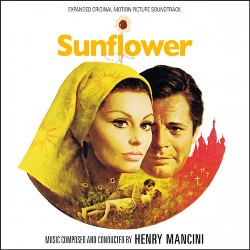
SUNFLOWER – Henry Mancini
 MOVIE MUSIC UK CLASSICS
Original Review by Craig Lysy
Renowned producer Carlo Ponti and acclaimed actor-director Vittorio de Sica hired screenwriter Cesare Zavattini to create, in the finest traditions of Italian cinema, a tragic love story. For this grand effort they recruited the two iconic Italian actors of the day to play the principles; Sophia Loren (Giovanna) and Marcello Mastroianni (Antonio). After many incarnations and disputes between Ponti and De Sica, a final screenplay was finally achieved. It reveals the story of two lovers caught up and swept away by the unforeseeable and irresistible currents of history. Sunflower, known in its original Italian as I Girasoli, is set in a small town in the southern Calabria region of Italy in the waning months of World War II. Read more…
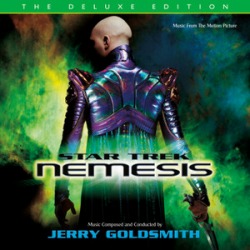
STAR TREK: NEMESIS – Jerry Goldsmith
 MOVIE MUSIC UK CLASSICS
Original Review by Craig Lysy
Sadly, the beloved Star Trek franchise took its final voyage with this tenth installment. For the storyline we are presented with yet another morality play, which explores the interplay of upbringing, fate and self-realization in seeking one’s destiny. Following a wedding between Will Riker and Deanna Troi, Picard receives startling orders from Star Fleet Command to proceed to Romulus as the Federation’s peace emissary. Evidently a coup d’état had ushered in a new leadership that wished to reset relations after centuries of unremitting animosity. Upon their arrival Picard discovers that the new leader Shinzon is not a Romulan, but instead a human, a clone of himself. Eventually he realizes a sinister deception as Shinzon’s true motives manifest. Shinzon desires to gain glory first by killing his genetic progenitor, Picard, and then by destroying Earth, a final repudiation of his humanity. Thus from a shared genetic template we see a duality, the polarity of goodness embodied in Picard and the polarity evil with Shinzon. What unfolds is a classic battle between light and darkness, a contest of wills with both Picard and Shinzon using their knowledge of the other and themselves to prevail. In the fateful final encounter, the Enterprise joined by Romulan loyalist ships battle Shinzon’s Scimitar, a cloaked mega vessel with superior shields and weapons of mass destruction. We witness Picard and Shnizon match wits with the most impressive battle scenes of the franchise. The film, while not embraced by critics, performed well and was profitable. The decision to end the franchise was very disappointing. Read more…
WYATT EARP – James Newton Howard
 MOVIE MUSIC UK CLASSICS
Original Review by Craig Lysy
Kevin Costner’s original vision for a biopic on Wyatt Earp was a six-part TV mini series. Director Lawrence Kasdan, who had previously directed Costner in Silverado, convinced him that his story was best presented on the big screen. Costner trusted Kasdan and so gave him the reigns to bring forth his vision. Kasdan rewrote much of the Dan Gordon’s original screenplay and fashioned it into an epic American journey of a complex man, an anti-hero whose love of family and kin defined his life and kept him true as he struggled to find his destiny. Set in the years following the Civil War through the Alaskan gold rush, we see Earp in many guises; as a family man, outlaw, U.S. Marshall and finally a prospector. Western folklore reveals Earp to be one of the most iconic men of the old American West, a man who fully embodied its fierce independence and nobility, but also its cruelty, violence and brutality. For the film Kasdan assembled a stellar cast, which included Costner in the title role, Dennis Quaid (Doc Holliday) and Gene Hackman (Nicholas Earp). Regretfully an earlier release of “Tombstone”, a very similar film, diminished “Wyatt Earp’s” impact. The overly long and plodding pace of the film failed to resonate with the public, which viewed it as a bloated “copy cat”, that resulted in both a much-derided critical and commercial failure. Read more…
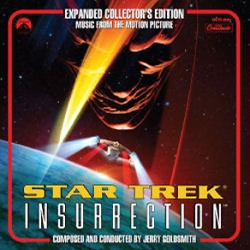
STAR TREK: INSURRECTION – Jerry Goldsmith
 MOVIE MUSIC UK CLASSICS
Original Review by Craig Lysy
The Next Generation crew returned for their third film with the addition of villain J. Murray Abraham (Ru’afo) and Picard’s love interest Donna Murphy (Anij). This 9th installment of the franchise offers in the finest Star Trek tradition another classic morality play. The story explores Machiavellianism, which espouses that “Might Makes Right” and that evil means may be used to achieve a “Greater Good”. The story is set on the planet Ba’ku, which is located in isolation in Sector 441. Ba’ku’s planetary rings emit a unique metaphasic radiation, which are both regenerative to health and life prolonging. We see a Federation team collaborating with the So’na, later to be revealed as disaffected Ba’ku ex-patriots, covertly seeking to remove the Ba’ku so that they may harvest the planet’s ring matter for ‘the betterment of all’. When Data malfunctions and exposes the sordid plan to the Ba’ku a crisis is precipitated. Picard and his crew choose to violate the direct orders of the mission commander Admiral Dougherty and defend the Ba’ku, believing that his mission violates the Prime Directive. This elicits war with the So’na who begin the forced removal of the Ba’ku and the harvesting of the planet’s rings. Our heroes succeed in defeating Ru’afo and in reuniting the Ba’ku with their estranged children, the So’na. The film was a commercial success, doubling its production costs and achieved some critical acclaim with both Hugo and Saturn Award nominations. Read more…
STAR TREK: GENERATIONS – Dennis McCarthy
 MOVIE MUSIC UK CLASSICS
Original Review by Craig Lysy
This seventh film in the franchise was conceived as a vehicle to pass the baton from the original series cast to the Next Generation cast. Set in the late 23rd century, we witness the maiden voyage of the Starship Enterprise B. Members of the original crew, Pavel Chekov, Montgomery Scott and James Kirk attend as honored guests. The maiden voyage quickly turns to disaster as an unseasoned captain and not fully functional ship are forced to rescue two transport ships from a destructive energy ribbon. The Enterprise B manages to save a handful of the ships’ passengers, including a scientist called Soran, but with heavy costs as Captain Kirk is lost when a destructive bolt breeches the hull. Seventy-eight years later, Captain Jean-Luc Picard and the crew of the Enterprise-D seek to defeat a now obsessed scientist Soran who is destroying entire star systems in an effort to regain the alternative reality of the Nexus energy ribbon. In a truly heroic battle, Picard and Kirk join forces to stop Soran before he destroys yet another civilization. The film was a commercial success, earning three time its production costs. Read more…
PROVIDENCE – Miklós Rózsa
 MOVIE MUSIC UK CLASSICS
Original Review by Craig Lysy
Providence served as the first English-language film from renowned French director Alain Resnais. True to form Resnais provides us with a drama about an unsympathetic, spiteful, alcoholic novelist, which again features his trademark playful surrealist touches and recurring use of characters shackled by recurrent memories. The story reveals Clive Langham (Sir John Gielgud) spending a painful night in his bed suffering from age ending health problems, vainly trying to create a final story based on his family played by Ellen Burstyn (Sonia), Dirk Bogarde (Claude) and David Warner (Kevin). He is an incredibly bitter man, drunken and tormented, who reveals through a series of flashbacks an unsympathetic, spiteful, conniving family. Clive makes each of his family members interact in a variety of bizarre settings – courtrooms, mortuaries and werewolf-haunted forests. It is apparent that his perceptions are distorted by a terrible bitterness and guilt, the full extent of this is not made clear until the end, when his “real” family members come to his house to celebrate his 78th birthday. The film was both a commercial and a critical success, earning the 1978 César Award for Best Film. Read more…
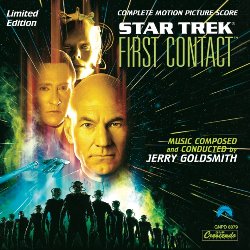
STAR TREK: FIRST CONTACT – Jerry Goldsmith
 MOVIE MUSIC UK CLASSICS
Original Review by Craig Lysy
As is consistent of the ethos of the Star Trek universe, we are again treated to a classic morality play that speaks to obsession and the powerful, yet ultimately self-destructive drive for vengeance. The script purposely draws upon classical references of Herman Melville’s great novel “Moby Dick”, which lends a potent gravitas to this latest voyage. The story reveals a bold attack by the Borg to destroy humanity by conquering it not in the present, but instead by destroying its past. Through use of a temporal vortex, the Borg time travel backwards to 21st century Earth, which lays vulnerable having been decimated by a third World War. Their plan hinges on destroying the Phoenix, Earth’s first warp capable ship. History reveals that its inaugural flight elicited a first contact encounter with the Vulcans who happened to be exploring the Terran system. This first contact laid the seed from which arose the United Federation Of Planets. Captain Picard follows the Borg back through time and must overcome his personal demons having been once assimilated by the Borg, as well as his obsession for revenge to save humanity’s future. The film was a critical success earning many awards as well as the most profitable Star Trek film of the franchise. Read more…
IN COUNTRY – James Horner
 MOVIE MUSIC UK CLASSICS
Original Review by Craig Lysy
For years Director Norman Jewison had eschewed making a film about the Vietnam War. Yet with over a decade passing since the fall of Saigon in 1975 he felt the time was at last right to address the war. As such, he chose to adapt Bobbie Ann Mason’s celebrated novel “In Country” for the screen. He did not wish to comment on the politics of the war, instead choosing to embark on a more intimate exploration of the lives of the men who fought bravely and honorable for their country. For his film he chose to explore the aftermath of the war on four men who fought it, as well as their families. The story reveals teenager Samantha Hughes (Emily Lloyd) who yearns to fill the void left by her father’s (Dwayne) death in Vietnam, or “In Country” as veterans describe. She also seeks to better understand her uncle Emmett and his friends Tom, Earl and Pete. Each man has returned home scarred and damaged by their tour of duty and unable to discuss their war experiences. Ultimately Samantha’s unyielding quest to discover her father initiates a liberating catharsis when she and Emmett visit the Vietnam War memorial in Washington D.C. Regretfully the film was a box office disaster and also failed to evoke any critical acclaim. Read more…
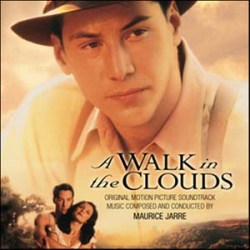
A WALK IN THE CLOUDS – Maurice Jarre
 MOVIE MUSIC UK CLASSICS
Original Review by Craig Lysy
The screenplay for A Walk in the Clouds was adapted and updated from the original 1942 Italian film Quattro Passi Fra Le Nuvole. In this incarnation the setting is California following the end of WWII. Paul Sutton (Keanu Reeves), a veteran adapting to civilian life, boards a bus and by chance meets Victoria Aragon (Aitana Sanchez-Gijon). She is headed home from college to help her family with the autumnal grape harvest of their estate called Las Nubes, or “the clouds.” Victoria is unmarried and with child and fears for her fate when she breaks the news to her traditionalist and old world Mexican father Alberto (Giancario Giannini). A sympathetic Paul proposes to masquerade as her husband in order to assist her in her time of need. As fate would have it, Paul and Victoria fall in love, weathering countless obstacles, including Alberto’s fierce opposition in the process. A crisis that threatens Las Nubes overcomes all opposition and serves to bring the lovers and family together for the quintessential happy ending. While not a critical success, the movie resonated with the public and also earned Maurice Jarre a Golden Globe win for best Film Score. Read more…
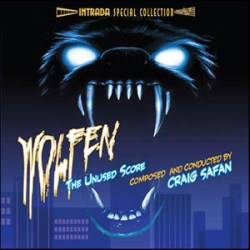
WOLFEN (REJECTED SCORE) – Craig Safan
 MOVIE MUSIC UK CLASSICS
Original Review by Craig Lysy
Director Michael Wadleigh chose to adapt Whitley Strieber’s novel Wolfen to film, as he believed it afforded him an opportunity to infuse depth and intelligence into the horror genre. The story is a mytho-historical tale that reveals the existence of a hidden intelligent species called Wolfen that have co-existed with humans for centuries. After a city cop (Albert Finney) is assigned to solve a horrific set of violent murders, he gradually unravels the mystery that are the Wolfen who will now do anything to ensure their anonymity. Replete with Indian legend and folklore about wolf spirits, the story was heralded for its sophistication and effort to elevate the horror genre. Regretfully, the film ran seriously over budget and Wadleigh was fired and never allowed to complete his vision. The film was not a commercial success, however critics acknowledged it as an unusual and ambitious effort. Read more…
L’AFRICAIN/THE AFRICAN – Georges Delerue
 MOVIE MUSIC UK CLASSICS
Original Review by Craig Lysy
Director Philippe De Broca had three passions; Africa, adventure and comedy. So when he was offered an opportunity to direct L’Africain, he needed no coaxing. The story concerns Victor (Philippe Noriet) and Charlotte (Catherine Deneuve) who have separated, only to have fate bring them back together in unusual circumstances. He is a bush pilot and conservationist who has fled civilization to Africa where he has setup a floating grocery store. Charlotte has also come to Africa to build a tourist center by Lake William where she hopes to study pygmies who live near by. She quickly realizes that Victor’s site is the best location to build and so they reunite and join in common cause. Yet soon old conflicts reemerge and when a gang of ruthless ivory smugglers, elephant stampedes, crocodiles and pygmies are thrown into the mix all hell breaks loose! Read more…
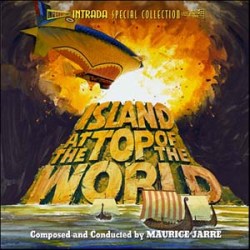
ISLAND AT THE TOP OF THE WORLD – Maurice Jarre
 MOVIE MUSIC UK CLASSICS
Original Review by Craig Lysy
The screenplay for Island at the Top of the World was based on the novel “The Lost Ones”, which was written by Ian Cameron and set in the location of Prince Patrick Island. The film is a classic adventure and discovery tale set in London circa 1907. British nobleman Sir Anthony Ross organizes a rescue party to the Arctic in a desperate search to recover his lost son Donald, who had embarked on an expedition in search of the fabled isle – the “Graveyard of Whales”. Joined by famous archaeologist Professor Ivarsson and Captain Brieux, an aeronaut who pilots the expedition, the team sets off in the Hyperion, an incredible mechanized French dirigible. Fate would have it that they discover an uncharted island named Astragard, or “Garden Of The Gods”, which is home to a lost colony of Vikings separated from humanity for centuries. The team ultimately must contend with a romance between Donald and the Viking Freyja, xenophobic Vikings who are unwilling to let their existence be revealed to the outside world, a fanatical High Priest Godi intent on executing these “invaders”, and lastly, killer whales that defend their sacred Graveyard. The film regretfully was neither a critical or commercial success. It suffered from inferior production quality, rare for a Disney film, and just did not resonate with the public. Read more…
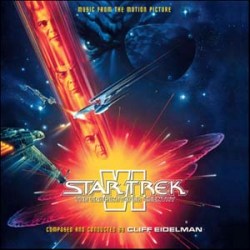
STAR TREK VI: THE UNDISCOVERED COUNTRY – Cliff Eidelman
 MOVIE MUSIC UK CLASSICS
Original Review by Craig Lysy
Star Trek VI was envisioned by Paramount executive Frank Mancuso as a rebound from the disaster that was the Star Trek V film, and a hand off the franchise to the Next Generation crew. As such he again hired Leonard Nimoy to write a script that would bring a memorable final adventure for our legendary crew. Drawing upon Gorbachev’s Glasnost initiative that catalyzed the dissolution of the Soviet Union, Nimoy fashioned a classic morality play, which dealt with the issues of racial prejudice, revenge, mistrust and humanity’s eternal search for “The Undiscovered County” – a lasting peace. The film begins dramatically with a cataclysmic explosion on the Klingon moon Praxis. The moon’s destruction fatally cripples energy production and the Klingons face the inevitable depletion of their ozone layer in 50 years, which will bring an irradiating end to their civilization. Chancellor Gorkon resolves to forge peace with the Federation and so bring to an end 70 years of unremitting hostilities, which he understands they can no longer sustain. Captain James Kirk and his crew are called upon by the Federation Council to escort the Chancellor to Earth, however reactionary elements on both sides jointly conspire to covertly sabotage the peace mission by attacking Gorkon’s vessel and assassinating him. Since the Enterprise appears to be responsible, Kirk and McCoy are remanded to Klingon authorities where they are tried, convicted and sent to certain death at the penal colony on Rura Penthe. A daring escape allows Kirk to regain the Enterprise and again save the day. He defeats the traitorous General Chang in battle and foils a second assassination of Klingon emissaries by Federation officers. The movie restored the franchise’s vitality, received critical acclaim and was a huge commercial success. Read more…
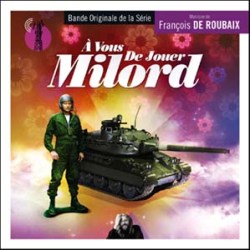
À VOUS DE JOUER MILORD – François de Roubaix
 MOVIE MUSIC UK CLASSICS
Original Review by Craig Lysy
À Vous de Jouer Milord was a 1974 spy drama mini-series of six episodes directed by the famous French director Christian-Jaque. The national security storyline concerned the theft of design schematics for the new generation French tank, the AMX 30. Justifiably alarmed by the loss of the schematics, the government resolved to call back into service their retired agent Hubert de Pomarec (AKA Milord) played by Henri Piégay to regain the stolen plans. Christian-Jaque imbued the mini-series with a comic book sensibility and robust action scenes with his lead performing his own stunts. While entertaining, it received no critical acclaim. Read more…

Shop at the Movie Music UK Store

Member of the

 MOVIE MUSIC UK