Archive
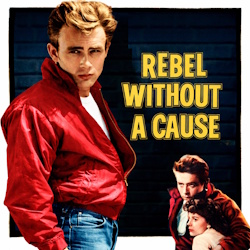
REBEL WITHOUT A CAUSE – Leonard Rosenman
 GREATEST SCORES OF THE TWENTIETH CENTURY
Original Review by Craig Lysy
Warner Brothers Pictures was looking for a vehicle to showcase their new, young contract actor James Dean. In 1954 they decided that they had finally found it with a 1944 novel by Robert M. Lindner, “Rebel Without A Cause: The Hypnoanalysis of a Criminal Psychopath”. They purchased the film rights, David Weisbart was assigned production with a $1.5 million budget, Stewart Stern was hired to write the screenplay, and Nicholas Ray was tasked with directing. For the cast, James Dean would star as Jim Stark, and joining him would be Natalie Wood as Judy, Sal Mineo as John “Plato” Crawford, Jim Backus as Frank Stark, Ann Doran as Carol Stark, Corey Allen as Buzz Gunderson, and William Hopper as Judy’s father. Read more…
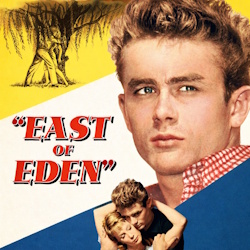
EAST OF EDEN – Leonard Rosenman
 GREATEST SCORES OF THE TWENTIETH CENTURY
Original Review by Craig Lysy
Warner Brothers Studios was approached by director Elia Kazan with a proposition to base a film on the fourth, and final part of John Steinbeck’s 1952 novel East of Eden. Given his reliable track record of success, the studio gave him the green light to proceed with the project. Kazan purchased the film rights from Steinbeck, and would manage production as well as direct. Paul Osborn was hired to write the screenplay. Casting was a struggle; Kazan rejected Marlon Brando and Montgomery Cliff as too old to play the teenage brothers and instead selected new talent 24-year-old James Dean to play Cal Trask. Joining him would be Julie Harris as Abra Bacon, Raymond Massey as Adam Trask, Richard Davalos as Aron Trask, Jo Van Fleet as Cathy Trask, and Burl Ives as Sam the sheriff. Read more…
THE COBWEB – Leonard Rosenman
 GREATEST SCORES OF THE TWENTIETH CENTURY
Original Review by Craig Lysy
Director Vincent Minnelli was intrigued by the cinematic possibilities offered by William Gibson’s novel, The Cobweb (1954), which takes place in a psychiatric institution where both the patients and the professional staff suffer from neuroses. He sold his idea to Metro-Goldwyn-Mayer Studios, John Houseman was tasked to produce, and a budget of $1,976 million was provided. Casting foundered when Robert Taylor, Lana Turner and Grace Kelly were either unavailable or declined. Eventually a fine cast was assembled, which included Richard Widmark as Dr. Stewart McIver, Lauren Bacall as Meg Rinehart, Charles Boyer as Dr. Devanal, Gloria Grahame as Karen McIver, Lilian Gish as Victoria Inch and John Kerr as Stevie. Read more…
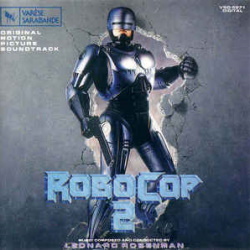
ROBOCOP 2 – Leonard Rosenman
 THROWBACK THIRTY
Original Review by Jonathan Broxton
After the unexpected critical and commercial success of Paul Verhoeven’s Robocop in 1987, it was inevitable that a sequel would be produced, and so in June 1990 Robocop 2 debuted in cinemas. Peter Weller returned to don the chrome armor for a second time as Alex Murphy, a detective in the futuristic Detroit Police Department who, after being murdered by criminals while on duty, is transformed into a half human-half machine cyborg crimefighter. The original movie was a violent action story that masked Verhoeven’s critiques of American hyper-consumerism and corporate corruption; Robocop 2 is a much more straightforward (although perhaps more graphically violent) story that sees Murphy trying to bring down a gang of drug dealers that are flooding the city with Nuke, a synthetic and highly addictive narcotic. Meanwhile, rampant corruption within the police department and its corporate owner, OCP, causes more issues with policing in the city, including mass strikes by cops. In order to address the problems city officials try to strike a deal with Cain, a vicious drug kingpin with a messiah complex. What could go wrong? The film co-stars Nancy Allen, Tom Noonan, and Belinda Bauer, was co-written by cult comic book creator Frank Miller, and was directed by The Empire Strikes Back’s Irvin Kershner, in what turned out to be his last film prior to his death. Read more…
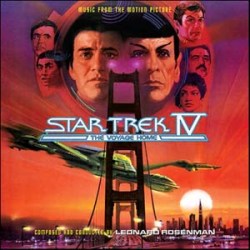
STAR TREK IV: THE VOYAGE HOME – Leonard Rosenman
 MOVIE MUSIC UK CLASSICS
Original Review by Craig Lysy
Coming off his directorial success with Star Trek III, Leonard Nimoy again assembled our iconic crew for a thoughtful eco-story that spoke to humanity’s poor stewardship of the Earth. The film opens with a massive space probe of unknown origin en route to Earth. When it arrives it delivers a cryptic message in a language that seems unintelligible. In addition, its power system neutralizes the Earth’s power grid and begins to vaporize its oceans. The exiled Captain Kirk and his fugitive crew correctly determine that the message is directed not to humanity, but instead to an extinct species, the Humpback whale. As such, they resolve to time travel back to late 20th century Earth to recover two humpback whales, hoping to bring them back to the future so they can respond to the probe’s message. Set in 20th century urban San Francisco, this new adventure was comic, light-hearted and proved to be a huge commercial success, earning profits of more than five times it’s production costs. Read more…
Leonard Rosenman, 1924-2008
 Composer Leonard Rosenman died on March 4, 2008, at the Motion Picture & Television Country House and Hospital in Woodland Hills, California. He had been suffering with dementia for many years, and died of a heart attack. He was 83.
Leonard Rosenman was born in September 1924, in Brooklyn, New York, to Jewish immigrants from Poland. After service in the Pacific with the United States Army Air Forces in World War II he studied piano and composition at Brooklyn College, and later at the University of California, Berkeley. Among his most influential teachers were Arnold Schoenberg and Roger Sessions – figures whose serialist and atonal techniques deeply informed Rosenman’s own compositional voice.
Rosenman’s entranc into the film world came through his friendship with actor James Dean; the two had met at a party for the cast of a Broadway play, and two weeks later Dean appeared at Rosenman’s doorstep wanting to take piano lessons. Dean later personally recommended him to director Elia Kazan for East of Eden in 1955, which proved to be a major breakthrough for the composer. Rosenman followed it later that year with Rebel Without a Cause, further establishing his reputation as a composer capable of capturing psychological intensity through unconventional harmonic language. These early scores were groundbreaking in their integration of dissonance and modernist techniques into mainstream Hollywood cinema. Read more…

Shop at the Movie Music UK Store

Member of the

 MOVIE MUSIC UK