Under-the-Radar Round Up 2017, Part 7
 Original Reviews by Jonathan Broxton
The seventh installment in my annual series of articles looking at the best “under the radar” scores from around the world sees us moving east to Asia. Asian film music – especially that of the far east and countries like Japan, China, and South Korea – is shockingly under-valued and un-discovered by the majority of film music fans in Europe and the United States, despite the fact that many of their films contain the bold, orchestral, theme-filled scores that they crave, but do not find in domestic blockbusters. My point in writing these reviews is to show that this great film music does exist if you’re willing to make a little effort to find it: case in point, these seven outstanding scores – four from Japan, one from China, one from Israel, and one outlier from Australia. We will be returning to this part of the world again soon!
Under-the-Radar Round Up 2017, Part 6
Original Reviews by Jonathan Broxton
The sixth installment in my annual series of articles looking at the best “under the radar” scores from around the world sees us jumping around the European mainland. Whereas Spain, Britain, and France all had enough scores to warrant articles of their own, other countries had maybe one or two outstanding highlights, and this article is an attempt to cover several of them. As such, here are seven of those outstanding pan-European efforts, including a huge fantasy adventure score from Russia, a rousing sports score from Finland, a rich romantic drama score from Italy, a comedy adventure score from the Netherlands, a superb seasonal animation score from Poland, among others. There will be more to come from this cross-continental adventure later!
Under-the-Radar Round Up 2017, Part 5
Original Reviews by Jonathan Broxton
The fifth installment in my annual series of articles looking at the best “under the radar” scores from around the world sees us in one of my favorite film music countries, Spain. I have long been a vocal promoter Spanish film music which, over last ten years or so, has become a soundtrack powerhouse filled with composers who – in terms of the number of excellent scores per film – are probably writing the highest quality film music in the world. 2017 was no exception, with dozens of excellent scores emerging from the country during the calendar year. This article contains the scores which, in my opinion, are the eight best, which encompass both film and television, span multiple genres, and are written both by familiar favorites and exciting newcomers.
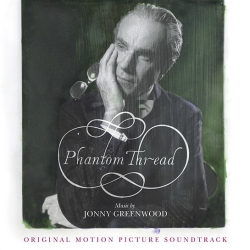
PHANTOM THREAD – Jonny Greenwood
 Original Review by Jonathan Broxton
Phantom Thread is a period romantic drama film written and directed by Paul Thomas Anderson. Set in England in the 1950s, it stars Daniel Day-Lewis as Reynolds Woodcock, a fashion designer and exquisite dressmaker, who runs a high-end haute couture business with his sister Cyril (Lesley Manville), and whose regular clients include the cream of European royalty. Reynolds is brilliant, an artist of tremendous skill and taste, but is also neurotic, difficult, irritable, and unhealthily obsessed with his late mother; he also frequently embarks on fiery relationships with women that fizzle out as soon as he gets bored, upon which he begins treating them with casual disdain. One day Reynolds meets Alma (Vicky Krieps), a shy waitress, to whom he is unexpectedly attracted. Before long Reynolds has moved Alma into his house in London, and she quickly becomes his muse, challenging him, confounding him, but also inspiring greatness in his work. However, their relationship is tempestuous, and before long it is heading down an unexpectedly dark path which may have serious repercussions for everyone involved. Read more…
DOWNSIZING – Rolfe Kent
 Original Review by Jonathan Broxton
Downsizing is the latest film from director Alexander Payne. It has a fascinating premise; in a research lab in Norway a team of scientists led by Dr. Jørgen Asbjørnsen (Rolf Lassgård) finds a way to shrink a human being from full size, down to about five inches tall – perfectly safe, no side effects, but irreversible – as a way to halt humanity’s over-consumption of the planet’s natural resources . Within a decade the new technology – known as ‘downsizing’ – has become incredibly popular, with hundreds of thousands of people undergoing the procedure and moving to brand new, specially built communities for small people, which offer every luxury imaginable. Into this world comes Paul Safranek (Matt Damon), who agrees to undergo the downsizing procedure with his wife Audrey (Kristen Wiig) as a way to escape from their dull life in the real world. However, before long, Paul finds that the ‘small world’ has its own set of problems, and after he meets a Serbian playboy businessman (Christophe Waltz) and a former Vietnamese political activitist (Hong Chau), his life changes in more ways than he could have ever anticipated. Read more…
BAFTA Nominations 2017
 The British Academy of Film and Television Arts (BAFTA) has announced the nominations for the 71st British Academy Film Awards, honoring the best in film in 2017.
In the Best Original Music category, which is named in memory of the film director Anthony Asquith, the nominees are:
- ALEXANDRE DESPLAT for The Shape of Water
- JONNY GREENWOOD for Phantom Thread
- DARIO MARIANELLI for Darkest Hour
- BENJAMIN WALLFISCH and HANS ZIMMER for Blade Runner 2049
- HANS ZIMMER for Dunkirk
This is the eighth BAFTA nomination for Desplat, who won for “The King’s Speech” in 2010 and “The Grand Budapest Hotel” in 2014; the second nomination for Greenwood; the third nomination for Marianelli; the first nomination for Wallfisch; and the ninth BAFTA film award nomination for Zimmer. Zimmer also has music nominations from the BAFTA TV Awards and the BAFTA Games Awards.
The winners of the 71st BAFTA Awards will be announced on February 18, 2018.
Under-the-Radar Round Up 2017, Part 4
Original Reviews by Jonathan Broxton
The fourth installment in my annual series of articles looking at the best “under the radar” scores from around the world sees us back in France, with a look at a wonderful octet of scores from films made in one of the world’s great cinematic nations. This set of scores ranges across every genre imaginable, and includes one by a controversial double Oscar-winner, two by beloved staples of classic French cinema, and two by one of the most impressive newcomers to emerge in 2017.
Golden Globe Winners 2017
 The Hollywood Foreign Press Association (HFPA) have announced the winners of the 75th Golden Globe Awards, honoring the best in film and American television of 2017.
In the Best Original Score category composer Alexandre Desplat won the award for his score for director Guillermo del Toro’s romantic fantasy The Shape of Water. This is Desplat’s second Golden Globe, him having won previously for The Painted Veil in 2006. In his acceptance speech, Desplat said:
“Thank you, merci, merci beaucoup. Different color from the previous one! Thank you Hollywood Foreign Press. Thanks to Fox Searchlight, to Miles Dale the producer, and Guillermo… you moved me. Your movie has moved me so much, inspired me so much, because it’s made of your humanity, your passion. I thank you also for all the dinners we have in Paris, and the ones to come. I want to thank all the musicians who recorded the score, they are marvelous. All the crew and cast: Richard [Jenkins], Sally [Hawkins], Doug [Jones]. The music department at Fox Searchlight, Queen Renee Fleming, Laura Engel, Ray Costa, my friend Katz, and Solrey – this is for you. Thank you very much!”
The other nominees were Carter Burwell for Three Billboards Outside Ebbing Missouri, Jonny Greenwood for Phantom Thread, John Williams for The Post, and Hans Zimmer for Dunkirk.
In the Best Original Song category, the winners were Benj Pasek, and Justin Paul for their song “This Is Me” from the screen musical The Greatest Showman.
The other nominees were Kristin Anderson-Lopez and Robert Lopez for “Remember Me” from Coco; Mariah Carey and Marc Shaiman for “The Star” from The Star; Nick Jonas, Justin Tranter, and Nick Monson for “Home” from Ferdinand; and Raphael Saadiq, Mary J. Blige, and Taura Stinson for “Mighty River” from Mudbound.
THE POST – John Williams
 Original Review by Jonathan Broxton
In 1971 the Washington Post was still a comparatively small-scale regional newspaper, lagging behind such behemoths as the New York Times in terms of prestige and influence. That all changed when the Post’s hard boiled news editor Ben Bradlee found himself in possession of what became known as The Pentagon Papers: a leaked classified report which proved that the US government had lied to the American people about the scope of its involvement in the Vietnam War, and that multiple US presidents were involved in the cover-up. Director Steven Spielberg’s film The Post tells the story of how the newspaper came into possession of the Papers, and the subsequent protracted legal and ethical battles that ensued over whether or not to publish; it stars Tom Hanks as Bradlee, Meryl Streep as the Post’s owner Kay Graham, and has a stellar supporting cast including Bob Odenkirk, Bruce Greenwood, Tracy Letts, Bradley Whitford, Matthew Rhys, Carrie Coon, Michael Stuhlbarg, and Sarah Paulson. Read more…
Under-the-Radar Round Up 2017, Part 3
Original Reviews by Jonathan Broxton
The third installment in my annual series of articles looking at the best “under the radar” scores from around the world returns to the United Kingdom, with a look at a half dozen or so more outstanding scores from films made in Britain. This set of scores from comprises comedies, dramas, and even a horror movie, and includes one by an Oscar-winner, one by a well-loved multiple Oscar nominee, and one by one of the most impressive newcomers to emerge in 2017.
DARKEST HOUR – Dario Marianelli
 Original Review by Jonathan Broxton
There are few twentieth century political and military leaders as respected and admired as Sir Winston Churchill. An army officer, Nobel prize winning writer, and artist, he served two terms as Prime Minister of the United Kingdom, from 1940 to 1945, and again from 1951 to 1955. He, along with his comrades Josef Stalin and Franklin Roosevelt, led the Allies to victory in World War II, and in so doing became one of the most well-known and recognizable figures in the world, with his iconic hat, jowls, and cigar. As an orator, he was patriotic and inspirational, and several of his most famous speeches – “we shall fight them on the beaches,” “never in the field of human conflict was so much owed by so many to so few” – are legendary. But he was also a complex, conflicted man, who failed to be as effective a governor in peacetime as he was in war. He has been portrayed on film many times over the years, but the performance given by actor Gary Oldman in director Joe Wright’s film Darkest Hour, may be the most acclaimed to date. Read more…
Dominic Frontiere, 1931-2017
 Composer Dominic Frontiere died on December 21, 2017, in his home in Tesuque, New Mexico, after a short illness. He was 86.
Dominic Carmen Frontiere was born in New Haven, Connecticut, in June 1931. A classically trained accordion prodigy who performed at Carnegie Hall as a teenager, Frontiere went on to study at the Juilliard School before beginning a career in Hollywood that spanned more than four decades. He first gained recognition as musical director at 20th Century Fox, where he collaborated with Alfred Newman and contributed to a variety of studio productions.
His association with director and producer Leslie Stevens led to Frontiere scoring his first major film, The Marriage-Go-Round, in 1961. That relationship led Frontiere to became an executive of the television and film production company Daystar Productions, a company Stevens run. He composed several famous television themes of the 1960s, such as those for The Outer Limits, The Rat Patrol, Branded, and The Flying Nun, as well as The Invaders, The Fugitive, and 12 O’Clock High for producer Quinn Martin.
In cinema, he earned acclaim for his scores to films including Hang ‘Em High (1968), starring Clint Eastwood, and Freebie and the Bean (1974) while his score for The Stunt won a Golden Globe Award and earned him a Grammy nomination in 1980. Other notable films scored by Frontiere include On Any Sunday in 1971, Cleopatra Jones and the Casino of Gold in 1975, Brannigan in 1975, The Aviator in 1985, and Color of Night in 1994, which was his final major work. Read more…
STAR WARS: THE LAST JEDI – John Williams
 Original Review by Jonathan Broxton
WARNING: THIS REVIEW CONTAINS PLOT SPOILERS. IF YOU HAVE NOT YET SEEN THE FILM, YOU MIGHT WANT TO CONSIDER WAITING UNTIL AFTER YOU HAVE DONE SO TO READ IT.
With George Lucas’s prequel trilogy having received almost universal critical disdain in the decade that followed the release of Revenge of the Sith, it took the 2015 film The Force Awakens to re-ignite the Star Wars franchise and bring back the love that so many millions had for the original trilogy that began in 1977. Luxuriating in $2 billion worldwide grosses, and having introduced a cache of interesting new characters to sit alongside the story stalwarts, The Force Awakens allowed Lucasfilm and the Walt Disney company to push forward with their plans for new sequels, as well as several standalone side-stories, confident that people were happy to come back to the galaxy far, far away. The first side-story, Rogue One, premiered in 2016, and a second movie looking at the early years of Han Solo is scheduled for 2018. But before we get into that, 2017’s most anticipated film is Star Wars: The Last Jedi, written and directed by Rian Johnson, which is the second film of the third trilogy, and the eighth ‘main story’ Star Wars film overall. Read more…
Under-the-Radar Round Up 2017, Part 2
Original Reviews by Jonathan Broxton
The second installment in my annual series of articles looking at the best “under the radar” scores from around the world concentrates on music from films from the land of Delerue, Jarre, and Desplat: la belle France! There has been an embarrassment of riches emanating from French cinema in 2017, and this first set of six reviews encompasses a number of outstanding scores, including two by one of Composers of the Year, Cyrille Aufort.
Golden Globe Nominations 2017

The Hollywood Foreign Press Association (HFPA) has announced the nominations for the 75th Golden Globe Awards, honoring the best in film and American television of 2017.
In the Best Original Score category, the nominees are:
- CARTER BURWELL for Three Billboards Outside Ebbing Missouri
- ALEXANDRE DESPLAT for The Shape of Water
- JONNY GREENWOOD for Phantom Thread
- JOHN WILLIAMS for The Post
- HANS ZIMMER for Dunkirk
This is the first Golden Globe nomination for Greenwood, and just his second major film music award nomination – he was previously nominated for a BAFTA for There Will Be Blood in 2007 – although he has been a multiple Grammy award nominee and winner for his work as a member of the alternative rock group Radiohead.
This is the 3rd nomination for Burwell, and the 9th nomination for Desplat, who previously won the Globe for The Painted Veil in 2006. It’s also the 25th nomination for Williams – who previously won Globes in 1975 for Jaws, 1977 for Star Wars, 1982 for E.T. The Extra-Terrestrial, and 2005 for Memoirs of a Geisha – and the 14th nomination for Zimmer, who previously won Globes for The Lion King in 1994 and Gladiator in 2000.
In the Best Original Song category, the nominees are:
- KRISTIN ANDERSON-LOPEZ and ROBERT LOPEZ for “Remember Me” from Coco
- MARIAH CAREY and MARC SHAIMAN for “The Star” from The Star
- NICK JONAS, JUSTIN TRANTER, and NICK MONSON for “Home” from Ferdinand
- BENJ PASEK, and JUSTIN PAUL for “This Is Me” from The Greatest Showman
- RAPHAEL SAADIQ, MARY J. BLIGE, and TAURA STINSON for “Mighty River” from Mudbound
The winners of the 75th Golden Globe Awards will be announced on January 7, 2018.

Shop at the Movie Music UK Store

Member of the

 MOVIE MUSIC UK