THE BUREAU OF MAGICAL THINGS – Brett Aplin
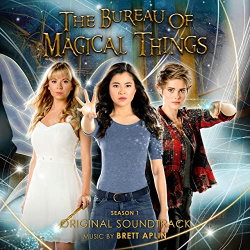 Original Review by Christopher Garner
The Bureau of Magical Things is an Australian television series for tweens and teens about a girl named Kyra, who is transformed by a magical book. She discovers a whole world of magical spells, objects, and creatures hidden amid the world she’s always known. She joins a colorful cast of young elves and fairies who are in training to join the Department of Magical Intervention (DMI), whose job it is to keep the magical world a secret. Kyra joins these magic students to save the world from a burgeoning threat. Elements of the show are clearly inspired by Harry Potter. The show was created by Jonathan M. Schiff, a titan of Australian television whose productions have launched the careers of no less than Liam Hemsworth and Margot Robbie. The first season of The Bureau of Magical Things aired in Australia in 2018 and then in the US on the Nickelodeon network. The second season aired in 2021, and the score was released in December. Read more…
FINAL ANALYSIS – George Fenton
 THROWBACK THIRTY
Original Review by Jonathan Broxton
Final Analysis was one of several ‘sexy thrillers’ that mainstream Hollywood produced in 1992 and 1993 – others included Basic Instinct and Body of Evidence – which sought to capitalize on the fact that there were several good looking leading men and women by putting them in various stages of undress and elements of danger. This film was directed by Phil Joanou from a screenplay by Wesley Strick, and was made as a clear homage to Alfred Hitchcock’s Vertigo. Richard Gere plays San Francisco-based psychiatrist Isaac Barr, who is drawn into a torrid affair with Heather (Kim Basinger), the sister of his current patient Diana (Uma Thurman). When Heather reveals to Barr that she is married to gangster Jimmy Evans (Eric Roberts), and wants out of the relationship, Isaac commits to helping her – but there is more to Heather than meets the eye, and before long Barr is drawn into a web of deceit and murder. Read more…
Academy Award Nominations 2021
 The Academy of Motion Picture Arts and Sciences (AMPAS) have announced the nominations for the 94th Academy Awards, honoring the best in film in 2021.
In the Best Original Score category, the nominees are:
- NICHOLAS BRITELL for Don’t Look Up
- GERMAINE FRANCO for Encanto
- JONNY GREENWOOD for The Power of the Dog
- ALBERTO IGLESIAS for Parallel Mothers
- HANS ZIMMER for Dune
This is the third Oscar nomination for Britell, the first Oscar nomination for Franco – and the first for an American woman since Ann Ronell in 1945, the second Oscar nomination for Greenwood, the fourth Oscar nomination for Iglesias, and the 12th Oscar nomination for Zimmer, who previously won for The Lion King in 1995
In the Best Original Song category, the nominees are:
- LIN-MANUEL MIRANDA for “Dos Oruguitas” from Encanto
- VAN MORRISON for “Down to Joy” from Belfast
- FINNEAS O’CONNELL and BILLIE EILISH for “No Time To Die” from No Time to Die
- DARIUS ‘DIXSON’ SCOTT and BEYONCÉ KNOWLES-CARTER for “Be Alive” from King Richard
- DIANE WARREN for “Somehow You Do” from Four Good Days
The winners of the 94th Academy Awards will be announced on March 27, 2022.
JOHN WILLIAMS REVIEWS 1970-1974
 In this latest installment of the new irregular series looking at the early career of some iconic composers, and in recognition of his 90th birthday this week, here is our look at the first part of second decade in the career of John Williams, and all the scores he wrote from 1970 through 1974.
The 1970s was the decade which really established Williams as a major composer in Hollywood film music circles; he moved mostly away from the light jazz scores that typified a great deal of his work in the 1960s, he dropped the cheerful name ‘Johnny Williams’ and became the much more serious ‘John,’ and he formed many of the directorial relationships that would result in much of his mainstream success – notably with a young and ambitions and incredibly talented kid from Cincinnati named Steven Spielberg.
Not included here are the scores where Williams adapted music by other people: Fiddler on the Roof (1971), where Williams worked with music by Jerry Bock and for which he received his first Academy Award for Best Scoring: Adaptation and Original Song Score, and Tom Sawyer (1973), where Williams adapted music Robert B. Sherman and Richard M. Sherman, and for which Williams received an Academy Award nomination for Best Scoring: Original Song Score and Adaptation, and a Golden Globe nomination for Best Original Score. Read more…
CITY LIGHTS – Charles Chaplin
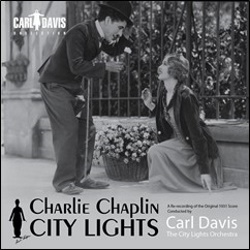 GREATEST SCORES OF THE TWENTIETH CENTURY
Original Review by Craig Lysy
Entering the 1920s Charlie Chaplin had become a global sensation, his career ascendent. In 1929 he conceived a new film, “City Lights”, a passion project in which he would produce, direct, write the screenplay, compose the score, and star. Chaplin was a perfectionist and it would take him 534 days of filming to realize his vision. He faced significant resistance from his studio United Artists who were not happy with his decision to eschew a talkie film, and instead stubbornly make another silent film, although one with a synchronous and original score. For Chaplin, his art and passion was pantomime, with his Tramp character beloved by the world and legend. He saw talkie films as a harbinger for the end of his art, and so his reaction was understandable. And so, he proceeded with his vision and a budget of $1.5 million dollars was provided. The cast included Chaplin as the Tramp, Virginia Cherrill as the blind Flower Girl, Florence Lee as the grandmother, Harry Myers as the eccentric millionaire, Al Ernest Garcia as the butler, and Hank Mann as the prizefighter. Read more…
BAFTA Nominations 2021
 The British Academy of Film and Television Arts (BAFTA) has announced the nominations for the 75th British Academy Film Awards, honoring the best in film in 2021.
In the Best Original Music category, which is named in memory of the film director Anthony Asquith, the nominees are:
- NICHOLAS BRITELL for Don’t Look Up
- ALEXANDRE DESPLAT for The French Dispatch
- JONNY GREENWOOD for The Power of the Dog
- DANIEL PEMBERTON for Being the Ricardos
- HANS ZIMMER for Dune
This is the second BAFTA nomination for Britell, the 11th BAFTA nomination for Desplat (who won the award for “The King’s Speech” in 2011, “The Grand Budapest Hotel” in 2014, and “The Shape of Water” in 2017), the third BAFTA nomination for Greenwood, the first film nomination for Pemberton (he was nominated previously for video games), and the 10th BAFTA nomination for Zimmer.
The winners of the 75th BAFTA Awards will be announced on 13 March, 2022.
IFMCA Award Nominations 2021
 INTERNATIONAL FILM MUSIC CRITICS ASSOCIATION AWARDS NOMINATIONS ANNOUNCED
JAMES NEWTON HOWARD AND HANS ZIMMER RECEIVE FOUR NOMINATIONS EACH; THREE WOMEN NOMINATED FOR BREAKTHROUGH COMPOSER AWARD; SCORES FROM AUSTRALIA, CHINA, FINLAND, FRANCE, SPAIN, VYING FOR MAJOR AWARDS
FEBRUARY 3, 2022. The International Film Music Critics Association (IFMCA) announces its list of nominees for excellence in musical scoring in 2021, for the 18th annual IFMCA Awards. Composers James Newton Howard and Hans Zimmer lead a very open field with the most number of nominations, both receiving a total of four. Composers Panu Aaltio, Nicholas Britell, Jonny Greenwood, Maurizio Malagnini, and Bear McCreary all received three nominations.
American composer Howard’s nominations are for his work on two films: the globe-trotting action-adventure “Jungle Cruise” starring Dwayne Johnson and Emily Blunt, which is based on the popular Disney theme park ride; and the animated fantasy “Raya and the Last Dragon,” which follows the adventures of a young girl in an alternate universe version of South East Asia, as she tries to save her family by hunting for a mythical dragon. “Jungle Cruise” is nominated for Score of the Year and Best Action/Adventure/Thriller Score, “Raya and the Last Dragon” is nominated for Best Animation Score, and Howard is nominated for Composer of the Year.
IFMCA member Christian Clemmensen said that “Jungle Cruise” is a combination of “skittish comedy, sincere drama, breakneck adventure, romantic teasing, and flowing fantasy, all inhabiting one whirlwind of a score” and concluded that it “represents most of what his collectors love about Howard’s writing.” IFMCA member John Mansell described “Raya and the Last Dragon” as “a fully symphonic work … mysterious, with rich and lush musical moments that are filled with the romantic and the comedic, a varied and vibrant work that is bursting to capacity with haunting themes and edged with emotive and poignant tone poems.”
German composer Zimmer’s nominations are for his work on two of 2021’s most popular and acclaimed films: director Denis Villeneuve’s “Dune,” based on the groundbreaking science fiction novel by Frank Herbert, and the action-packed 25th James Bond film “No Time to Die,” which marks the end of actor Daniel Craig’s term playing the legendary British spy. “Dune” is nominated for Score of the Year and Best Fantasy/Sci-Fi/Horror Score, “No Time to Die” is nominated for Best Action/Adventure/Thriller Score, and Zimmer is nominated for Composer of the Year.
IFMCA member Jon Broxton wrote that there was “something timeless, ancient, epic, but also futuristic and progressive” about the music from “Dune,” and concluded that “when it works, and Zimmer really gets to the heart and soul of Frank Herbert’s story and Denis Villeneuve’s vision, it’s some of the most effective film music of 2021”. IFMCA member James Southall said that “No Time to Die” is “essentially the score that lots of Bond fans have wanted for a while, combining all the traditional musical elements you’d expect, and giving them a modern twist, along with the oft-requested deep interpolation of the song into the score,” and called it “entertaining from start to finish.” Read more…
NEW BABYLON – Dmitri Shostakovich
 GREATEST SCORES OF THE TWENTIETH CENTURY
Original Review by Craig Lysy
The film’s genesis lies with Factory of the Eccentric Actor (FEKS), an avant-garde artists association founded in 1922 by Grigori Kozintsev and Leonid Trauberg. The mission of the organization was to promote a new film methodology call “Eccentrism”, which rejected the traditional aesthetics of bourgeois art, instead seeking a new path that would embrace Futurism, Surrealism and Dadaist Constructionism. To that end Kozintsev and Trauberg conceived of a film that would tell the story of the Paris Commune of 1871; the first effort to form a government committed to communist principles. Their screenplay was reviewed and they secured permission to proceed from Goskino – The Soviet State Committee for Cinematography, which would fund and distribute the film. Kozintsev and Trauberg would jointly direct and a fine cast was assembled, which included; Yelena Kuzima as Louise, Pyotyr Sobolevsky as Jean, Sergei Gerasimov as Loutro, Vsevolod Pudovkin as Baliff, Oleg Zhakov as a member of the Paris Commune, and Yanina Zhejmo as milliner Teresa. Read more…
THE KING’S DAUGHTER – Joseph Metcalfe, John Coda, Grant Kirkhope
 Original Review by Jonathan Broxton
Back in 2013 director Sean McNamara began pre-production on a film version of the popular 1997 fantasy novel ‘The Moon and the Sun’ by Vonda McIntyre, and worked with screenwriters Barry Berman and James Schamus on the script. The story involves King Louis XIV of France – the Sun King – who is searching for the secret to immortality, having recently survived an assassination attempt. Eventually King Louis’s efforts leads to the discovery of a mermaid named Sherzad, the last of her kind, whose flesh is rumored to make the eater immortal. Meanwhile a young cellist named Marie-Josèphe comes to the court, unaware that she is actually the king’s illegitimate daughter. Marie-Josèphe and Sherzad arrive at Versailles simultaneously, and unexpectedly form a connection; later, when Marie-Josèphe falls in love with a handsome courtier named Yves de la Croix, she vows to save Sherzad from a terrible fate: ritual sacrifice during a lunar eclipse. Read more…
MEDICINE MAN – Jerry Goldsmith
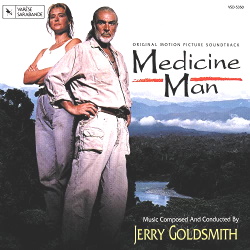 THROWBACK THIRTY
Original Review by Jonathan Broxton
Medicine Man is a drama with an ecological theme, written by Tom Schulman and Sally Robinson, and directed by John McTiernan, who at that time was one of Hollywood’s premier directors, hot on the heels of Predator, Die Hard, and The Hunt for Red October. The film stars Sean Connery as Dr. Robert Campbell, a medical researcher working deep in the Amazonian rainforest, who has gone missing after his wife and research partner abandon him. The pharmaceutical company funding Campbell’s work sends Dr. Rae Crane (Lorraine Bracco) – a brash, tough talking New Yorker – to find him; eventually, she locates him working in a remote tribal village, but they clash immediately, with Campbell’s latent sexism and bad-temperedness preventing him from taking her seriously, and with Rae being desperately unsuited to life in the jungle. However, the two bury their differences when a new threat emerges: a Brazilian logging company is building a road nearby, which threatens to displace the local native population, and potentially destroy the plant that Campbell believes may provide a cure for cancer. Read more…
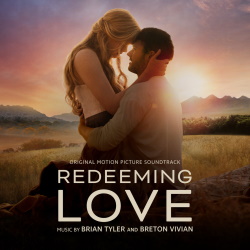
REDEEMING LOVE – Brian Tyler, Breton Vivian
 Original Review by Jonathan Broxton
Redeeming Love is a ‘faith-based drama’ directed by D. J. Caruso, based on a popular novel by Francine Rivers, which was itself a re-telling of the biblical story of Hosea, a prophet who married an unfaithful woman. The film is set in the 1850s at the height of the California gold rush and tells the story of Angel, a woman who was sold to a brothel as a child and who has essentially spent her entire life working as a prostitute. Despite her miserable life Angel is positive and optimistic, and her prospects begins to change when she meets and falls in love with Michael, a kind-hearted farmer who ‘rescues’ her following a beating from a client. However, the road to true love and redemption is always fraught with perils, and before long Angel and Michael find themselves dealing with all sorts of trials and tribulations – not only in terms of their circumstances in the present, but also as a result of Angel’s horrific past experiences coming back to haunt them. The film stars Abigail Cowan and Tom Lewis as Angel and Michael, with Famke Janssen, Logan Marshall-Green, and Nina Dobrev in supporting roles, and has an original score by Brian Tyler and Breton Vivian. Read more…
DER HEILIGE BERG/THE HOLY MOUNTAIN – Edmund Meisel
 GREATEST SCORES OF THE TWENTIETH CENTURY
Original Review by Craig Lysy
In 1926 the future documentary filmmaker (and Nazi propagandist) Leni Riefenstahl was a dancer and an aspiring actress. A chance meeting between her and director Arnold Fanck was fateful as he was impressed by both her beauty and singlemindedness. As such, he began to write sketches to a film he envisioned, a love story, which would showcase her talents. Fanck took his screenplay – called Der Heilige Berg, or The Holy Mountain – to the UFA production company, who agreed to support the project. Harry R. Sokal was assigned production with a budget of 1.5 million RM. Fanck would direct and handle cinematography. His cast consisted of Riefenstahl as Diotima, Luis Trenker as Karl, Frida Richard as Mother, Ernst Petersen as Vigo, Friedrich Schneider as Coli, and Hannes Schneider as Mountain Guide. Read more…
Movie Music UK Awards 2021
 I said that 2020 has been, by far, the strangest year in living memory for both films and film music – but 2021 almost matched it. Although the rampant COVID-19 coronavirus pandemic wreaked havoc on the film industry across around the world, there was still a terrific amount of excellent music that came out this year, as mainstream studio tentpoles delayed from 2020 finally hit cinemas, and competed with a number of outstanding indie and international features.
Ultimately three of my five nominees for Score of the Year came from obscure sources – the Netherlands, Spain, and Finland – with one well-regarded indie, and just one major studio film from an established Hollywood A-Lister. Quite a change from the usual set of names. Not only that, as you go further and further down the list you will find numerous unexpected choices, including a medieval comedy from Germany, a sweeping historical drama from China, an outdoor adventure from Australia, an animated TV series from Japan, and so much more – even a special award from a TV extravaganza from Egypt! So, without further ado, here are my choices… Read more…
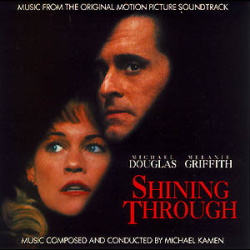
SHINING THROUGH – Michael Kamen
 THROWBACK THIRTY
Original Review by Jonathan Broxton
Shining Through is an old-fashioned World War II spy thriller with a romantic undercurrent, written and directed by David Seltzer, based on the novel by Susan Isaacs. The film stars Melanie Griffith as Linda Voss, a clerk in a New York law office, who gets swept up into a world of espionage and intrigue when her employer, attorney Ed Leland (Michael Douglas), discovers she speaks German. Ed is secretly a colonel in the OSS, and he enlists Linda for an important assignment: she is to travel to Berlin and, while posing as a member of the household staff of a Nazi officer, steal top-secret plans for a missile weapon the Germans are developing. The film co-stars Liam Neeson, Joely Richardson, and John Gielgud, and has excellent technical pedigree, but unfortunately was a critical flop and a commercial disaster: critic Roger Ebert wrote that Shining Through was “such an insult to the intelligence that I wasn’t able to suspend my disbelief … scene after scene is so implausible that the movie kept pushing me outside and making me ask how the key scenes could possibly be taken seriously”. As such, the film is mostly forgotten today, a footnote in the careers of its three main stars. Read more…
Under-the-Radar Round Up 2021, Part 7
 Original Reviews by Jonathan Broxton
2021 is over and, as the world of mainstream blockbuster cinema and film music continues to recover from the COVID-19 Coronavirus, I again urge people to look beyond the confines of mainstream Hollywood to find the best film music being written. As such, I now present the seventh and final part of my final group of reviews looking at the best “under the radar” scores from around the world – the five titles included here again represent some of the best film music heard this year, and include a historical drama from Malta, a big-screen reboot of a beloved Japanese-Spanish children’s animated series from the 1980s, a sweeping British natural history documentary, a Norwegian Christmas fantasy-comedy, and a documentary from Iran with a score by one of 2021’s breakthrough composers.

Shop at the Movie Music UK Store

Member of the

 MOVIE MUSIC UK