Golden Globe Winners 2014
 The Hollywood Foreign Press Association (HFPA) have announced the winners of the 72nd Golden Globe Awards, honoring the best in film and American television of 2014.
In the Best Original Score category Icelandic composer Jóhann Jóhannsson won the award for his score for The Theory of Everything. In his acceptance speech, Jóhannsson said:
“Well, this is a great honor. When you’re given material like The Theory of Everything to work with it feels like my job is very easy. A great script, wonderful performances, and all expertly directed by James Marsh who I want to thank especially for inviting me to be a part of his team. I want to thank the Hollywood Foreign Press, I want to thank Eric Fellner and Tim Bevan, Working Title, Universal, Focus Features, my wonderful team, Tim Hughes, and Kevin Korn and all at GSA, my family in Iceland and Denmark, and I want to share this with the musicians and technicians who helped create the score. Thank you so much.”
The other nominees were Alexandre Desplat for The Imitation Game, Trent Reznor and Atticus Ross for Gone Girl, Antonio Sánchez for Birdman, and Hans Zimmer for Interstellar.
In the Best Original Song category, the winners were John Legend and Lonnie Rashid Lynn Jr. (aka Common) for their song “Glory” from the civil right drama Selma.
The other nominees were Elizabeth Grant (aka Lana Del Rey) for “Big Eyes” from Big Eyes, Greg Kurstin, Sia Furler and Will Gluck for “Opportunity” from Annie, Patti Smith and Lenny Kaye for “Mercy Is” from Noah, and Ella Yelich-O’connor (aka Lorde) for “Yellow Flicker Beat” from The Hunger Games: Mockingjay, Part I.
BAFTA Nominations 2014
 The British Academy of Film and Television Arts (BAFTA) has announced the nominations for the 68th British Academy Film Awards, honoring the best in film in 2014.
In the Best Original Music category, which is named in memory of the film director Anthony Asquith, the nominees are:
- ALEXANDRE DESPLAT for The Grand Budapest Hotel
- JÓHANN JÓHANNSSON for The Theory of Everything
- MICA LEVI for Under the Skin
- ANTONIO SÁNCHEZ for Birdman
- HANS ZIMMER for Interstellar
These are the first BAFTA nominations for Jóhannsson, Levi, and Sánchez. It is the 7th BAFTA nomination for Desplat, who won the award in 2011 for his score for The King’s Speech, and the 7th BAFTA film nomination for Zimmer.
The winners of the 68th BAFTA Awards will be announced on February 8, 2015.
Under-the-Radar Round Up 2014, Part 3
 Original Reviews by Jonathan Broxton
My third article in my Review of the Year 2014 looks at the Best Scores from Poland and Eastern Europe. It has been exciting to watch the emergence of several young, talented Polish composers over the last few years, as the ‘old guard’ of composers like Wojciech Kilar and Zbigniew Preisner pass the film music torch onto the next generation. This year’s crop of scores from the European continent’s eastern edge includes two scores examining the subject of the 1944 Warsaw Uprising from different musical points of view, the score for the top-grossing film at the Polish box office in 2014, and an excellent multi-national fantasy score from Russia, written by a Spaniard!
Under-the-Radar Round Up 2014, Part 2
Original Reviews by Jonathan Broxton
I’m pleased to present the latest installment in my on-going series of articles looking at the best under-the-radar scores from around the world.
This article, the second of 2014, looks at four of the best scores from Italy. Italian cinema doesn’t quite have the same level of acclaim and popularity as it did in the past, and the glory days when composers such as Ennio Morricone, Pino Donaggio, Nino Rota, and Riz Ortolani dominated the country’s film music scene appear to be mostly over; meanwhile, several of today’s most prominent Italian composers, including Dario Marianelli, Carlo Siliotto, and Nicola Piovani, tend to work primarily on non-Italian projects.
Ironically, some of the most promising Italian film music being written today appears to be for television, and three of the four scores featured here originated on the small screen: Stefano Caprioli’s Furore: Il Vento della Speranza and I Segreti di Borgo Larici, both of which showcase his rich, classical, strongly thematic style, and Andrea Farri’s Le Mani Dentro la Città, an excellent example of contemporary action-thriller scoring which blends orchestra and electronics without allowing the latter to overwhelm the former. The final score is Alexander Cimini’s Red Krokodil, a stunningly beautiful and unexpectedly symphonic accompaniment to a dark and disturbing art-house drama, and one which earmarks Cimini as “a composer to watch.”
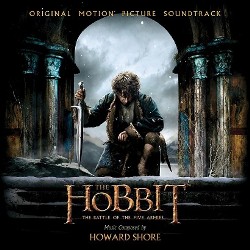
THE HOBBIT: THE BATTLE OF THE FIVE ARMIES – Howard Shore
 Original Review by Jonathan Broxton
And so, at last, after an astonishing 13-year trip across Middle Earth in the company of director Peter Jackson, through three Lord of the Rings films and two Hobbit films, we come to the conclusion of the saga with The Battle of the Five Armies, the third and final film based on J.R.R. Tolkien’s classic fantasy story The Hobbit. The film picks up immediately where the second film in the trilogy, The Desolation of Smaug, left off last year, with the hobbit Bilbo Baggins (Martin Freeman) and his dwarf cohorts looking on helplessly as the dragon Smaug (Benedict Cumberbatch), having emerged from under the mountain of Erebor, decimates the city of Laketown, before finally being brought down by the brave Bard (Luke Evans). In the aftermath of the devastation, the survivors of Laketown regroup in the ancient city of Dale, while the newly-crowned dwarfish king Thorin Oakenshield (Richard Armitage) jealously guards his new wealth from inside his impregnable stronghold. However, news of Smaug’s death quickly spreads across Middle Earth, and before long numerous different armies are massing outside Erebor’s gates, each claiming a valid right to the treasure inside, or having insidious ulterior motives of conquest and destruction. Read more…
Under-the-Radar Round Up 2014, Part 1
Original Reviews by Jonathan Broxton
I’m pleased to present the latest installment in my on-going series of articles looking at the best under-the-radar scores from around the world.
This article, the first of 2014, explores seven outstanding scores from recent months, including an epic Japanese historical television drama about the life of a brilliant military strategist navigating the turbulent world of 16th-century feudal Japan, a Vietnamese drama-thriller about an aging actress whose desperate attempt to restore her fading beauty leads to tragedy and a sinister cover-up, an inspirational Taiwanese sports drama telling the true story of a multicultural high school baseball team that overcame enormous odds to compete for the Japanese national championship in 1931, a Vietnamese supernatural thriller about a young heart-transplant recipient haunted by visions connected to the mysterious family of her donor, a spectacular Japanese period action film in which a former assassin is called upon to prevent a ruthless enemy from overthrowing the newly established Meiji government, a somber samurai revenge drama about a loyal warrior who spends thirteen years hunting the men responsible for his master’s death, and a beautiful Studio Ghibli animated drama about a lonely young girl whose friendship with the mysterious Marnie gradually reveals an unexpected connection to her own past.
Already in 2014 I have reviewed Christopher Young’s magnificent score for the Chinese epic fantasy adventure The Monkey King, and Jo-Yeong Wook’s score for the revisionist samurai action film Kundo: Age of the Rampant. You can read my review of The Monkey King here, my review of Kundo: Age of the Rampant here.
EXODUS: GODS AND KINGS – Alberto Iglesias, Harry Gregson-Williams, Federico Jusid
 Original Review by Jonathan Broxton
Ridley Scott’s epic version of the biblical exodus story, Exodus: Gods and Kings, is lavish film making on an enormous scale. Based on the tale of Moses and his efforts to liberate the people of Israel from slavery under an Egyptian pharaoh, it stars Christian Bale as Moses, Joel Edgerton as the pharaoh Ramses, John Turturro, Aaron Paul, Sigourney Weaver and Ben Kingsley. Scott’s version is more rooted in historical realism than Cecil B. DeMille’s 1956 epic The Ten Commandments, but the film still covers all the major bases of the story: Moses and Ramses growing up together as brothers, the burning bush through which Moses communicates with God, the plagues which attack Egypt when Ramses refuses to free the slaves, the parting of the Red Sea, and the writing of the Ten Commandments. Visually, the film is a triumph, depicting the glory and opulence of ancient Egyptian civilization in majestic detail, but dramatically the story flounders occasionally, and some great actors – especially Paul, Weaver, and Tara Fitzgerald – are woefully underused. Read more…
BIRDMAN – Antonio Sánchez
 Original Review by Jonathan Broxton
Birdman is an unusual dark comedy/drama about the existential crisis of an actor, directed by Mexican filmmaker Alejandro González Iñárritu. In what is possibly the most perfect piece of casting ever, Michael Keaton plays Riggan Thompson, the star of a series of popular 1980s super-hero films, who after a period of career doldrums is trying to reinvent himself as a serious dramatic actor by staging a play in an off-Broadway theater. The play is being produced by Riggan’s best friend/lawyer Jake (Zach Galifianakis), and stars Riggan’s slightly unbalanced girlfriend Laura (Andrea Riseborough), nervous first-time-Broadway-actress Lesley (Naomi Watts), and critically acclaimed thespian Mike Shiner (Edward Norton), whose genuine talent is almost eclipsed by his raging ego, and who has taken a liking to Riggan’s daughter/assistant Sam (Emma Stone). Behind the scenes, Riggan is taunted by hallucinatory visions of his Birdman character, making him increasingly paranoid and self-critical, while problems with the rest of the production threaten to send it spiraling out of control. Read more…
Golden Globe Nominations 2014
 The Hollywood Foreign Press Association (HFPA) have announced the nominations for the 72nd Golden Globe Awards, honoring the best in film and American television of 2014.
In the Best Original Score category, the nominees are:
- ALEXANDRE DESPLAT for The Imitation Game
- JÓHANN JÓHANNSSON for The Theory of Everything
- TRENT REZNOR and ATTICUS ROSS for Gone Girl
- ANTONIO SÁNCHEZ for Birdman
- HANS ZIMMER for Interstellar
These are the first major film music award nominations for both Jóhannsson and Sánchez, although Sánchez has won four Grammy awards for his work as a jazz musician. This is the 7th nomination for Desplat, who won the Globe in 2006 for The Painted Veil, the 3rd nomination for Reznor and Ross, who won the Globe in 2010 for The Social Network, and the 12th nomination for Zimmer, who previously won Globes for The Lion King in 1994 and Gladiator in 2000.
In the Best Original Song category, the nominees are:
- ELIZABETH GRANT (LANA DEL REY) for “Big Eyes” from Big Eyes
- GREG KURSTIN, SIA FURLER and WILL GLUCK for “Opportunity” from Annie
- JOHN LEGEND and LONNIE RASHID LYNN Jr. (COMMON) for “Glory” from Selma
- PATTI SMITH and LENNY KAYE for “Mercy Is” from Noah
- ELLA YELICH-O’CONNOR (LORDE) for “Yellow Flicker Beat” from The Hunger Games: Mockingjay, Part I
The winners of the 72nd Golden Globe Awards will be announced on January 11, 2015.
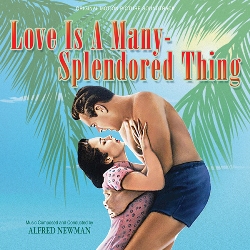
LOVE IS A MANY-SPLENDORED THING – Alfred Newman
 MOVIE MUSIC UK CLASSICS
Original Review by Craig Lysy
Buddy Adler, the Production Head of Fox Studios saw money to be made by the hit novel “A Many Splendored Thing” by Han Suyin. He purchased the film rights an hired trusted screenwriter John Patrick to adapt it for the big screen. The story offers a potent commentary on an inter-racial romance set in Hong Kong during the waning days of the 1940s. American reporter Mark Elliot (William Holden), who is estranged from his wife, falls passionately in love with widowed Eurasian doctor Han Suyin (Jennifer Jones). For a short time they manage to find happiness together, but events soon overtake them. Mark’s wife refuses his request for a divorce, and their romance precipitates a palpable prejudice from both her family and Hong Kong society. Han is eventually ostracized from the community and loses her position at the hospital. As Mark ships out to cover the Korean War they desperately write each other in hope of maintaining a connection and salvaging their relationship, but alas, it is to no avail as Mark gets killed during the war. Han does not relent in her love and the story ends with her visiting the green hill where they used to meet. The film was both a commercial and critical success, earning eight Academy Awards nominations, winning three for Best Costume Design, Best Song and Best Score. Read more…
Manuel De Sica, 1949-2014
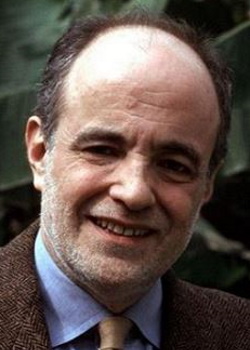 Composer Manuel De Sica died in Rome on December 5, 2014, at the age of 65, following a heart attack.
The son of legendary director Vittorio De Sica and Spanish actress María Mercader, he established an identity independent of his celebrated family through a career encompassing more than 70 film scores, television music, concert works and popular songs. His best-known films included The Garden of the Finzi-Continis, The Icicle Thief, Al lupo Al lupo, Cemetery Man, and Celluloide.
Manuel De Sica was born in Rome on February 24, 1949. He studied music from childhood and attended the Conservatory of Santa Cecilia, where his teachers included the influential modernist composer Bruno Maderna. Although surrounded by cinema—his father was one of the defining figures of Italian neorealism—De Sica initially pursued music on its own terms, developing interests in both classical composition and contemporary popular styles. In 1969 he formed the pop group The Ancients, with whom he appeared on Italian television.
His entrance into film music nevertheless came through his father. De Sica made his feature debut at just 19 with A Place for Lovers (1968), starring Faye Dunaway and Marcello Mastroianni. Their most important collaboration followed with The Garden of the Finzi-Continis (1970), Vittorio De Sica’s acclaimed adaptation of Giorgio Bassani’s novel about an aristocratic Jewish family living under Fascism. Manuel’s elegant, melancholy score brought him international attention and a Grammy nomination, while the film itself won the Academy Award for Best Foreign Language Film. Read more…
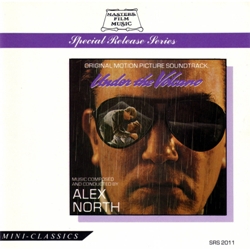
UNDER THE VOLCANO – Alex North
 THROWBACK THIRTY
Original Review by Jonathan Broxton
Under the Volcano is a critically-acclaimed drama based on the important novel by Malcolm Lowry. Set against the backdrop of imminent war in Europe, and taking place on the Mexican fiesta celebrating the Day of Dead, the film follows one day in the life of Geoffrey Firmin, a British consul living in alcoholic disrepair and obscurity in a small southern Mexican town in 1939. The film was one of the last directed by the legendary John Huston, and starred Albert Finney as Geoffrey, Anthony Andrews as his idealistic half-brother Hugh, and Jacqueline Bisset as his ex-wife, Yvonne, who has returned to Mexico with hopes of healing Geoffrey and their broken marriage. Lost amid the blockbusters of the period, the film is largely forgotten today, despite its stellar credentials, and despite its multiple Award nominations, which included Oscar recognition for Finney’s leading role, and for its score by the great Alex North. Read more…
BERNARD HERRMANN – Fathers of Film Music, Part 7
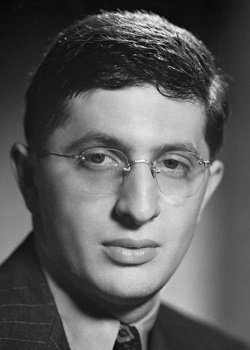 Article by Craig Lysy
Born: 29 July 1911, New York, New York.
Died: 24 December 1975
“Near the snow, near the sun, in the highest fields. See how these names are feted by the waving grass, and by the streamers of white cloud, and whispers of wind in the listening sky… The names of those who in their lives fought for life, who wore at their hearts the fire’s center. ”
Herrmann carried this excerpt from a poem by Stephen Spender in his wallet his entire life. Within its words are found the burning nexus of this remarkable man.
Bernard Herrmann was born in New York City, the first of three children by Abraham and Ida Herrmann, one of many Jewish families that fled the Tsarist Russian pogroms of the 1880s. His father inculcated Bernard with a love and appreciation of the arts, taking him to the opera as well as having him tutored in the violin. His artistic gift manifested early when he won a composition prize at the age of thirteen. He decided early in life to concentrate on music and so after high school enrolled at New York University. Read more…
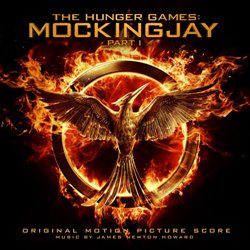
THE HUNGER GAMES: MOCKINGJAY, PART I – James Newton Howard
 Original Review by Jonathan Broxton
The third movie in the massively popular Hunger Games franchise based on the novels by Suzanne Collins, Mockingjay is the first part of the epic finale to the story of Katniss Everdeen and her efforts to overthrow the cruel and corrupt government of Panem. It picks up immediately after the events of the second film, Catching Fire, and finds Katniss, having destroyed the hunger games dome built to stage the ‘quarter quell’, being rescued by the rebels and taken to District 13, the stronghold previously thought to be in ruins, but which is actually under the control of rebel leader Alma Coin. Katniss’s actions have instigated an uprising in the other districts, inspiring the ruthless President Snow to retaliate with sadistic military action; not only that, Snow has taken Katniss’s friend Peeta Mullark prisoner, and is using him to spread propaganda against Katniss. The film stars Jennifer Lawrence, Josh Hutcherson, Liam Hemsworth, Woody Harrelson, Elizabeth Banks, Julianne Moore, Philip Seymour Hoffman, Jeffrey Wright, Stanley Tucci, and Donald Sutherland, is directed by Francis Lawrence, and sees composer James Newton Howard returning for the third time. Read more…
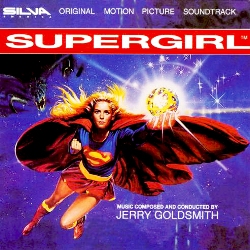
SUPERGIRL – Jerry Goldsmith
 THROWBACK THIRTY
Original Review by Jonathan Broxton
Supergirl was envisaged as a spin-off, capitalizing on the enormous success of the Christopher Reeve Superman franchise. Originally created in 1959 by Otto Binder and Al Plastino, the character was a popular but under-utilized member of the DC Comics family until this, her first big-screen appearance in 1984. Directed by Jeannot Szwarc from a screenplay by David Odell, the film starred Helen Slater as Clark Kent’s cousin Kara, an inhabitant of Argo City, the last surviving remnant of the planet Krypton following its destruction in the first reel of Superman: The Movie. When Kara’s teacher and mentor Zaltar (Peter O’Toole) accidentally allows a special and exceptionally powerful jewel called the Omegahedron to travel to Earth, Kara follows it, intending to retrieve it and bring it home; once there, she finds she has acquired powers similar to that of her cousin, which she must use to stop an evil witch named Selena (Faye Dunaway), who has found the Omegahedron and intends to use it to increase her powers. Read more…

Shop at the Movie Music UK Store

Member of the


