ANT-MAN – Christophe Beck
 Original Review by Jonathan Broxton
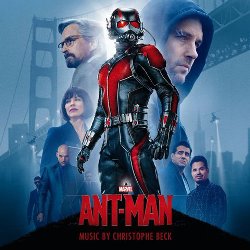
A wholly unlikely new addition to the Marvel Cinematic Universe, Ant-Man is the latest super hero film to hit the silver screen. Originally created by Stan Lee, Larry Lieber and Jack Kirby for the comic ‘Tales to Astonish’ in 1962, this first big-screen adventure for the character focuses on cat burglar Scott Foley, whose efforts to put aside his life of crime are stymied by his inability to hold down a regular job, jeopardizing his relationship with his daughter Cassie. Talked into committing “one last job” by his former cellmate Luis, Scott breaks into a house to steal a safe, unaware that the house belongs to scientist and inventor Hank Pym, who has created a suit which will shrink the wearer down to the size of an ant, while simultaneously giving him super-human powers. Unbeknownst to Scott, Pym – who became the original Ant-Man in 1963 – has manipulated events so that he can convince Scott to become a new Ant-Man, and help him retrieve the shrinking technology from his former protégé, the ruthless Darren Cross, who has stolen it, and intends to it sell to agents of Hydra. The film is directed by Peyton Reed, stars Paul Rudd as Foley, Michael Douglas as Pym, Corey Stoll as Cross, and Evangeline Lilly as Pym’s daughter Hope Van Dyne, and has an original score by Christophe Beck. Read more…
SILVERADO – Bruce Broughton
 THROWBACK THIRTY
Original Review by Jonathan Broxton
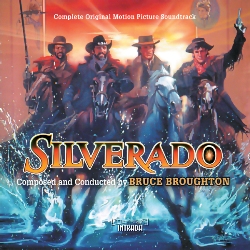
Despite being the quintessential genre of American cinema, the western often goes through periods of decline, lulls in production where very few films of quality are produced by Hollywood. The early 1980s was one of those periods when cowboys were seemingly out of fashion, having been tainted by the overblown budget and massive failure of Heaven’s Gate at the box office in 1980. It would take five years for someone to take a gamble on another one, but two came out in the summer of 1985 – Clint Eastwood’s introverted and introspective Pale Rider, and Lawrence Kasdan’s more traditionally adventurous Silverado. With an all-star cast of talented character actors including Kevin Kline, Scott Glenn, Kevin Costner, Jeff Goldblum, Brian Dennehy, Danny Glover, Linda Hunt, and even John Cleese, the film follows the escapades of four drifters who become unlikely friends and find themselves in the small town of Silverado, New Mexico, caught in the middle of a land war between open range cowboys and homesteading farmers, and dealing with individual demons from their own past. The film was a modest financial success, taking $32 million at the box office, and was generally well received at the time, but as the years have gone by Silverado is now looked on more favorably, and is considered a turning point in the revitalization of the genre. Read more…
I AM BIG BIRD: THE CAROLL SPINNEY STORY – Joshua Johnson
 Original Review by Jonathan Broxton
Sesame Street was one of the few American kid’s TV shows that aired in the United Kingdom when I was a child, so I grew up being very familiar with its cast of characters, both human and muppet. While that lovable ball of red fuzz Elmo is undoubtedly the star of the show these days, for many years the center of attention was Big Bird, the eight-foot tall yellow creature who has the innocence and inquisitiveness of a six year old child. Since the character first debuted on the show in 1969 he has been played by Caroll Spinney, a master puppeteer and artist. Now 81 years old, Spinney is the subject of this new documentary feature from directors Dave La Mattina and Chad Walker, which charts Spinney’s life, from his early years growing up in Massachusetts, to the beginnings of his friendship with Jim Henson, and his work on the Street controlling both Big Bird and Oscar the Grouch. Read more…
ANTHONY ADVERSE – Erich Wolfgang Korngold
 GREATEST SCORES OF THE TWENTIETH CENTURY
Original Review by Craig Lysy
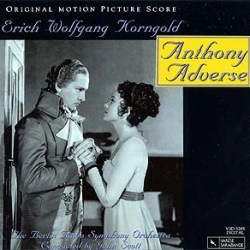
Warner Brothers Studio was in the market for a period piece romance and found its inspiration in Harvey Allen’s massive 1200 page novel “Anthony Adverse” (1933), paying an amazing $40,000 for the screen rights. Veteran director Mervyn LeRoy was hired to manage the project with Sheridan Gibney and Milton Krims tasked with adapting the mammoth novel for the big screen. The stellar cast included Frederic March as Anthony Adverse, Olivia de Havilland as Angela Giuseppe, Donald Woods as Vincent Nolte, Anita Louise as Maria Bonnyfeather, Edmund Gwenn as John Bonnyfeather and Claude Rains as Marquis Don Luis. Read more…
MAD MAX BEYOND THUNDERDOME – Maurice Jarre
 THROWBACK THIRTY
Original Review by Jonathan Broxton
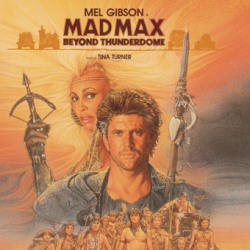
The third in director George Miller’s series of Mad Max movies, Beyond Thunderdome once again starred Mel Gibson and continued the adventures of the former Australian Highway Patrol officer Max Rockatansky, as he tries to survive in a post-apocalyptic society. Fifteen years after the events of Mad Max II, Max finds himself in Bartertown, a vicious society of scavengers and opportunists overseen by the ruthless Aunty Entity, played by Tina Turner. In exchange for returning to him his vehicle – which she has scavenged – she forces him in to conflict with Master Blaster, a dwarf and his hulking masked bodyguard, who control Bartertown’s fuel supply; to resolve the conflict, Max finds himself taking part in gladiatorial games inside the ‘thunderdome’, an enormous metal arena where people duel to the death. The film was an enormous success – the highest grossing film of the original trilogy – and further cemented Mel Gibson’s box office bankability as a leading man; his next film would be the smash hit buddy-cop action movie Lethal Weapon, two years later. Read more…
POLDARK – Anne Dudley
 Original Review by Jonathan Broxton
Poldark is one of those British period romantic dramas that the BBC does so well. Based on the series of historical novels by Winston Graham, this is actually the second adaptation of the story made by Auntie Beeb, following the massively popular and successful series starring Robin Ellis and Angharad Rees which first began airing in 1975. The stories follow the fortunes of Ross Poldark, a British Army officer who returns to his home in Cornwall from the American Revolutionary War only to find that his fiancée, Elizabeth Chynoweth, having believed him dead, is about to marry his cousin Francis. Ross attempts to restore his own fortunes by reopening one of his family’s long-derelict tin mines, and after several years he marries Demelza Carne, a poor servant girl, and gradually comes to terms with the loss of Elizabeth’s love. However, as is always the case with stories such as these, the course of true love never runs smooth, and the dramatic saga of the Poldark family continues across the generations. The show stars Aidan Turner as Poldark, Eleanor Tomlinson as Demelza, Heida Reid as Elizabeth, and Kyler Soller as Francis. Read more…
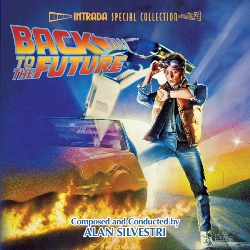
BACK TO THE FUTURE – Alan Silvestri
 THROWBACK THIRTY
GREATEST SCORES OF THE TWENTIETH CENTURY
Original Review by Jonathan Broxton
In the spring of 1985, Robert Zemeckis was a young up-and-coming director who had enjoyed some success with the Michael Douglas-Kathleen Turner adventure flick Romancing the Stone the year before, but for the most part was still largely an unknown quantity. His breakthrough came with the release of Back to the Future, a classic time-travelling comedy adventure which went on to become the biggest grossing film of the year, made Michael J. Fox a movie star, and cemented the much-derided DeLorean automobile into cinematic folklore forever. Fox stars as Marty McFly, a typical 1980s kid from suburban California, who is accidentally sent back to the year 1955 by his friend, scientist and inventor Doc Brown (Christopher Lloyd), who has built a time machine out of the aforementioned DeLorean. Stranded in time and without enough fuel to return home, Marty must seek help from the 1955 version of Doc – but, unfortunately, he inadvertently puts his own future at risk when the teenage version of his mother Lorraine (Lea Thompson) meets and develops a crush on him rather than George (Crispin Glover), the man destined to be his father… Read more…
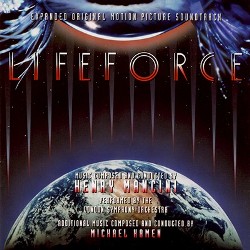
LIFEFORCE – Henry Mancini
 THROWBACK THIRTY
GREATEST SCORES OF THE TWENTIETH CENTURY
Original Review by Jonathan Broxton
What do you think of when you think of the music of Henry Mancini? The gentle romance of Breakfast at Tiffany’s? The effortlessly cool jazz of Peter Gunn or The Pink Panther? The forbidden passion of The Thorn Birds? The playful “Baby Elephant Walk” from Hatari? I’d bet my bottom dollar that most people would come up with those classics long before they thought of an epic orchestral sci-fi horror score, but that’s exactly what Mancini wrote for Lifeforce, a British-American production directed by Tobe Hooper and produced by the notorious Yoram Globus and Menahem Golan for Cannon Films. The film is a loose adaptation of Colin Wilson’s 1976 novel The Space Vampires, and stars Steve Railsback as the head of a multi-national space exploration team sent to investigate Halley’s Comet as it makes one of it’s regular 75-year passes past Earth. The team finds a space craft concealed inside the comet’s corona, and inside the space craft they find the preserved bodies of three seemingly humanoid aliens in suspended animation, including one incredibly beautiful female. However, when the space exploration team’s ship returns home, Mission Control in London finds it empty, save for the three aliens, which soon awake and begin draining ‘life force’ energies from every human they encounter. The film co-starred Peter Firth, Frank Finlay, Patrick Stewart, and Mathilda May, who spends almost the entire film completely naked; despite this obvious selling point, the film was a disaster, recouping less than half of its $25 million budget, and receiving terrible reviews from most critics of the time. Read more…
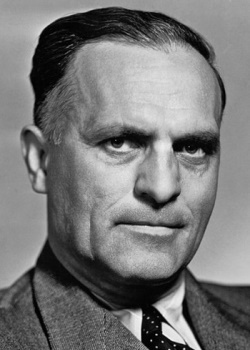
HERBERT STOTHART – Fathers of Film Music, Part 11
 Article by Craig Lysy
Born: 11 September 1885, Milwaukee, Wisconsin.
Died: 1 February 1949.
Herbert Stothart was born of Scottish and German ancestry in Milwaukee, Wisconsin, in 1885. He studied at Milwaukee Normal School with a curriculum tailored to prepare him for an academic career as a teacher of history. He helped pay for his education by working as a theatre usher, which also elicited a lifelong fascination with movies. It came to pass that he joined an Episcopal Church choir, which kindled a fervent love of music. When he entered the University of Wisconsin, he continued on this path by composing and conducting musicals for the Haresfoot Dramatic Club. His exposure to the musical arts and his extracurricular activities staging school musicals ignited in Stothart a lifelong passion for music, which would now dominate his life. His hard work paid off when one of his productions, “Manicure Shop”, was successfully staged professionally in Chicago, which opened opportunities for further musical studies in Europe. Once this occurred his career path was firmly set, and he returned to America, securing full-time employment as a composer for vaudeville and New York musical theatre. Read more…
JURASSIC WORLD – Michael Giacchino
 Original Review by Jonathan Broxton
In 1998 a 29-year-old producer and aspiring composer for Disney Interactive was hired to write the score for The Lost World: Jurassic Park, a video game spin off from the recently-released Jurassic Park sequel that had hit cinema screens the year before. The game was one of the first PlayStation console titles to feature an original live orchestral score, and the title was so successful that it led to the composer being given further video game assignments, most notably in the Medal of Honor series, and eventually prestigious TV and film scoring jobs. That composer was Michael Giacchino – the first composer to successfully blur the lines between scoring video games and theatrical movies – and, with the release of Jurassic World, his almost 20-year career has come full circle. The film is intended to be a direct sequel to the original Jurassic Park – ignoring entirely the events of The Lost World and Jurassic Park III – and is set 20 years later in the now fully-functioning, open and successful theme park that John Hammond envisaged, albeit with the events of the original film having been covered up and buried by Ingen’s PR department. Bryce Dallas Howard plays Claire Dearing, the park’s operations manager, who is visited by her two nephews Zach and Gray for a vacation. Unfortunately Claire is preoccupied with recruiting corporate sponsors for their new attraction, a genetically-modified dinosaur called Indominus Rex, and so essentially leaves the kids to their own devices in the park. Things change when Indominus apparently escapes from his paddock, and Claire calls on the park’s chief animal trainer, Owen Grady (Chris Pratt), to recapture the beast before it starts eating the tourists… Read more…
COCOON – James Horner
 THROWBACK THIRTY
GREATEST SCORES OF THE TWENTIETH CENTURY
Original Review by Jonathan Broxton
Cocoon was one of the major box-office successes of 1985, a winning combination of science fiction adventure and family drama directed by Ron Howard. The film stars Don Ameche, Wilford Brimley and Hume Cronyn as three old-timers living in a retirement community in Florida; part of their daily routine is to sneak into an unoccupied house next door and swim in its swimming pool. One day they find a number of strange, rock-like objects at the bottom of the water, but after checking them out, decide to swim there anyway; following their swim, the three geezers suddenly find themselves rejuvenated with a vigorous, youthful energy, and they share their discovery with their respective wives and lady friends, played by Gwen Verdon, Maureen Stapleton, and Jessica Tandy. However, much to the shock of the senior citizens, the ‘rocks in the pool’ turn out to be cocoons containing dozens of sick aliens, left behind by friendly extra-terrestrials centuries ago, and which were about to be returned to their home planet by their leader, Brian Dennehy, with the help of a local ship captain, played by Steve Guttenberg – until the pool was drained of its life force by the old folks. As such, the sextet of retirees must work with the aliens to help them find a way home, without revealing the secret of the pool. The film earned two Academy Awards – one for Best Supporting Actor for Don Ameche, and one for Best Visual Effects – and boasted a magnificent score by the then 32-year-old James Horner. Read more…
James Horner, 1953-2015
 Composer James Horner died on June 22, 2015, when the single-engine S-312 Tucano aircraft he was piloting crashed in the Los Padres National Forest near Santa Barbara, California. He was 61.
One of the most successful and recognizable film composers of his generation, Horner wrote music for more than 100 films during a career spanning almost four decades, including Star Trek II: The Wrath of Khan, Aliens, Field of Dreams, Glory, Braveheart, Apollo 13, Titanic, A Beautiful Mind and Avatar. His combination of sweeping melody, unusual instrumental colors, electronics and powerful orchestral writing made him one of Hollywood’s dominant musical voices of the 1980s, 1990s and 2000s.
James Roy Horner was born in Los Angeles on August 14, 1953, the son of Austrian-born production designer and director Harry Horner and his wife Joan. His father enjoyed a distinguished Hollywood career of his own, winning Academy Awards for his art direction on The Heiress and The Hustler. James began playing piano at the age of five and spent part of his youth in England, studying at London’s Royal College of Music. He subsequently returned to California, studied music at USC and continued his graduate studies at UCLA, where he also taught music theory. Initially intending to pursue a career in concert music and academia, Horner discovered film scoring after composing for student productions at the American Film Institute.
Like many important Hollywood filmmakers of his generation, Horner received his first professional opportunities from Roger Corman. His early assignments included The Lady in Red, Humanoids from the Deep and Battle Beyond the Stars (1980), the latter allowing him to write an ambitious orchestral science-fiction score on an extremely limited budget. The production also brought him into contact with future director James Cameron and producer Gale Anne Hurd, beginning relationships that would become enormously significant later in his career. Read more…
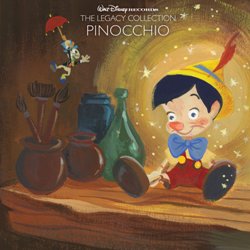
PINOCCHIO – Leigh Harline, Paul J. Smith, Ned Washington
 GREATEST SCORES OF THE TWENTIETH CENTURY
Original Review by Craig Lysy
After reading the novel “The Adventures of Pinocchio” by Carlo Collodi, Walt Disney felt it could be made into a fine Disney animated feature. When he picked up his honorary Oscar for “Snow White and the Seven Dwarfs” in 1937, he advised the Academy of his intent to bring Pinocchio to the big screen. The film became a passion project and its budget ballooned from $500,000 to $2.5 million, with several major rewrites. The voice cast included Dickie Jones as Pinocchio and (Alexander the Donkey, Cliff Edwards as Jiminy Cricket, Evelyn Venable as the Blue Fairy), Christian Rub as Geppetto, Walter Catlett as John Worthington Foulfellow the Red Fox, Charles Judels as Stromboli, Frankie Darro as Lampwick and Thurl Ravenscroft as Monstro the Whale. This film offers the classic tale of Geppetto the woodworker, who makes a wooden marionette, whom he names Pinocchio. He has no son and when he goes to bed he makes a wish that Pinocchio become a real boy. His wish is heard, and the Blue Fairy comes during his sleep, and brings Pinocchio to life, but he is not yet fully human. She advises Pinocchio that if he is brave, truthful and unselfish, he will become a real boy. She assigns Jiminy Cricket to be his conscience. Well, after a long adventure, with many struggles along the way, Pinocchio succeeds, becomes a real boy, and he and Geppetto live happily ever after. The film resonated with the public and was a commercial success. It also received critical acclaim and secured two Academy Awards for best Original Score, and Best Song “When You Wish Upon A Star”. This was the first time a film secured these two wins together. Read more…
TEXAS RISING – John Debney, Bruce Broughton
 Original Review by Jonathan Broxton
The American cable TV channels A&E and History have, in recent years, been branching out of their usual comfort zone and producing a number of epic mini-series chronicling important events or people in American history. Their first effort, in 2012, told the story of the feud between the Hatfields & McCoys that has since become part of American folklore; the second, in 2013, was a chronicle of the lives of gangsters Bonnie & Clyde, while the third, in 2014, was an extended biography of the life of magician Harry Houdini. Their latest project is a 10-hour western epic called Texas Rising, which chronicles the events of the 1835 war which led to the state of Texas breaking away from Mexico, and briefly becoming an independent nation, before becoming the 28th state of the United States. A large number of important historical events, like the battle at the Alamo, and pivotal figures from the American west, such as Davy Crockett, Daniel Boone, and Sam Houston, are depicted by director Roland Joffé, whose cast includes a who’s who of character actors, including Bill Paxton, Brendan Fraser, Ray Liotta, Kris Kristofferson, Jeffrey Dean Morgan, Crispin Glover and Jeff Fahey. Read more…
UNITED PASSIONS – Jean-Pascal Beintus
 Original Review by Jonathan Broxton
Those of you who know me will know that, in addition to film music, one of the greatest loves of my life is the sport which Americans insist on calling soccer, but which most of the rest of the world calls football. I have been a fan of the beautiful game since I was a small boy, and have followed the fortunes of my club team, Sheffield Wednesday, and the English national team for more than 30 years. Globally, the sport is run by the Fédération Internationale de Football Association, better known by its acronym FIFA, and unless you have been living under a rock recently, you will know all about the allegations regarding FIFA and charges of corruption, bribery, and alleged vote-rigging, in relation to the awarding of the 2018 and 2022 World Cups to Russia and Qatar, amongst other things. Read more…

Shop at the Movie Music UK Store

Member of the


