Archive
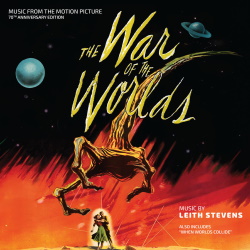
THE WAR OF THE WORLDS – Leith Stevens
 GREATEST SCORES OF THE TWENTIETH CENTURY
Original Review by Craig Lysy
In 1925 Paramount Pictures purchased the film rights to the 1897 H. G. Wells novel “War of the Worlds”. For twenty-six years the studio struggled due to technical challenges to bring the film into production under several producers – Cecil B. DeMille, Arzén Cserépy, Sergei Eisenstein, Alexander Korda, Watterson Rothacker and Alfred Hitchcock. Finally, in 1951, George Pal, who had gained success in the emerging science fiction genre with Destination Moon in 1950 and When Worlds Collide in 1951, was assigned production with a $2 million budget. Byron Haskin was tasked with directing, and Barré Lyndon would write the screenplay. Fort the cast, Pal once again went with lesser known actors, opting to maximize his budget for special effects. Gene Barry would star as Dr. Clayton Forrester, joined by Ann Robinson as Sylvia van Buren, Les Tremayne as Major General Mann, Bob Cornthwaite as Dr. Pryor, and Lewis Martin as Reverend Dr. Matthew Collins. Read more…
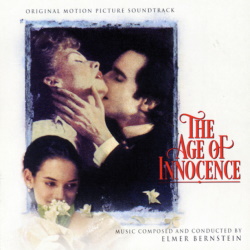
THE AGE OF INNOCENCE – Elmer Bernstein
 THROWBACK THIRTY
Original Review by Jonathan Broxton
Despite it containing almost no physical brutality whatsoever, director Martin Scorsese called his film The Age of Innocence “the most violent film he ever made”. However, unlike the blood-soaked intensity of films like Mean Streets, Taxi Driver, Raging Bull, and Goodfellas, the violence in The Age of Innocence is powerfully emotional, and it takes a heavy toll on the characters in the story. The film is a period drama adapted from the acclaimed novel by Edith Wharton, and is set in New York in the 1870s. Newland Archer (Daniel Day-Lewis), a wealthy and respected lawyer from a prominent family, becomes engaged to May Welland (Winona Ryder), a young woman from a similarly esteemed background. However, Newland’s life takes a complicated turn when May’s cousin, Countess Ellen Olenska (Michelle Pfeiffer), returns to New York after a failed marriage in Europe. Ellen’s arrival disrupts the rigid social norms and expectations of New York’s upper class, as she is seen as unconventional and a potential scandal; despite this, Newland finds himself drawn to Ellen’s free-spirited and non-conformist nature, leading to a passionate but forbidden love affair. Read more…
A HAUNTING IN VENICE – Hildur Guðnadóttir
 Original Review by Jonathan Broxton
A Haunting in Venice is the third adaptation of an Agatha Christie novel by director Kenneth Branagh, after Murder on the Orient Express in 2017, and Death on the Nile in 2022. It’s also, by quite some significant margin, the worst. It’s very loosely based on Christie’s 1969 work Halloween Party and sees the Belgian master detective Hercule Poirot living in semi-retirement in Venice, when he is convinced to attend a Halloween party by his old friend novelist Ariadne Oliver; also at this party will be a supposed psychic medium, Joyce Reynolds, and Ariadne wants Poirot to help her unmask Reynolds as a fraud. However, as the night unfolds, Poirot gets drawn into a sinister plot involving murder, hidden family secrets, and a supposed curse of ghostly children haunting the palazzo where the séance takes place. The film stars Kenneth Branagh as Poirot, Tina Fey as Oliver, and Michelle Yeoh as Reynolds, plus Kelly Reilly, Jamie Dornan, Jude Hill, and Camille Cottin in supporting roles. Read more…
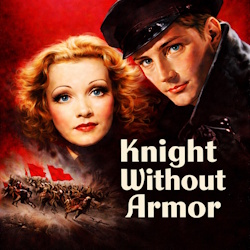
KNIGHT WITHOUT ARMOUR – Miklós Rózsa
 GREATEST SCORES OF THE TWENTIETH CENTURY
Original Review by Craig Lysy
Director Alexander Korda saw opportunity with the 1933 novel “Knight Without Armour” by James Hilton. He believed its tale of romance, intrigue and espionage during the tumult of the Russian Revolution would translate well to the big screen. His London Film Productions company would finance the film and he would oversee production with a $350,000 budget. Jaques Feder was tasked with directing, and Lajos Bíró and Frances Marion were hired to write the screenplay. A fine cast was hired, including Marlene Dietrich as Alexandra Adraxine, Robert Donat as A. J. Fothergill/Peter Ouranov, Irene Vanbrugh as Duchess, Basil Gil as Axelstein, and John Clements as Poushkoff. Read more…
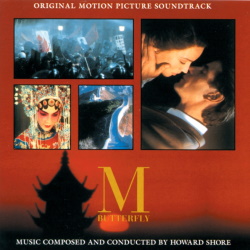
M. BUTTERFLY – Howard Shore
 THROWBACK THIRTY
Original Review by Jonathan Broxton
M. Butterfly is an epic romantic drama film directed by David Cronenberg, based on the Tony Award-winning play of the same name by David Henry Hwang, which was itself inspired by the classic opera Madam Butterfly by Giacomo Puccini. The movie tells the story of Rene Gallimard, a French diplomat stationed in China in the 1960s and 1970s, who becomes romantically involved with Song Liling, a Chinese opera singer. As the years go by, Gallimard’s career flourishes, and he becomes entangled in espionage, sharing sensitive information with Song Liling, whom he believes to be a woman. However, Gallimard remains oblivious (or, perhaps, intentionally overlooks) to the fact that Song Liling is actually a male spy working for the Chinese government; eventually, the revelation of Song’s true identity, and his espionage activities, lead to dramatic and tragic consequences for Gallimard. The film is a fascinating exploration of issues related to gender, sexuality, and East-West cultural clashes, as well as the power dynamics within their unconventional relationship. The film stars Jeremy Irons as Gallimard, and John Lone as Song, with support from Barbara Sukowa and Ian Richardson. Read more…
THE HILL – Geoff Zanelli
 Original Review by Jonathan Broxton
The Hill is a biographical sports drama directed by Jeff Celentano, which tells the true story of Rickey Hill, a young boy growing up in Texas in the early 1970s who dreams of becoming a baseball player despite wearing leg braces and suffering from a degenerative spinal disease. His father, a strict but kind pastor, tries to dissuade young Rickey from following his baseball dreams as he is worried that the physical toll of the game will result in him suffering further injuries, but Rickey persists, and eventually catches the eye of a legendary Major League Baseball scout who encourages him to try out to play for the Montreal Expos. The film was written by Angelo Pizzi – the screenwriter of such classic sports dramas as Hoosiers and Rudy – and contains many of the rousing, overcoming-the-odds touchstones that those iconic films featured. It stars Colin Ford as Rickey, who is supported by screen icons including Dennis Quaid, Scott Glenn, and Bonnie Bedelia. Read more…
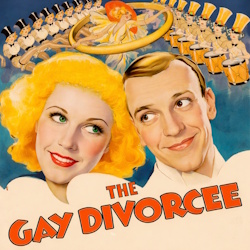
THE GAY DIVORCEE – Kenneth S. Webb, Samuel Hoffenstein
 GREATEST SCORES OF THE TWENTIETH CENTURY
Original Review by Craig Lysy
The 1933 film Flying Down To Rio starring Fred Astaire and Ginger Rogers was a huge commercial success for RKO Pictures, earning the studio a profit of $1.08 million. Pandro S. Berman, the Head of Production at RKO, decided to strike again while the iron was hot with another pairing of the duo. He chose to adapt the very successful 1932 Broadway stage musical The Gay Divorce by Dwight Taylor. He purchased the film rights but was forced to change the film title by the Hays Office censors who determined; “A divorcee might possibly be happy, but it was felt that the institution of divorce itself could never be”. Berman would manage production with a modest $520,000 budget, Mark Sandrich was tasked with directing, and George Marion Jr. and Dorothy Yost would write the screenplay. For the cast, Fred Astaire would reprise his Broadway stage role as Guy Holden, joined by Ginger Rogers as Mimi. Read more…
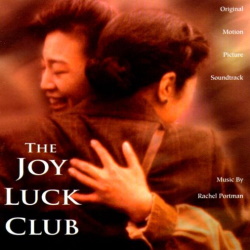
THE JOY LUCK CLUB – Rachel Portman
 THROWBACK THIRTY
Original Review by Jonathan Broxton
Anyone who has read this website for any length of time will know that one of my favorite sub-genres of film music is the ‘east/west crossover,’ meaning scores which blend a western symphonic orchestra with specialist solo instruments from China, Japan, Korea, and other East Asian cultures; instruments like the shakuhachi, shamisen, taiko drums, erhu, dizi, pipa, and so many more. There is something wholly evocative about this style to me, the way the two types of instruments complement each other, one enhancing the beauty of the other. My love of this style goes back thirty years, and was originally influenced by this score – The Joy Luck Club by Rachel Portman – which was the first east/west crossover score I consciously heard. Read more…
MIRACULOUS – LADY BUG & CAT NOIR: THE MOVIE – Jeremy Zag
 Original Review by Jonathan Broxton
Miraculous – Lady Bug & Cat Noir: The Movie is a French animated action adventure film, a big-screen adaptation of the popular animated television series Miraculous: Tales of Ladybug & Cat Noir, which was created by Thomas Astruc and Jeremy Zag and debuted in 2015. It follows two Parisian teenagers, Marinette Dupain-Cheng and Adrien Agreste, who transform into the superheroes Ladybug and Cat Noir, respectively, to protect the city from supervillains. In this story the supervillain is Hawk Moth, who is searching for a magical jewel which could help him bring his dead wife back to life; the twist in this is the fact that Hawk Moth is in reality Adrien’s father. Read more…
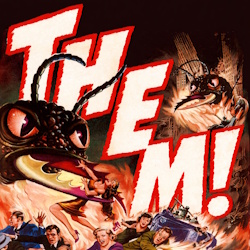
THEM! – Bronislau Kaper
 GREATEST SCORES OF THE TWENTIETH CENTURY
Original Review by Craig Lysy
The 1950s opened the flood gates to an ever-expanding and increasingly popular Science Fiction genre with films such as “Destination Moon” (1950), “The Day The Earth Stood Still (1951), “The Thing From Another World” (1951), and “The War of The Worlds” (1953). In 1954 Warner Brothers conceived a pioneering 3D-color project based on a short story by George Worthing Yates that would launch the Science Fiction sub-genre “Big Bugs”, which would feature massive insects as the monster. David Weisbert was assigned production, but executives cut his budget, abandoned a 3D-color format, insisting instead on a widescreen black and white format for the film. Ted Scerdeman and Russell Hughes were hired to write the screenplay and Gordon Douglas was tasked with directing. The cast included James Whitmore as Sargent Ben Peterson, Edmund Gwenn as Dr. Harold Medford, Joan Weldon as Dr. Pat Medford, James Arness as FBI agent Robert Graham, Onslow Stevens as General O’Brien, and Sean McClory as Major Kibbee. Read more…
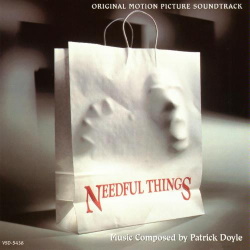
NEEDFUL THINGS – Patrick Doyle
 THROWBACK THIRTY
Original Review by Jonathan Broxton
Needful Things is a cautionary drama film with a horror-supernatural twist, directed by Fraser Heston (son of legendary actor Charlton), and based on a 1991 novel by Stephen King. The story revolves around a mysterious shop owner named Leland Gaunt (Max von Sydow), who opens a store called ‘Needful Things’ in the small town of Castle Rock, Maine. Gaunt sells various items to the townspeople, each one seemingly fulfilling their deepest desires and fantasies. However, these apparently innocent transactions come with a sinister price – they require the recipients to perform increasingly malevolent and destructive acts against their fellow townspeople. As the town becomes divided and chaos ensues, local sheriff Alan Pangborn (Ed Harris) starts to investigate the bizarre occurrences and tries to uncover the truth behind Gaunt and his shop. The film co-stars Bonnie Bedelia, J. T. Walsh, and Amanda Plummer, and was a reasonable success at the box office in the late summer of 1993, although it was less popular with critics – Roger Ebert famously compared watching it to enduring ‘Satanic water torture’. Read more…
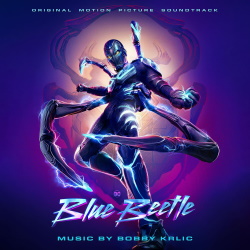
BLUE BEETLE – Bobby Krlic
 Original Review by Jonathan Broxton
There has been a lot of talk in Hollywood recently about the use of A.I. to create content. It is part of the ongoing strikes happening right now; the actors union SAG-AFTRA are concerned about digital image rights among other things, while the writers union WGA are concerned about their work being undermined by text-generating software like ChatGPT. So far the impact of A.I. on film music has been negligible, but there are certainly concerns about whether music-composing software, similar to what ChatGPT does for text, will eventually become a norm, potentially replacing human composers when it comes to creating music. The reason I’m talking about this in relation to the score for Blue Beetle is because, for perhaps the first time ever, I feel like I’m listening to a score generated by a bot. Read more…
KNIGHTS OF THE ROUND TABLE – Miklós Rózsa
 GREATEST SCORES OF THE TWENTIETH CENTURY
Original Review by Craig Lysy
The enormous commercial success of Ivanhoe in 1952 served as a catalyst for invigorating the swashbuckling costume epic. MGM executive Don Schary decided to proceed with his studio’s first film in Cinemascope with an epic retelling of the story of King Arthur and the Knights of the Round Table. He assigned production to Pandro S. Berman with a $2.6 million budget. Talbot Jennings, Jan Lustig and Noel Langley were hired to write the screenplay, adapting the 1485 tale “Le Morte d’Arthur” by Sir Thomas Malory, and Alfred Lord Tennyson’s 1859 work “Idylls of the King,” and Richard Thorpe was tasked with directing. A stellar cast was assembled, which included Robert Taylor as Sir Lancelot, Ava Gardner as Guinevere, Mel Ferrer as King Arthur, Anne Crawford as Morgan Le Fay, Stanley Baker as Mordred, Felix Aylmer as Merlin, Maureen Swanson as Elaine, Gabriel Woolfe as Sir Percival, and Robert Urquhart as Sir Gawain. Read more…
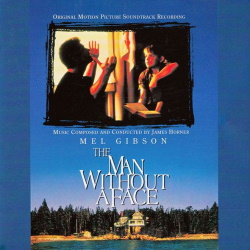
THE MAN WITHOUT A FACE – James Horner
 THROWBACK THIRTY
Original Review by Jonathan Broxton
The Man Without a Face is a drama film about the unlikely friendship between a teacher and a student, and is based on the 1972 novel of the same name by Isabelle Holland. It was the directorial debut of Mel Gibson, who also stars in the eponymous role as Justin McLeod, a former teacher who was disfigured in a car accident, leaving him with severe facial burns, and who now lives a reclusive life on an island off the coast of Maine, estranged from society due to his appearance and his emotional scars. Things change for McLeod when a teenage boy named Chuck Norstadt, who is struggling with his studies and is on the verge of flunking out of the military school he desperately wants to attend, approaches him for help with his education. Despite initial hesitation from Chuck’s mother, they form an unlikely friendship, and McLeod agrees to tutor the boy in various subjects. As the summer progresses, McLeod’s mentorship helps Chuck not only academically but also emotionally, while Chuck’s faith in McLeod starts to help him shed some of his bitterness and anger. However, rumors and misunderstandings about the ‘true nature’ of their relationship begin to circulate in the small town, leading to suspicion and hostility. The film co-stars Nick Stahl as Chuck, as well as Margaret Whitton, Fay Masterson, Gaby Hoffmann, Geoffrey Lewis, and Richard Masur. It received mostly positive reviews from critics at the time, although it is somewhat forgotten today. Read more…
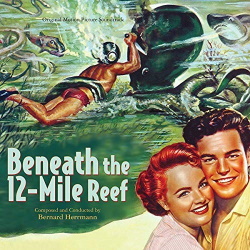
BENEATH THE 12-MILE REEF – Bernard Herrmann
 GREATEST SCORES OF THE TWENTIETH CENTURY
Original Review by Craig Lysy
20the Century Fox revolutionized the film industry in 1953 with Stereophonic Cinemascope, which was used for “The Robe” and “How to Marry a Millionaire”. To further capitalize on the new technology Darryl F. Zanuck, who was in charge of film production envisioned taking it underwater. A.I. Bezzerides was hired to write the screenplay, which would incorporate an underwater narrative and feature a love story inspired by Shakespeare’s play “Romeo and Juliet” (1597). Robert Bassler was assigned production, provided a $1.56 million budget, and Robert D. Webb was tasked with directing. The film cast would include; Robert Wagner as Tony Petrakis, Terry Moore as Gwyneth Rhys, Gilbert Roland as Mike Petrakis, Angela Clarke as Mama Petrakis, and Peter Graves as Arnold Dix. Read more…

Shop at the Movie Music UK Store

Member of the

 MOVIE MUSIC UK