Archive
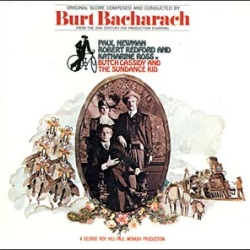
BUTCH CASSIDY AND THE SUNDANCE KID – Burt Bacharach
 GREATEST SCORES OF THE TWENTIETH CENTURY
Original Review by Craig Lysy
For screenplay writer William Goldman, “Butch Cassidy and the Sundance Kid” was a passion project. He first came upon the story of Cassidy and Longbaugh in the late 1950s, was fascinated by the men, and felt it was a story that needed to be brought to the big screen. Richard Zanuck of 20th Century Fox saw gold when he read the script and purchased the rights for an astounding $400,000! He tasked John Foreman to produce and George Roy Hill to direct. A stellar cast was brought in, which included; Paul Newman (Butch Cassidy), Robert Redford (The Sundance Kid), Katherine Ross (Etta Place), Jeff Corey (Sheriff Bledsoe, and Strother Martin (Percy Garris). Read more…
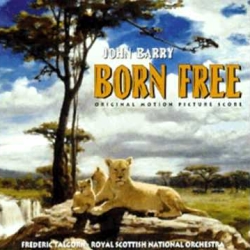
BORN FREE – John Barry
 GREATEST SCORES OF THE TWENTIETH CENTURY
Original Review by Craig Lysy
Producers Carl Forman, Sam Jaffe and Paul Radin came across the book “Born Free: A Lioness of Two Worlds” (1960) by renowned naturalist Joy Adamson, and believed her heart-warming tale could be brought to the big screen. They purchased the film rights and hired screenwriter Lester Cole to forge the screenplay. For the cast, Director James Hill brought in veteran British actors Virginia McKenna (Joy Adamson) and Bill Travers (George Adamson) to lead an ensemble, which included Geoffrey Keen (John Kendall), Peter Lukoye (Nuru), Surya Patel (the Doctor) and Geoffrey Best as (Watson). Read more…
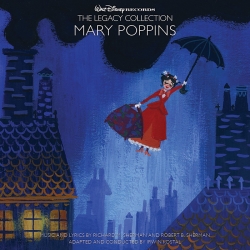
MARY POPPINS – Richard M. Sherman, Robert B. Sherman, Irwin Kostal
 GREATEST SCORES OF THE TWENTIETH CENTURY
Original Review by Craig Lysy
Walt Disney had long kept the book Mary Poppins in his office and was determined to one day bring it to the big screen for his daughters. The book series authored by P. L. Travers offered a series of fantastic tales, which unfortunately lacked a cohesive story. Disney tasked the Sherman brothers and screenplay writer Don DaGradi to create a cogent narrative. Robert Stevenson was tasked with directing the film and he secured a fine cast, which included Julie Andrews making her acting debut as Mary Poppins, Dick Van Dyke as Bert, David Tomlinson as George Banks, Glynis Johns as Winifred Banks, and Karen Dotrice and Matthew Garber the Banks children Jane and Michael. The story tells the tale of a nanny who comes to the aid of a family in disarray. She uses her magical gifts to bring back joy into the lives of the children, but to also reconnect George with his family. The movie was both a critical and commercial success earning eight Academy Award nominations, winning five for Best Actress, Best Film Editing, Best Special Effects, Best Original Song and Best Film Score. Read more…
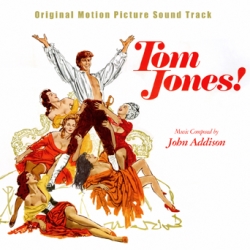
TOM JONES – John Addison
 GREATEST SCORES OF THE TWENTIETH CENTURY
Original Review by Craig Lysy
Producer and director Tony Richardson drew inspiration from an 18th century English novel “A History of Tom Jones, a Foundling”, by Henry Fielding. He hired John Osborne to adapt it to the big screen and cast the film audaciously, selecting rising star Albert Finney for the titular role. Rounding out the cast was Susannah York (Sophie Western), Edith Evans (Miss Western), Joan Greenwood (Lady Ballaston), Hugh Griffith (Squire Western) and making his film debut, David Warner as the villain Blifil. The story offers a classic period piece full of drama, treachery, seduction and intrigue. Squire Allworthy discovers an infant on his bed and chooses to raise little Tom Jones as if he were his own son. Tom’s grows up to become an attractive, dashing, and very popular young man with the ladies, It comes to pass that he falls madly in love with Sophie, who returns his affections. Yet there is an insurmountable impediment – Tom is stigmatized as a bastard, and Sophie’s father forbids her to wed a man below her station. Blifil who seeks Allworthy’s estate engineers Tom’s dishonor and dismissal by Squire Allworthy. An irrepressible Tom however is not to be denied, and he travels far and wide, all the time enjoying a multiplicity of women, fine food and drink along the way! As fate would have it he ultimately triumphs, overcoming all obstacles set against him, and earns Sophie’s hand in marriage when his true identity as Bridget’s Allworthy’s illegitimate son and Allworthy’s nephew is finally revealed. The film was both a commercial and critical success, earning an amazing ten Academy Award nominations, winning four, for Best Picture, Best Director, Best Screenplay and Best Score. Read more…
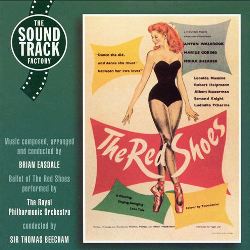
THE RED SHOES – Brian Easdale
 GREATEST SCORES OF THE TWENTIETH CENTURY
Original Review by Craig Lysy
Following their success with Black Narcissus in 1947 the directorial team of Michael Powell and Emeric Pressburger decided to adapt the fairy tale “The Red Shoes” by Hans Christian Anderson for the big screen. The story tells of the girl who dons beautiful red shoes, which danced away with her, through the streets, into a dark nether land and eventually, to her death. They created the screenplay and brought in renowned choreographer Jack Cardiff to choreograph the ballet. Powell and Pressburger sought authentic artistry for their film and so decided early on that they would use professional dancers who could act, rather than actors who could dance. They also wanted to create a realistic feeling of a ballet troupe and so included a fifteen-minute ballet as the high point of the film. Worth noting was the brilliance of the film’s cinematography, particularly its use of color. Ballerina Moira Shearer was brought in for the lead role of Vicky Page, with Marius Goring (Julian Craster) playing her love interest and Anton Walbrook (Boris Lermontov) as her ruthless authoritarian impresario. Read more…
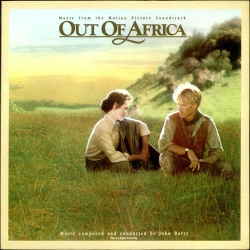
OUT OF AFRICA – John Barry
 THROWBACK THIRTY
GREATEST SCORES OF THE TWENTIETH CENTURY
Original Review by Jonathan Broxton
The winner of seven Academy Awards – including Best Picture, Best Director, Best Screenplay, and Best Cinematography – Out of Africa is generally considered one of the greatest romantic dramas in cinema history. Directed by Sydney Pollack, it is based on the semi-autobiographical writings of aristocratic Danish author Karen Dinesen, specifically the period in the 1910s when she moved to live on a coffee plantation in colonial Kenya with her then-husband, Baron Bror von Blixen-Finecke, and had an affair with a rugged and handsome big game hunter, Denys Finch Hatton. The film is a sumptuous, visually magnificent love letter to the unspoiled African savannah, reveling in the majestic vistas of the country, and using them as a backdrop to the affair Karen engages in, as her husband becomes increasingly distant and neglectful. Anchored by the three central performances of Meryl Streep as Karen, Robert Redford as Denys, and Klaus-Maria Brandauer as Bror, the film explores such challenging themes as marital fidelity, the expectations and conventions of aristocratic society, the role of women in the 1910s, and the differences between European and African tribal cultures, as well as the threat of World War I that loomed over everything. Read more…
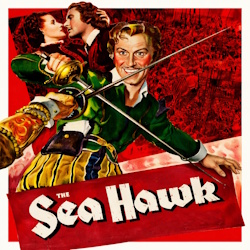
THE SEA HAWK – Erich Wolfgang Korngold
 GREATEST SCORES OF THE TWENTIETH CENTURY
Original Review by Craig Lysy
Warner Brothers Studios was very much interested in remakes of author Rafael Sabatini’s two seafaring novels The Sea Hawk (1915) and Captain Blood (1922). After acquiring the Vitagraph company, which produced the earlier Silent Era films, the studio set in motion its plan. Captain Blood (1935) was a stunning success, which propelled Errol Flynn to stardom, however the studio shelved The Sea Hawk in favor of starring Flynn in The Adventures Of Robin Hood (1938) and The Private Lives Of Elizabeth And Essex (1939). Upon completion of filming the Studio assigned Henry Blanke and Hal Wallis to produce The Sea Hawk and Michael Curtiz to direct. Howard Koch and Seton Miller were tasked with writing a swashbuckling epic to showcase Flynn’s charisma and talent. Supporting Erroll Flynn as Geoffrey Thorpe would be Henry Daniell as Lord Wolfingham, Brenda Marshall as Doña María, Claude Rains as Don José Álvarez de Córdoba, Donald Crisp as Sir John Burleson, Flora Robson as Queen Elizabeth I, Alan Hale as Carl Pitt and Una O’Connor as Miss Latham. Read more…
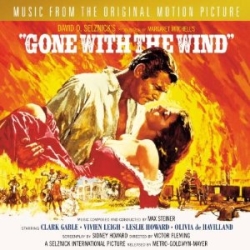
GONE WITH THE WIND – Max Steiner
 GREATEST SCORES OF THE TWENTIETH CENTURY
Original Review by Craig Lysy
Margaret Mitchell’s 1936 novel Gone With The Wind caught legendary producer David O. Selznick’s eye and he saw destiny in the making. At his bidding MGM purchased the film rights for an unprecedented $50,000. This was a passion project for Selznick and no expense would defer him from realizing his vision. Screenwriter Sidney Howard was hired to do the impossible – adapt the massive 1,037-page story to the big screen. Victor Fleming was tasked with directing and a cast that has become legend were hired including Clark Gable as Rhett Butler, Vivien Leigh as Scarlet O’Hara, Leslie Howard as Ashley Wilkes, Olivia de Havilland as Melanie Hamilton, Thomas Mitchell as Gerald O’Hara, Barbara O’Neil as Ellen O’Hara and Hattie McDaniel as Mammy. No movie to this date provided such a grand and epic sweep, and in the end six hours of film were shot, which featured thousands of actors. Read more…
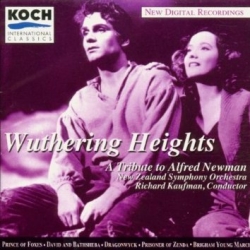
WUTHERING HEIGHTS – Alfred Newman
 GREATEST SCORES OF THE TWENTIETH CENTURY
Original Review by Craig Lysy
In 1938 studio executive Samuel Goldwyn was intent on finding a new project for his studio’s star Merle Oberon. By coincidence William Wyler was seeking financial backing for his next film, which would adapt Emily Bronte’s 1847 novel Wuthering Heights. He argued to Goldwyn that it would be a perfect tragic romantic tale to showcase Oberon’s talents. Goldwyn agreed and decided he would produce the film, with Wyler tasked with directing. He provided a generous budget and brought in screenwriters Charles MacArthur, Ben Hecht and John Huston to write the screenplay. They drew inspiration from the first sixteen chapters of the 34-chapter novel, and changed the setting from the 18th to the 19th Century. For their cast, Merle Oberon would take on the starring role of Catherine Earnshaw, joined by Laurence Olivier as Heathcliff. David Niven would play Edgar Linton and Geraldine Fitzgerald, Isabella Linton. Read more…
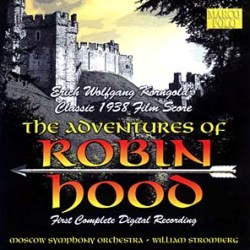
THE ADVENTURES OF ROBIN HOOD – Erich Wolfgang Korngold
 GREATEST SCORES OF THE TWENTIETH CENTURY
Original Review by Craig Lysy
In 1935 Warner Brothers Studio sought to bring an epic swashbuckling film to the big screen and William Keighley was hired to direct. Screenwriters Norman Reilly Raine and Seton Miller were brought in to write the script, for which they drew inspiration from the Medieval Robin Hood legends. A stellar cast was assembled including; Errol Flynn (Sir Robin of Locksley AKA Robin Hood), Olivia de Havilland (Lady Marian Fitzwalter), Basil Rathbone (Sir Guy of Gisbourne), Claude Reins (Prince John), Patrick Knowles (Will Scarlett), Eugene Pallette (Friar Tuck), Alan Hale Sr. (Little John) and Melville Cooper (High Sheriff of Nottingham). Read more…
ALEXANDER NEVSKY – Sergei Prokofiev
 GREATEST SCORES OF THE TWENTIETH CENTURY
Original Review by Craig Lysy
Film director Sergei Eisenstein had secured the favor of Soviet dictator Stalin with two films, which extolled the revolution and Communist party; The Battleship Potemkin (1925) and October: Ten Days That Shook The World (1928). Unfortunately, a misguided foray to the West to make films unrestrained by the demands of Soviet Realism caused him to fall out of favor. Upon returning to the Soviet Union in 1932 he was slowly rehabilitated and fortune smiled upon him when Stalin approved production of a film about Alexander Nevsky. Dimitri Vasilyev was assigned by the Ministry of Culture to keep Eisenstein on schedule and budget. The screenplay would be written by Eisenstein and Pyotyr Pavlenko. The telegenic Nikolay Cherkasov would play the titular role and be supported by Nikolay Okhlopkov as Vasili Buslaev and Andrei Abrikosov as Gavrilo Oleksich. Sergei Eisenstein made Alexander Nevsky during the dark pall of the Stalinist era. The film offers an obvious allegory on the historic Germanic-Russian animus, as well as the escalating distrust and tension felt with the Nazi regime. The story celebrates Prince Alexander Nevsky, who achieves an apotheosis, passing unto legend after he leads the armies of Holy Mother Russia to victory over the crusading Catholic Teutonic Knights. Read more…
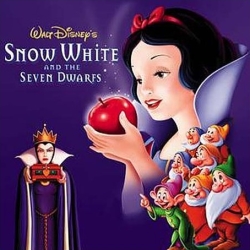
SNOW WHITE AND THE SEVEN DWARFS – Frank Churchill, Leigh Harline, Paul J. Smith
 GREATEST SCORES OF THE TWENTIETH CENTURY
Original Review by Craig Lysy
Walt Disney Productions had been very successful in producing animated short subject films such as Mickey Mouse and the Silly Symphonies. In 1934 CEO Walt Disney believed it was time to move his studio into the realm of producing feature films. To that end he resolved to inaugurate a new era by producing a feature animated film based on the fairytale of Snow White and the Seven Dwarfs by the Brothers Grimm. Disney would produce the film and he tasked screenwriter Richard Creedon and a team of seven writers to come up with the screenplay. David Hand was hired as supervising Director for a team of five directors. For the cast Adriana Caselotti would voice for the titular role. Joining her would be Lucille La Verne as Queen Grimhilde (the witch), Henry Stockwell as the Prince, Stuart Buchanan as the Huntsman, and Moroni Olsen as The Magic Mirror. For the seven dwarfs we have Roy Atwell as Doc, Pinto Colvig as both Grumpy and Sleepy, Otis Harlan as Happy, Scotty Mattraw as Bashful, Billy Gilbert as Sneezy, and Eddie Collins as Dopey. Read more…
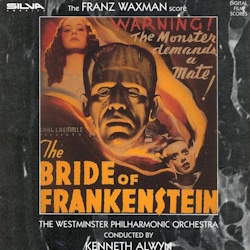
THE BRIDE OF FRANKENSTEIN – Franz Waxman
 GREATEST SCORES OF THE TWENTIETH CENTURY
Original Review by Craig Lysy
Due to the tremendous commercial success of Frankenstein in 1931, Universal Studios was highly motivated to film a sequel. However, director James Whale was not interested preferring to pursue other projects, going on to make The Old Dark House in 1932 and The Invisible Man in 1933. Ultimately, he succumbed after four relentless years of badgering, and agreed to direct The Bride of Frankenstein for release in 1935. He brought in trusted screenwriters John Balderston and William Hurlbut to write the script for “The Return of Frankenstein” and he was given a budget of $300,000. Over time the story evolved leading it to be retitled “The Bride of Frankenstein”. Boris Karloff would reprise the role of the monster, while Colin Cleve would return as Henry Frankenstein. Joining them would be Valerie Hobson as Elizabeth, Ernest Thesiger as Doctor Pretorius, Elsa Lanchester as the Monster’s bride, Glavin Gordon as Lord Byron, Douglas Walton as Percy Bysshe Shelley, Dwight Frye as Karl Glutz, and Una O’Connor as Minnie. Read more…
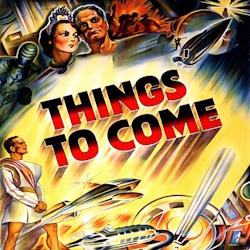
THINGS TO COME – Arthur Bliss
 GREATEST SCORES OF THE TWENTIETH CENTURY
Original Review by Craig Lysy
H. G. Wells published his novel The Shape Of Things To Come in 1933 and it immediately resonated with the public. Producer Alexander Korda was coming off the success of his last film, The Private Lives of Henry VIII, and recognized an opportunity to cash in on the popularity of Wells’s latest book. He purchased the film rights, but Wells imposed significant contractual constraints, which ensured he maintained creative control and wrote the screenplay. Korda tasked William Cameron Menzies with directing and brought in a stellar cast, which included Raymond Massey as John and Oswald Cabal, Edward Chapman as Pippa and Raymond Passworthy, Ralph Richardson as Rudolf – the Boss, Margaretta Scott as Roxana Black and Rowena Cabal, Cedric Hardwicke as Theotocopulos, Naurice Braddell as Dr. Edward Harding, Pearl Argyle as Catherine Cabal, and Sophie Stewart as Mrs. Cabal. The story paints a grim tale of a catastrophic World War, which commences in 1940 and rages for decades. After a plague pandemic in 1966 wipes out most of the populace, civilization collapses and people return to an agrarian life in small towns. It comes to pass that one day an advanced aircraft lands in one of the communities and brings news that an organization is restoring civilization to communities such as this. Civilization is reborn and an advanced society re-emerges with humanity living in grand underground cities. Yet there are those that remember the Great War, and on the eve of the first manned spaceflight to the Moon, these Luddites rebel against the new social order. The film had only modest commercial success and in the end did not cover its production costs of 260,000 pounds. Critics, however, hailed it as a masterpiece and it has served as an iconic example of thoughtful and provocative and science fiction. Read more…
KING KONG – Max Steiner
 GREATEST SCORES OF THE TWENTIETH CENTURY
Original Review by Craig Lysy
Director and screenwriter Merian Cooper awoke one night from a nightmare of a giant gorilla terrorizing New York City. The nightmare served as the catalyst for conceiving a film, which would pit the giant gorilla against a Komodo dragon and other beasts. He pitched his idea to R.K.O. executive David Selznick who saw opportunity to lift the struggling studio out of debt and tasked Cooper with both producing and directing the film. To save money he would use stop-motion animation, as well as the huge jungle stage that had been built for The Most Dangerous Ground (1932) rather than shooting on location. A screenplay was crafted by Cooper, James Creelman and Ruth Rose, which secured Selznick’s blessing. The cast would include Fay Wray as Ann Darrow, Robert Armstrong as Carl Denham, Bruce Cabot as John Driscoll, Frank Reicher as Captain Englehorn, and Noble Johnson as the native chief. The story offers a classic “Beauty and the Beast” tale, which takes place in 1932 and is set in New York City. Famed filmmaker Carl Denham has conceived his most audacious film yet, which will be shot on an isle of legend – the uncharted Skull Island where resides an enormous best of unfathomable power. He finds Ann Darrow, a young actress down on her luck and offers her a role of a lifetime, starring in his new film to be shot on an exotic South Seas island. She jumps at the opportunity and they set sail on the Venture for Skull Island. Read more…

Shop at the Movie Music UK Store

Member of the

 MOVIE MUSIC UK