Archive
PLANET OF THE APES – Jerry Goldsmith
 GREATEST SCORES OF THE TWENTIETH CENTURY
Original Review by Craig Lysy
Producer Arthur P. Jacobs sold 20th Century Fox on a bold new effort to reinvigorate the science fiction genre, which had languished since the start of the decade. The vehicle for the genre resurrection would be Pierre Boulle’s 1963 novel La Planète des Singes (Planet of the Apes). After securing the film rights Rod Serling and Michael Wilson were tasked with writing the screenplay. The technical challenges of the required prosthetic make-up delayed the film for quite some time. Fox Studios finally gave the green light to film when make-up designer John Chambers developed prosthetics flexible enough for the actors to express facial emotions. Jacobs had always seen Charlton Heston playing the lead role of John Taylor and on his request, Franklin Schaffner was hired to direct. A fine cast was assembled, which included Roddy McDowell as Cornelius, Kim Hunter as Zira, Maurice Evans as Dr. Zaius, James Daly as Honorius, Lou Wagner as Lucius, and Linda Harrison as Nova. Read more…
BULLITT – Lalo Schifrin
 GREATEST SCORES OF THE TWENTIETH CENTURY
Original Review by Craig Lysy
Steve McQueen was seeking a script for his next film and took a liking to author Robert Fish’s novel Mute Witness (1963). His production company Solar Productions purchased the film rights, and brought in Alan Trustman and Henry Kleiner to write the screenplay. He made a surprising choice to bring in English director Peter Yates after viewing the stunning extended car chase scene in his last movie, Robbery (1967). McQueen chose to change the film’s title to “Bullitt”, which based his character Frank Bullitt on real life San Francisco Inspector Dave Toschi, with who he studied as part of his training and orientation to police procedures and practices. McQueen would play the titular role, which would be a departure for him in that for the first time he would abandon his ‘rebel’ persona and join the Establishment as a police officer. To round out the cast, McQueen brought in Robert Vaughn as Walter Chalmers and Jacqueline Bisset as Cathy. Read more…
IL BUONO, IL BRUTTO, IL CATTIVO/THE GOOD THE BAD AND THE UGLY – Ennio Morricone
 GREATEST SCORES OF THE TWENTIETH CENTURY
Original Review by Craig Lysy
The commercial success of the Spaghetti Westerns A Fistful of Dollars and For A Few More Dollars caught the eyes of studio executives at United Artists. They contacted Italian screenwriter Luciano Vincenzoni, offered him a contract, and expressed a desire to purchase film rights for the next installment. The Italian creative team of producer Alberto Grimaldi, director Sergio Leone and Vincenzoni met and agreed to collaborate. They proposed a story set during the American Civil War, where three rogues join in an uneasy alliance in search of buried treasure. United Artists agreed to the storyline and provided a generous budget of $1.2 million. Vincenzoni joined with Leone, Agenore Incrocci, and Furio Scarpelli to create the screenplay that was not without controversy, in that it eschewed the traditional Americana romanticism. It instead offered a potent social commentary on capitalism, greed, as well as the destructiveness and absurdity of war. Its heroes are less pure, less righteous and more morally ambiguous, where the clear lines between hero and villain are blurred. Read more…
DOCTOR ZHIVAGO – Maurice Jarre
 GREATEST SCORES OF THE TWENTIETH CENTURY
Original Review by Craig Lysy
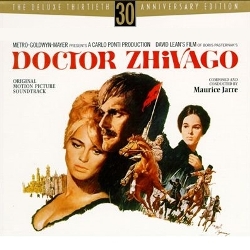
Doctor Zhivago was adapted by screenwriter Robert Bolt from the famous novel written by Boris Pasternak. The original manuscript was smuggled out of the Soviet Union in 1957 and awarded the Nobel Prize for Literature in 1958. Director David Lean recruited a stellar cast for his film that included Omar Shariff as Yuri Zhivago, Geraldine Chaplin as his wife Tonya, Rod Steiger as Viktor Komarovsky, Tom Courtenay as General Pasha Strelnikov, Alec Guinness as Yuri’s half-brother Yevgraf and finally, Julie Christie as Lara Guishar. This timeless and epic film tells the tale of young lovers drawn together by fate, caught in the cruel currents of war, clinging desperately to each other to survive amidst the clash of empires, as they bear witness to a grand romantic age succumbing to a cruel and violent new order. It is a magnificent film of sweeping and poetic grandeur for which I am eternally grateful. The film was a critical success earning 10 Oscar nominations, winning five including Best Score for Jarre. It was also a commercial success earning $112 million, more than sufficient to cover its production costs of 11 million. Read more…
GOLDFINGER – John Barry
 GREATEST SCORES OF THE TWENTIETH CENTURY
Original Review by Craig Lysy
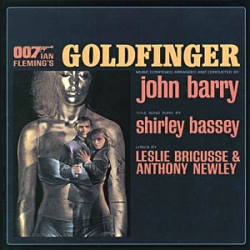
Producers Albert Broccoli and Harry Saltzman wished to capitalize on the burgeoning success of the Bond franchise, but could not proceed with the next installment “Thunderball” due to ongoing litigation between Ian Fleming and Kevin McClory over screenplay rights. As such they decided to move forward with Fleming’s next novel, Goldfinger. Guy Hamilton would return as director and was rewarded with a budget, which exceeded that of the first two Bond films combined. A fine cast was assembled, but not without significant challenges. Orson Welles was approached for the role of Auric Goldfinger, but his salary demands were too high. As such they brought in German actor Gert Frobe to play the titular role, but his poor English necessitated dubbing his lines. Sean Connery returned to reprise his role as James Bond with Honor Blackman joining as Pussy Galore, Shirley Eaton as Jill Masterson, Harold Sakata as Oddjob, Bernard Lee as Department Head M, Cec Linder as CIA liaison Felix Leiter, and Desmond Llewelyn as Q. Read more…
THE PINK PANTHER – Henry Mancini
 GREATEST SCORES OF THE TWENTIETH CENTURY
Original Review by Craig Lysy
Producer Martin Jurow of the Mirisch Company felt the time was right to bring a sophisticated comedy to the big screen. The story would involve a jewel heist, which would pit the urbane and debonair jewel thief, Sir Charles Lytton, against the hapless and bumbling Inspector Jacques Clouseau. He tasked Blake Edwards to direct the project, who then personally collaborated with Maurice Richlin to fashion a hilarious screenplay. Casting went awry as Peter Ustinov, Ava Gardner and Janet Leigh all had issues, which prevented them from joining the production. Yet Blake was an experienced director who nevertheless succeeded in assembling a fine cast, which included David Niven as Sir Charles Lytton, Peter Sellers as Jacques Clouseau, Robert Wagner as George Lytton, Claudia Cardinale as Princess Dala, Brenda De Banzie as Angela Dunning, and Capucine as Simone Clouseau. Read more…
THE FALL OF THE ROMAN EMPIRE – Dimitri Tiomkin
 GREATEST SCORES OF THE TWENTIETH CENTURY
Original Review by Craig Lysy
Director Anthony Mann of El Cid fame sought to reprise his success with another ancient epic, this time set in the waning days of the Roman Empire. He assembled a stellar cast that included Sophia Loren (Lucilla), Alec Guinness (Marcus Aurelius), Stephen Boyd (Livius), Christopher Plummer (Commodus), James Mason (Tiomedes) and Omar Sharif as Sohamus. Regretfully, the film was less epic and more a wooden documentary as it plodded through its three-hour plus running time. The story centers on the intrigue and contest for love and power in the court of Emperor Marcus Aurelius. After the emperor is assassinated, a power mad, vain and unstable Commodus assumes the throne and begins a reign of terror, ultimately banishing all who earned his disfavor including Livius, Lucilla and Tiomedes. The film was a commercial failure bringing in only 20% of its 19 million dollar production costs. The score however achieved critical success being nominated by both the Academy of Motion Pictures and The Golden Globes. Tiomkin succeeded in winning a well-deserved Golden Globe. Read more…
CLEOPATRA – Alex North
 GREATEST SCORES OF THE TWENTIETH CENTURY
Original Review by Craig Lysy
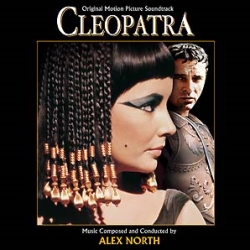
20th Century Fox had descended into financial troubles in the late 1950s due to a string of poorly performing films. They decided to regain the glory of their past by remaking one of their prior gems – the 1917 film Cleopatra . They needed a producer to bring the film to fruition, and when veteran Walter Wanger approached the studio to tell the story of Cleopatra, an astounding synergy was realized. He tasked Joseph Mankiewicz with directing, and Ranald MacDougall and Sidney Buchman joined him in fashioning the script. Mankiewicz’s original conception was to make two, three-hour films; Caesar and Cleopatra, and Anthony and Cleopatra. He was however overruled by the studio who insisted on a single film. A cast for the ages was assembled with Elizabeth Taylor playing the titular role of Cleopatra. Supporting her would be Richard Burton as Marc Anthony, Rex Harrison as Julius Caesar, Roddy McDowell as Octavian, and Martin Landau as Rufio. Read more…
HOW THE WEST WAS WON – Alfred Newman, Ken Darby
 GREATEST SCORES OF THE TWENTIETH CENTURY
Original Review by Craig Lysy
MGM Studios, in an effort to regain its former glory, embarked on a sweeping multi-generational tale, an epic story so grand in its storytelling that three directors would be needed to shoot its five vignettes. The film drew inspiration from a Life magazine photo essay titled “How the West Was Won”. Producer Bernard Smith hired James R. Webb to write a screenplay with a massive canvass and Henry Hathaway was tasked with directing three of the vignettes; The Rivers (1839), The Plains (1851) and The Outlaws (1889). John Ford would direct The Civil War (1861–1865) segment, and George Marshall would direct The Railroad (1868). A massive stellar cast was hired, which many consider to be the greatest assembly of stars ever hired for a single project; Carroll Baker as Eve Prescott, Agnes Moorhead as Rebecca Prescott, Karl Malden as Zebulon Prescott, Debbie Reynolds as Lilith Prescott, Lee Cobb as Lou Ramsey, Henry Fonda as Jethro Stewart, Carolyn Jones as Julie Rawlings, Gregory Peck as Cleve Van Valen, George Peppard as Zeb Rawlings, Robert Preston as Roger Morgan, John Wayne as General William Tecumseh Sherman, Richard Widmark as Mike King, Walter Brennan as Colonel Jeb Hawkins, Raymond Massey as President Abraham Lincoln, and Harry Morgan as General Ulysses S. Grant. Read more…
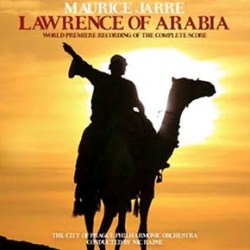
LAWRENCE OF ARABIA – Maurice Jarre
 GREATEST SCORES OF THE TWENTIETH CENTURY
Original Review by Craig Lysy
David Lean and Sam Spiegel purchased the film rights to T. E. Lawrence’s book “The Seven Pillars of Wisdom” and hired Robert Bolt to write the screenplay on the enigmatic war hero. A stellar cast was hired that included Peter O’Toole (T.E. Lawrence), Alec Guiness (Prince Feisal), Anthony Quinn (Auda Abu Tayi), Jack Hawkins (General Allenby) and Omar Sharif as Sherif Ali. The film centers on Thomas Edward Lawrence, a complex and insolent British Lieutenant assigned to Cairo during World War I. He is ordered to assess the possibility of recruiting Prince Feisal of Arabia as an ally in their struggle against the Ottoman Turks. On his own initiative he instead chooses to rally the recently defeated Arab army for an audacious trans desert assault against the port city of Aqaba. He succeeds and returns to Cairo in triumph where he is promoted and ordered to return and lead the Arab revolt. His guerrilla army harasses the Turks with surprise desert raids and train line assaults that disrupt their command and control. Along the way the war violence and his complicity in a massacre serves to plague his conscience and forever scar him. Eventually, he leads his army northward captures Damascus and helps end the control of the Ottoman Empire. With his mission complete, he is sent back to England only to die young at the age of 46 in a motorcycle accident. The film was a stunning success winning seven Academy Awards including Best Score for Maurice Jarre. Read more…
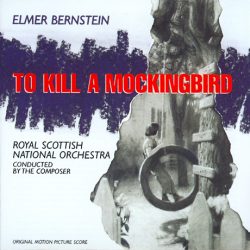
TO KILL A MOCKINGBIRD – Elmer Bernstein
 GREATEST SCORES OF THE TWENTIETH CENTURY
Original Review by Craig Lysy
Universal Studio executives saw the universal critical acclaim afforded Harper Lee’s Pulitzer Prize winning novel To Kill A Mockingbird, and purchased the film rights, determined to bring her poignant story to the big screen. The project however stalled creatively and did not gain momentum until a generous budget was allocated and producer Alan J. Pakula took the reigns. He was inspired by the project, hired Horton Foote to write the screenplay, and tasked Robert Mulligan to direct. They brought in Gregory Peck to play the leading role of Atticus Finch, and Robert Duvall secured his debut role as Boo Radley. For Atticus’ children, newcomers Mary Badham was chosen to play Scout, and Phillip Alford to play Jem. Rounding out the cast were Brock Peters as Tom Robinson, James Anderson as Bob Ewell, Cillin Wilcox as Mayella Ewell, and John Megna as Dill Harris. Read more…
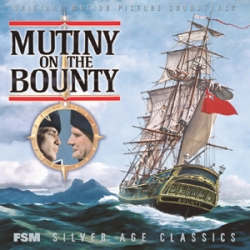
MUTINY ON THE BOUNTY – Bronislau Kaper
 GREATEST SCORES OF THE TWENTIETH CENTURY
Original Review by Craig Lysy
Following the stunning success of the remake of the epic Ben-Hur in 1959, MGM studio executives decided to draw water from the same well, accepting director John Sturges’ suggestion of a remake of their classic 1935 film Mutiny on the Bounty. Producer Aaron Rosenberg was tasked with bringing the film to fruition, and on Sturges’ advice hired Marlon Brando to provide the necessary star power. Veteran director Carol Reed was chosen to manage the film and a fine cast was hired to support Brando in his role as Lieutenant Fletcher Christian, including the renown Trevor Howard as Captain Bligh, Richard Harris as seaman John Mills, Hugh Griffith as seaman Alexander Smith, Richard Haydn as Botanist William Brown and Tarita Teripaia as Princess Maimiti. The studio granted a truly massive budget of $14 million dollars that would include local filming on Tahiti and building a $750,000 replica of the Bounty. Trouble however arose quickly due to an ever-evolving script, which included six screenplays that were rejected by the mercurial Brando. The film was to be shot over one year, but thanks to Brando’s rewrites, reshoots and prima dona tirades, Reed quit and production ended up taking three years to film! Read more…
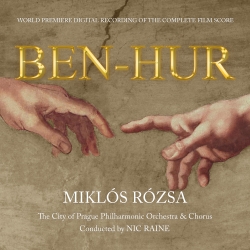
BEN-HUR – Miklós Rózsa
 GREATEST SCORES OF THE TWENTIETH CENTURY
Original Review by Craig Lysy
As a new decade dawned, MGM studio executives began searching for a grand tale to bring to the screen. They decided in 1952 to cast their lot with a remake of their epic 1925 silent film, Ben-Hur. The film’s source material would again reference Lew Wallace’s 1880 novel Ben-Hur: A Tale of the Christ. It would take six years before producer Sam Zimbalist could bring the project to fruition. It required twelve versions of the script, from four different writers, to finally satisfy the demands of director William Wyler. Casting was also challenging as over 5,000 people needed to be hired for minor roles and extras. The studio spared no expense, ultimately providing Wyler with an astounding $15 million budget. Charlton Heston secured the titular role of Judah Ben-Hur and was supported by a fine cast, which included Stephen Boyd as Messala, Jack Hawkins as Quintus Arius, Haya Harareet as Esther, Martha Scott as Miriam, Sam Jaffe as Simonides, Hugh Griffith as Sheik Ilderim, Cathy O’Donnell as Tirzah, Frank Thring as Pontius Pilate, and Finlay Currie as Balthazar narrator. Read more…
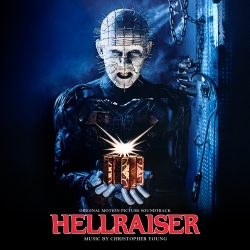
HELLRAISER – Christopher Young
 THROWBACK THIRTY
GREATEST SCORES OF THE TWENTIETH CENTURY
Original Review by Jonathan Broxton
In the early autumn of 1987 the movie world was introduced to its newest horror franchise: Hellraiser, based on the acclaimed novella ‘The Hellbound Heart’ by British author Clive Barker. It was directed by Barker himself, making his filmmaking debut, and contains sinister themes involving sexual experimentation and sadomasochism, dressed up with a darkly romantic sheen of gothic horror. The plot involves an ancient puzzle box which falls into the hands of the amoral Frank Cotton (Sean Chapman) and which, once solved, releases a group of demonic figures known as Cenobites, who then abduct and subject their unwitting victims to endless torture. Years after Frank’s disappearance his brother Larry (Andrew Robinson), Larry’s daughter Kirsty (Ashley Laurence), and Larry’s new wife Julia (Clare Higgins) move into Frank’s old house; Larry is unaware that Julia had a passionate affair with Frank before he disappeared. A common household accident results in the skinless corpse of Frank somehow being resurrected in the attic; in order to finalize his reincarnation, Frank needs a fresh supply of human blood, which the still-obsessed Julia agrees to provide. However, the Cenobites have found out about Frank’s escape from ‘hell,’ and their terrifying leader, Pinhead (Doug Bradley), resolves to bring him back – at which point Kirsty finds herself caught in the middle of the nightmare. Read more…
EL CID – Miklós Rózsa
 GREATEST SCORES OF THE TWENTIETH CENTURY
Original Review by Craig Lysy
Producer Samuel Bronston had just finished his epic film King of Kings (1961) and decided that the time was finally right to realize his long desired ambition to bring the story of El Cid to the screen. Fredric Frank, a longtime collaborator with Cecil B. DeMille, had written a brilliant story and Bronson tasked him, Philip Yordan and Ben Barzman with writing the screenplay. Anthony Mann was given the director reigns and a stellar cast was hired. Charlton Heston was cast for the titular role and joined by Sophia Loren as Doña Chimene, Herbert Lom as Ibn Yussuf, Raf Vallone as Count García Ordóñez, Geneviève Page as Doña Urraca, John Fraser as King Alfonso VI, Michael Hordem as Don Diego, and Frank Thring as Emir Al-Kadir. Controversy among the two principle actors arose when Heston found out that Loren was being paid one million dollars more than him. He became furious and his disdain leaked out into his performance. You will notice that he consistently refuses to look at Loren, even during romantic moments, which detracted from his performance and the film’s narrative. Read more…

Shop at the Movie Music UK Store

Member of the

 MOVIE MUSIC UK