THE ROCK – Nick Glennie-Smith, Hans Zimmer, Harry Gregson-Williams
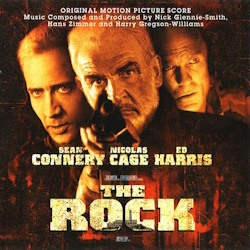 THROWBACK THIRTY
Original Review by Jonathan Broxton
One of the major summer blockbusters of 1996, The Rock is possibly the epitome of mid-1990s cinematic excess. Directed by Michael Bay and produced by Jerry Bruckheimer and Don Simpson, it is a massive action epic of ridiculous proportions, self-important and serious but also somehow incredibly good fun, and it helped solidify Bay and Bruckheimer’s hyper-kinetic, testosterone-fueled, purposefully stylized aesthetic as the default for box-office smashes for several years thereafter. The film stars Nicolas Cage as FBI chemical weapons specialist Stanley Goodspeed, who is called into action to stop General Francis Hummel (Ed Harris). Hummel is a highly decorated Marine who has become increasingly bitter over the U.S. government’s refusal to acknowledge or compensate the families of soldiers killed during covert military operations. Hummel and a group of similarly disillusioned Marines steal a cache of VX nerve gas rockets, seize control of the former prison on Alcatraz Island, and take a group of tourists hostage, threatening to launch the weapons at San Francisco unless the government pays $100 million in reparations to the dead soldiers’ families.
With conventional military options severely limited, FBI Director James Womack (John Spencer) turns to Goodspeed (Nicolas Cage), who knows everything there is to know about VX but has virtually no combat experience. To get a Navy SEAL team inside Alcatraz, however, the authorities also need the reluctant assistance of John Mason (Sean Connery), a former British intelligence operative who escaped from the supposedly inescapable prison decades earlier and has subsequently spent years incarcerated without trial. Mason agrees to help, although his own agenda – including reconnecting with his estranged daughter Jade (Claire Forlani) – quickly complicates matters. Michael Biehn, William Forsythe, and David Morse co-star in supporting roles as Hummel’s men.
 I love this movie. It’s big, it’s dumb, but it’s spectacular and engaging and always entertaining. One thing I really like about the film is that Hummel is an unusually sympathetic antagonist. He takes Alcatraz not for personal enrichment but in an attempt to force the government to honor the families of his fallen men, and while his methods – hostage-taking, theft of chemical weapons, and the threat of mass murder – are obviously indefensible, his underlying grievance is presented as entirely genuine. You don’t expect that type of moral complexity from a Michael Bay movie, and it’s one of the reasons the film works as well as it does.
One of the other things I love about The Rock is the fact that Sean Connery’s casting as the mysteriously imprisoned British intelligence operative, combined with his extraordinary survival skills, debonair confidence, and sardonic humor, has inspired the enduring fan theory that John Mason is really an aging James Bond under another name. It is not official canon, of course, but The Rock plays knowingly enough with Connery’s 007 persona that the idea is remarkably easy to entertain.
The final thing that really makes The Rock work is its score. The Rock is generally associated with Hans Zimmer, but the story is actually much more complicated: Nick Glennie-Smith was originally intended to be the principal composer, but Zimmer became heavily involved when the production sought a different direction. Harry Gregson-Williams joined to contribute additional music as the schedule tightened, and ultimately, all three men received main-composer credits. Their resulting score is now considered one of the defining early examples of the collaborative Media Ventures approach that would eventually evolve into Remote Control Productions, and its influence on Hollywood action music is difficult to overstate.
Zimmer was of course already one of Hollywood’s biggest composers, and was well-versed in the action genre, having scored films like Backdraft, Thelma & Louise and True Romance, won an Academy Award for The Lion King, and helped launch the ‘power anthem’ genre with Crimson Tide in 1995, which Jerry Bruckheimer also produced. Glennie-Smith had worked in numerous different capacities for Zimmer going all the way back to the late 1980s and the Stanley Myers era, but The Rock was his mainstream debut as a lead composer. 35-year-old Gregson-Williams, meanwhile, was very much at the beginning of his career, having recently relocated from England to Los Angeles with just a few short films and British TV movies under his belt.
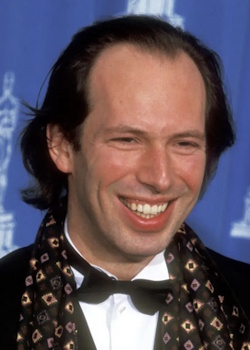 The score is built around two main recurring ideas and one minor secondary theme. The most famous is Hummel’s theme, a broad, tragic, martial melody combining solemn brass, strings, and a choir, backed by electronic textures. The music is interesting because of the way it is layered and blended so that the organic orchestral instruments and the synths are almost indistinguishable from each other; Zimmer adopted this approach in scores like Backdraft and Crimson Tide, continued it in later works like The Peacemaker, and it has always been a bone of contention for film music fans, especially symphonic purists, creating no end of controversy and discussion over the years. Similarly, the masculine ‘vowel choir’ featured prominently in those other scores and is front and center here, adding weight and earnestness to the overall palette. In my youth, I was very quick to criticize this approach but now, thirty years removed from its inception, I find myself enjoying it immensely. It has an appealing, nostalgic character that comes from a very specific era in film music history, and people who grew up on this style – as I did – may very well find themselves reacting to it with similar amounts of affection.
The second main theme is a more aggressive all-encompassing action theme, driven by clipped brass figures, surging strings, pounding percussion rhythms, and wailing electric guitars; while Mason receives a tender, Celtic-flavored melody, often carried by whistle or recorder, especially in scenes that relate to his daughter.
“Hummell Gets the Rockets” opens the score magnificently with expansive performances of Hummel’s theme and the main action theme, along with several bombastic variants. The initial military solemnity establishes Hummel’s theme with dramatic weight before pivoting into relentless action as underscore for the initial assault on the naval weapons depot. The move from elegiac brass and choir to hammering action rhythms is quintessential 1990s Media Ventures scoring, as the huge bass, metallic percussion, synth pulses and brassy ostinatos create irresistible forward motion. But there is a compelling intellectual quality to this music too, underneath all the bravado, because Glennie-Smith and Zimmer do not treat Hummel as a conventional villain. Ed Harris plays him as an honorable man who has crossed a moral line out of anger and grief, and the music often responds with a touch of real nobility.
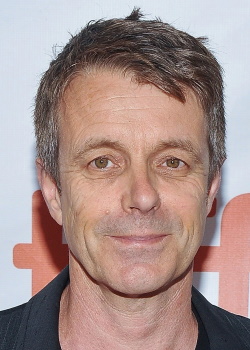 Across ten minutes of “Rock House Jail” Glennie-Smith and Zimmer move between ominous suspense, militaristic grandeur, and full-throttle action, with some of the best statements of Hummel’s material. The combination of orchestra, prominent solo trumpet, choir and electronics gives the music a real sense of scale and makes the takeover of Alcatraz an exciting, intense set piece. There is a real sense of gravitas to the statements of Hummel’s theme, especially in the scene where he inspires his men with a rousing speech, reminding them what they are fighting for, while the massive power anthem that emerges at the 4:00 mark is inspiring in all the best ways.
The pretty “Jade,” which is entirely a Nick Glennie-Smith creation, provides a welcome change of pace. Mason’s relationship with his estranged daughter allows his Celtic-tinged theme, prominently carried by pennywhistle, to emerge in its purest form, and the cue is lovely: gentle, melancholy, and unexpectedly vulnerable.
“In the Tunnels” plunges the score back into danger. Low electronic pulses, throbbing percussion, tense strings, and fragments of the action material build steadily as Mason leads the SEAL team through the passages beneath Alcatraz, intent on stopping Hummel’s plans. Once the operation disintegrates, the music becomes increasingly forceful, culminating in some exhilarating rhythmic writing, including outstanding statements of the main theme, and some notably complicated percussion patterns. The synthetic edge that Glennie-Smith and Zimmer give to the music is aggressive and very reminiscent of Zimmer’s early career work in the Black Rain vein, but in context it is exactly right.
“Mason’s Walk – First Launch” is suspenseful and dramatic, more subdued than a lot of the rest of the score, offering just the merest hints of thematic ideas in what is otherwise an extended exercise in tension-building. “Rocket Away,” at more than fourteen minutes, is essentially a miniature action symphony containing much of the climactic material, including several stirring performances of both main themes, all surrounded by scintillating action rhythms. The brass and percussion hammer away relentlessly, and the music keeps finding another gear, resulting in several easy musical thrills. The most satisfying moment comes when the bombast finally subsides and Mason’s pennywhistle theme returns, giving the whole thing a welcome injection of warmth and humanity.
“Fort Walton – Kansas” is a brief coda, presenting a relaxed romantic idea with acoustic guitar and a light rock flavor as Goodspeed’s adventure winds down. It sounds almost like another score entirely, but after so much military percussion and explosive action it works as a charming exhale, and its stylistic lightness gives the album some much-needed breathing room. The final cue, “The Chase,” is actually the work of additional music composer Don Harper and is pure adrenaline: electric guitars, hyperactive percussion, synths, orchestra, and rhythmic figures flying past at absurd speed.
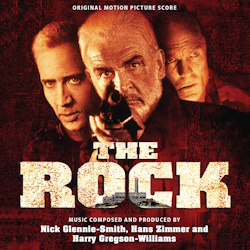 The original CD of the score for The Rock was successful enough, but in the years since its release Zimmer went on record multiple times saying how much he hated it. Finally, after many years of fan pressure, 2023 saw an expanded 2-CD release of the full score from Intrada Records, assembled and produced by Stéphane Humez of the official Hans Zimmer website. The album features the complete score in film order plus a wealth of alternates and demos for a total of more than two hours of 1990s action extravaganza goodness. The most notable new elements of the score are the additional explorations of the theme for Mason and his daughter, which add an increased level of emotional pathos to the whole thing, plus several more statements of the cool theme that is only heard in the “Fort Walton” cue on the original album. There are also several outstanding action sequences, notably the extended versions of “Haircut/Escape: The Chase!!,” “Mason Into Furnace/SEALs Tunnel–SEAL Attack,” and the incredible 16-minute “Mission’s Over/Final Attack/Finale,” which shake the walls with their power and intensity. Fans will want to seek out this significantly superior presentation immediately.
Thirty years later, The Rock remains a landmark. Its descendants became so ubiquitous that it is easy to forget how fresh this combination of orchestra, electronics, rock instrumentation and modular action writing once sounded, and how exciting it remains to this day, if you can reconcile yourself to its unique symphonic-synthetic blend. The themes are excellent, the action music is ferocious, Hummel’s material gives the score genuine dramatic weight, Mason’s theme provides a beautiful emotional counterbalance, and it is tremendous fun.
In a completely coincidental but nevertheless ironic twist, I am publishing this review just days after the sad death of lead composer Nick Glennie-Smith, who left us last weekend at the age of 74. Glennie-Smith may never have achieved the individual celebrity of Zimmer, but his contribution to the sound of modern Hollywood was substantial; the muscular excitement he gave The Rock helped shape an entire generation of blockbuster film music, and the score remains one of the defining action works of the 1990s.
Buy the Rock soundtrack from the Movie Music UK Store
Track Listing:
- ORIGINAL 1996 RELEASE
- Hummell Gets The Rockets (6:25)
- Rock House Jail (10:12)
- Jade (2:01)
- In The Tunnels (8:40)
- Mason’s Walk – First Launch (9:34)
- Rocket Away (14:25)
- Fort Walton – Kansas (1:37)
- The Chase (7:35)
- EXPANDED 2023 INTRADA RELEASE
- Opening–Naval Weapons Depot (8:07)
- Baby Gas (2:28)
- Romance I–Tour’s Over Bob (3:46)
- Hummel Speech/Alcatraz Reopened (2:25)
- Hummel’s Demands To Pentagon (1:21)
- Possible Romantic Cue (0:46)
- Mason Montage (1:26)
- San Francisco Montage (1:17)
- Interrogation–Quarter (1:28)
- Window Crash/Fairmont (2:07)
- Haircut/Escape: The Chase!! (9:21)
- Goodspeed Tracks Jade (0:50)
- Jade (1:58)
- Blueprints (1:05)
- Hummel/SEALs (7:14)
- Mason Into Furnace/SEALs Tunnel–SEAL Attack (9:24)
- Aftermath (0:51)
- Bombs (3:43)
- The Morgue (1:45)
- Indiana Jones/Fight With Marines (6:17)
- Hostage/Goodspeed Captured (5:35)
- Plasma Bomb Is Ready (0:52)
- Hammer Head (6:02)
- President’s Lament (1:59)
- Mission’s Over/Final Attack/Finale (16:19)
- Fort Walton, Kansas (1:39)
- End Titles (Hummel/SEALs) (2:14)
- SEAL Attack (Alternate Segment) (1:34) BONUS
- Fort Walton, Kansas (Alternate) (1:37) BONUS
- Main Theme Idea (Nick’s Demo Sketch) (2:36) BONUS
- Hummel Speech–Alcatraz Reopened (Demo Version) (2:24) BONUS
- Haircut / Escape: The Chase!! (Demo Version 1) (3:37) BONUS
- Haircut / Escape: The Chase!! (Demo Version 2) (8:04) BONUS
- Haircut / Escape: The Chase!! (Demo Version 3) (8:16) BONUS
- Naval Weapons Depot (Rock Mix) (4:17) BONUS
Running Time: 60 minutes 29 seconds — Original
Running Time: 134 minutes 12 seconds — Expanded
Hollywood Records HR-62062-2 (1996) Original
Intrada Special Collection ISC 491 (1996/2023) Expanded
Music composed by Nick Glennie Smith and Hans Zimmer. Conducted by Nick Glennie Smith, Bruce Fowler, and Don Harper. Orchestrations by Bruce Fowler, Dennis Dreith, Walt Fowler, Ladd McIntosh, and Suzette Moriarty. Additional music by Harry Gregson-Williams and Don Harper. Recorded and mixed by Bruce Botnick and Alan Meyerson. Edited by Bob Badami. Album produced by Nick Glennie Smith, Hans Zimmer, and Harry Gregson-Williams. Intrada expanded album produced by Stéphane Humez.
Leave a comment

Shop at the Movie Music UK Store

Member of the


One of the best soundtracks of the 90s!
Rest in peace, Nick Glennie Smith…