Archive
LA STRADA – Nino Rota
 GREATEST SCORES OF THE TWENTIETH CENTURY
Original Review by Craig Lysy
Director Federico Fellini said he conceived the story for his film La Strada from a well of melancholia. He collaborated with Tulio Pinelli and Ennio Flaiano to write the screenplay, but then struggled to find financing. Undeterred, he as director actually began filming before securing financial support as this was a passion project. Eventually Ponti-De Laurentiis Cinematografica signed on for production with Carlo Ponti and Dino De Laurentiis joining as producers. For the cast, Fellini was determined to cast Anthony Quinn as the lead and although repeatedly rebuffed, Quinn eventually agreed to take the part of Zampanó. Joining him would be Giulietta Masina as Gelsomina, Richard Basehart as Il Mato, and Aldo Silvani as Il Signor Giraffa. Read more…
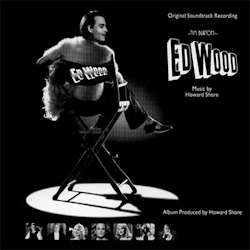
ED WOOD – Howard Shore
 THROWBACK THIRTY
Original Review by Jonathan Broxton
Edward D. Wood Jr. was an American filmmaker, actor, and writer, best known for his low-budget, unconventional films, often cited as some of the worst ever made. Despite lacking technical skill and often facing financial constraints, Wood had a passionate drive for filmmaking, and he eventually became known for two B-movies released in the 1950s: Glen or Glenda (1953), and Plan 9 from Outer Space (1959). Wood was also known for his eccentricities, including his love of angora and cross-dressing, which he incorporated into his films. Though ridiculed in his lifetime, he later gained a cult following and is now mostly celebrated for his unique, optimistic vision. Read more…
THE 4:30 MOVIE – Bear McCreary
 Original Review by Jonathan Broxton
Nostalgia for the 1980s is at an all-time high, and at the moment one of its leading proponents is writer-director Kevin Smith. He is five years older than me but, for the most part, we are both 80s kids, and we share an affinity for the movies and music of the era. His latest film, The 4:30 Movie, is an affectionate homage to that decade, a semi-autobiographical romantic comedy drama about a teenager growing up in suburban New Jersey in 1986, who spends his time sneaking into movie theaters with his friends, and embarking on his first hesitant relationship with his high school crush. It stars Austin Zajur, Nicholas Cirillo, Reed Northrup, Siena Agudong, and Ken Jeong, and has been warmly received by critics as Smith’s most personal film to date. Read more…
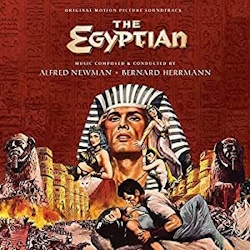
THE EGYPTIAN – Alfred Newman, Bernard Herrmann
 GREATEST SCORES OF THE TWENTIETH CENTURY
Original Review by Craig Lysy
Following the commercial success of “The Robe” in 1953, 20th Century Fox executive Daryl F. Zanuck decided to cash in with another lavish religious epic set in ancient Egypt. He was inspired by the 1945 novel “The Egyptian” by Mika Waltari, which was itself based upon the ancient 2,000-year-old Egyptian tale “Story of Sinuhe”. Zanuck purchased the film rights and personally took charge of production with a massive $3.9 million budget. He also decided that he would film with CinemaScope and DeLuxe Color. Philip Dunne and Casey Robinson were hired to write the screenplay and Michael Curtiz was borrowed from Paramount Studios to direct. A stellar cast was assembled, which included Jean Simmons as Merit, Edmund Purdom (a late replacement for Marlon Brando who quit one week before filming) as Sinuhe, Victor Mature as Horemheb, Bella Darvi as Nefer, Gene Tierney as Baketamon, Michael Wilding as Pharoah Akhenaten, and Peter Ustinov as Kaptah. Read more…
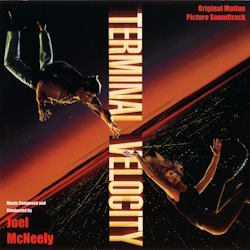
TERMINAL VELOCITY – Joel McNeely
 THROWBACK THIRTY
Original Review by Jonathan Broxton
Terminal Velocity was the first of two action movies set in the world of skydiving to hit cinema screens in 1994 (the other was the much more popular and successful Drop Zone, scored by Hans Zimmer). This film was directed by Deran C. Sarafian and starred Charlie Sheen as former Olympic gymnast-turned-daredevil skydiver Richard “Ditch” Brodie. One day a woman named Christa Morrow (Nastassja Kinski) comes to Ditch’s skydiving school asking him to teach her how to jump, but then apparently dies in a freak accident, leaving Ditch in legal trouble. Later, Ditch discovers that Christa is alive and is actually part of a complex conspiracy involving stolen gold and Russian mobsters; Christa is a former KGB agent trying to stop a group of criminals from using the gold to finance a coup in Russia. Despite the film containing some admittedly rather impressive aerial stunts and action sequences – including a pivotal scene which features Sheen falling to earth while at the wheel of a Cadillac Allanté – the film turned out to be as ridiculous as the plot suggests, and flopped badly with both critics and audiences. Read more…
Under-the-Radar Round Up 2024, Part 3
 Original Reviews by Jonathan Broxton
I’m pleased to present the latest instalment in my on-going series of articles looking at the best under-the-radar scores from around the world.
This article, the third of 2024, covers seven scores from a wide array of genres and countries: a Chinese thriller about an autistic math genius, a French historical TV mini-series, a Spanish romantic thriller, a Japanese romantic survival horror movie based on a TV show, a French action comedy, a Japanese TV series about surrogate parenting, and a French swashbuckling TV series, all of which feature superb and memorable thematic writing!
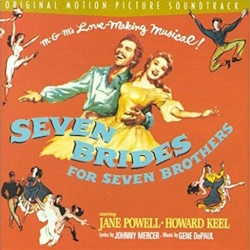
SEVEN BRIDES FOR SEVEN BROTHERS – Gene de Paul, Johnny Mercer, Adolph Deutsch, Saul Chaplin
 GREATEST SCORES OF THE TWENTIETH CENTURY
Original Review by Craig Lysy
MGM was seeking to produce another in its fine line of musicals and decided they had found their story; “The Sobbin’ Women” by Stephen Vincent Benet, which was itself derived from the ancient roman mythological tale “The Rape of the Sabine Women”. Jack Cummings was assigned production with a budget of $2.54 million. Albert Hackett, Frances Goodrich and Dorothy Kingsley were hired to write the screenplay, Michael Kidd was brought in as choreographer, and Stanley Donen was tasked with directing. For the cast of the seven brothers and their brides, we have; Howard Keel as Adam and Jane Powell as Milly, Jeff Richards as Benjamin and Julie Newmar as Dorcas, Matt Mattox as Caleb and Ruta Kilmonis as Ruth, Marc Platt as Daniel and Norma Doggett as Martha, Jacques d’Amboise as Ephraim and Virginia Gibson as Liza, Tommy Rall as Frank and Betty Carr as Sarah, and Russ Tamblyn as Godeon and Nancy Kilgas as Alice. Joining them would be Ian Wolfe as Reverend Elcott, Howard Petrie as Pete Perkins, Russell Simpson as Mr. Bixby and Marjorie Wood as Mrs. Bixby. Read more…
My Brilliant Friend: The Subtle Art of Max Richter
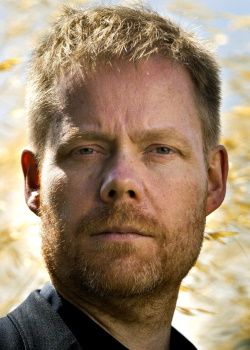 by Mark Walker
There’s a moment in the second episode of the HBO-RAI TV series My Brilliant Friend that encapsulates for me everything about the subtle art of Max Richter’s film scoring. In a pivotal sequence the two young girls, Lila and Elena, decide to venture outside of their Neapolitan ghetto for the very first time. It is, naturally, Lila’s idea. She’s the daring, wilful, feisty one; contrast with middle-of-the-road Elena, always afraid to challenge the status quo, yet irresistibly fascinated by the allure of her brilliant friend. The scene is richly symbolic and tells us much about the relationship between the pair that will develop – in the course of Elena Ferrante’s wonderful novels and in this astonishingly faithful and utterly riveting TV adaptation – throughout their lives into adulthood and old age. As the girls pass under the ominous railway bridge – a literal and metaphorical gateway to the outside world – they hold hands, they shout joyfully making echoes in the tunnel, they are excited about the journey ahead.
Richter scores all this initially with just a piano – simple arpeggios, a very simple melody, his wistful motif for Elena and Lila in fact. As the girls walk along the dusty highway, the string ensemble joins in, solemn legato chords enhance the feeling of melancholy. This seems odd at first, since the trip has begun with such apparent optimism. Then, as thunderclouds build overhead and we see Lila start to drag her feet, there’s a touch of magic – a solo violin takes over the poignant melody, soaring above the ensemble. The music has been telling us all along that this is not going to be the jolly adventure we and the characters had imagined. Read more…
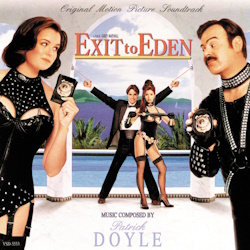
EXIT TO EDEN – Patrick Doyle
 THROWBACK THIRTY
Original Review by Jonathan Broxton
Exit to Eden is a romantic comedy-drama film loosely based on Anne Rice’s 1985 novel of the same name. The film was by directed Garry Marshall and stars Aussie actor Paul Mercurio – hot from his success in Strictly Ballroom in 1992 – as Elliot Slater, a photographer who travels to a BDSM-themed island resort called Eden, where guests can explore their fantasies. At Eden, he meets Lisa Emerson (Dana Delany), the resort’s lead dominatrix, and the two develop a romantic relationship. Meanwhile two detectives, played by Rosie O’Donnell and Dan Aykroyd, follow Elliot to Eden because they discover that he accidentally took the only known photograph of Omar (Stuart Wilson), an international diamond smuggler; Omar himself also discovers that Elliot has a photo of him, and also goes to Eden to try to recover the film. What follows is a series of increasingly ridiculous comedic situations involving all parties. Read more…
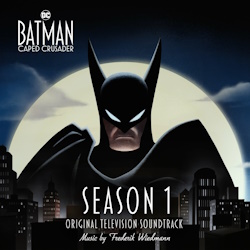
BATMAN: CAPED CRUSADER – Frederik Wiedmann
 Original Review by Jonathan Broxton
Despite being a long-time fan of the character as a whole – at least since Michael Keaton donned the mask and cowl in 1989 – for some reason I never really embraced the world of Animated Batman. I never sat down and watched any episodes of Batman: The Animated Series when it premiered in 1992, I have only seen the Mask of the Phantasm movie once, and I have not seen any of the numerous subsequent films or TV shows that have been released in the thirty years since then. I don’t know why; by all accounts they are all well-made, well-written, dramatically interesting stories with a clear internal logic, stylish design, and a whole host of excellent voice actors, notably Mark Hamill and the late Kevin Conroy. Musically, too, composers as talented as Danny Elfman, the late Shirley Walker, and the Dynamic Music Partners trio comprising Kristopher Carter, Michael McCuistion, and Lolita Ritmanis, have all written excellent scores across a myriad of episodes and entries. Read more…
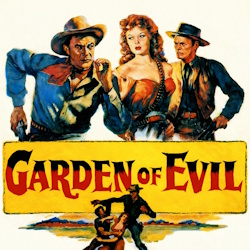
GARDEN OF EVIL – Bernard Herrmann
 GREATEST SCORES OF THE TWENTIETH CENTURY
Original Review by Craig Lysy
CinemaScope technology with its anamorphic lens transformed film-making in 1953, by allowing Hollywood studios to shoot widescreen pictures to offer big screen visuals that could not be duplicated by the emerging TV market. 20th Century Fox studio executive Daryl F. Zanuck decided that he wanted to use the new technology to bring a Western to the big screen as never seen before. Writers Fred Freiberger and William Turnberg were hired to write an original screenplay, Charles Brackett was assigned production with a $2.1 million budget, and Henry Hathaway was tasked with directing. A fine cast was assembled, including; Gary Cooper as Hooker, Susan Hayward as Leah Fuller, Richard Widmark as Fiske, Cameron Mitchell as Luke Daly, Hugh Marlowe john Fuller, and Victor Manuel Mendoza as Vincente Madariaga. Read more…
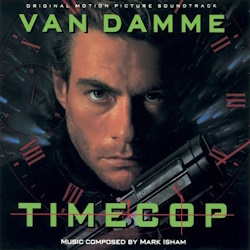
TIMECOP – Mark Isham
 THROWBACK THIRTY
Original Review by Jonathan Broxton
Timecop is a science fiction action film directed by Peter Hyams and starring Jean-Claude Van Damme, Ron Silver, and Mia Sara. The story is set in a future where time travel has been invented and is regulated by the Time Enforcement Commission (TEC) to prevent temporal crimes. Van Damme plays Max Walker, a so-called ‘timecop’ who enforces these laws, but whose life is turned upside down when his wife is murdered in a home invasion. A decade later, Walker discovers that a corrupt politician named McComb is using time travel to manipulate past events so that he can amass power and wealth in the present; Walker’s investigation leads him to confront McComb’s men across different points in time, including a pivotal moment when McComb attempts to ensure his younger self gains control of a major corporation. As Walker battles to stop McComb he faces the challenges of time paradoxes and the dangers of altering history – including a new situation where he discovers he may be able to alter history to save his wife. Read more…
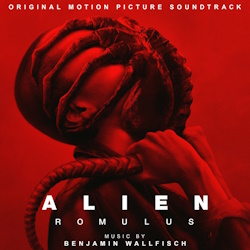
ALIEN: ROMULUS – Benjamin Wallfisch
 Original Review by Jonathan Broxton
The seventh film in the Alien franchise that began in 1979, Alien: Romulus expands the original universe created by director Ridley Scott and writers Dan O’Bannon and Ronald Shusett in new and interesting directions, exploring links between the original film and the recent ‘prequels’ Prometheus and Covenant. Chronologically the film takes place between Alien and Aliens and follows the adventures of a group of disaffected young adults seeking to find a way out of their soul-crushing life working at the Weyland-Yutani mining/terraforming colony Jackson’s Star on planet LV-410. They plan to steal a spacecraft and make their way to Romulus, what they believe to be a derelict research station in orbit, close to the LV-410’s belt of planetary rings. However, once they dock with the research station and begin exploring inside looking for cryo-pods, they soon realize that the dangers they faced on the planet are nothing like the ones they face here. To reveal more plot details would do a disservice to the story and how it unfolds… suffice to say, there are face huggers and alien xenomorphs involved, and much more besides. Read more…
MOONFLEET – Miklós Rózsa
 GREATEST SCORES OF THE TWENTIETH CENTURY
Original Review by Craig Lysy
In 1951 the English novel Moonfleet, written in 1898 by J. Meade Falkner, caught the eye of MGM executives, who decided that this exciting, Gothic, swashbuckling melodrama in the vein of Treasure Island could be successfully brought to the big screen. MGM purchased the film rights, John Houseman was placed in charge of production with a $1.96 million budget, Jan Lustig and Margaret Fitts were hired to write the screenplay, and Fritz Lang was tasked with directing. A stellar cast was assembled, including Stewart Granger as Jeremy Fox, George Sanders as Lord James Ashwood, Joan Greenwood as Lady Clarista Ashwood, John Whiteley as John Mohune, and Viveca Lindfors as Mrs. Minton. Read more…

Shop at the Movie Music UK Store

Member of the

 MOVIE MUSIC UK