Archive
CAPTAIN UNDERPANTS – Theodore Shapiro
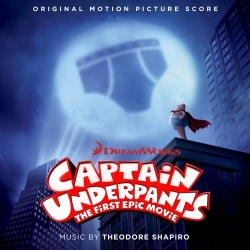 Original Review by Jonathan Broxton
I’m so out of touch with children’s popular culture these days that, prior to a few weeks ago, I had never even heard of Captain Underpants, and had no clue that they made a film about him. The character comes from the enormously popular series of children’s novels by American author and illustrator Dav Pilkey, in which George Beard and Harold Hutchins – two overly imaginative pranksters who spend hours in a treehouse creating comic books – accidentally hypnotize their mean teacher Mr. Krupp into thinking that he’s a ridiculously enthusiastic, incredibly dimwitted superhero named Captain Underpants. In this animated adventure, Captain Underpants finds himself in conflict with Professor Poopypants, a brilliant scientist who, having being constantly made fun of because of his name, decides to try to take over the world. The film is directed by David Soren, has a voice cast that includes Kevin Hart, Ed Helms, Thomas Middleditch, Nick Kroll, and Jordan Peele, and has a spectacular score by composer Theodore Shapiro. Read more…
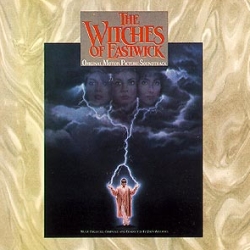
THE WITCHES OF EASTWICK – John Williams
 THROWBACK THIRTY
GREATEST SCORES OF THE TWENTIETH CENTURY
Original Review by Jonathan Broxton
A raucous fantasy comedy based on the novel by John Updike, The Witches of Eastwick stars Susan Sarandon, Michelle Pfeiffer, and Cher, as three women in a small New England town suffering from broken relationships: fiery artist Alexandra (Cher) is a widow, shy and insecure teacher Jane (Sarandon) is a divorcee, and mousy writer Sukie (Pfeiffer) was abandoned by her husband, leaving her to raise six children alone. Despite them living in a town with a history of magic, none of the women realize that they have powers of witchcraft, until an unusual stranger named Daryl Van Horne (Jack Nicholson) arrives in town and begins courting each of them in turn; before long, the women are spending time at Daryl’s mansion, learning about their powers, and finally indulging the passionate, sexual sides of their personality after years of being unfulfilled and repressed. However, as Daryl’s behavior starts to get more and more unpredictable, the women begin to worry about his intentions, and whether his arrival in Eastwick was a good idea. Read more…
THE MUMMY – Brian Tyler
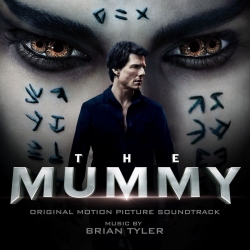 Original Review by Jonathan Broxton
The Mummy is the first film in Universal Pictures’s series of new interlocking ‘Dark Universe’ films based on their roster of classic monsters. Tom Cruise stars as Nick Morton, an officer in the United States Army who moonlights as a treasure hunter. While on assignment in Iraq with his partner, Chris Vail, Nick accidentally unearths an ancient tomb containing a sarcophagus, inside of which are the mummified remains of an Egyptian princess. With the help of archeologist Jennifer Halsey, Nick determines that the princess in question is Ahmanet, who murdered her father, the Pharaoh, as part of a ritual intended to give the Egyptian god of death human form, and was buried alive as punishment. Finally freed from her prison after two thousand years, Ahmanet returns to life and unleashes her revenge upon the world; the only things standing in her way are Nick and his allies, and a mysterious organization called the Prodigium, a secret society dedicated to hunting supernatural threats, whose leader is the equally mysterious Dr. Henry Jekyll. Read more…
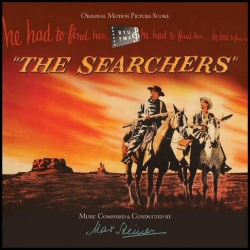
THE SEARCHERS – Max Steiner
 MOVIE MUSIC UK CLASSICS
Original Review by Craig Lysy
Renowned director John Ford had long been recognized as a master of the Western genre with successes, which included Stagecoach (1939), My Darling Clementine (1946), Fort Apache (1948) and Wagon Master (1950). He came upon a novel The Searchers (1954) by Alan Le May that he believed offered a powerful narrative, which needed to be brought to the big screen. Warner Brothers Studio approved the project, purchased the film rights and tasked Ford with bringing his vision to fruition. Frank Nugent was hired to write the screenplay and Ford assembled a stellar cast, which included; John Wayne as Ethan Edwards, Jeffrey Hunter as Martin Pawley, Vera Miles as Laurie Jorgensen, Ward Bond as Reverend Captain Samuel Clayton, Natalie Woods as Debbie Edwards and Henry Brandon as Scar. The story was set in Texas and inspired by a real life event, the 1836 kidnapping of Cynthia Ann Parker by Comanche Indians. She would spend twenty-four years of her life among them, bearing and raising three sons with her Comanche husband. Read more…
PIRATES OF THE CARIBBEAN: DEAD MEN TELL NO TALES – Geoff Zanelli
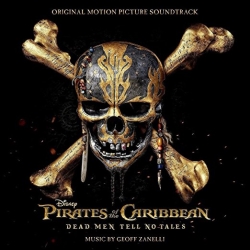 Original Review by Jonathan Broxton
Dead Men Tell No Tales is the fifth entry in Disney’s tentpole Pirates of the Caribbean franchise, based on the classic dark rides found at Disney theme parks the world over. Directed by Norwegian filmmakers Joachim Rønning and Espen Sandberg, it picks up the story of Captain Jack Sparrow (Johnny Depp) several years after the events of the fourth film, On Stranger Tides. Down on his luck and having to resort to robbing banks to make ends meet, Jack becomes embroiled in a new adventure when the ghost of Captain Salazar (Javier Bardem), fearsome pirate hunter of the Spanish Navy, is released from a cursed prison in the so-called Devil’s Triangle; Salazar, who blames Jack for his long imprisonment, begins to track Jack’s ship looking for revenge. In an effort to stop Salazar, Jack teams up with Carina Smyth (Kaya Scodelario), an intelligent young woman accused of being a witch; his old nemesis Barbossa (Geoffrey Rush), now a wealthy shipping fleet owner; and Henry Turner (Brenton Thwaites), the now-adult son of Jack’s old friends Will and Elizabeth. Together, they search for the mythical Trident of Poseidon, which they believe has the power to break Salazar’s curse… and may hold other magical powers too. Read more…
THE UNTOUCHABLES – Ennio Morricone
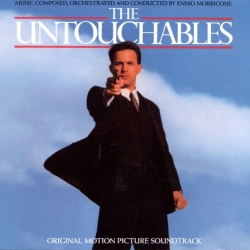 THROWBACK THIRTY
Original Review by Jonathan Broxton
The colorful life of gangster Al Capone has captured the imagination of the American public for decades. He was the notorious crime boss of Chicago during the prohibition era in the late 1920s and early 1930s, and was beloved, despised, and feared in equal measure – many in Chicago’s working class neighborhoods saw him as a Robin Hood figure, helping the downtrodden of the city. Attitudes towards him changed in the aftermath of the brutal St. Valentine’s Day Massacre in 1929, after which law enforcement officials became more intent on bringing him to justice. Brian De Palma’s 1987 film The Untouchables tells a dramatic version of this largely true story, as dogged federal agent Elliot Ness forms a team of equally determined investigators in an attempt to end Capone’s criminal activity once and for all. The film starred Kevin Costner as Ness, Robert De Niro as Capone, and Sean Connery as Ness’s world-weary ex-cop partner Jimmy Malone, a role which won him an Academy Award for Best Supporting Actor. Read more…
THE TEN COMMANDMENTS – Elmer Bernstein
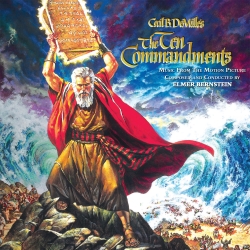 GREATEST SCORES OF THE TWENTIETH CENTURY
Original Review by Craig Lysy
Legendary producer-director Cecil B. DeMille, who at 72 was nearing the end of a great career, sought to reclaim past glory with a film that would serve as his crowning achievement. After much thought, he found his answer, in his past. He announced to the world in 1952 of his intention to remake his 1923 film, “The Ten Commandments.” DeMille stated that his retelling of the story would focus exclusively on the life of Moses. This epic film’s preparation took five years, with the script alone requiring three years to write, and the actual filming taking two years. DeMille insisted on a timeless script and so hired a quartet of screenplay writers headed by Aeneas MacKenzie to accomplish the task. The team drew upon three contemporary novels; “Prince Of Egypt” by Dorothy Clarke Wilson, “Pillar Of Fire” by Reverend J. H. Ingraham and “On Eagle’s Wing” by Reverend A. E. Southon. Lastly, DeMille insisted on historical accuracy and fidelity to the ancient texts, which included the works of Philo, Josephus, Eusebius, The Midrash and The Holy Scriptures. Read more…
WONDER WOMAN – Rupert Gregson-Williams
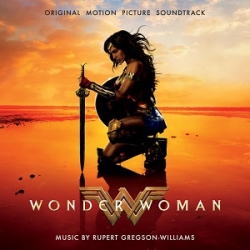 Original Review by Jonathan Broxton
It’s taken more than 70 years for Wonder Woman to appear in her own major live-action movie. The character first appeared in print in 1941, the creation of American psychologist and writer William Moulton Marston, and has been seen as a feminist icon for more than half a century. Prior to her extended cameo in the 2016 film Batman v Superman: Dawn of Justice the most prominent depiction of her character on screen, prior to this film, was the popular 1970s TV series starring Lynda Carter; now she is front and center of her own origin story, with Israeli actress Gal Gadot playing the title role. Read more…
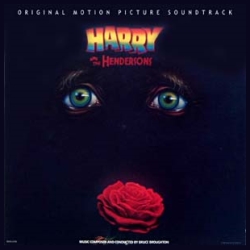
HARRY AND THE HENDERSONS – Bruce Broughton
 THROWBACK THIRTY
Original Review by Jonathan Broxton
Harry and the Hendersons – released as Bigfoot and the Hendersons in the UK – is a warm-hearted family comedy about the most famous mythological creature of North American folklore, the sasquatch, or bigfoot. The film stars John Lithgow as George Henderson, an average family man who, while traveling home with his wife and children after a camping vacation, accidentally hits and apparently kills a large animal with his car on a remote forest road. Upon investigation, George realizes that the animal is a real bigfoot, and decides to take the carcass home; unfortunately, once they arrive back in suburban Seattle, it quickly becomes clear that the animal is far from dead. Despite their initial shock, the Hendersons soon discover that the bigfoot – whom they name Harry – is kind, peaceful, and intelligent, and they resolve to take him back to the wilderness, but find opposition in the form of ruthless hunter LaFleur, who has been tracking Harry and his kind for years. The film, which was directed by William Dear and co-stars Don Ameche, David Suchet, and Melinda Dillon, was a modest commercial and popular hit in the early summer of 1987, but went on to win an Academy Award for Best Makeup for the astonishing bigfoot effects applied to 7’2″ actor Kevin Peter Hall. Read more…
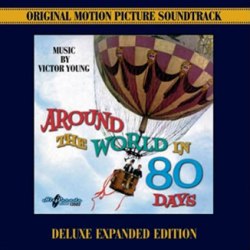
AROUND THE WORLD IN 80 DAYS – Victor Young
 GREATEST SCORES OF THE TWENTIETH CENTURY
Original Review by Craig Lysy
Ever-ambitious producer Mike Todd sought to bring an epic adventure tale to the big screen. He hired screenwriter James Poe to adapt renowned author Jules Verne’s novel “Around The World In 80 Days”. He gave the director reigns to Michael Anderson who brought in an amazing cast which included; David Niven as the classic Victorian English gentleman Phileas Fogg, Mexican icon Cantinflas as the resourceful “Jack of all Trades” Passepartout, Shirley MacLaine as the captivating Princess Aouda, her debut acting role, and Robert Newton as the redoubtable Inspector Fix. The story takes place in England circa 1872 and centers on an epic adventure taken by Phileas Fogg and his man servant Passepartout. Fogg makes the audacious claim that he can circumnavigate the world in eighty days. He offers a £20,000 wager with four skeptical compatriots of the Reform Club, thus setting the stage for the adventure. Read more…
ALIEN: COVENANT – Jed Kurzel
 Original Review by Jonathan Broxton
Alien Covenant is director Ridley Scott’s second prequel to the 1979 masterpiece Alien, following on from 2012’s Prometheus. In this film, which takes place fifteen years after the end of the previous one, we follow the space ship Covenant, which is ferrying several thousand human colonists to a remote Earth-like planet. However, an accident aboard the vessel kills the captain and forces other crew members to wake from stasis and carry out repairs; then, after they intercept what appears to be a distress call from a nearby planet, the new captain Oram (Billy Crudup) decides to investigate, despite the objections of both his second in command Daniels (Katherine Waterston), and the ship’s android Walter (Michael Fassbender). After arriving on the planet, Daniels quickly finds her misgivings to have been correct, and before long the crew is fighting for its life. Read more…
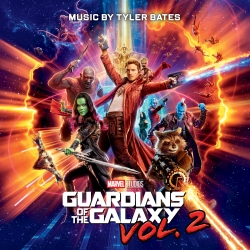
GUARDIANS OF THE GALAXY VOL. 2 – Tyler Bates
 Original Review by Jonathan Broxton
The latest entry into the Marvel Cinematic Universe is Guardians of the Galaxy Vol. 2, in which writer/director James Gunn blends epic space action and special effects with broad comedy and a whole host of unresolved daddy issues. In the aftermath of the events of the first film, the Guardians – Star Lord Peter Quinn (Chris Pratt), Gamora (Zoe Saldana), Drax (Dave Bautista), Rocket (Bradley Cooper), and the newly-sprouted Baby Groot (Vin Diesel) – are now working as heroes for hire, saving planets for a price. Unfortunately for the Guardians, the aftermath of their most recent job results in them running from the haughty and arrogant High Priestess of the Sovereigns (Elizabeth Debicki), space pirate Yondu Udonta (Michael Rooker), and Gamora’s vengeful sister Nebula (Karen Gillan), all of whom have different reasons for wanting to find the Guardians. Unexpectedly, the Guardians receive help from an omnipotent and powerful creature named Ego (Kurt Russell), who claims to be Quinn’s father… Read more…
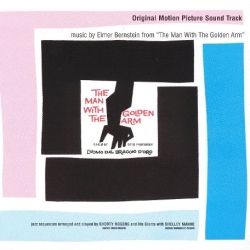
THE MAN WITH THE GOLDEN ARM – Elmer Bernstein
 GREATEST SCORES OF THE TWENTIETH CENTURY
Original Review by Craig Lysy
Actor John Garfield came across Nelson Algren’s novel The Man with the Golden Arm (1949) and was inspired to bring it to the big screen. He purchased the film rights and planned to take on the lead role of Frankie. He immediately ran into censoring problems as the Production Code Authority (PCA) and the Catholic National League of Decency (NLD) would not sanction the film because it featured drug trafficking and drug addiction. The film’s fate passed to renowned director Otto Preminger after he was bequeathed the film rights following Garfield’s death in 1952. Preminger related that he was attracted to the story because “I think there’s a great tragedy in any human being who gets hooked on something, whether it’s heroin or love or a woman or whatever.” Like Garfield, Preminger ran into a wall with the PCA and NLD, but he was determined to overcome all obstacles to fulfill his vision. He brought in Algren to adapt his novel, but personality clashes led to Algren’s replacement with screenwriter Walter Newman. Significant changes to the story were made, which led Algren to sue Preminger for the film rights, however the suit was later dropped as Algren could not afford the legal expenses. Read more…
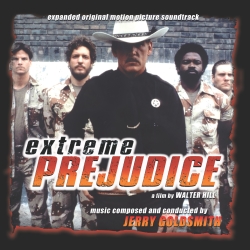
EXTREME PREJUDICE – Jerry Goldsmith
 THROWBACK THIRTY
Original Review by Jonathan Broxton
Extreme Prejudice is a western-flavored action thriller directed by Walter Hill, starring Nick Nolte as Jack Benteen, a grizzled Texas Ranger who teams up with a platoon of elite US Army commandos led by Major Hackett (Michael Ironside). Their mission is to take down a major trafficker running shipments of narcotics across the border from northern Mexico into El Paso; the only stumbling block, for Benteen at least, is the fact that the trafficker is Cash Bailey (Powers Boothe), Benteen’s childhood best friend. As the soldiers close in on Bailey’s compound, Benteen finds his loyalties tested, especially when a beautiful woman named Sarita (Maria Conchita Alonso) – both men’s ex-girlfriend – enters the fray. The film is a gritty, sweat-soaked, uncompromising thriller, and an homage to the great western The Wild Bunch, which received decent reviews when it opened in cinemas in May 1987. Read more…
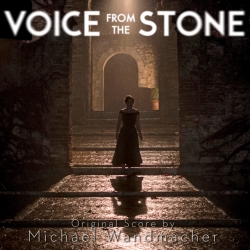
VOICE FROM THE STONE – Michael Wandmacher
 Original Review by Jonathan Broxton
Voice from the Stone is a supernatural thriller adapted from the novel La Voce Della Piera by Silvio Raffo, directed by Eric Howell. The film stars Emilia Clarke – Daenerys Targaryan from Game of Thrones – as Vera, a nurse in Tuscany in the 1950s who is hired by the recently widowed Klaus (Marton Csokas) to help his young son, Jakob (Edward George Dring), who has been mute and withdrawn since the death of his mother. However, as Vera comes to learn more about the boy and his father, and their relationship with the deceased wife/mother, she begins to discover ghostly goings on within the wall of Klaus’s imposing castle home, some of which begin to affect her on a deeply personal level. The film is a beautifully shot, handsomely mounted production that makes wonderful use of the evocative Italian locations, and features an impressively restrained and attractive score by composer Michael Wandmacher. Read more…

Shop at the Movie Music UK Store

Member of the

 MOVIE MUSIC UK