Archive
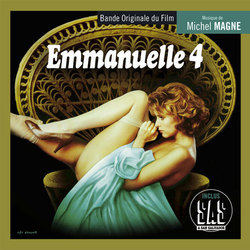
EMMANUELLE 4/S.A.S. À SAN SALVADOR – Michel Magne
 MOVIE MUSIC UK CLASSICS
Original Review by Craig Lysy
The original Emmanuelle (1974) was adapted from the novel by Emanuelle Arsan. It proved to be a box office sensation, which spawned a franchise. Director Francis Leroi, well known for his work with erotica, took up the Opus 4 story line with an added twist. Sylvia (Sylvia Kristen) is desperately trying to escape from her former lover Marc, and so she goes to Brazil where renowned plastic surgeon Dr. Santamo transforms her into the beautiful Emmanuelle. Her new more youthful identity now played by Mia Nygren potentiates a profound sexual awakening, which is complicated by her memories of Marc. It suffices to say that the plot offers unexpected plot twists, which provide multiple opportunities to fully explore the characters.
Pierre Bachelet, Francis Lai and Serge Gainsbourg had respectively scored the first three films of the franchise. Michel Magne, well known for his neo-romantic style was a natural choice for the film. Like his predecessors, he infused his writing with a modern romanticism and provided a number of beautiful songs. You will notice immediately how Magne provides a rich musical palate, which spans from the chaotic, to the playful, to the sensual erotic. Read more…
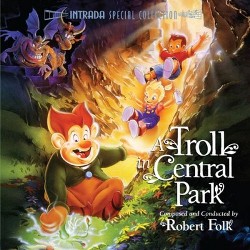
A TROLL IN CENTRAL PARK – Robert Folk
 MOVIE MUSIC UK CLASSICS
Original Review by Craig Lysy
Producers Don Bluth and Gary Goldman had a long history of successful animated films that included “An American Tail” and “The Land Before Time”. With their company now set in Ireland, Bluth decided to utilize traditional Celtic mythology for his next film. In this new story, Stanley is a friendly troll blessed with the gift of a wondrous and magical green thumb that allows him to grow flowers by merely sticking it into the ground. Unfortunately the evil troll Queen Gnorga banishes him from her realm to modern day Manhattan for his life generating gift and kindness to humans. Stanley adapts to his new cave home in Central Park and befriends Gus and Rosie who unknown to their parents have set out on a magnificent adventure. But all is endangered when Queen Gnorga journeys to Manhattan, armed with her purple thumb intent on turning everything she touches to stone. As is fitting, goodness prevails and our heroes defeat and overthrow the evil Queen. The film was not a critical success and failed at the box office, not even coming close to recovering its production costs. Read more…
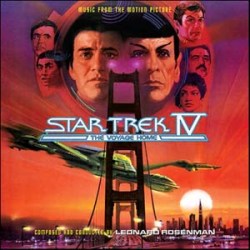
STAR TREK IV: THE VOYAGE HOME – Leonard Rosenman
 MOVIE MUSIC UK CLASSICS
Original Review by Craig Lysy
Coming off his directorial success with Star Trek III, Leonard Nimoy again assembled our iconic crew for a thoughtful eco-story that spoke to humanity’s poor stewardship of the Earth. The film opens with a massive space probe of unknown origin en route to Earth. When it arrives it delivers a cryptic message in a language that seems unintelligible. In addition, its power system neutralizes the Earth’s power grid and begins to vaporize its oceans. The exiled Captain Kirk and his fugitive crew correctly determine that the message is directed not to humanity, but instead to an extinct species, the Humpback whale. As such, they resolve to time travel back to late 20th century Earth to recover two humpback whales, hoping to bring them back to the future so they can respond to the probe’s message. Set in 20th century urban San Francisco, this new adventure was comic, light-hearted and proved to be a huge commercial success, earning profits of more than five times it’s production costs. Read more…
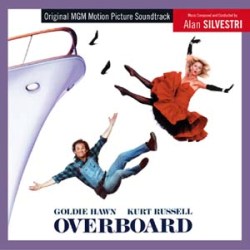
OVERBOARD – Alan Silvestri
 MOVIE MUSIC UK CLASSICS
Original Review by Craig Lysy
Director Gary Marshall, who was well known for his comedic success on TV with shows like Happy Days, Laverne and Shirley, Mork and Mindy, hired writer Leslie Dixon to write a new romantic comedy, Overboard. This outrageous story concerns a wealthy and pretentious married couple, Joanna Stayton (Goldie Hawn) and Grant Stayton III (Edward Herrmann) and Dean Proffitt (Kurt Russell) a local redneck carpenter. Joanna is a bitch of a woman who, after stiffing Dean for carpentry work, happens to fall overboard. She wakes up with amnesia and so begins a comic and outrageous story. Grant takes the opportunity to deny knowing her and seizes his long desired chance to escape a horrific marriage. Meanwhile Dean falsely claims to be her husband – seeking her household care of his four kids as recompense for his unpaid job. Well, be careful what you ask for! As the plot develops Joanna and Dean begin to fall in love, Joanna’s mother closes in on a search for her daughter, and the return of Joanna’s memory looms. To say the plot was silly and contrived is an understatement! Nevertheless the chemistry between Hawn and Russell worked and it suffices to say that Americans just love a romantic comedy. As such the film went on to become a big commercial success. Read more…
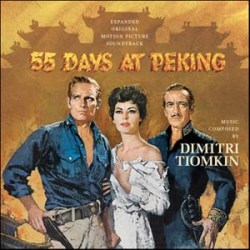
55 DAYS AT PEKING – Dimitri Tiomkin
 MOVIE MUSIC UK CLASSICS
Original Review by Craig Lysy
55 Days at Peking is an epic film which joined politics and a love story as it explored European imperialism at the dawn of the 20th century. Set in Peking (now Beijing) we see the capital city occupied and under the financial domination of eleven European countries and Japan. They exploit the populace, are immune from Chinese laws and compete for economic control. A populist peasant rebellion called the Boxers rises up with fury and covert support from the Dowager Empress to expel the foreigners and restore Chinese honor and sovereignty. Producer Samuel Bronston assembled a stellar cast that included Charlton Heston as U.S. Major Matt Lewis, Ava Gardner as Russian Baroness, Natalie Ivanoff with whom he falls in love and David Niven as Sir Arthur Robinson, head of the British delegation. Regretfully despite the grandeur of its sets, its splendor and pageantry, the film’s narrative was uninspired, its script weak, and it suffered massive production challenges; implacable hostility between Heston and Gardner (she quit the film and they were forced to kill off her character!), went through four directors and ended up being both a commercial and critical failure. Read more…
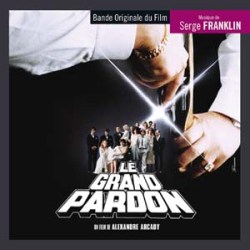
LE GRAND PARDON/THE BIG PARDON – Serge Franklin
 MOVIE MUSIC UK CLASSICS
Original Review by Craig Lysy
Le Grand Pardon is, for all practical purposes, a Jewish version/variation of the famous 1972 film “The Godfather”. The story focuses on the Bettouns, a family of Sephardic Jews and the expanding criminal enterprise run by head of the family Raymond, their godfather. Growing tensions play out as we see Raymond’s inability to compartmentalize his criminal enterprise from the intimacy of his family life as a turf war develops and escalates with a rival Arabic gang. It suffices to say unlike director Alexandre Arcady’s first film, the successful “Le Coup de Sirocco”, that “Le Grand Pardon” was unsuccessful both critically and commercially. Read more…
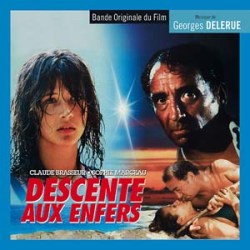
DESCENTE AUX ENFERS/DESCENT INTO HELL – Georges Delerue
 MOVIE MUSIC UK CLASSICS
Original Review by Craig Lysy
The 1986 film Descente Aux Enfers was adapted from the murder mystery novel by author David Goodis. It tells the story of Alan Kolber (Claude Brasseur), a middle-aged alcoholic French crime novelist and his wife Lola (a very young Sophie Marceau in one of her first film roles), a young woman half his age who are struggling in an unhappy marriage. They resolve to take a holiday to Haiti in an attempt to reset their marriage. Things go terribly awry when a drunken Alan kills a mugger and ends up being blackmailed for murder when he fails to report the incident. What unfolds is a tale of drama and hidden secrets as aspects of Lola’s past come to light as they struggle to find funds to pay the blackmailer. Read more…
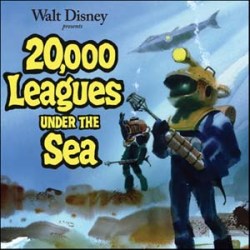
20,000 LEAGUES UNDER THE SEA – Paul J. Smith
 MOVIE MUSIC UK CLASSICS
Original Review by Craig Lysy
This classic Jules Verne’s novel was adapted to the screen by Earl Felton. It tells the story of the adventure of Professor Aronnax (Paul Lukas), Ned Land (Kirk Douglas) and Conseil (Peter Lorre) whom Captain Nemo (James Mason) captures after he sinks their ship. Aboard his submarine the Nautilus, they explore the underwater wonders of the sea and battle amazing sea creatures. But all is not well as Nemo, despite his scientific genius, is quite mad and uses the power of the Nautilus to pursue a course of vengeance upon humanity. Ultimately Nemo is undone by his own demons and arrogance as he and the Nautilus perish into the ocean depths as our three heroes escape. The film was the first to use the new Cinemascope technology and was both a commercial and critical success, earning Oscars for Best Art Direction and Best Special Effects. Read more…
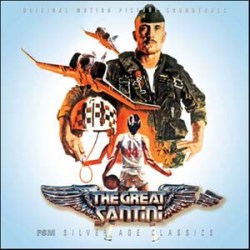
THE GREAT SANTINI – Elmer Bernstein
 MOVIE MUSIC UK CLASSICS
Original Review by Craig Lysy
The Great Santini was adapted from Pat Conroy’s semi-autographical tribute to his father Bull Meechum, a tough, and hard-edged Marine fighter pilot. The film explores how he struggles in peacetime to adapt to his new life as well as to be a loving father and husband without relinquishing his tough guy warrior image. The film starred Robert Duvall as Col. “Bull” Meechum, Michael O’Keefe as his eldest son, Ben and Blythe Danner as his wife, Lillian. Although the film was a critical success and earned Oscar nominations for both Duvall and O’Keefe, it was a commercial failure, never able to resonate with the viewing public. Read more…
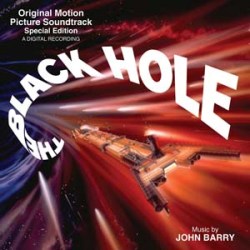
THE BLACK HOLE – John Barry
 MOVIE MUSIC UK CLASSICS
Original Review by Craig Lysy
The Black Hole was to be Disney’s effort to take the successful disaster movie genre into outer space. Conceived in 1975 as a “Poseidon Adventure in Space”, the film was never able to germinate until the Star Wars phenomenon served to catalyze a resurgence of the space epic genre. Gary Nelson was hired to direct with Jeb Rosebrook given the task of adapting the earlier disaster in space script to a more epic adventure tale involving a monstrous black hole. The movie had a stellar cast that included Ernest Borgnine, Yvette Mimieux, Anthony Perkins and Maximillian Schell, as well as Roddy McDowall who provided the voice of the robot VINCENT. Set in the year 2130 C.E. aboard the USS Palomino, the story details the discovery of the lost USS Cygnus, which is seen apparently derelict, orbiting a massive black hole just beyond its event horizon. An investigation into the mystery that was the Cygnus leads to a grim discovery that threatens to end the lives of all involved. Although Disney conceived the film as an epic much in the mold of 2001: A Space Odyssey and provided a story replete with symbolic references to Dante’s Inferno, uninspired directing and a truly poor script resulted in critical failure. The film was nevertheless a commercial success due to its amazing special effects and myriad of robots that won the hearts of the audience. Read more…
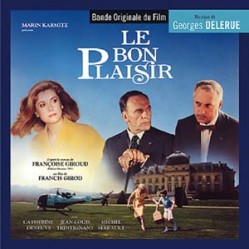
LE BON PLAISIR – Georges Delerue
 MOVIE MUSIC UK CLASSICS
Original Review by Craig Lysy
This suspense film directed by Francis Girod is based on Françoise Giroud’s novel, which explores the tale of a the French president (Jean-Louis Trintignant) who is informed after several years of the existence of a illegitimate son born from an extramarital affair with his former mistress Claire (Catherine Deneuve). To conceal the damaging news he conspires to use the secret service to cover up any kind of proof likely to tarnish his reputation.
What is most interesting is how this movie parallels actual historical events. When the film was released, Francois Mitterrand was the newly elected President of France. Unknown to the public at the time was that he had sired an illegitimate child whose existence was kept hidden up to around the time of his death. Many journalists knew of this “state secret” and it is reasonable to consider that perhaps so did the makers of this film. In the final analysis this film may be no more than pure coincidence, but we must admit that the parallels are striking. Read more…
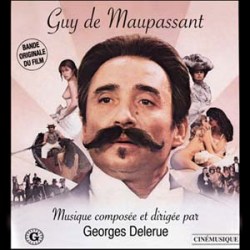
GUY DE MAUPASSANT – Georges Delerue
 MOVIE MUSIC UK CLASSICS
Original Review by Craig Lysy
This film presents a fictionalized biography of Guy de Maupassant, a popular 19th-century French writer, considered one of the fathers of the modern short story. Director Michael Drach explores his dying days, as he suffers and finally succumbs to the unforgiving ravages of syphilis. We observe a series of flashbacks that bring his life into full view – a vision that is viewed through the lens of his unremitting passion for sexual encounters. Amidst this flowing montage of vignettes are highlights that feature important literary figures in his life; his mother, his lesbian friend Gisele d’Estoc, and various other players. Regretfully we must bear witness to his descent into madness as all the stories of his life swirl together as the unstayable scythe of death approaches. Read more…
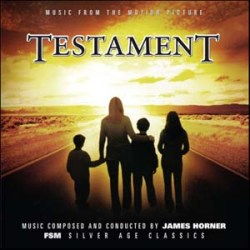
TESTAMENT – James Horner
 MOVIE MUSIC UK CLASSICS
Original Review by Craig Lysy
Testament was adapted from a short story “The Last Testament” written by Carol Armen. Originally conceived as a TV movie, Paramount executives were so impressed with the final product that they instead chose to release it in theatres across the country. The story concerns itself with the aftermath of a cataclysmic nuclear war. Its intimate narrative is seen through the eyes of Carol Wetherley, a mother who lives in the northern California town of Hamlin outside of San Francisco. After her husband is lost with the destruction of San Francisco, she struggles with determination and dignity to ensure the safety and continuity of her family. Yet all seems for naught as one by one her neighbors and family begin to succumb to the horrific ravages of radiation poison. The film earned critical acclaim for its intimate portrayal and was a commercial success. Read more…
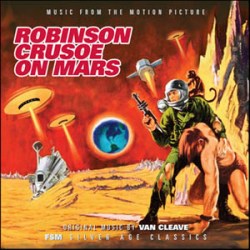
ROBINSON CRUSOE ON MARS – Nathan Van Cleave
 MOVIE MUSIC UK CLASSICS
Original Review by Craig Lysy
Robinson Crusoe on Mars was conceived by Ib Melchoir (Angry Red Planet), who envisioned it as the first in a series of literary classics that he would update to the 20th century and adapt to an outer space setting. The film was directed by Byron Haskin (Conquest of Space) and featured stunning cinematography of Martian vistas that were designed by the brilliant team of art directors. It starred Paul Mantee (Kit) as a marooned astronaut who is forced to eject from his spacecraft due to a malfunction. Stranded on an unforgiving surface, he struggles to find food, water, oxygen and combat a terrible loneliness born of his isolation. He is eventually joined by an escaped slave (Victor Lundin), who becomes his man “Friday.” Together they must evade cruel aliens that seek to regain their lost property. Adam West of Batman fame also appeared in the film as Mantee’s co-pilot along with the monkey Mona who steals the show! Regretfully Melchoir would not realize his grand vision of an outer space series as the film just did not resonate with audiences. Read more…

Shop at the Movie Music UK Store

Member of the

 MOVIE MUSIC UK
COMMENT LES SÉDUIRE/1001 WAYS TO LOVE – François de Roubaix
Original Review by Craig Lysy
This CD is a compilation of music from three films directed by Jean-Claude Roy and scored by François de Roubaix. Roy and de Roubaix became good friends during the French-Algerian War circa 1958 and worked together several times during their careers prior to the composer’s untimely death in a diving accident off the island of Tenerife in 1975, when the composer was just 36 years old. The films covered here are Les Strip-Teaseuses (or, to give it it’s full title, Strip-Teaseuses Ou Ces Femmes Que L’on Croit Faciles) from 1964, Les Combinards from 1966 and Comment les Séduire from 1968. Read more…