Archive
Carl Davis, 1936-2023
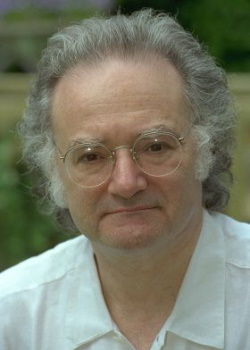 Composer Carl Davis died on August 3, 2023, at his home in Oxfordshire, England, following a brain haemorrhage. He was 86.
Davis was born in Brooklyn, New York, in October 1936, and studied composition there and in Copenhagen. He was working with the New York City Opera and the Robert Shaw Chorale, and writing music for off-Broadway productions, prior to traveling to the United Kingdom in 1961 to attend the Edinburgh Festival. It was while in Edinburgh that Davis was offered a job composing music for the satirical comedy series That Was The Week That Was; Davis subsequently spent the rest of his working career predominantly in the UK.
Over the next 30 years or so, Davis wrote hundreds of scores for British film and television. On the big screen, his works included The Bofors Gun (1968), I, Monster (1971), Up Pompeii (1971), Man Friday (1975), The Sailor’s Return (1978), The French Lieutenant’s Woman (1981), Champions (1983), King David (1985), Scandal (1989), The Rainbow (1989), Frankenstein Unbound (1990), The Trial (1993), Widows’ Peak (1994), and Topsy-Turvy (1999), the latter of which saw him adapting music by Gilbert and Sullivan.
On the small screen, his works included The Naked Civil Servant (1975), Oppenheimer (1980), Winston Churchill: The Wilderness Years (1981), The Hound of the Baskervilles (1982), The Far Pavilions (1984), The Pickwick Papers (1985), Hotel du Lac (1986), Silas Marner (1986), Pride and Prejudice (1995), Anne Frank Remembered (1995), and Cranford (2008), as well as the groundbreaking documentary series The World at War (1973). He won the BAFTA Award for Film Music for The French Lieutenant’s Woman, and was nominated on six other occasions between 1981 and 2008. He also received two Emmy nominations, in 1972 and 1993, and a Grammy nomination in 1983, again for The French Lieutenant’s Woman. Read more…
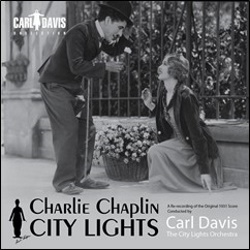
CITY LIGHTS – Charles Chaplin
 GREATEST SCORES OF THE TWENTIETH CENTURY
Original Review by Craig Lysy
Entering the 1920s Charlie Chaplin had become a global sensation, his career ascendent. In 1929 he conceived a new film, “City Lights”, a passion project in which he would produce, direct, write the screenplay, compose the score, and star. Chaplin was a perfectionist and it would take him 534 days of filming to realize his vision. He faced significant resistance from his studio United Artists who were not happy with his decision to eschew a talkie film, and instead stubbornly make another silent film, although one with a synchronous and original score. For Chaplin, his art and passion was pantomime, with his Tramp character beloved by the world and legend. He saw talkie films as a harbinger for the end of his art, and so his reaction was understandable. And so, he proceeded with his vision and a budget of $1.5 million dollars was provided. The cast included Chaplin as the Tramp, Virginia Cherrill as the blind Flower Girl, Florence Lee as the grandmother, Harry Myers as the eccentric millionaire, Al Ernest Garcia as the butler, and Hank Mann as the prizefighter. Read more…
Under-the-Radar Round Up 2016, Part 5
 Original Reviews by Jonathan Broxton
The fifth installment in my annual series of articles looking at the best “under the radar” scores from around the world concentrates on music from films and television from my home country, the United Kingdom. This year’s crop of British beauties includes a lovely animation score from a respected veteran, an exciting drama score from an increasingly impressive talent, and several outstanding scores for television.
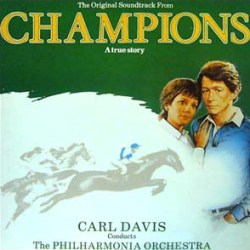
CHAMPIONS – Carl Davis
 THROWBACK THIRTY
Original Review by Jonathan Broxton
When I was a kid, Grand National day was one of my favorite days of the British sporting calendar. I had, and continue to have, a very personal connection with it, as it was something I shared with my late grandfather, who had a passion for the sport of kings, and my childhood memories of spending those Saturdays with him in the 1980s are some of my fondest. For those who don’t know what it is – which is probably every American reading this – the Grand National is a steeplechase horse race, in which 40 brave and gallant horses and their equally brave and gallant jockeys test themselves by negotiating 30 daunting fences over two 2-mile circuits of the challenging Aintree racecourse in Liverpool. The race has been run every year since 1839, and has grown to become a major television event in the UK, watched by millions across the country. The winning horses, winning jockeys, and the race’s controversies go down in history and become part of the nation’s sporting lexicon – speak to pretty much any Englishman of my generation, and he will know what you’re talking about if you mention Devon Loch or Red Rum, Ginger McCain or Jenny Pitman. However, by far the most famous Grand National in terms of human and equine drama was the race run in 1981. Read more…

Shop at the Movie Music UK Store

Member of the

 MOVIE MUSIC UK