EMPIRE OF THE SUN – John Williams
 THROWBACK THIRTY
GREATEST SCORES OF THE TWENTIETH CENTURY
Original Review by Jonathan Broxton
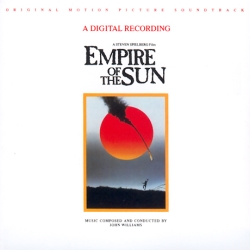
By the end of 1986, Steven Spielberg was probably the most famous and financially successful director in Hollywood. However, although he had directed a handful of the highest grossing films of all time – Jaws, Close Encounters of the Third Kind, Raiders of the Lost Ark, E. T. The Extra-Terrestrial, Indiana Jones and the Temple of Doom –he privately expressed a desire to make more serious films. The comparative failure of The Color Purple in 1985 just magnified that desire, so in 1987 he decided to try again, by making a movie based on J. G. Ballard’s semi-autobiographical coming-of-age novel Empire of the Sun. The film starred the then 13-year-old Christian Bale as Jim Graham, an upper class English schoolboy living with his diplomat parents in Shanghai in 1941, whose life is shattered by the outbreak of World War II, and who ends up desperately trying to survive in a Japanese prisoner of war camp. Unfortunately for Spielberg, the film – which also starred John Malkovich, Miranda Richardson, and Nigel Havers – did not ignite the passions of audiences like his popcorn blockbusters did, and it was only a moderate critical and commercial success; Spielberg would have to wait another five years for his breakthrough into cinematic respectability with Schindler’s List in 1993. In addition, the film was largely overlooked at the Academy Awards, receiving only six technical nominations, but not winning any. Read more…
ANNIHILATION – Ben Salisbury, Geoff Barrow
 Original Review by Jonathan Broxton
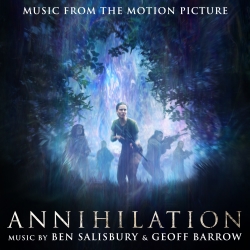
Annihilation is an ambitious and intelligent sci-fi action-drama based on the series of Southern Reach novels by author Jeff Vander Meer. The film stars Natalie Portman as Lena, a biologist and former soldier, who is recruited by a secret US military science organization, and becomes part of a team sent to investigate ‘the shimmer,’ a mysterious phenomenon that has appeared in the Florida Everglades. Once inside the quarantined shimmer zone, Lena and her all-female team – psychologist Ventress, medic Anya, physicist Josie, and geologist Sheppard – begin to search for the source of the phenomenon, and encounter all manner of unusual animals and plants along the way. However, unknown to the other members of the group, Lena also has a secondary mission of her own: to find out what happened to her husband Kane, who was part of a previous team sent into the Shimmer, and which never returned. The film co-stars Jennifer Jason Leigh, Gina Rodriguez, Tessa Thompson, Tuva Novotny, and Oscar Isaac, and was directed by Alex Garland. Read more…
PLANET OF THE APES – Jerry Goldsmith
 GREATEST SCORES OF THE TWENTIETH CENTURY
Original Review by Craig Lysy
Producer Arthur P. Jacobs sold 20th Century Fox on a bold new effort to reinvigorate the science fiction genre, which had languished since the start of the decade. The vehicle for the genre resurrection would be Pierre Boulle’s 1963 novel La Planète des Singes (Planet of the Apes). After securing the film rights Rod Serling and Michael Wilson were tasked with writing the screenplay. The technical challenges of the required prosthetic make-up delayed the film for quite some time. Fox Studios finally gave the green light to film when make-up designer John Chambers developed prosthetics flexible enough for the actors to express facial emotions. Jacobs had always seen Charlton Heston playing the lead role of John Taylor and on his request, Franklin Schaffner was hired to direct. A fine cast was assembled, which included Roddy McDowell as Cornelius, Kim Hunter as Zira, Maurice Evans as Dr. Zaius, James Daly as Honorius, Lou Wagner as Lucius, and Linda Harrison as Nova. Read more…
FIFTY SHADES FREED – Danny Elfman
 Original Review by Jonathan Broxton
Following it’s publication in 2011, the novel Fifty Shades of Grey by E. L. James became a literary phenomenon. Originally a self-published and sex-filled piece of Twilight fan fiction, it eventually morphed into an original story that followed the relationship between mousy college student Anastasia Steele and enigmatic billionaire Christian Grey, who is an enthusiastic practitioner of bondage, dominance, and sadomasochism. The book and its two sequels topped best-seller lists around the world, with the first story selling over 125 million copies worldwide. Films inevitably followed; Fifty Shades of Grey premiered in 2015, the first sequel Fifty Shades Darker came along in 2017, and now we have this third and final installment, Fifty Shades Freed. James Foley returns to the director’s chair for the second time, and Dakota Johnson and Jamie Dornan reprise their roles as Ana and Christian. Read more…
IFMCA Award Winners 2017
 INTERNATIONAL FILM MUSIC CRITICS ASSOCIATION ANNOUNCES WINNERS OF 2017 IFMCA AWARDS; “PHANTOM THREAD” TAKES SCORE OF THE YEAR, MULTIPLE WINS FOR MICHAEL GIACCHINO, BENJAMIN WALLFISCH
The International Film Music Critics Association (IFMCA) announces its list of winners for excellence in musical scoring in 2017, in the 2017 IFMCA Awards.
The award for Score of the Year goes to British composer Jonny Greenwood for his score for critically acclaimed period drama “Phantom Thread,” directed by Paul Thomas Anderson, and starring Daniel Day-Lewis. In describing the score, IFMCA member Jon Broxton wrote that it was a “quite masterful score from Greenwood, one which gets deeply under the skin of the damaged, potentially dangerous, but nevertheless mutually fulfilling relationship at the center of the story. The abstract, impressionistic, modernistic textures perfectly capture the torment that both characters at times feel, as well as their willful and often unpleasant personalities. Then, when he opens up his orchestra and performs the Phantom Thread theme with glorious melodrama, or when he writes elegant romantic music for what should be the dreadful finale, the whole thing simply soars”. The score was also named Best Original Score for Drama Film; these are the first IFMCA Award wins of Greenwood’s career, him having previously been nominated for Breakthrough Film Composer of the Year in 2007 and Best Original Score for an Action/Adventure/Thriller Film for “Inherent Vice” in 2014. Read more…
BLACK PANTHER – Ludwig Göransson
 Original Review by Jonathan Broxton
The utter dominance of comic book action movies at the American box office continues with the success of Black Panther, the 18th film in the Marvel Cinematic Universe. It’s the origin story of a character who appeared for the first time in Captain America: Civil War in 2016, and explores the history of the fictional African nation of Wakanda, which is the most technologically advanced civilization on Earth thanks to its unlimited supplies of the metal vibranium, but pretends to be a poor third world country to hide its power. Chadwick Boseman plays T’Challa, the new King of Wakanda, who takes up the mantle of the Black Panther after his father’s death in Captain America: Civil War; returning home to begin leading his country, T’Challa finds himself facing a threat in the shape of Eric Killmonger (Michael B. Jordan), a mercenary with ties to Wakanda, whose actions send the entire country into a civil war of its own. The film co-stars Lupita Nyongo, Danai Gurira, Martin Freeman, Daniel Kaluuya, Letitia Wright, Angela Bassett, Forest Whitaker, Sterling K. Brown, and Andy Serkis, and is directed by Ryan Coogler. Read more…
BULLITT – Lalo Schifrin
 GREATEST SCORES OF THE TWENTIETH CENTURY
Original Review by Craig Lysy
Steve McQueen was seeking a script for his next film and took a liking to author Robert Fish’s novel Mute Witness (1963). His production company Solar Productions purchased the film rights, and brought in Alan Trustman and Henry Kleiner to write the screenplay. He made a surprising choice to bring in English director Peter Yates after viewing the stunning extended car chase scene in his last movie, Robbery (1967). McQueen chose to change the film’s title to “Bullitt”, which based his character Frank Bullitt on real life San Francisco Inspector Dave Toschi, with who he studied as part of his training and orientation to police procedures and practices. McQueen would play the titular role, which would be a departure for him in that for the first time he would abandon his ‘rebel’ persona and join the Establishment as a police officer. To round out the cast, McQueen brought in Robert Vaughn as Walter Chalmers and Jacqueline Bisset as Cathy. Read more…
BAFTA Winners 2017
 The British Academy of Film and Television Arts (BAFTA) have announced the winners of the 71st British Academy Film Awards, honoring the best in film in 2017.
In the Best Original Score category composer Alexandre Desplat won the award for his score for director Guillermo del Toro’s romantic fantasy film The Shape of Water. In accepting his award, Desplat said:
“Yes, what a venue for music! Thank you, it’s… it’s marvelous. Guillermo, your film is unique, and the poetry you’ve given us is amazing, and for music there’s always a good bonding between music and poetry, so thank you, thank you very much. Thanks to Fox Searchlight. This music was recorded here in London by the London Symphony Orchestra at Abbey Road [applause] Marvelous musicians! Many of them, one of them is here tonight, Solrey, the best musician I have ever met and… [applause] and, Antonia, my daughter. Hi, Antonia! And… I thank you. It’s marvelous. Thank you.”
The other nominees were Jonny Greenwood for Phantom Thread, Dario Marianelli for Darkest Hour, Benjamin Wallfisch and Hans Zimmer for Blade Runner 2049, and Hans Zimmer again for Dunkirk.
Jóhann Jóhannsson, 1969-2018
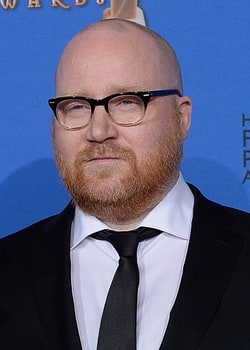 Composer Jóhann Jóhannsson died on February 9, 2018, at his home in Berlin, Germany, of an accidental drug overdose. He was 48 years old.
Jóhann Jóhannsson was born in Reykjavik, Iceland, in September 1969. After graduating from university he started his musical career in the mid-1990s as a guitarist playing in various Icelandic indie rock bands, before founding Kitchen Motors, an art organization that encouraged musical collaborations between artists from numerous different genres. He began scoring television projects and films in his native Iceland in 1999, beginning with the TV series Corpus Camera and the theatrical feature The Icelandic Dream [Íslenski Draumurinn] for director Robert Ingi Douglas, and went on to write several acclaimed scores for Icelandic directors over the next several years.
Jóhannsson scored his first English-language film, Personal Effects for director David Hollander, in 2009, first came to international prominence in 2013 when he was asked to score the dark thriller Prisoners starring Hugh Jackman and Jake Gyllenhaal by director Denis Villeneuve. He followed this with the score for the Steven Hawking bio-pic The Theory of Everything in 2014, for which he won the Golden Globe Award for Best Original Score, and was nominated for an Academy Award for Best Original Score, a BAFTA Award for Best Film Music, and a Grammy Award for Best Score Soundtrack for Visual Media. Read more…
IFMCA Award Nominations 2017
 INTERNATIONAL FILM MUSIC CRITICS ASSOCIATION AWARD NOMINATIONS ANNOUNCED; MULTIPLE NOMINATIONS FOR ALEXANDRE DESPLAT, MICHAEL GIACCHINO, DANIEL PEMBERTON, JOHN WILLIAMS
FEBRUARY 8, 2018. The International Film Music Critics Association (IFMCA) announces its list of nominees for excellence in musical scoring in 2017, for the 14th annual IFMCA Awards. In a wide open field, the most nominated composers are Alexandre Desplat and Daniel Pemberton, who both received four nominations, Michael Giacchino, who received five nominations, and John Williams, who received six nominations for new work, plus an additional three for archival re-releases of some of his classic scores.
56-year old Frenchman Alexandre Desplat is nominated for his work on two scores – director Guillermo Del Toro’s critically acclaimed monster movie romance “The Shape of Water,” and director Luc Besson’s epic space fantasy “Valerian and the City of a Thousand Planets” – and is one of the five nominees for Composer of the Year. IFMCA member James Southall said that “The Shape of Water” was “yet another from the top drawer of Desplat,” and went on to describe him as “one of the most consistently impressive film composers of the last couple of decades,” who has “managed to be so successful without having to water down his highly-distinctive musical voice at all”. Desplat previously received IFMCA Score of the Year honors in 2008 for “The Curious Case of Benjamin Button”. His other major scores in 2017 include director George Clooney’s satirical racial drama ‘”Suburbicon,” and the French-language comedy-drama “D”Après Une Histoire Vraie,” directed by Roman Polanski. Read more…
Movie Music UK Awards 2017
 After a little bit of a slow start, 2017 ended up being a really excellent year for film music. Many of the industry’s most reliable and storied composers had superb years, each writing multiple outstanding scores, while a bevy of exceptionally talented newcomers made their marks on the genre for the first time, proving that – hopefully – the future is in good hands if they continue to be given quality projects to score.
Despite the lack of a true ***** masterpiece, I ended up with an astonishing 66 scores which, were I still handing out star ratings, would have rated **** or better. And it’s not just Hollywood staples – composers working in China and Japan, Britain and France, Russia and Poland and Finland, Spain and Italy, all wrote outstanding music this year, proving once again that there is magnificent music out there – if only you’re prepared to look for it. So, without further ado, here are my choices… Read more…
Under-the-Radar Round Up 2017, Part 9
 Original Reviews by Jonathan Broxton
The ninth and final installment in my annual series of articles looking at the best “under the radar” scores from around the world finds us on a triumphant return to Asia, with eight more reviews of the best film music the continent has to offer. And what a treasure trove it is, encompassing animated fantasies, TV series, war movies, epic dramas, and a guest appearance from the world’s most beloved 100-foot lizard. There are four scores from Japan, two from China, and one each from Turkey and Vietnam, rounding out what has been an eye-opening journey around the darkest reaches of the film music globe, searching for bright spots.
Under-the-Radar Round Up 2017, Part 8
Original Reviews by Jonathan Broxton
The penultimate installment in my annual series of articles looking at the best “under the radar” scores from around the world sees us back on Europe mainland for a final dash around the continent. This is where we get really obscure: we’ve got a total of eight scores here, including a TV series from Poland, a historical action movie from Russia written by a rock musician, a Norwegian supernatural thriller, children’s adventure films from both Germany and Norway – one of which is animated – and a comedy road movie about racism from Finland! It just goes to show that good film music being written everywhere, in the most unexpected places, if only you have the patience to seek it out.
John Morris, 1926-2018
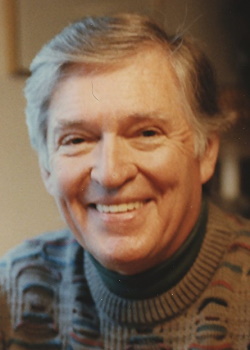 Composer John Morris died on January 25, 2018, at his home in Red Hook, New Jersey, following complications from a respiratory infection. He was 91.
John Leonard Morris was born in October 1926, in Elizabeth, New Jersey. After his family moved to Kansas while he was young, Morris continued studying piano, and by the late 1940s he moved back to the New York City are, where he studied at both Juilliard School and at The New School. He pursued a career as a concert pianist and musical director before transitioning to composing for theater and film. Morris began his long and fruitful collaboration with writer-director Mel Brooks in the late 1950s, and together they worked on two musicals, Shinbone Alley (1957) and All-American (1962).
Morris and Brooks continued to work together when Brooks brought his play ‘Springtime for Hitler’ to the big screen as The Producers in 1967, and their collaboration continued through a string of hits including Blazing Saddles (1974), Young Frankenstein (1974), Silent Movie (1976), High Anxiety (1977), History of the World, Part I (1981), and Spaceballs (1987), among many others. His deft orchestral parodies and lovingly crafted pastiches matched Brooks’ irreverent humor beat for beat. Read more…
Academy Award Nominations 2017
 The Academy of Motion Picture Arts and Sciences (AMPAS) have announced the nominations for the 90th Academy Awards, honoring the best in film in 2017.
In the Best Original Score category, the nominees are:
- CARTER BURWELL for Three Billboards Outside Ebbing Missouri
- ALEXANDRE DESPLAT for The Shape of Water
- JONNY GREENWOOD for Phantom Thread
- JOHN WILLIAMS for Star Wars: The Last Jedi
- HANS ZIMMER for Dunkirk
This the first nomination for Greenwood and the second nomination for Burwell. Desplat has now been nominated nine times, having previously won for The Grand Budapest Hotel in 2014, while Zimmer has now been nominated eleven times, having previously won the The Lion King in 1994.
Incredibly, this is the 51st Oscar nomination for John Williams, which breaks his own record for the most nominated living person, and maintains his position as the second most nominated person of all time after Walt Disney (who had 59). He previously won Academy Awards for Fiddler on the Roof in 1971, Jaws in 1975, Star Wars in 1977, E. T. The Extra-Terrestrial in 1982, and Schindler’s List in 1993.
In the Best Original Song category, the nominees are:
- KRISTIN ANDERSON-LOPEZ and ROBERT LOPEZ for “Remember Me” from Coco
- MARY J. BLIGE, RAPHAEL SAADIQ, and TAURA STINSON for “Mighty River” from Mudbound
- BENJ PASEK and JUSTIN PAUL for “This Is Me” from The Greatest Showman
- SUFJAN STEVENS for “Mystery of Love” from Call Me By Your Name
- DIANE WARREN and LONNIE LYNN JR. (COMMON) for “Stand Up For Something” from Marshall
The winners of the 90th Academy Awards will be announced on March 4, 2018.

Shop at the Movie Music UK Store

Member of the

 MOVIE MUSIC UK