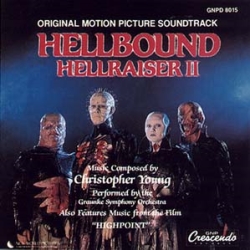
HELLBOUND: HELLRAISER II – Christopher Young
 THROWBACK THIRTY
GREATEST SCORES OF THE TWENTIETH CENTURY
Original Review by Jonathan Broxton
The 1987 film Hellraiser, based on the novella The Hellbound Heart by British horror author Clive Barker, was an unexpected critical and commercial success at the box office, and as such an immediate sequel was commissioned to cash in on the new popularity of Pinhead and his merry band of ‘cenobite’ demons, who live in a realm of hell where pleasure, pain, and suffering are one. The resulting film, titled Hellbound: Hellraiser II, takes place in the immediate aftermath of the first film, and finds protagonist Kirsty (Ashley Laurence) – having escaped from Pinhead (Doug Bradley) – recovering in a mental institution under the care of Dr Channard (Kenneth Cranham). However, it is revealed that Channard is secretly obsessed with cenobites, and has been searching for the ‘lament configuration’ puzzle box that summons them for years. Despite Kirsty’s desperate pleas, Channard recovers the bloody mattress that Kirsty’s stepmother Julia (Clare Higgins) died on in the last film, and uses it to resurrect her; so begins a gruesome, desperate game, as Channard and Julia explore the realms of hell together, while Kirsty tries to stop the cenobites once and for all. The film was written by Peter Atkins and is directed by journeyman Tony Randel, taking over duties from Barker. Read more…
BAFTA Nominations 2018
 The British Academy of Film and Television Arts (BAFTA) has announced the nominations for the 72nd British Academy Film Awards, honoring the best in film in 2018.
In the Best Original Music category, which is named in memory of the film director Anthony Asquith, the nominees are:
- TERENCE BLANCHARD for Blackkklansman
- NICHOLAS BRITELL for If Beale Street Could Talk
- BRADLEY COOPER, STEFANI GERMANOTTA (LADY GAGA), and LUKAS NELSON for A Star is Born
- ALEXANDRE DESPLAT for Isle of Dogs
- MARC SHAIMAN for Mary Poppins Returns
This is the ninth BAFTA nomination for Desplat, who won for “The King’s Speech” in 2010, “The Grand Budapest Hotel” in 2014, and for “The Shape of Water” in 2018; and the second nomination for Shaiman, who was previously nominated for “Sleepless in Seattle” in 1993. It is the first nomination for both Blanchard and Britell. Cooper, Nelson, and Lady Gaga are nominated for the numerous original songs they wrote for the latest screen version of A Star is Born.
The winners of the 72nd BAFTA Awards will be announced on February 20, 2019.
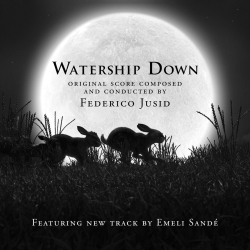
WATERSHIP DOWN – Federico Jusid
 Original Review by Jonathan Broxton
The 1972 novel Watership Down by Richard Adams is a classic of British literature. Note that I said literature and not children’s literature, because although the story is about a group of anthropomorphized rabbits, the story is very much an adult one. Following the destruction of their warren, a group of rabbits led by the brave Hazel, the sensitive Fiver, and the strong Bigwig make their way across the English countryside in search of a new home, and must fight against all manner of dangers – both natural and man-made – as they do so. What’s so brilliant about Adams’s novel is the way in which it creates an entire culture for the rabbits, with a creation myth, gods and spirits, a unique language with specialized vocabulary, and even a hierarchical society – the latter of which comes into play when Hazel and his friends encounter rabbits from an authoritarian rival warren overseen by the tyrannical General Woundwort. When you combine this with themes that mirror classical epics about life and death, environmentalism, and politics, the result is one of the great English books of the last fifty years. The story was made into a much-loved animated film in 1978 – again, not for kids – and is now a three-part mini-series jointly produced by the BBC and Netflix, directed by Noam Murro, which features an astonishing voice cast including James McAvoy, Nicholas Hoult, John Boyega, Ben Kingsley, Tom Wilkinson, Gemma Arterton, Olivia Colman, Daniel Kaluuya, Taron Egerton, and many many others. Read more…
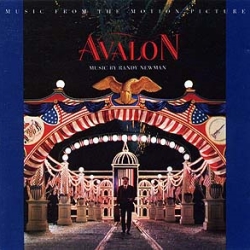
AVALON – Randy Newman
 GREATEST SCORES OF THE TWENTIETH CENTURY
Original Review by Craig Lysy
Avalon offered Barry Levinson’s third installment of his semi-autobiographical tetralogy of ”Baltimore Films” – Diner (1982), Tin Men (1987), Avalon (1990) and Liberty Heights (1999) – which explored immigrant life in his hometown Baltimore from the 1940s through the 1960s. He served as producer, director and screenwriter for the project and his production company Baltimore Pictures financed the film. He brought in a first class cast, which included Leo Fuchs as Hymie Krichinsky, Lou Jacobi as Gabriel Krichinsky, Armin Mueller-Stahl as Sam Krichinsky, Joan Plowright as Eva Krichinsky, Israel Rubinek as Nathan Krichinsky, Eve Gordon as Dottie Kirk, Elizabeth Perkins as Ann Kaye, Aiden Quinn as Jules Kaye and Elijah Wood as Michael Kaye. The film offers a commentary on the challenges of immigrant Russian-Jews trying to assimilate in America. Sam, the patriarch of the Krichinsky family, arrives in 1914 to forge a new life, eventually settling in Baltimore where he works as a wallpaper man. Matriarch Eva is firmly grounded in the old ways and ensures the family stays true to its roots. Conflicts between old country familial culture and modern American culture are inevitable and elicit generational clashes as Sam and Eva struggle to balance the old with the new. Despite hardships, which include an armed robbery, a devastating home fire, and children abandoning their surname for an American one, the family holds together, weathering the storm, united in love. The film was a commercial success and secured four Academy Award nominations including Best Screenplay, Best Cinematography, Best Costume Design and Best Film Score. Read more…
Golden Globe Winners 2018
 The Hollywood Foreign Press Association (HFPA) have announced the winners of the 76th Golden Globe Awards, honoring the best in film and American television of 2018.
In the Best Original Score category composer Justin Hurwitz won the award for his score for director Damien Chazelle’s film First Man, which tells the life story of the first man on the moon Neil Armstrong. This is Hurwitz’s second Golden Globe, him having won previously for La La Land in 2016. In his acceptance speech, Hurwitz said:
“OK, alright. I have to thank Nick Baxter who mixed this score, and John Taylor who mixed this movie, because a theremin score could have ended up being very annoying, and they found the right place for everything to sit and showed that great mixers can make a composer look good. So, thanks to them. I want to thank Tom Cross who cut the film, and the whole editorial department – Harry Yoon, John To, Derek Drouin, Jennifer Stelemma, Jeff Harlacker, Jason Miller – I’m in awe of how you guys put together something so complex. Thank you of course to Damian [Chazelle], who is brilliant and loyal and touches every detail of our work. Thank you HFPA, thank you everybody at Universal, and the Los Angeles musicians.”
The other nominees were Marco Beltrami for A Quiet Place, Alexandre Desplat for Isle of Dogs, Ludwig Göransson for Black Panther, and Marc Shaiman for Mary Poppins Returns.
In the Best Original Song category, the winners were Stefani Germanotta (Lady Gaga), Mark Ronson, Anthony Rossomando, and Andrew Wyatt, for their song “Shallow” from the latest version of A Star Is Born.
The other nominees were Jón Þór Birgisson (Jónsi), Troye Sivan, and Brett McLaughlin for “Revelation” from Boy Erased; Kendrick Lamar Duckworth, Anthony Tiffith, Mark Spears (Sounwave), Solána Rowe (SZA), and Al Shuckburgh (Al Shux) for “All the Stars” from Black Panther; Annie Lennox for “Requiem for A Private War” from A Private War; and Dolly Parton and Linda Perry for “Girl in the Movies” from Dumplin’.
VICE – Nicholas Britell
 Original Review by Jonathan Broxton
How much do we actually know about Dick Cheney? According to director Adam McKay’s new film Vice, the answer is ‘not enough’. The film is a fascinating, hilarious, eye-opening piece of cinema, one part biopic, one part satire, and one part exposé of the way the political machine works in Washington DC, examining how one man can have so many fingers in so many pies that he can fundamentally alter the entire world without us really realizing it. It follows Cheney from his early years as an electrical lineman and violent drunk in Wyoming, his relationship with his wife Lynne, and how he eventually turned his life around and over the course of the next 40 years became a White House staffer during the Nixon administration, the White House Chief of Staff under Gerald Ford, a long-term member of the House of Representatives, the US Secretary of Defense under George Bush, the CEO of the Halliburton oilfield services company, and eventually Vice President under George W. Bush. He was directly involved in Operation Desert Storm, the military response to 9/11, the invasion of Iraq and the ousting of Saddam Hussein, and the drafting of the US Patriot Act – but the film also posits that he was also indirectly involved in the creation of Fox News to act as a mouthpiece for right wing views, advocated for the torture enemy combatants at Guantanamo Bay and elsewhere, and helped created the circumstances which led to the rise of ISIS. Changing the world indeed. Read more…
BATMAN – Danny Elfman
 GREATEST SCORES OF THE TWENTIETH CENTURY
Original Review by Craig Lysy
Bringing Batman to the cinema was a torturous journey that took ten years to come to fruition. Producers Benjamin Melniker and Micheal Uslan purchased screen rights from DC Comics in 1979, and their creative vision was to abandon the campy TV iteration and fashion a dark and serious exposition of the hero. Regretfully United Artists, Columbia Pictures and Universal Pictures all turned down the project, as they wanted a script that reprised the campiness of the TV series. Eventually in 1980 Warner Brothers took on the project seeking to capitalize on its massive success with Superman. Tom Mankiewicz was hired to write the script, which was completed in 1983. Yet the project stalled until 1985 when Tim Burton was hired. Burton wanted his own vision and so rejected Mankiewicz’s script, instead tasking Sam Hamm, a comic book fan, to write a new screenplay. After three years of delays by Warner Brothers executives, the film was given the green light to proceed in April of 1988. Casting the principles could have supported a feature film of its own. Instead of going with one of the leading male action movie stars of the day, Burton selected Michael Keaton whom he had directed in Beetlejuice, which caused uproar among comic book fans who sent 50,000 letters of protest to studio executives. The casting drama continued when Robin Williams was hired for the role of the Joker and then let go in favor of Jack Nicholson. Rounding out the cast would be Kim Basinger as Vicki Vale, Pat Hingle as Commissioner Gordon, Billy Dee Williams as Harvey Dent, and Jack Palance as Carl Grissom. Read more…
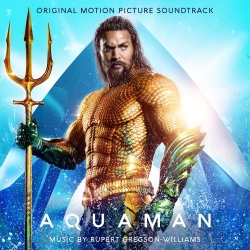
AQUAMAN – Rupert Gregson-Williams
 Original Review by Jonathan Broxton
There have been some truly bonkers super-hero films over the years, but Aquaman may take the cake as being the nuttiest of all. It tells the origin story of the much-derided DC Comics character who first appeared on film in 2016’s Batman v Superman: Dawn of Justice, and then again in 2017’s Justice League; it stars Jason Momoa as Arthur Curry, the long-estranged son of the Queen of Atlantis, who after many years living amongst regular humans must return home and reclaim his throne in order to stop the megalomaniacal plans of his brother. The film is directed by James Wan and co-stars Amber Heard, Nicole Kidman, Patrick Wilson, Willem Dafoe, Dolph Lundgren, and Temuera Morrison and, to give it its due, it looks absolutely phenomenal. Other than some rather ropey de-aging which makes Morrison look like his own bad Madame Tussaud’s waxwork, the special effects in the film are simply mind-blowing; the concept design and seascapes of the underwater Atlantean kingdom are so beautiful and creative, and some of the shot composition – especially during the Trench sequence – is just spectacular. However, all this is undermined by the truly terrible screenplay, the non-existent chemistry between the leads, the bafflingly clichéd dialogue, the plot contrivances that make the deus ex machina of other films seem inspired, and the existence of several utterly weird individual moments. This film contains – and I’m not kidding here – an octopus playing the drums, Heard wearing a dress made of jellyfish, battle-hardened seahorses fighting sentient crab people, sharks with frickin’ laser beams on their heads, flying wine knives, Momoa eating roses as a snack, Kidman eating a goldfish like it’s an outtake from A Fish Called Wanda, a bad guy who calls himself Ocean Master with no hint of irony, a random tourist getting crushed by a building and then walking away like nothing happened, Willem Dafoe sporting a man-bun topknot, and an ancient racist underwater sea monster voiced by Julie Andrews, among many other truly mind-boggling things. You’ll just have to experience it for yourselves. Read more…
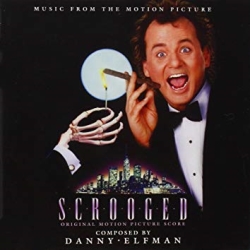
SCROOGED – Danny Elfman
 THROWBACK THIRTY
Original Review by Jonathan Broxton
There have been so many different cinematic versions and variations on Charles Dickens’s A Christmas Carol over the years, its amazing that people keep coming up with ways to make them new and fresh. In the winter of 1988, however, director Richard Donner and screenwriters Mitch Glazer and Michael O’Donoghue did just that with Scrooged, which re-imagined the story as a comedic tale of redemption set in the world of network television. Bill Murray plays Frank Cross, a morality-free and highly cynical TV studio executive who takes perverse delight in designing increasingly tasteless programming while tormenting his employees. After one particularly heartless episode when he forbids his secretary from leaving work on Christmas Eve to take care of her sick son, Frank is visited by a series of ghosts, each of whom show him the error of his ways, teach him to be a better person, and allow him to feel the true spirit of Christmas. The film co-stars Karen Allen, John Forsyth, Carol Kane, Robert Mitchum, and Bobcat Goldthwaite, and has since gone on to be considered a seasonal classic which was somewhat ahead of its time. Read more…
MARY QUEEN OF SCOTS – Max Richter
 Original Review by Jonathan Broxton
The rivalry that existed between Mary Stuart, the daughter of King James V of Scotland, and Elizabeth Tudor, the daughter of King Henry VIII of England and Anne Boleyn, came to be one of the defining elements of British political and royal life. Various complicated legal issues regarding legitimacy and succession meant that the two cousins had valid claims to the British throne, but it was Elizabeth who eventually took it, becoming queen in 1558. Within a year Mary had married King Francis II of France, but following his death just two years later she returned to Scotland to take up her throne there. Tragedy and death dogged Mary’s life – her first husband was murdered, and her second husband eventually fled to Scandinavia – and by 1567 she had been forced to abdicate her throne in favor of her one year old son. Seeking the help of her cousin, she left for London, but the increasingly paranoid Elizabeth saw her as a threat, and had her imprisoned for plotting to assassinate her; Mary was eventually executed in 1586. This story has been told many times on screen, most famously in a popular 1971 film starring Vanessa Redgrave and Glenda Jackson. This version of the story stars Saoirse Ronan and Margot Robbie as the two queens, and is directed by Josie Rourke from a screenplay by House of Cards creator Beau Willimon. Read more…
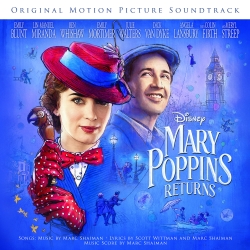
MARY POPPINS RETURNS – Marc Shaiman
 Original Review by Jonathan Broxton
Is there a more beloved screen musical than Mary Poppins? The Walt Disney-produced 1964 classic, based on the series of novels by P. L. Travers, made a star of actress Julie Andrews, entered songs like “Feed the Birds,” “A Spoonful of Sugar,” and “Supercalifragilisticexpialidocious” into the enduring cinematic lexicon, and won the hearts of children and adults all around the world. When it was announced that, more than 50 years later, a sequel was in production, it was inevitable that comparisons between it and the original would be made – how could they not be? The potential for disaster was enormous. Thankfully for all concerned, Mary Poppins Returns is a triumph in every respect, an overwhelmingly joyous ‘happiness bomb’ that pays respectful homage to the legendary first film while continuing the story in a thoughtful, respectful, fun, and emotional way. The film is set some thirty years after the first one, in pre-War rather than Edwardian London, and finds the original Banks children Jane and Michael as adults. Michael is a widower with three children of his own, living in his father’s home; however, in the aftermath of his wife’s death, Michael has sunk into a depression, and is in danger of losing the house to the bank. Just as all hope seems lost their magical childhood nanny, Mary Poppins, returns, and with the help of a London lamplighter named Jack, sets about putting things right for the Banks children for a second time. Read more…
Golden Globe Nominations 2018
 The Hollywood Foreign Press Association (HFPA) has announced the nominations for the 76th Golden Globe Awards, honoring the best in film and American television of 2018.
In the Best Original Score category, the nominees are:
- MARCO BELTRAMI for A Quiet Place
- ALEXANDRE DESPLAT for Isle of Dogs
- LUDWIG GÖRANSSON for Black Panther
- JUSTIN HURWITZ for First Man
- MARC SHAIMAN for Mary Poppins Returns
This is the first Golden Globe nomination for Beltrami, and the first major film music nomination of any kind for Göransson, although Göransson has been a multiple Grammy award nominee and winner for his work as a producer for Donald Glover and Childish Gambino.
This is the 2nd nomination for Hurwitz, who previously won the Globe for La La Land in 2016, the 2nd nomination for Shaiman, and the 10th nomination for Desplat, who previously won the Globe for The Painted Veil in 2006 and The Shape of Water in 2017.
In the Best Original Song category, the nominees are:
- JÓN ÞÓR BIRGISSON (JÓNSI), TROYE SIVAN, and BRETT McLAUGHLIN for “Revelation” from Boy Erased
- KENDRICK LAMAR DUCKWORTH, ANTHONY TIFFITH, MARK SPEARS (SOUNWAVE), SOLÁNA ROWE (SZA), and AL SHUCKBURGH (AL SHUX) for “All the Stars” from Black Panther
- STEFANI GERMANOTTA (LADY GAGA), MARK RONSON, ANTHONY ROSSOMANDO, and ANDREW WYATT for “Shallow” from A Star Is Born
- ANNIE LENNOX for “Requiem for A Private War” from A Private War
- DOLLY PARTON and LINDA PERRY for “Girl in the Movies” from Dumplin’
The winners of the 76th Golden Globe Awards will be announced on January 6, 2019.
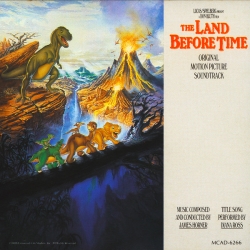
THE LAND BEFORE TIME – James Horner
 THROWBACK THIRTY
GREATEST SCORES OF THE TWENTIETH CENTURY
Original Review by Jonathan Broxton
The Land Before Time is an animated feature film for children, directed by Don Bluth and produced by Steven Spielberg and George Lucas. It’s set in the late cretaceous period, and follows the adventures of a group of orphaned dinosaurs searching for a fabled oasis where there is food, water, and safety. The main character is Littlefoot, a young Apatosaurus, who along with his friends – each of whom is a different species, such as a triceratops or a pteranodon – find themselves having to escape from numerous dangers, not least of which is a deadly ‘sharptooth’ Tyrannosaurus Rex that is hunting them. The film was incredibly popular at the time, and it works on multiple levels. Firstly, it is a fun story for children, with playful characters and a friendly cartoonish animation style. However, it also has some deeper meaning, addressing issues of racism (some of the adult dinosaurs are prejudiced against different species), climate change (the dinosaurs don’t know it, but they are living through a famine that heralds the beginning of their extinction event), friendship, and family. There is also some surprisingly dark material too, including some quite intense and frightening sequences involving the Tyrannosaurus, as well as character deaths which left real emotional scars on an entire generation of kids. Amazingly, the film spawned an incredible thirteen direct-to-video sequels and even a TV series, although none of them reached the level of acclaim the original had. Read more…
THE GRINCH – Danny Elfman
 Original Review by Jonathan Broxton
Whenever I tell this fact to Americans they invariably look at me like I’m from Mars, but I swear I’m telling the truth: growing up as a child in England, I had never really heard of Dr Seuss. I think I might have had some passing awareness of The Cat in the Hat, but beyond that the literary canon of the rhyming Theodor Geisel remained a complete mystery to me. My childhood literary icons were Roald Dahl, Enid Blyton, A. A. Milne, E. Nesbit, and people like that, and so when director Ron Howard made a feature film based on Seuss’s book How the Grinch Stole Christmas starring Jim Carrey in 2000, I went into it blind (it perhaps says something that the film was released simply as ‘The Grinch’ in UK cinemas, such was the nation’s general unfamiliarity with the character). I have since become aware of the 1966 Boris Karloff-voiced animated short film, and come to understand it’s status as a festive American television staple, and as such it is no longer surprising to me that there is now a full-length animated film based on the same story. Like the previous incarnations, it tells the tale of the eponymous mean and grumpy green creature who hates Christmas so much that he decides to ‘steal’ it by ruining the holiday for the citizens of Whoville, who live in the valley beneath his mountaintop home. Of course, in the process of ruining things, the Grinch actually comes to learn the true meaning of the season – and they all live happily ever after. The film is directed by Scott Mosier and Yarrow Cheney, and features Benedict Cumberbatch voicing the title role. Read more…
THE VIKINGS – Mario Nascimbene
 GREATEST SCORES OF THE TWENTIETH CENTURY
Original Review by Craig Lysy
Kirk Douglas came upon the 1951 novel The Viking by Edison Marshall and thought it offered a great opportunity to showcase his talents as a leading man. His production company Bryna Productions purchased the screen rights, and he brought in Jerry Bresler to produce. He tasked veteran Richard Fleischer whom he had successfully collaborated with on 20,000 Leagues Under The Sea (1954) to direct. Calder Willingham and Dale Wasserman were hired to write the screenplay, and after several incarnations, a final script was realized. To achieve his vision, Douglas insisted on authenticity and so the film was shot on location in Norway, whose harsh, damp and cold weather placed actors and crew under great duress. Douglas would play the lead role of Einar and be supported by Tony Curtis as Eric, Ernest Borgnine as Ragnar Lodbrok, Janet Leigh as Princess Morgana, James Donald as Lord Egbert, Alexander Knox as Father Goodwin, and Frank Thring as King Aella of Northumbria, with narration provided by Orson Welles. Read more…

Shop at the Movie Music UK Store

Member of the


